



ADA laboratory design is where accessibility laws and lab specs. On paper, ADA lab design rules apply to a specific set of buildings like public schools, government facilities, private teaching labs, and any lab open to the public. In practice you this accommodation more in schools and academic buildings for instance but not limited to a K-12 STEM classroom renovation, a community college biology teaching lab, a university chemistry teaching bay.
For this guide, we cover what the Americans with Disabilities Act requires, where and how it applies, and why the ADA laboratory design demand curve tilts so sharply towards educational spaces.
By the OnePointe Solutions Lab Design Team.
What ADA Means
The Americans with Disabilities Act is a 1990 civil rights law. It prohibits disability discrimination in employment, public services, public accommodations, and telecommunications. For an ADA lab, the operative piece is the built-environment portion, the 2010 ADA Standards for Accessible Design. The Department of Justice adopted the 2010 Standards on September 15, 2010. They became mandatory for new construction and alterations on March 15, 2012.
Two federal bodies drive these standards: The U.S. Access Board – writes the guidelines and the Department of Justice adopts and enforces. When a laboratory casework spec references “ADA compliance,” it is pointing to the DOJ-adopted 2010 Standards, which incorporate the Access Board’s 2004 ADAAG Chapters 3–10 by reference.
Chapter 2 of the standards sets scoping like what and how many elements must comply. Chapter 3 holds the technical criteria – dimensions, clearances, and hardware rules. A compliant ADA laboratory design spec has to satisfy both.
How ADA Laboratory Design Applies to Fixed Casework
ADA laboratory design applies to fixed and built-in elements. That’s the first sorting rule. A permanently installed teaching bench, a fume hood casework run, a fixed reception desk, a built-in sink cabinet falls under here. Moveable or modular furniture is not directly covered. However, it can still create a violation when it blocks an accessible route or knee clearance. Consequently, casework choices are where ADA compliance is either engineered in or lost and/or forgotten.
Not every work surface must be accessible. Section 226.1 sets a scoping rule: at least 5%, but no fewer than one of work surfaces for non-employee use must comply with Section 902. Employee-only surfaces are exempt, though Title I still requires reasonable accommodation. In a teaching lab this exception is moot: students are non-employees, so the 5% rule governs.
Where ADA Laboratory Design Is Legally Required
Three titles of the ADA carry construction-relevant weight, plus a separate education statute that overlays.
Title II governs state and local governments and their programs. ADA.gov confirms that public education falls under Title II. That covers every public K-12 school, community college, and state university. State and local governments must follow the ADA regardless of size. State and local government labs, from a public university teaching bay to a municipal water-quality lab, are covered here.
Title III covers public accommodations and commercial facilities. According to ADA.gov’s Title III page, this explicitly includes private schools, doctors’ offices and private hospitals, day care centers, and organizations offering courses or examinations for professional certification. A private testing lab that receives samples from the public falls under Title III as a public accommodation. Commercial facilities like office buildings, warehouses, factories must also meet the 2010 Standards for new construction, though they carry fewer program-access obligations. Important to keep in mind.
Title I has employment. It applies to employers with 15 or more employees and requires reasonable accommodation for qualified individuals with disabilities. This is where industrial R&D labs eventually intersect with ADA through individual accommodation requests, not building-code compliance at design.
Section 504 of the Rehabilitation Act layers on top of Title II for schools. Codified at 34 CFR Part 104, Section 504 prohibits disability discrimination in any program receiving federal financial assistance. Because nearly every public district and college receives federal funding, Section 504’s accessibility requirements in §§104.21–104.23 apply on top of Title II. The Individuals with Disabilities Education Act (IDEA) adds program-space obligations for special education services delivered in labs.
Why Schools Drive the ADA Laboratory Design Market
Legally the rules are broad. Practically, ADA laboratory design specification requests concentrate in a narrow slice. Schools and academic buildings are where accessible lab casework is more common with reasons why:
First, the population served. A public school district designs for every child in its attendance zone. Disability should not be a filter for enrollment. A community college enrolls adults with mobility, dexterity, and sensory disabilities, while a private employer might never encounter pre-hire. The design brief starts from universal use.
Second, the funding forces the issue. Federal Title I dollars, state facilities funding, and municipal bond programs all attach disability-access strings, and Section 504 pulls in every federally funded program. A district cannot get the money and do nothing about the work actually be in compliance.
Third, private R&D labs opt into a different pattern. A pharmaceutical company or a battery-testing lab is a Title I employer, not a Title III public accommodation. They design to code minimums and address individual accommodation case-by-case after hiring. As a result, most private R&D casework requests are standard 36-inch bench height with a mobile ADA cart as the flex accommodation. Not a fully accessible seat at every bay.
The Dimensional Spec for ADA Laboratory Design
ADA lab design comes down to four dimensional requirements from the 2010 Standards.
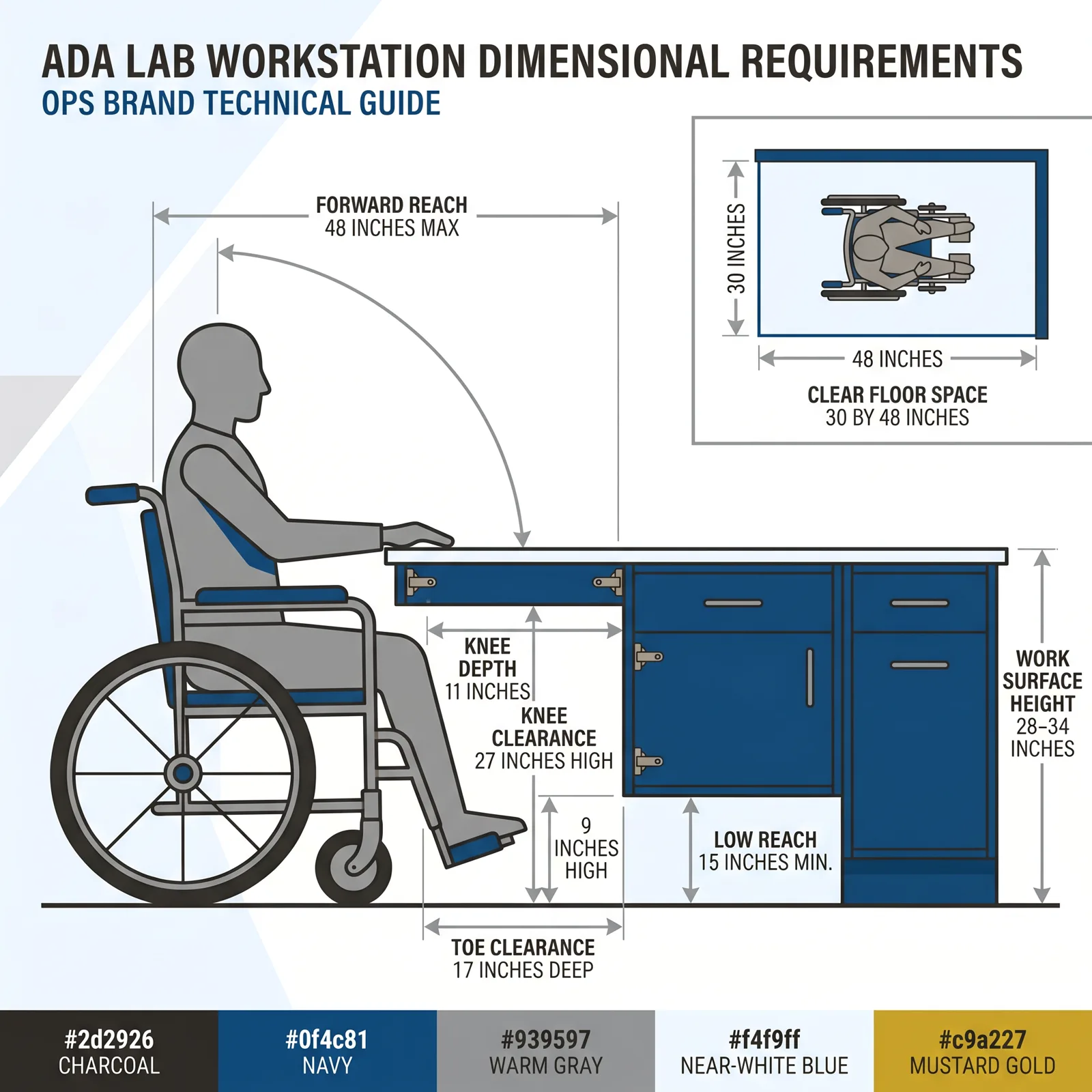
- Work surface height: Section 902.3: 28 inches (710 mm) minimum to 34 inches (865 mm) maximum above the finish floor. For children’s tables (used primarily by children 5 and older), Section 902.4.2 sets 26 inches (660 mm) minimum to 30 inches (760 mm) maximum.
- Clear floor space: Section 305.3: 30 inches (760 mm) wide by 48 inches (1220 mm) deep minimum, positioned for a forward approach at the accessible seat.
- Knee clearance: Section 306.3: 27 inches (685 mm) high, 30 inches (760 mm) wide, 11 inches (280 mm) deep minimum at 9 inches (230 mm) above floor, reducing to 8 inches (205 mm) deep at 27 inches height.
- Toe clearance: Section 306.2: 17 inches (430 mm) deep minimum by 9 inches (230 mm) high by 30 inches (760 mm) wide minimum below the bench.
Reach ranges from Section 308 apply to controls, outlets, and any operable part the user must reach. Unobstructed forward reach caps at 48 in (1220 mm) with a 15-in (380 mm) low minimum. Over an obstruction deeper than 20 in, the high reach drops to 44 in (1120 mm). Side reach ranges follow parallel rules. For children’s use, the Access Board publishes separate ranges by age band (3–4, 5–8, 9–12).
K-12, Higher-Ed, and Public-Facility Layout Patterns
ADA laboratory design shows up in three quite different room types, all built on the same dimensional envelope.
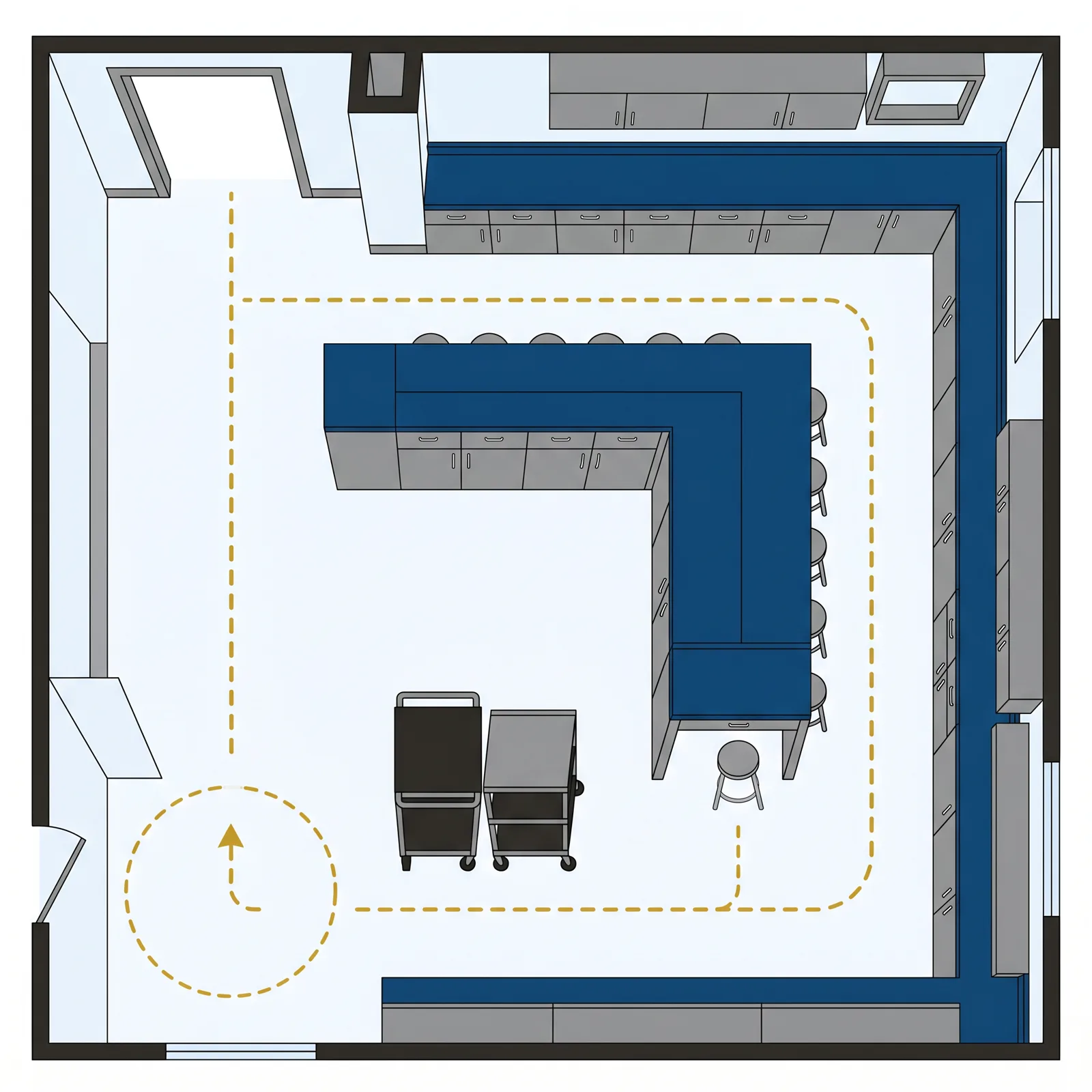
K-12 STEM classrooms lean on perimeter bench with a mobile-cart center. The perimeter run holds fixed sinks, gas, and casework at 30-inch children’s height in elementary or 34-inch adult height in middle school and up. Two accessible seats per class of 24–30 students satisfies the 5% rule with margin. The center island is left as mobile carts so a wheelchair user can pull into any group, not just the designated seat.
Community college and university teaching labs favor U-shaped or peninsula bays with one adjustable-height accessible seat per bay. Adult reach ranges apply. The accessible seat gets its own sink, gas, and duplex outlet within Section 308 reach. The peninsula end is left open with no undercabinet. That satisfies knee and toe clearance without cabinet modification.
Public-facility labs like municipal water testing, state crime labs, health department wet labs spec accessible casework at the 5% minimum for public-serving zones. That means reception, sample intake, and public-viewing bays. Staff-only zones follow the Title I accommodation process instead.
Casework Choices for Accessible Benches
Three casework choices carry most of the weight in ADA laboratory design: the frame, the top, and the hardware.
Frame. A fixed-height table frame between 32-34 inches works. An adjustable-height frame, hand-crank, manual or electric offers more flexibility. Electric frames typically travel 22 to 48 inches and let one bench serve wheelchair users, seated ambulatory students, and standing use without reconfiguration. The 2010 Standards do not require adjustable height but do not prohibit it, and Universal Design guidance favors it for teaching.
Top. Phenolic and epoxy resin dominate school specs. Both meet SEFA 3 chemical-resistance. Phenolic runs lighter, more cost effective, and fabricates easier if in-field cuts are needed. Epoxy is more chemically robust for chemistry teaching. Stainless is rare in academic settings and largely reserved for cleanroom or medical training.
Hardware. Section 309.4 requires operable parts to be usable with one hand and without tight grasping, pinching, or twisting of the wrist.
Plumbing, Gas, and Electrical Reach
The bench itself is only half the compliance picture. Every operable part above and below the top must sit within Section 308 reach range.
- Duplex outlets and data jacks – 15 in (380 mm) minimum to 48 in (1220 mm) maximum for unobstructed forward reach. Outlets behind a 24-in-deep bench become obstructed reach and drop to 44 in max.
- Faucet handles and lever controls – operable with one hand, no tight grasping (Section 309.4). Lever, wrist-blade, or foot-pedal handles meet this. Round knob faucets do not.
- Lab gas turrets and vacuum cocks – same 15–48 in reach envelope, same one-hand rule. Deck-mounted turrets should use lever or paddle handles.
- Emergency eyewash – ANSI/ISEA Z358.1 requires an eyewash within 10 seconds of unobstructed travel from the hazard. An accessible seat must have an eyewash on an accessible route with no lip, sill, or step.
Two field-level rules save rework. First, mount duplex outlets on the face of the bench apron rather than behind the top. This converts an obstructed reach into an unobstructed 48-inch reach for a seated user. Second, spec the accessible seat’s gas turret and vacuum cock on the deck at the front edge, not the backsplash. A 20-inch-deep obstruction plus a backsplash-mounted turret pushes the operable part past both the 44-inch obstructed forward reach and the one-hand rule.
Circulation, Aisles, and Egress
An accessible bench that a wheelchair user cannot reach is not accessible. Circulation is where academic lab layouts can often fail. For example, you have a compliant bench, but the aisle between two rows of casework is only 32 inches wide. It needs to be 36.
The core requirements from Chapter 4:
- Accessible route clear width – 36 inches (915 mm) minimum, reducing to 32 inches (815 mm) for a distance of no more than 24 inches (Section 403.5).
- Turning space – 60 inches (1525 mm) diameter clear circle, or a T-shaped turning space within a 60-inch square (Section 304).
- Employee work areas -Section 206.2.8 requires common-use circulation paths within employee work areas to comply with 36-inch clear width. Notably, this applies to work areas of 1,000 sq ft or more; smaller work areas defined by permanent partitions or casework are exempted from the interior circulation rule.
In a teaching lab, plan for 36-in aisles between casework rows and one 60-in turning circle per functional zone. Also plan a straight accessible route from the room entry to at least one accessible seat and to the emergency eyewash.
Texas Accessibility Standards and Procurement
For Texas projects, a second standard applies alongside federal ADA laboratory design rules. The 2012 Texas Accessibility Standards (TAS), effective March 15, 2012 and administered by TDLR under Government Code Chapter 469, govern buildings in the state. TAS parallels the 2010 ADA Standards and adopts the same 902 heights and 305/306 clearances. Texas plan review is handled by TDLR-registered accessibility specialists.
On procurement: adjustable-height frames add cost but are a great investment gpt the first time enrollment shifts and a bay needing to serve new users with demo. Phenolic tops with rounded corners are worth the upcharge over traditional square/rectangular cuts. Mobile ADA cabinets, satisfy the 5% rule in existing buildings where fixed casework cannot be reconfigured.
ADA laboratory design is a set of dimensional and hardware rules layered on the same Division 12 spec the rest of the project uses. Fold the four dimensional requirements plus the Section 309.4 hardware rule into the master casework spec, then flag the accessible bays on the plan. See also our guides to phenolic countertops, epoxy countertops, mobile and modular lab casework, and reading a Division 12 lab spec.
Need ADA Compliant Lab Furniture?
If you designing, purchasing or remodeling a lab that has to meet ADA-compliance in some capacity with the laboratory furniture, we can help. We offer standard ADA compliant heights in our casework and tables, at 32 inches. As well as can manufacture tailored height adjustable tables, whether manual, hand crank or electric. Our line of fume hoods, are even designed for accessibility and wheelchair operator use. They are ADA compliant by meeting ADA height and reach guidelines so seated users can safely and comfortably operate the hood controls and work within the hood. Needing ADA sinks and faucet fixtures – we have those too. Allow us to meet your ADA lab needs all from one place.
Give us a call today (866-612-7312) to get started or shoot us a message to be connected with a rep.