



If you have spent time specifying laboratory casework, you have already seen a phenolic resin countertop. It is the dark matte work surface in many teaching labs, biology suites, and even research benchtops where the chemistry is real but not catastrophic. A phenolic resin countertop sits in the middle of the lab worktop market — not as bulletproof as stainless, not as moldable as epoxy, but well-suited to the majority of bench work most labs actually do. This 2026 spec guide walks lab managers, architects, and Division 12 spec writers through what the material is, where it shines, and where it stops being the right call.
What a Phenolic Resin Countertop Actually Is
A solid phenolic composite countertop is built from many layers of kraft paper saturated with phenolic resin, then compressed in a heated press at roughly 1,000 PSI and 300°F until the resin cross-links into a single rigid panel. SEFA 3-2010 §5.7 describes the result as “a compression molded composite of a homogeneous core of organic fiber reinforced phenolic” with one or more non-porous integrally cured surfaces. The industry also uses the terms solid phenolic composite, phenolic composite resin, and phenolic core. All refer to the same material.
Importantly, phenolic resin countertops are not the same product as standard high-pressure laminate. Standard HPL uses the same phenolic-kraft core, but is thin — typically 1/16″ — and is always bonded to a substrate like particleboard. By comparison, lab-grade solid phenolic composite is much thicker (standard 1″, also 3/4″ and 1/2″), solid through, and engineered to stand alone as a structural work surface. HPL is a surface cladding; solid phenolic is a worktop.
Where Phenolic Resin Countertops Belong
The short answer is that phenolic resin countertops belong wherever the chemistry is routine, the heat is modest, and the bench needs to move or stay light. Teaching labs, microbiology labs, biology benches, prep rooms, instrument benches and mobile lab carts are all good fits. Generally, if the typical day involves dilute acids, dilute bases, common solvents, alcohols, and routine sample prep, then phenolic will hold up indefinitely.
By contrast, phenolic is the wrong call for hot work, perchloric acid hoods, sustained hydrofluoric acid exposure, or anywhere an open flame is part of the procedure. Heat is the single most common failure mode, and we will come back to it shortly.
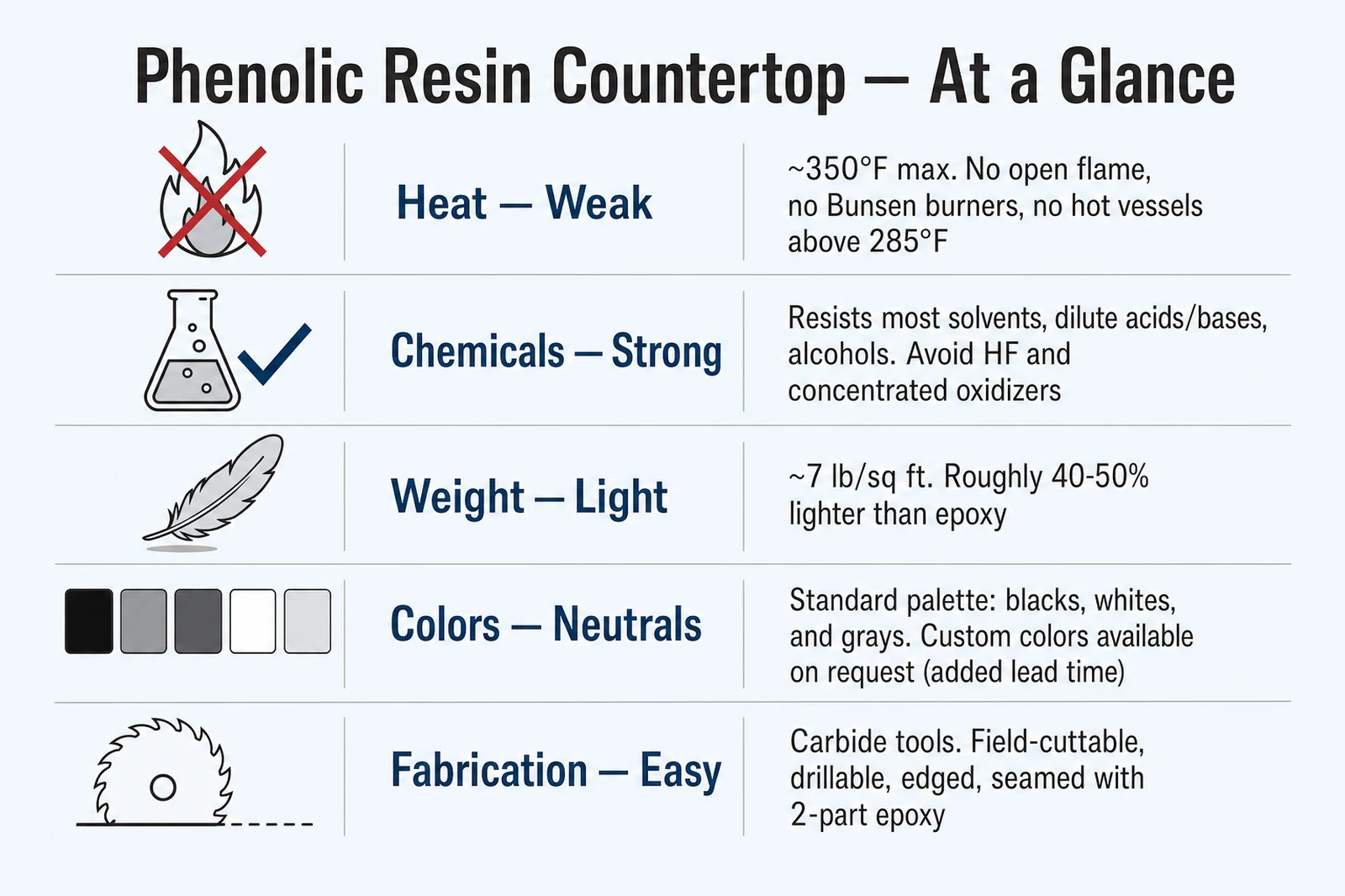
Chemical Resistance: Stronger Than People Expect
The benchmark for lab worktop chemical resistance is the SEFA 3-2010 §2.1 chemical resistance test. The standard exposes a worktop to 49 reagents — volatile and non-volatile — for 24 hours at 73°F, then rates the surface on a 0 to 3 scale (no effect, slight change, clearly discernible change, objectionable change). To earn Laboratory Grade status, a material may receive no more than four Level 3 results across the full panel.
Independent SEFA-format testing summarized by ChemTops shows phenolic resin scoring 0 (No Effect) on the vast majority of common lab chemicals, including acetone, benzene, chloroform, methylene chloride, toluene, xylene, 96% sulfuric acid, 70% nitric acid, and 40% sodium hydroxide. Notably, phenolic did not score a 2 or 3 on any tested reagent in that data set. For most general-purpose lab chemistry, a phenolic resin countertop will outlast the cabinetry beneath it — when properly cared for and maintained.
That said, three real-world limits deserve flagging. First, the SEFA test runs at ambient temperature; hot concentrated oxidizers behave differently and should not contact a phenolic surface. Second, hydrofluoric acid scores only Excellent (1) at 48% — workable, but not the first choice for routine HF work. Third, perchloric acid hood interiors require materials impervious to perchlorate residues per NFPA 45, which means stainless steel or a PVC liner — not phenolic.
Heat Tolerance: The Limit That Matters
Heat is where phenolic resin countertops draw a hard line. Most sources cite a continuous-use ceiling of roughly 350°F (175°C), and the practical working number is lower than that. SEFA 3-2010 §2.5 warns that excessive heat can produce blisters, cracks, and surface breakdown, and instructs specifiers to consult the manufacturer for any hot crucible or Bunsen burner application.
In practice, a phenolic resin countertop is not appropriate for direct open flame, sustained hot vessel contact above roughly 285°F, hot crucible work, or muffle furnace transfer surfaces. If the lab routinely runs Bunsen burners, alcohol lamps, or hot plates with sustained high-temperature vessels, the right spec is epoxy resin or stainless steel. Per Custom Fabricators, epoxy carries a higher continuous heat rating and is generally considered self-extinguishing against brief flame contact, while stainless steel handles essentially unlimited lab temperatures.

Weight: The Quiet Advantage
One-inch-thick phenolic resin runs roughly 7 lb per square foot. One-inch epoxy resin runs roughly 11 lb per square foot. For a standard 72″ × 30″ worktop, that is about 108 lb in phenolic versus 165 lb in epoxy — a 53% reduction.
This matters more than it sounds. Mobile lab carts, suspended cantilevered workstations, wall-mounted floating benches, and any future-flexible casework design is affected by weight. A lighter worktop frees structural capacity for equipment, allows longer unsupported spans, simplifies installation, and reduces freight costs. If you are designing a reconfigurable lab program where benches will move every few years, phenolic is a great option for the spec.
Colors, Edges, and What You Can Actually Spec
Standard phenolic countertops have a limited color palette of grays, blacks, and whites. Custom colors are available with specifying the laminate sheet color, where you can tap into greens, blues, reds, tans, and more — however, this extends standard lead times, comes at a higher cost, and is limited to fabricators able to accommodate.
For comparison, epoxy has a broader color palette. Though black is most common, off-whites, grays, browns, blues, and white epoxy exist as well but at a noticeable cost premium.
Phenolic also comes in a matte low-sheen finish that reduces glare and reads cleanly in a working lab.
One historical caveat is the black core. Traditional phenolic panels show a black edge regardless of face color, because the kraft paper core is dark. Color-through phenolic is available in gray, white, and black, where the core and face match. If the design needs a uniform edge in a light color, ask the fabricator specifically for color-through stock. Available edge profiles include square, beveled, drip groove, and radius corners. Marine (raised) edges, which are common in epoxy, can only be applied to phenolic using attached curb strips.
Fabrication, Lead Time, and Cost Positioning
Phenolic resin countertops cut like dense hardwood. Standard carbide-tipped saw blades, brad-point drill bits, and router bits all work with no special tooling. If the material needs onsite modification — for example, a hole position needs to change after install — a fabricator can drill it without removing the worktop. Standard fabricated sizes run up to roughly 5 ft × 10 ft. Slabs can run up to 5 ft × 12 ft, which covers most single-piece bench runs. Seaming, when required, is done with a 2-part epoxy smooth-on kit.
On cost, phenolic sits on the lower end of the lab worktop market. It is generally 20 to 40 percent less than epoxy, and well below stainless steel. The combination of low-tier pricing, ease of fabrication, light weight, and strong general chemical resistance is what makes phenolic a great spec for teaching, biology, and general-purpose research labs.
When To Spec Something Else
Though there are plenty of reasons to not go with phenolic from trivial things like aesthetics or more paramount like chemical capabilities, here are some additional scenarios to help as a guide when to not spec phenolic resin countertops. First, any program with sustained open flame, hot crucible work, or routine high-temperature contact should default to epoxy or stainless. Second, perchloric acid fume hoods require stainless steel interiors and dedicated wash-down systems per NFPA 45; phenolic is not appropriate inside a perchloric hood. Third, if the lab requires a fully seamless integrated sink-and-worktop unit with a molded marine edge, that is achievable only in stainless steel; phenolic cannot be cast into shape.
For other scenarios — biology, microbiology, teaching, general research, mobile carts, prep benches and instrument tables phenolic resin countertops are the well-engineered default. Although somewhat still new to the industry, as epoxy resin has been around the longest, the material has been a great addition to the industry due it’s price point, comparable chemical performance and fabricator-friendly construction.
At OnePointe Solutions, we can help you decide whether phenolic, epoxy, stainless, or another worksurface material is the right call for your lab program. A worktop spec is one of the longer-lived decisions in a lab buildout, and choosing the right material the first time pays dividends across the full life of the lab.
For more helpful information on lab work surface and material selection, check out our other guides below.