


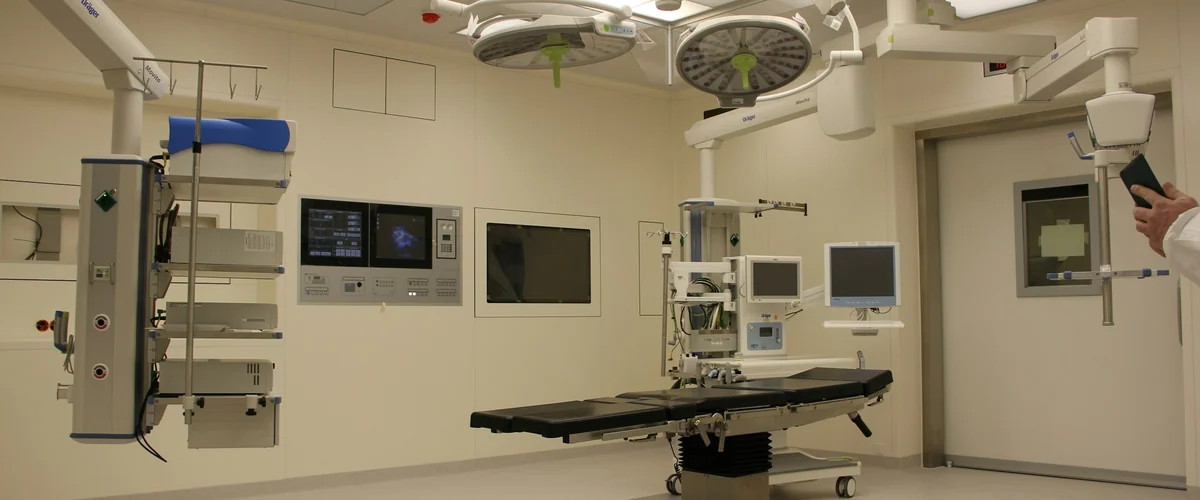
Specifiers reach for stainless steel lab cabinets when the environment punishes ordinary casework. In particular, sterile compounding, biocontainment, vivarium washdown, and pharmaceutical manufacturing all require surfaces that resist chemical attack, survive repeated decontamination, and tolerate continuous moisture. However, stainless is not a default upgrade. For instance, in a typical chemistry teaching lab, painted steel or phenolic-topped casework delivers chemical resistance comparable to stainless across most common reagents at a meaningfully lower cost — and phenolic and epoxy resin handle several specific reagent classes (notably hydrofluoric acid and halogenated solvents) better than austenitic stainless. The right question is not whether to use stainless steel lab cabinets, but which grade, which finish, and in which rooms.
This guide walks through the three austenitic grades specifiers actually encounter (304, 316, and 316L), what SEFA 8-2023 requires of stainless construction, what ASTM A240 and A380 anchor at the mill and finish levels, and where USP, CDC, NIH, and ISO standards make stainless the only defensible answer. Furthermore, it covers where stainless is the wrong call and what to use instead.
304, 316, 316L: The Three Grades That Matter
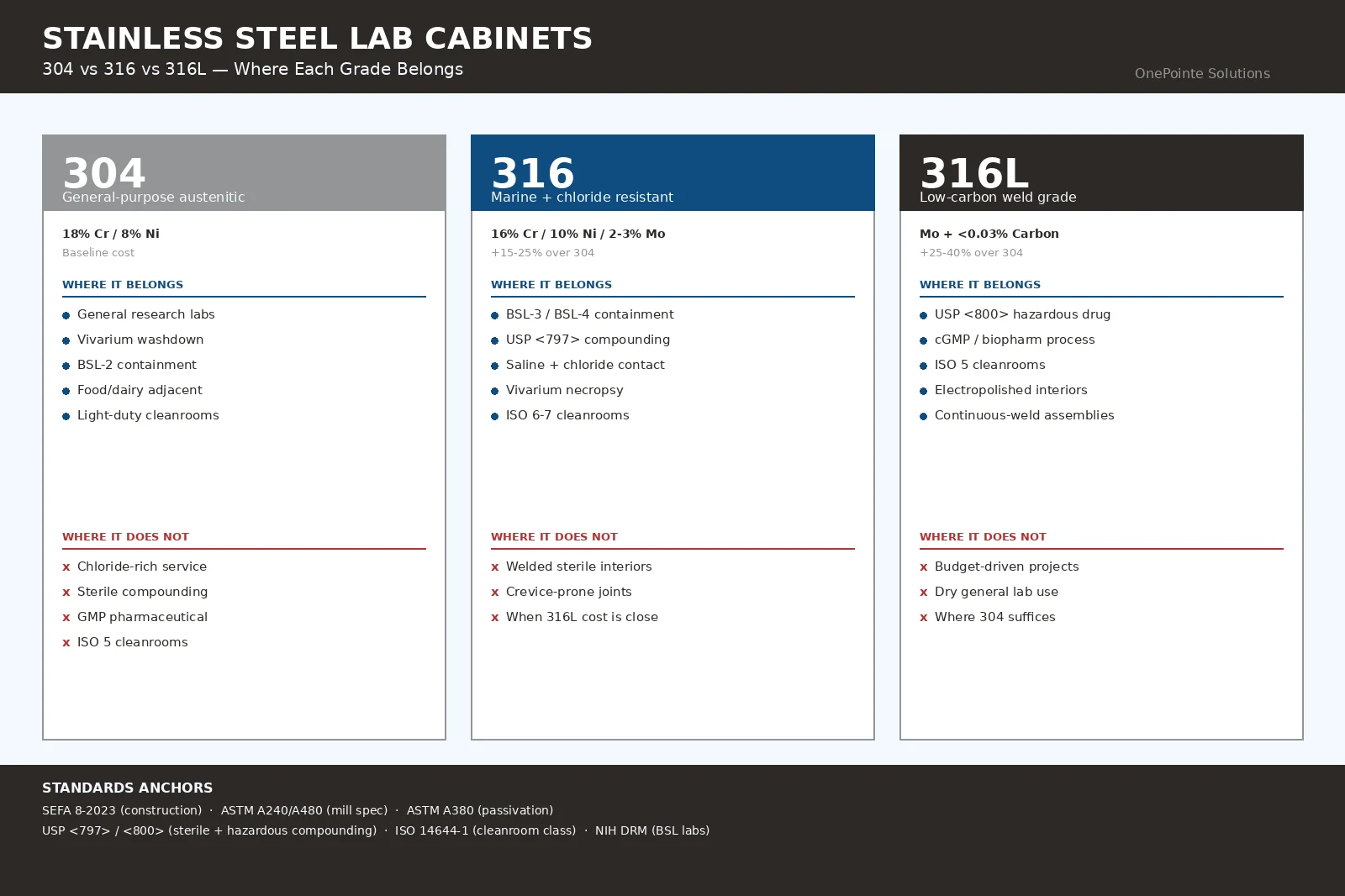
All three grades are austenitic 300-series stainless steels with a chromium-nickel matrix. The differences are narrow on paper but consequential in service. Specifically, per the Nickel Institute’s wrought-austenitic guide, Type 304 carries 18-20% chromium and 8-10.5% nickel with no molybdenum. By contrast, Type 316 adds 2-3% molybdenum, which is the source of its chloride and pitting resistance. Similarly, Type 316L matches 316’s chemistry but caps carbon at 0.03% instead of 0.08%, which prevents carbide precipitation at welds.
In practice, most lab casework specifies either 304 or 316, with 304 being the most common general-purpose grade and 316 the standard upgrade for sinks, countertops, and washdown service. Per the NIH ORF Stainless Steel Technical Bulletin, Type 316 and Type 316L are treated as interchangeable minimum grades for laboratory sinks. Therefore, 316L is not a default upgrade over 316 — it is a weld-zone refinement. Specifically, the Nickel Institute notes that L-grade material is only necessary for welded components, where the low carbon prevents carbide precipitation at heat-affected zones. Consequently, 316L should be called out by name when continuous welding meets corrosive service: cleanroom, cGMP, sterile compounding, and pharmaceutical manufacturing. For mechanically fastened 316 cabinets or lightly welded assemblies in typical wet-lab service, plain 316 is the appropriate working spec. OnePointe’s 304 and 316 stainless steel casework line follows these grade-and-weld rules from the outset.
Notably, the grade hierarchy is not arbitrary. According to the NIH Office of Research Facilities Stainless Steel Technical Bulletin, Type 316 or 316L is the minimum grade for laboratory sinks, while Type 304/304L is the minimum for handwash and scrub sinks only. NIH specifies that 304 is not adequate for wet-lab sinks because it is susceptible to chloride attack from bleach and halogenated disinfectants used in routine decontamination. In practice, however, off-the-shelf laboratory sinks are predominantly stocked in 304 — 316 sinks are typically a special-order item with longer lead times and a meaningful cost premium. Specifiers who need 316 for a wet-lab sink should call it out by grade and accept the procurement reality; conversely, any wet-lab sink spec that defaults to 304 without examining the chloride exposure has undersized the grade against NIH guidance.
What SEFA 8-2023 Actually Requires
To begin with, SEFA 8-M is the performance standard for metal laboratory casework published by the Scientific Equipment and Furniture Association. Notably, the 2020/2023 revision is the definitive pass/fail standard for structural integrity, chemical resistance, and durability of stainless steel lab cabinets. A spec that references SEFA 8 without naming the edition is a soft spec; specifiers should anchor SEFA 8-2023 explicitly.
Structurally, SEFA 8-M requires a 2,000-pound distributed load on the countertop for 24 hours with no permanent distortion, a 200-pound concentrated point load, and a torsion test that allows no more than 1/8 inch of diagonal racking. For doors and drawers, the standard requires 100,000 hinge cycles without binding or catch failure, plus 150-pound static drawer loads and rolling internal impact tests. Per the SEFA 2020 Desk Reference, the chemical resistance test exposes surfaces to 49 reagents; acceptance requires no more than 4 Level 3 conditions across the panel.
Similarly, gauge requirements are explicit. Typically, SEFA-compliant stainless steel lab cabinets use 18-gauge body panels, 16-gauge top rails and structural members, 14-gauge drawer slides, and 11-gauge corner gussets. Hardware should meet BHMA A156.9 Grade 1 with 5-knuckle hinges and 100-pound full-extension drawer slides. Specifiers who allow lighter gauges in a Division 12 35 53 section will end up with cabinets that pass on paper but rack and twist under real-world load.
ASTM A240, A480, and A380: Mill, Finish, and Post-Treatment
SEFA 8 governs the casework. By contrast, ASTM standards govern the metal itself and the way fabricators finish it. Specifically, ASTM A240/A240M is the mill-level chemistry and mechanical property spec for stainless plate and sheet. In particular, it defines the carbon, chromium, nickel, and molybdenum ranges that separate 304 from 316 from 316L and sets tensile and yield minimums. ASTM A480 is the companion tolerance and finish standard, including the definition of the No. 4 brushed finish that appears in nearly every Division 12 stainless section.
For sterile and cleanroom applications only, the spec may add electropolishing as a specialty post-process beyond the standard No. 4 finish. Specifically, electropolishing electrochemically removes a thin surface layer and reduces roughness to Ra values below 0.38 micrometers, which is the threshold many ISO 5 and USP Category 3 environments require. An overview of ASTM A380 notes that electropolishing provides roughly 30 times the corrosion resistance of passivation alone. However, electropolishing carries a meaningful cost premium and adds documentation requirements, so it belongs in the spec only where surface roughness or bioburden control demands it — not on general lab casework.
Passivation per ASTM A380 and A967 is a chemical post-treatment that removes iron contamination left by welding and fabrication. It doesn’t usually appear in general Division 12 lab casework specs, but for any continuously welded stainless assembly — cleanroom, cGMP, BSL-3/4 service — it’s worth calling out as a submittal. The NIH Stainless Steel Technical Bulletin requires fabricated stainless components in those settings to comply with ASTM A380 and A967, and skipping it on a welded cabinet exposed to repeated decontamination leaves iron contamination on the surface that becomes a corrosion-initiation site within months.
Where Stainless Steel Lab Cabinets Belong
Generally, stainless steel lab cabinets are the right answer wherever a published standard or regulatory body requires impervious, cleanable, and chemically resistant surfaces. First, USP hazardous-drug compounding facilities require surfaces that are smooth, impervious, free from cracks and crevices, and able to withstand repeated decontamination with hydrogen peroxide, bleach, and quaternary ammonium compounds. Per USP as summarized by ASHRM, the physical environment provisions specifically describe surfaces that exclude porous materials.
Second, BSL-3 and BSL-4 laboratories require bench tops that, per the CDC BMBL 6th Edition, are “impervious to water and resistant to heat, organic solvents, acids, alkalis, and other chemicals.” Furthermore, the University of California BSL-3 Design Standards explicitly list stainless steel, phenolic resin, and epoxy resin as the three acceptable bench top materials for BSL-3 laboratories and require casework that seals to floors and walls or stands off the wall far enough for cleaning access.
Third, ISO 14644-1 cleanrooms at ISO Class 5 through Class 7 demand wall-and-bench combinations with negligible particle shedding. Smooth-welded stainless steel lab cabinets with electropolished interior surfaces and coved corners meet this requirement when standard casework cannot, which is why OnePointe’s cleanroom cabinet program defaults to stainless construction for ISO 5 and ISO 7 builds. Fourth, NIH vivarium and necropsy environments use stainless because the daily wash-down cycle with high-pressure hot water and detergents destroys other materials within months. Finally, FDA 21 CFR 211.65 requires that cGMP pharmaceutical manufacturing surfaces be non-additive, non-reactive, and non-absorptive, which welded 316L stainless with an electropolished interior reliably delivers.
Where Stainless Is the Wrong Call
For several common lab environments, stainless steel lab cabinets are an expensive mismatch. First, general chemistry labs running concentrated sulfuric acid, hydrofluoric acid, or halogenated solvents will see stainless attacked more aggressively than purpose-built phenolic resin or epoxy work surfaces. The same NIH bulletin that endorses 316 for sinks also notes that stainless is not the recommended material for surfaces routinely exposed to halogenated organics or strong acids; those environments call for epoxy or phenolic.
Similarly, teaching labs and educational environments rarely justify stainless because the cost premium over painted steel is significant for an application where chemical resistance is not the critical driver and phenolic or epoxy work surfaces perform comparably. Similarly, dry instrumentation labs and admin support spaces share the same logic. Furthermore, stainless steel lab cabinets show every fingerprint, water mark, and scratch under typical lab lighting; in spaces where visual cleanliness matters but biological or chemical exposure does not, the maintenance burden often outweighs the perceived hygiene benefit.
The No. 4 Finish: What Division 12 Actually Calls For
No. 4 brushed is the finish that appears in essentially every Division 12 35 53 stainless casework section. Specifically, ASTM A480 defines it as a uniformly directional satin grit pattern with a maximum roughness average (Ra) of 25 microinches. The directional pattern hides minor wear and water spotting better than a mirror polish, cleans down well with standard lab disinfectants, and is the standard finish on stainless cabinet bodies, drawer fronts, countertops, and shelving from every reputable Division 12 fabricator.
No. 4 is the right call for general lab casework, vivarium service, BSL-2 and BSL-3 wet-lab work, and the broad majority of stainless steel lab cabinets that show up on a project. For matched work surfaces, specifiers should call out stainless steel lab countertops in 304 or 316 with the same No. 4 finish as the cabinet bodies, which keeps the cleanability bar consistent across the bench.
Two related processes occasionally appear in stainless specs, though neither is a peer finish to No. 4 and neither shows up in the typical Division 12 section. Passivation per ASTM A380 and A967 is a post-fabrication chemical treatment, not a visible finish; it removes iron contamination from welding and machining and restores the chromium oxide passive layer. It’s worth calling out as a submittal requirement when the project warrants it — particularly cleanroom, cGMP, or any continuously welded stainless assembly — but it doesn’t typically appear in general lab casework specs. Electropolishing is a specialty electrochemical process that drops surface roughness below Ra 0.38 micrometers; it is not a general lab casework finish and rarely appears in standard Division 12 sections. When it does land in a spec, it’s limited to USP , USP , ISO Class 5 cleanrooms, cGMP process areas, and similar sterile or contained environments where surface roughness and bioburden control are the controlling requirement.
Construction Anchors for the Division 12 Spec
Specifiers can lock the following anchors into Division 12 35 53 (Laboratory Casework). First, specify grade explicitly: Type 316L for continuously welded assemblies in USP , USP , ISO 5, and cGMP environments where weld-zone corrosion is the controlling risk; Type 316 for BSL-3/4, vivarium service, lab sinks, and the broad majority of wet-lab casework; Type 304 only where wet exposure is incidental. Second, require continuous welds, not spot welds, on all internal joints subject to wash-down. Notably, the NIH Technical Bulletin requires full-penetration welds for any cabinet that will see decontamination cycles.
Third, require 18-gauge minimum body construction, 16-gauge top rails, 14-gauge drawer slides, and 11-gauge corner gussets per SEFA 8-2023. Fourth, prohibit exposed fasteners on interior surfaces; in addition, all interior joinery should use continuous welds or captive concealed fasteners. Fifth, require coved interior corners (minimum 3/4-inch radius) for any cabinet serving sterile compounding, cleanroom, or biocontainment work. Sixth, specify the finish: No. 4 brushed per ASTM A480 for general lab casework, vivarium, and BSL-3 work; add electropolished to Ra 0.38 micrometers maximum only for cleanroom, USP /, or cGMP interiors. Seventh, for continuously welded assemblies in cleanroom, cGMP, or repeated-decontamination service, add passivation per ASTM A380 and ASTM A967 as a submittal requirement. Furthermore, require submittal of mill test reports per EN 10204 3.1 for the actual stainless heat used on the project.
Methodology Note
Every figure in this stainless steel lab cabinets guide traces back to a primary source. Specifically, grade chemistry comes from ASTM A240 and the Nickel Institute. In addition, service-suitability guidance comes from the NIH Office of Research Facilities Stainless Steel Technical Bulletin. Similarly, SEFA 8 performance criteria come from the SEFA 2020 Desk Reference. Furthermore, containment requirements come from the CDC BMBL 6th Edition and the University of California BSL-3 Design Standards. Likewise, sterile compounding requirements come from USP and USP . Finally, pharmaceutical manufacturing requirements come from FDA 21 CFR 211.65. No competitor brand names appear in this guide.
For broader context on lab casework material selection, see our Lab Casework Materials Guide 2026. For fume hood control decisions that pair with stainless cabinet specifications, see the VAV vs CAV Fume Hoods 2026 guide. For the broader OnePointe lab casework program that wraps stainless, painted steel, and phenolic options into one Division 12 package, and for common specification pitfalls to avoid, see Laboratory Design Mistakes: Furniture and Functionality.