


Every fume hood specification eventually arrives at the same fork in the road. Constant air volume, or variable air volume? The VAV vs CAV decision shapes capital cost, energy cost, control complexity, and the daily behavior of every researcher in the room. First, the energy stakes are real. Lawrence Berkeley National Laboratory estimates that the U.S. operates roughly 750,000 fume hoods at an aggregate cost of about $4.2 billion per year. However, the savings story sold by most VAV vendors is contingent on something rarely discussed in the design phase: whether the people in the lab will actually close the sash.
This VAV vs CAV fume hood guide walks through how each control mode works, what the standards require, what real audit data shows, and when CAV is still the right answer. Specifically, this is written for specifiers, EH&S officers, and facility managers who need to make a defensible decision on day one of design.
How CAV Fume Hoods Work
A constant air volume fume hood exhausts a fixed CFM regardless of sash position or occupancy. In other words, the system delivers full design exhaust 24 hours a day, 7 days a week. In a bypass-style CAV hood, closing the sash routes air through a bypass opening at the top, keeping total exhaust constant. In a non-bypass design, closing the sash forces the same volume through a smaller opening, sharply raising face velocity and creating turbulence at the face.
The 100 feet-per-minute face velocity that anchors most CAV specs comes from two documents. First, SEFA 1-2026 defines 100 fpm through a fully opened vertical sash as the conventional baseline. A typical 6-foot bench-top hood requires roughly 1,100 CFM to hit that target. Second, ANSI/ASHRAE 110-2016 (R2025) sets the performance test: an “as manufactured” tracer-gas containment of AM 0.05 ppm using SF₆ at 4.0 L/min, with an “as installed” target of AI 0.10 commonly written into institutional specs.
The result is simple, predictable airflow. As a consequence, the HVAC system must condition and supply 1,100 CFM of outdoor air every minute, every day, regardless of whether anyone is using the hood. University of Illinois energy modeling using Trane TRACE puts the operating cost of a single campus CAV hood at approximately $5,500 per year. Furthermore, LBNL data shows per-hood operating costs ranging from $4,600 in a moderate climate like Los Angeles to $9,300 in an extreme cooling climate like Singapore.
How VAV Fume Hoods Work
A variable air volume fume hood modulates exhaust CFM in response to sash position, with target face velocity held inside a band — typically 60 to 100 fpm depending on hood class and specification. The controller takes one of three input signals. First, a sash-position sensor (a linear potentiometer, infrared beam, or reed switch array) tracks sash height; the controller multiplies sash height by hood width to derive the open face area, then commands the exhaust valve to the CFM required to hit target face velocity. Second, a sidewall velocity sensor measures actual face velocity directly. Third, modern systems combine sash-position sensing with closed-loop airflow measurement at the exhaust valve for the tightest control.
The exhaust valve itself is the other half of the system. An I2SL energy study compared a closed-loop butterfly valve against a pressure-independent venturi-style valve in the same 8-inch duct. The butterfly valve operated at static pressures as low as -0.40 in. W.C. and consumed roughly 60% less exhaust fan energy than the venturi valve, which could not operate below -0.65 to -1.70 in. W.C. of inlet static pressure. As a result, in retrofit projects where duct static is constrained, valve selection alone can shift VAV ROI by years.
Minimum Exhaust Floor
A VAV hood cannot reduce exhaust to zero. Every system needs a minimum floor that prevents stagnation, maintains fire and explosion dilution, and flushes any residual chemicals. Historically, ANSI/AIHA Z9.5 referenced a minimum of 25 CFM per square foot of interior work surface whenever chemicals were present. However, Z9.5-2012 §3.3.2 replaced that crude rule with a performance-based range of 150 to 375 hood air changes per hour (ACHh) based on interior volume. For a 50 ft³ 6-foot hood, that range translates to about 125 to 313 CFM minimum. UC Irvine subsequently demonstrated that hoods can safely operate at 200 to 250 ACHh — cutting setpoint energy cost from roughly $2,344 per hood per year down to $1,250 to $1,563 per hood per year at $7.50/CFM/year with no measured loss of containment.
The Energy Story (and Its Asterisk)
The headline numbers in any VAV vs CAV comparison are striking. University of Illinois modeled four scenarios for the same hood. CAV without heat recovery runs about $5,500 per year. CAV with heat recovery drops to $3,200. VAV without heat recovery falls to $2,100 — a 62% reduction. VAV with heat recovery lands near $1,500, a 73% total reduction. Therefore, on paper, the case for VAV is one-sided.
Real audit data tells a more complicated story. First, VAV only saves energy when the user actually closes the sash. As Ohio State Chemistry notes, a VAV hood adjusts face velocity to sash height, so a sash left fully open exhausts at roughly the same rate as a CAV hood — except the project has now sunk the VAV control premium into a system delivering zero return. As a result, the moment user behavior breaks, the VAV vs CAV math collapses and the savings disappear.
Second, real labs leave sashes open more than designers want to admit. A 2006 NC State study measured 49% to 65% of hoods open in academic chemistry labs over a two-week audit. Notably, supervisors had specifically instructed many of those users to keep their sashes at 18 inches continuously. An MIT Chemistry study found average sash height around 16.3% open before intervention, with hoods almost never fully shut.
What Sash-Management Programs Actually Deliver
The good news: behavioral programs work when committed to seriously. Harvard’s Shut the Sash program, running in 19 labs across 350 researchers since 2005, reduced average hood exhaust from 409 CFM with sashes open to 250 CFM with manual closing — and to 231 CFM with automatic sash closers. Total measured savings exceed $200,000 per year across program buildings. Similarly, MIT’s monthly feedback program cut average sash position by 26% and saved $41,000 per year, although half of those savings came from just 4 of 25 labs. Furthermore, Colorado School of Mines hit $12,000 to $15,000 in savings at a single building and is on track for $22,000 to $30,000 campus-wide.
However, two findings should temper expectations. First, MIT’s data shows the gains are unevenly distributed — a few committed labs carry most of the savings, while others never engage. Second, behavioral programs do nothing in demand-controlled ventilation systems. McGill’s McIntyre building reconfigured its VAV hoods to modulate based on contaminant concentration rather than sash position; the formal post-installation finding was that “behavior change (around fume hood use) has absolutely no impact on energy consumption” in that building. In other words, the control architecture decides whether user behavior matters at all.
The Safety Argument: Containment Under Variable Flow
Specifiers sometimes treat VAV as purely an energy decision. It is not. ASHRAE 110-2016 distinguishes three testing regimes: as manufactured (factory), as installed (field commissioning, before occupancy), and as used (periodic re-testing). For VAV systems, the as-installed test must cover the full range of operating modes — fully open, at the design sash stop, and at minimum flow with the sash fully closed. If the system cannot maintain containment at minimum flow, that operating mode fails the spec.
Two additional VAV-specific tests apply. First, the VAV face velocity control test verifies the system maintains target face velocity at every sash configuration. Second, the VAV response test requires flow modulation to occur in less than 5 seconds following sash movement, with flow variations no greater than ±10% of design — per Z9.5-2012 §5.2. Third, sash movement effect tests run three open/close cycles during tracer gas release to evaluate containment during transient response. Flow Sciences’ technical guidance warns that a poorly maintained VAV system can lose containment during rapid sash movements in the same way a poorly designed CAV hood does.
Z9.5-2022 Commissioning Requirements
The current standard — ANSI/ASSP Z9.5-2022 — sets the commissioning floor every spec should reference. Section 7.1.1 requires commissioning of all newly installed, renovated, or modified lab ventilation systems before personnel use them. Section 7.2.3.4 requires “as installed” testing of every fume hood before exposure to hazards. Section 7.3.3 requires annual testing of mechanical components to validate continued performance and BAS data accuracy. Section 4.3.3 requires every hood to have a flow indicator, flow alarm, or face velocity alarm capable of detecting deviations up to ±20% from setpoint. Section 4.3.2 explicitly requires a formal risk assessment when setting minimum hood airflow — addressing containment, fire and explosion potential, corrosive atmosphere, duct static pressure, room pressurization, and the operating range of the airflow control system.
When CAV Still Wins
CAV is not a legacy compromise in a VAV vs CAV evaluation — for several common situations, it is the correct answer. First, low-occupancy and intermittent-use labs (such as teaching labs running 4 hours per day, 5 days per week) generate VAV setpoint energy 164+ hours per week without recovering the capital premium. Second, single-hood or low-density rooms where the room’s minimum ACH rate already exceeds fume hood demand will see zero net energy savings from closing the sash; UC Davis’ rule of thumb is that VAV saves energy only when lab floor area to cumulative hood face area ratio falls below 100:1. Third, facilities with lifecycles under 10 years often cannot amortize the VAV control premium — ACEEE puts VAV payback at 4 to more than 10 years depending on lab conditions.
Fourth, perchloric acid and radioisotope hoods are not candidates for VAV at all. Perchloric work requires dedicated CAV exhaust with isolated ductwork and wash-down systems; explosive perchlorate crystal deposits can form during any reduction in flow. Radioisotope hoods are governed by NRC regulations and fall outside the scope of Z9.5-2022 entirely. Fifth, high-exothermic applications (acid digestion, hydrofluoric work, high-heat reactions) may require a minimum VAV setpoint so close to design flow that the turndown benefit disappears.
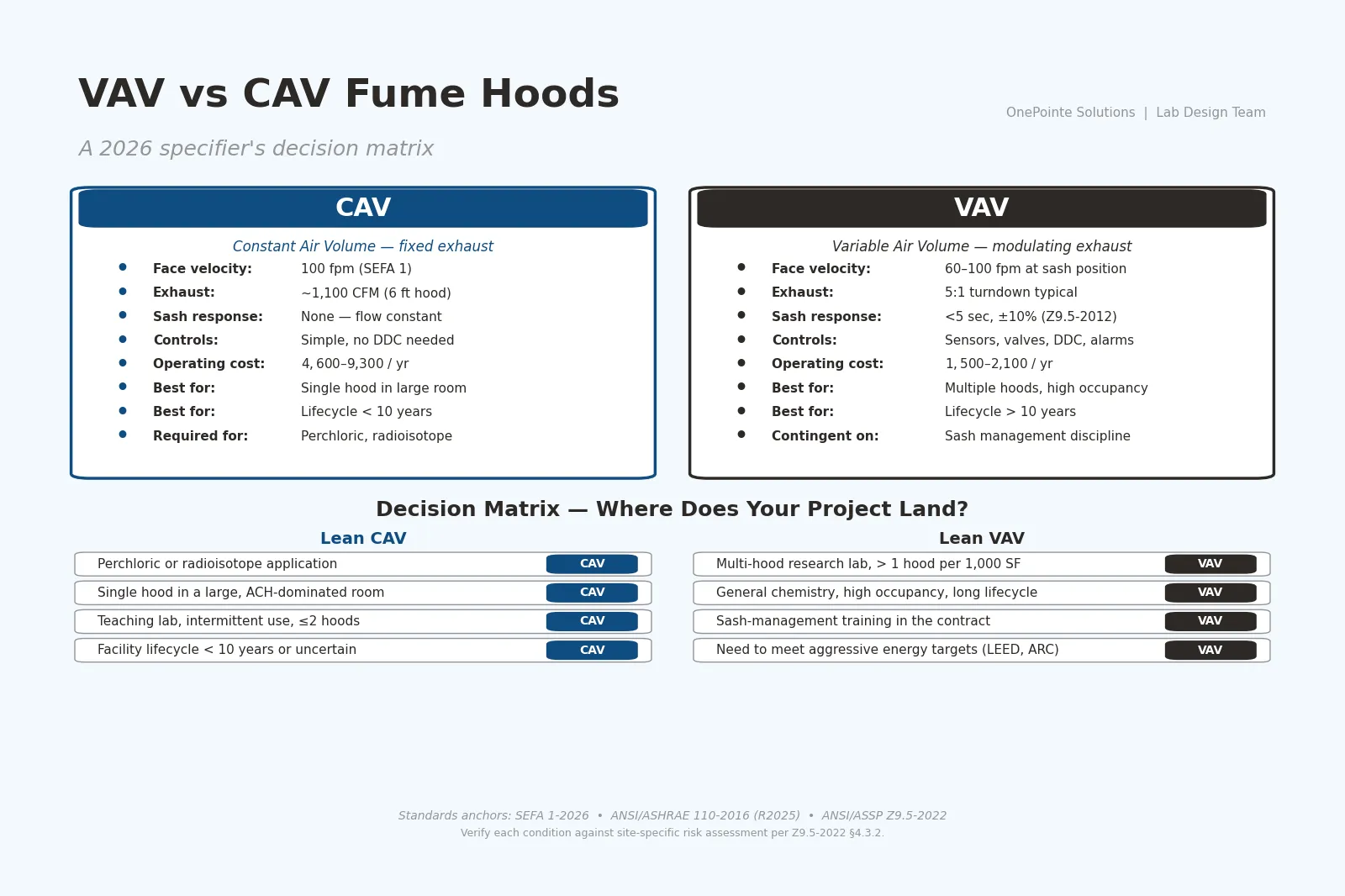
Selection Matrix
| Condition | Lean CAV | Lean VAV |
|---|---|---|
| Single hood in a large room | Yes | |
| Multiple hoods in a small room (> 1 hood / 1,000 SF) | Yes | |
| Facility lifecycle > 10 years | Yes | |
| Facility lifecycle < 10 years or uncertain | Yes | |
| Perchloric acid or radioisotope application | Yes | |
| General chemistry research, high-occupancy | Yes | |
| Teaching lab, intermittent use, few hoods | Yes | |
| Sash-management training committed to in contract | Yes | |
| High-performance CAV at 60 fpm in ACH-dominated room | Yes |
Spec-Language Checklist
Specifiers can drop the following anchors into Division 11 53 13 (Laboratory Fume Hoods) to ensure the VAV vs CAV decision actually delivers the performance the design assumed. First, specify the face velocity target explicitly — 100 fpm at the 18-inch sash stop for conventional hoods, or 60 fpm at full open sash for high-performance hoods with documented ASHRAE 110 AM 0.05 and AI/AU 0.10 containment. Second, write the ASHRAE 110 containment rating into the spec at both AM and AI levels, and require AI testing at every sash configuration including minimum flow. Third, specify VAV response: flow modulation within ±10% of setpoint in less than 5 seconds following sash movement.
Fourth, specify the minimum exhaust floor numerically rather than by formula — calculate the CFM equivalent of the chosen ACHh value, and write that number into Part 2 Products. Fifth, require dual-setpoint flow alarms with audible and visual indicators that suppress nuisance alarms during unoccupied-mode setback. Sixth, require contractor-provided sash management training prior to occupancy, with training records submitted to the owner. Furthermore, the field testing language should reference ANSI/ASHRAE 110 (current edition) with all five required tests called out: face velocity, flow visualization, tracer gas containment at 4.0 L/min SF₆, sash movement effect tests, and (for VAV) face velocity control and response tests.
Methodology Note
Every figure in this VAV vs CAV fume hood guide traces back to a primary government, university, standards body, or peer-reviewed source. Operating cost figures are from LBNL and University of Illinois energy modeling. Sash-position audit data is from NC State, MIT Chemistry, Harvard, Colorado School of Mines, and UC Irvine. Performance test requirements come directly from ASHRAE 110-2016 (R2025) and ANSI/ASSP Z9.5-2022. Where industry literature commonly cites the “30 to 50% VAV savings” range without primary support, this guide omits that range in favor of measured project data. No competitor brand names appear in this guide.
For background on how the six fume hood types relate to each other, see our Lab Fume Hoods 2026 Guide. For the underlying energy economics in dollar terms, see Fume Hood Energy Cost Savings.
Author: OnePointe Solutions Lab Design Team.