


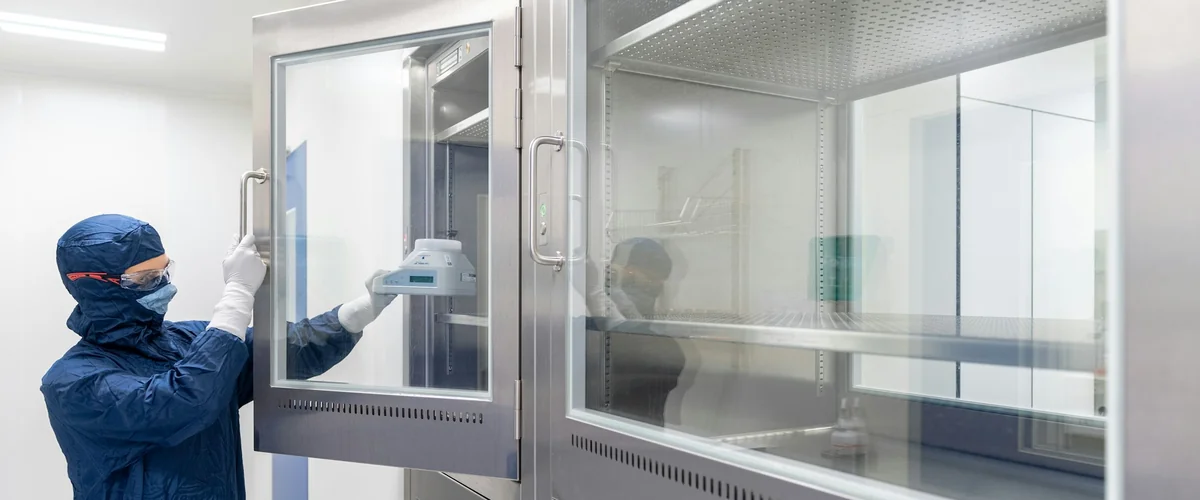
In short, the term “fume hood” covers six fundamentally different fume hood types. Each one is engineered for a different hazard envelope, and each one is governed by a different combination of standards. Walk into any chemistry lab, and you will find one of them. However, walk into the wrong one with the wrong chemistry, and you will find a containment failure — and that failure almost always traces back to a spec writer who treated the category as one product instead of six.
For that reason, this guide walks through all six fume hood types in production today. First, we cover the standards every spec should reference (SEFA 1, ASHRAE 110, and ANSI/ASSP Z9.5). Next, we walk through the design and application profile of each hood type (bypass, low-flow, ductless, perchloric, radioisotope, walk-in), the chemistry profiles each one fits, and the mis-applications that show up in EH&S incident reports year after year. Finally, you will find a side-by-side decision matrix comparing all six fume hood types and a spec framework for matching hood to application.
Three Standards That Govern All Fume Hood Types
Before the six fume hood types make sense individually, you need the three standards that govern fume hood performance across every type in scope.
SEFA 1: Construction and Performance
SEFA 1 (Laboratory Fume Hoods) is the construction and performance standard. First, it sets how hoods come together in the factory, how the field crew checks them at install, and how the user runs them every day. Specifically, SEFA 1 covers three lifecycle tests: As Manufactured (AM) in the factory, As Installed (AI) during commissioning before occupancy, and As Used (AU) with the actual apparatus in place. Furthermore, the standard sets a face velocity range of 60 to 100 feet per minute (fpm), with 100 fpm as the standard-practice target and a uniformity tolerance of ±20% across the sash. In addition, cross-drafts at the hood face must stay below 30% of face velocity or 30 fpm — whichever is lower. (For details, see the published SEFA 1-2026 standard.)
ASHRAE 110: The Test Method
ASHRAE 110, on the other hand, is the test method, not the spec. Specifically, it lays out the tracer gas test: an ejector inside the hood releases sulfur hexafluoride (SF6) at 4.0 liters per minute, while detector probes sample the breathing zone of a mannequin at three positions for five minutes each. Notably, the pass thresholds — ≤0.05 ppm for As Manufactured, ≤0.10 ppm for As Installed and As Used — come from purchasing specs and SEFA, not from ASHRAE 110 itself. (For example, AIHA sums up the test method, and the ANSI overview of ASHRAE 110 lives here.)
ANSI/ASSP Z9.5: The Design Standard
Finally, ANSI/ASSP Z9.5-2022 (Laboratory Ventilation) is the design standard. Its §4.3.1 is the single most-cited paragraph in the fume hood field: design face velocities of 80 to 100 fpm work for most applications, hoods with strong containment may run below 80 fpm, and the standard does not recommend operating any hood below 60 fpm because no one can reliably measure containment at low velocities. (Other standards cover the work that Z9.5 leaves out — for instance, radioisotope labs, BSL-3/4 facilities, and explosives labs. For reference, Caltech Green Labs sums up the §4.3.1 language.)
In short, every fume hood spec — every line in every project — should reference these three documents by edition. Anything less is shorthand.
1. Bypass (Constant-Volume) Fume Hood
First, the bypass hood is the workhorse of general chemistry. It uses a constant-volume (CAV) ducted design with a bypass grille across the top of the sash opening. As a result, when the user lowers the sash, the bypass opens and pulls in room air, keeping total exhaust volume — and therefore the building’s HVAC balance — roughly steady.
When to spec: Generally, this means teaching labs, undergraduate organic and analytical labs, and research labs with stable, predictable chemistry profiles. In particular, anywhere VAV controls add cost and complexity that the energy savings do not earn back. Furthermore, the bypass design is also the simplest to commission and the easiest to maintain — single-speed exhaust fan, no pressure-independent valves, no sash sensors, no BAS drift.
Drawback: Energy. The CAV hood pulls full design exhaust around the clock, no matter where the sash sits, and the building conditions all of that air. As a result, in a multi-hood facility, the hood becomes the single largest line item in the lab’s operating budget — which is the whole reason low-flow and VAV hoods exist. (For the operating cost picture, see our earlier post on fume hood energy economics.)
Standards reference: SEFA 1 §3.2.1; ASHRAE 110 (CAV procedure); Z9.5-2022 §4.3.1.
2. Low-Flow / High-Performance Fume Hood
Second, low-flow hoods (also called high-performance or HP hoods) hold SEFA-grade containment at face velocities of 60 to 80 fpm rather than the standard 100 fpm. Specifically, they get there through aerodynamic refinements: foil airfoil sills, contoured side walls, tuned baffle geometry, and (in most installations) variable-air-volume (VAV) controls that match exhaust to sash position.
When to spec: Typically, this means new high-density lab buildings where energy drives operating cost. Similarly, renovations with tight utility upgrade budgets. Or, alternatively, any project with sustainability targets — LEED, Living Building Challenge, or institutional Net-Zero commitments. Furthermore, the energy savings from VAV-controlled low-flow hoods are real and well documented; for example, UC Irvine’s low-flow study and University of Kansas’s high-performance spec are both public and worth reading before writing your own.
The catch: Low-flow energy savings depend entirely on sash management behavior. For instance, a VAV hood with the sash wide open all day exhausts as much as a CAV hood. Therefore, auto-sash closers, sash position alarms, and user training are not optional — they are part of the system. Likewise, ANSI Z9.5-2022 §4.3.3 requires a flow indicator on every hood, and for VAV hoods, sash position alarms count as standard practice.
Standards reference: SEFA 1 (low-velocity designation); ASHRAE 110 (verify AM ≤0.05 ppm at the rated low velocity, not just at 100 fpm); Z9.5-2022 §4.3.2.
3. Ductless (Recirculating / Filtering) Fume Hood
Third, the ductless hood is the most controversial product category in the fume hood catalog. It uses activated carbon and HEPA filters to scrub contaminants from exhaust air, then recirculates that air back into the laboratory rather than venting to the building exhaust stack. As a result, it requires no ductwork, no dedicated exhaust fan, and no HVAC penetration — which makes capital cost the lowest of any hood type.
However, that low capital cost is exactly why the category exists, and exactly why so many specifiers mis-apply it.
When to spec (the narrow case): A ductless hood fits only when (a) the chemistry is precisely known and stable, (b) all chemicals fall within the certified adsorption profile of the installed filter, (c) volumes are small, and (d) institutional EH&S has approved the application in writing. Specifically, ANSI/ASSP Z9.5-2022 §5.2 limits ductless hoods to applications “that the user can safely perform on an open bench” — which is the standard’s way of saying these are not real fume hoods, they are local exhaust devices with a filter.
Where Ductless Hoods Go Wrong
Common mis-applications: First, hydrofluoric acid (carbon does not reliably capture HF, and breakthrough is odorless at dangerous concentrations). Next, perchloric acid (the carbon filter is itself an organic substrate; perchloric acid contact with carbon can form explosive organic peroxides). Also, unknown research chemistry, common in university settings where future use changes faster than the filter spec. As a result, many institutional EH&S programs prohibit ductless hoods categorically — for example, Tulane OEHS states “ductless fume hoods are not approved for installation or use,” and Stanford EH&S permits them only on case-by-case approval.
Finally, if a project specifies a ductless hood, mandatory signage must identify allowable chemicals, the filter type, the change schedule, and the fact that the hood recirculates air to the room.
Standards reference: ANSI/ASSP Z9.5-2022 §5.2; ASHRAE 110-2016; SEFA 1.
4. Perchloric Acid Fume Hood
Fourth, the perchloric acid hood is not a configuration choice — it is a non-negotiable safety requirement for any laboratory conducting heated perchloric acid work. Specifically, NFPA 45 §12.1 states it directly: “Perchloric acid heated above ambient temperatures shall only be used in a chemical fume hood specifically designed for its use.”
Why a dedicated hood is required: Heated perchloric acid generates vapor that condenses on duct, fan, and hood-interior surfaces, where it forms highly shock-sensitive perchlorate salts that can detonate on mechanical disturbance — including the routine vibration of a running fan. As a result, a dedicated hood with continuous wash-down is the only way to keep ductwork free of these deposits. (For example, Princeton EH&S documents the explosion mechanism plainly.)
Required design features:
- Type 316 stainless steel interior, coved seamless welded seams (no organic materials)
- Dished work surface with integral drainage trough at the rear baffle
- Integrated wash-down system on a daily-use cycle (or after each use)
- Type 316 stainless exhaust duct, fully welded, sloped for gravity drainage, with spray wash rings every 10 to 12 feet of vertical run
- Dedicated exhaust fan — never manifolded with other hoods — with motor outside the air stream
- Acid-resistant gaskets and sealants (PTFE/fluorocarbon preferred)
Face velocity target: The VA Master Specification 11 53 13 calls for 125 fpm on perchloric hoods — higher than the 100 fpm general-chemistry baseline — which reflects the elevated containment certainty the application requires.
Standards reference: NFPA 45 §12.1; ANSI/ASSP Z9.5-2022 §3.2.5; SEFA 1-2026 §3.2.4. Notably, the VA spec linked above is the most accessible government master specification, and most spec writers treat it as a writing template.
5. Radioisotope Fume Hood
Fifth, the radioisotope hood (also called a radionuclide or radioactive materials hood) provides simultaneous containment of airborne chemical and radioactive hazards. Similarly to the perchloric hood, it is a bench-top hood with material and design modifications that the application dictates. Importantly, Z9.5-2022 explicitly excludes radioisotope laboratories from its scope; instead, NRC regulations under 10 CFR Part 20 and NRC Regulatory Guide 3.32 govern these hoods.
Required design features:
- Type 304 stainless steel interior with coved seamless welded seams (304 rather than 316; minimal cobalt content reduces activation concerns)
- Dished, reinforced work surface — up to 1,000 lb per hood section to support lead shielding containers
- Lead-lined wall and leaded-glass viewing-panel options for gamma-emitting isotopes
- Vertical-rising sash only — horizontal sliding panels are excluded by SEFA 1 §3.2.3 to preserve single-pane shielding continuity
- HEPA (or ULPA) filtration plus activated carbon for radioiodine and volatile radioactive gases, with bag-in / bag-out housings for safe filter change-out
- Dedicated drain to a liquid radioactive waste holding tank
Face velocity target: Specifically, NRC Regulatory Guide 3.32 specifies a design face velocity of 150 fpm (minimum 120 fpm) to prevent reverse flow of contaminated air. Furthermore, the rule does not permit VAV controls in radioisotope service — the simplicity and predictability of CAV operation outweigh the energy penalty.
Standards reference: 10 CFR Part 20; 10 CFR Part 35; NRC Regulatory Guide 3.32; SEFA 1-2026 §3.2.3.
6. Walk-In / Floor-Mount Fume Hood
Finally, the walk-in hood is a full-height enclosure that sits on the laboratory floor rather than on a bench. It exists because some experimental apparatus — for instance, distillation columns, reflux setups, pilot-plant reactors, fermenters, drum-handling rigs — does not fit inside a bench-top hood.
However, the name is misleading. SEFA 1 §3.2.5 is explicit: despite the term “walk-in,” no person should enter the enclosure during active hazardous work or while vapor concentrations remain inside it. Specifically, entry is for setup only, with no active chemistry running.
When to spec: First, tall apparatus that exceeds bench-top sash height (distillation, reflux, scale-up reactors). Second, floor-standing equipment that needs contained ventilation (large instruments, pilot-plant reactors, drum operations). Third, some perchloric digestion configurations that need a walk-in form factor with the dedicated wash-down system layered on top.
What it is not for: Highly toxic materials. Specifically, SEFA 1 §3.2.5 explicitly cautions against this — the large face area is inherently susceptible to face velocity variations and cross-drafts, which means containment certainty is lower than in a properly commissioned bench-top hood. Therefore, for high-toxicity work, a smaller, lower-CFM bench-top hood under tighter aerodynamic control is the right answer.
Face velocity target: Generally, 80 to 100 fpm (the standard SEFA range). However, total exhaust volume runs substantially higher than a bench-top hood of comparable width — typically 1,500 to 2,500 CFM for a six-foot walk-in versus 800 to 1,200 CFM for a six-foot bench-top hood. As a result, the design team must evaluate the building exhaust system for the increased CFM demand before commit.
Standards reference: SEFA 1-2026 §3.2.5; ASHRAE 110-2016; ANSI/ASSP Z9.5-2022.
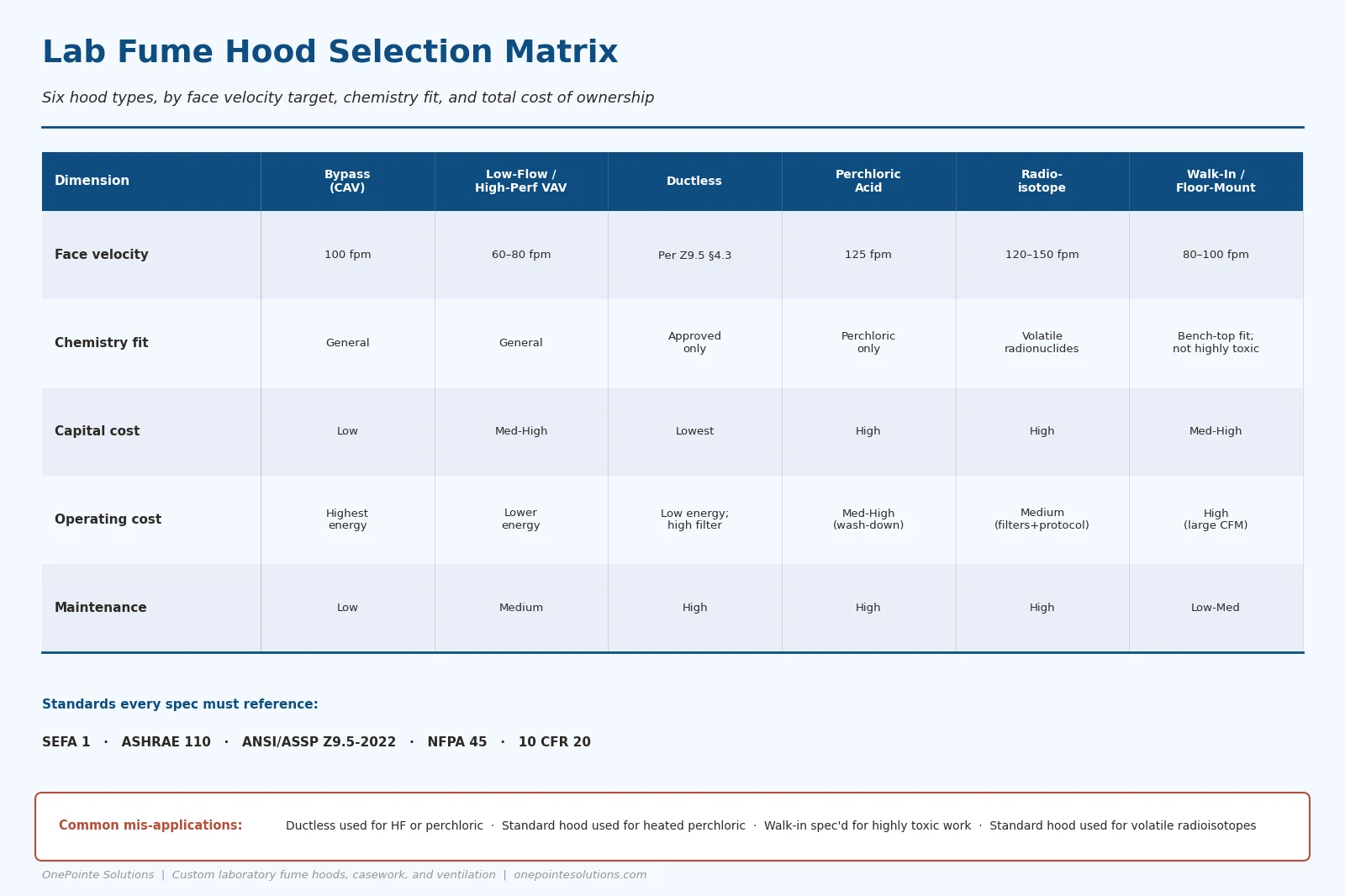
Fume Hood Types Compared: The Selection Matrix
In short, chemistry profile, hazard class, and operational context determine hood type — not available footprint, available capital, or what the last project used. Therefore, cross-reference your application against the six fume hood types below.
| Dimension | Bypass CAV | Low-Flow / HP VAV | Ductless | Perchloric | Radioisotope | Walk-In |
|---|---|---|---|---|---|---|
| Face velocity | 100 fpm | 60–80 fpm | Per Z9.5 §4.3 | 125 fpm | 120–150 fpm | 80–100 fpm |
| Chemistry fit | General | General; not at min flow with high-dilution work | Known & approved only; never HF, perchloric, or unknown | Perchloric only | Volatile radionuclides; α/β emitters | Bench-top fit; not for highly toxic |
| Capital cost | Low (ducted) | Medium-high | Lowest | High | High | Medium-high |
| Operating cost | Highest energy | Lower energy; higher controls | Low energy; high filter cost | Medium-high (wash-down) | Medium (filters + protocol) | High (large CFM) |
| Maintenance | Low | Medium | High (filter program) | High (daily wash-down) | High (decon + NRC records) | Low-medium |
Specifying the Right Hood: A Four-Question Framework
Before writing the SEFA 1 / ASHRAE 110 / Z9.5 reference into the spec, first work through these four questions to narrow down the appropriate fume hood types for your application:
- Chemistry profile. First, what chemicals will the lab use, in what concentrations, in what processes, at what temperatures? Document the inventory; it determines the hood type and rules out the wrong ones (for example, perchloric, radioisotope, HF, and BSL-rated work each demand specific hoods).
- Sash management reality. Second, will the lab use auto-sash closers? Sash alarms? User training? If the answer is “we hope so,” then a CAV bypass hood will outperform a VAV hood on real-world energy consumption.
- Building exhaust capacity. Third, what does the existing exhaust system rate for? For instance, a bank of low-flow VAV hoods may fit within current capacity; a single walk-in may not. Therefore, get the mechanical engineer involved before the team locks the hood count.
- Service-life expectation. Finally, hoods carry commissioning credentials for the chemistry of today. If the program is likely to evolve over 10 to 20 years, then build in headroom — for example, oversized exhaust capacity, capped utility runs, accessible duct chases — to support a hood-type change later without a gut renovation.
A Note on Pricing
First, specific dollar figures vary materially by region, configuration, finish package, control system, accessory load, and freight. Moreover, public sources sufficient to compare all six fume hood types on a single normalized capital basis do not exist. What does exist is the relative ordering above (ductless lowest, perchloric and radioisotope highest), supported by the materials and infrastructure differences that government master specifications document. Therefore, for project-specific pricing, work with a manufacturer against a written spec that references SEFA 1, ASHRAE 110, and ANSI/ASSP Z9.5 by edition.</p>
<p>In addition, for the cabinet and work surface decisions that pair with the hood selection, see our Lab Casework Materials 2026 Guide</a>.</p>
OnePointe Solutions designs, manufactures, and installs custom laboratory fume hoods and casework for research, clinical, and industrial laboratories nationwide. Contact our lab design team to discuss your application.