



If you manage a laboratory, the single most expensive piece of infrastructure in your building probably isn’t your mass spectrometer, your autoclave, or your walk-in cold room.
It’s your fume hoods.
A standard 6-foot constant-air-volume (CAV) fume hood costs approximately $8,260 per year in energy to operate — and a facility with twenty hoods is quietly burning through $165,000 in annual operating expense, most of it invisible on any single monthly utility bill. Published research from Lawrence Berkeley National Laboratory puts the aggregate U.S. figure at roughly $4.2 billion per year across the estimated 750,000 hoods currently in service.
For lab managers, facility directors, and procurement leaders, fume hoods represent one of the largest — and most addressable — cost centers in the entire building. At OnePointe Solutions, we design and manufacture fume hoods and custom lab casework for facilities nationwide, and we see the same cost-driver patterns repeat across climate zones and lab types.
This guide breaks down exactly where the money goes, why fume hoods consume so much energy, and the four proven strategies for cutting operating costs by 40% to 85%.
Why Fume Hoods Cost So Much to Operate
A fume hood is, fundamentally, a machine that throws away conditioned air.
Every cubic foot of air a hood exhausts has already been heated in winter, cooled in summer, humidified, dehumidified, and filtered. Your HVAC system spent real money conditioning that air. Your fume hood then pulls it through the sash and ejects it out of the roof — typically within seconds of it entering the room.
The numbers are staggering. An average 6-foot CAV fume hood operating at a 100 fpm face velocity with the sash fully open moves approximately 70,800 cubic feet of tempered air per hour. That’s the equivalent of completely replacing the air in a 2,000-square-foot home roughly four times every hour — and doing it continuously, 24 hours a day, 365 days a year.
Put another way: a single continuously operating fume hood consumes as much energy as three to three-and-a-half average American households combined.
This is why labs are four to five times more energy-intensive than typical commercial buildings. And it’s why a thoughtful fume hood strategy can move a facility’s entire energy budget in a way that lighting retrofits and envelope upgrades simply cannot.
Breaking Down the $8,260 Annual Cost
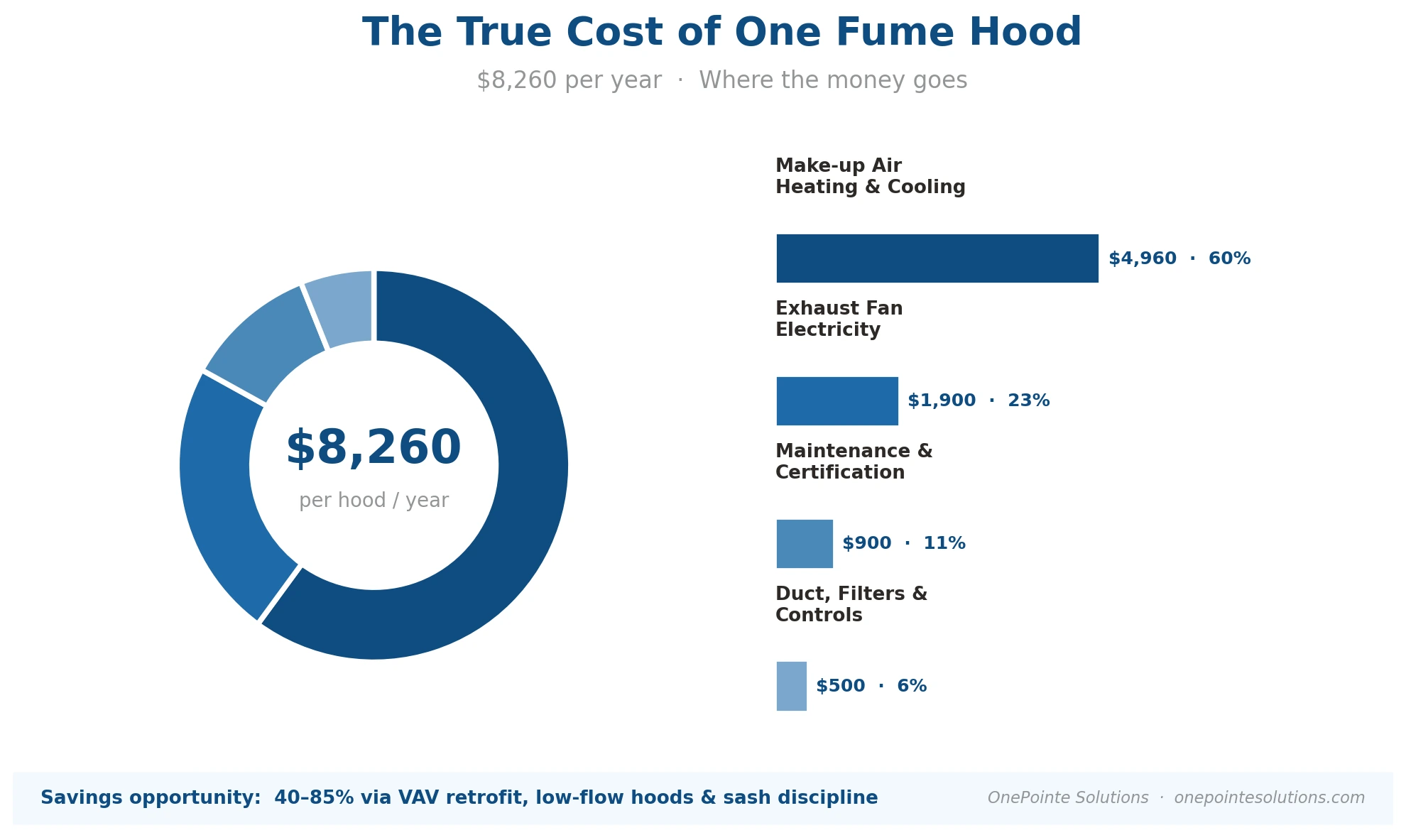
The per-hood cost figure is not a flat benchmark — it’s highly climate-dependent. Research from LBNL documents annual operating costs ranging from approximately $4,600 per year in mild climates like Los Angeles to over $9,300 per year in cooling-dominated climates like Singapore. In extreme heating climates (Fairbanks, for example), costs can push above $12,000 per hood per year.
The cost breaks down across four components:
- Heating and cooling the makeup air that replaces what the hood exhausts — usually the largest single line item
- Fan energy for both the exhaust fan and the building’s supply-air system
- Reheat to maintain space temperature when high exhaust rates overcool the room
- Peak demand charges from utilities, which penalize facilities with high simultaneous draw
The critical insight: most of these costs are not driven by the hood itself. They’re driven by the volume of air the hood moves. Which means every strategy for reducing cost ultimately comes down to moving less air — without compromising containment.
The Four Proven Strategies to Cut Fume Hood Operating Costs
1. Sash Management (Zero Capex, Immediate Payback)

The single cheapest energy-saving policy any lab can implement is to close the sash when the hood is not in active use.
On a variable air volume (VAV) system, a fully closed sash can reduce exhaust airflow demand by more than 50%, often dropping volumetric flow from 1,000+ CFM down to the low hundreds. Even on a constant-air-volume system, closed sashes reduce the hood’s face velocity target and extend hood and HVAC component life.
The tactics are simple and well-documented:
- Post “Shut the Sash” signage at eye level on every hood
- Include sash discipline in new-hire lab safety training
- Install automated sash closers on high-traffic hoods
- Run a quarterly “sash audit” during walk-throughs
One university documented savings of nearly $300,000 per year after retrofitting 44 hoods with VAV controllers and implementing a sash management program. The capital cost was recouped in under three years.
2. Convert to Variable Air Volume (VAV)
If your hoods are still running constant air volume, you are almost certainly leaving money on the table.
CAV hoods exhaust the same volume of air regardless of whether the sash is open eighteen inches or fully closed. VAV systems, by contrast, modulate exhaust airflow in real time based on sash position — pulling only as much air as is needed to maintain safe containment.
Published energy savings from VAV conversions typically range 40% to 70%, and aggressive retrofits pairing VAV with sash management and occupancy sensing have documented savings of up to 85%.
VAV conversion is a capital project — there’s no avoiding that — but the payback math is usually compelling:
- Payback period: Typically 2–5 years, depending on climate and hood count
- Secondary benefits: Reduced HVAC equipment wear, extended component life, and lower peak demand charges
- Safety upside: VAV systems maintain a constant face velocity regardless of sash position, which is actually safer than CAV in most real-world use cases
3. Specify High-Performance Low-Flow Hoods
For new construction or hood replacement, high-performance low-flow designs — like the Notus fume hood — maintain safe containment at face velocities well below the traditional 100 fpm benchmark, sometimes as low as 60 fpm.
Because volumetric airflow is the product of face velocity and sash opening area, cutting face velocity by 40% cuts the hood’s exhaust demand — and its energy cost — by roughly the same amount.
Third-party data from ASHRAE 110 containment testing confirms that modern low-flow designs meet or exceed containment performance of traditional hoods at significantly lower airflow rates. Published reductions in annual operating cost versus conventional bypass hoods run as high as 70%, particularly when paired with VAV controls and aggressive sash management.
4. Run a Hood Census and Decommission What You Don’t Need
This is the audit every facility should run, and almost none do.
Walk the building with the PI of each lab and ask one question per hood: is this hood actively supporting research right now? In most facilities, somewhere between 10% and 20% of hoods are functionally acting as storage cabinets — holding reagents, glassware, or equipment that could live on an open bench or in a flammable cabinet.
Every decommissioned hood saves the full $5,000–$9,000 per year in energy, plus HVAC capacity that can be reallocated to active research spaces. The only cost is the cap-and-seal of the exhaust connection.
Start with the oldest hoods and the ones in labs that have changed PIs in the last three years. The list builds itself.
What This Means for Your Budget
If you manage a facility with 20 fume hoods and your hoods are predominantly CAV, you are spending approximately $165,000 per year to run them — and you can reasonably expect to cut that figure by $70,000–$130,000 per year through some combination of the four strategies above.
The order of operations for most facilities:
- Immediate (30 days): Sash management program, hood census, decommission unused hoods
- Short-term (6–12 months): VAV pilot on one lab or wing to document ROI
- Medium-term (1–3 years): Phased VAV conversion across the facility
- Long-term (replacement cycle): Default to high-performance low-flow hoods for all new specifications
The labs that are winning on operating cost right now are not the ones with the newest buildings. They’re the ones with a disciplined, sequential plan to retire high-flow CAV hoods and replace them with modern airflow management — often as part of a broader complete lab furniture refresh that aligns casework, benches, and hoods on a single standard.
A Note on Specification
If you are specifying new hoods, new casework, or a full lab build, the single most important decision is not the brand of the hood. It’s matching hood type to lab type — research, clinical, or industrial — and integrating the hood into a coherent airflow and casework strategy from day one. Our in-house team offers full laboratory design services covering airflow planning, casework layout, and hood selection as a single package.
A high-performance hood installed into a poorly designed ventilation scheme will underperform both on safety and energy. A CAV hood integrated into a well-designed VAV system is a constraint on the whole facility. For labs evaluating low-flow options as part of that planning work, the Notus is our current-generation answer.
Design the system, not the part.
OnePointe Solutions manufactures laboratory fume hoods, casework, and industrial workbenches at our facility in Elgin, TX. If you’re planning a new build, renovation, or hood replacement project, our lab planning team can help you scope the right specification for your lab type, climate, and budget. Request a consultation →