


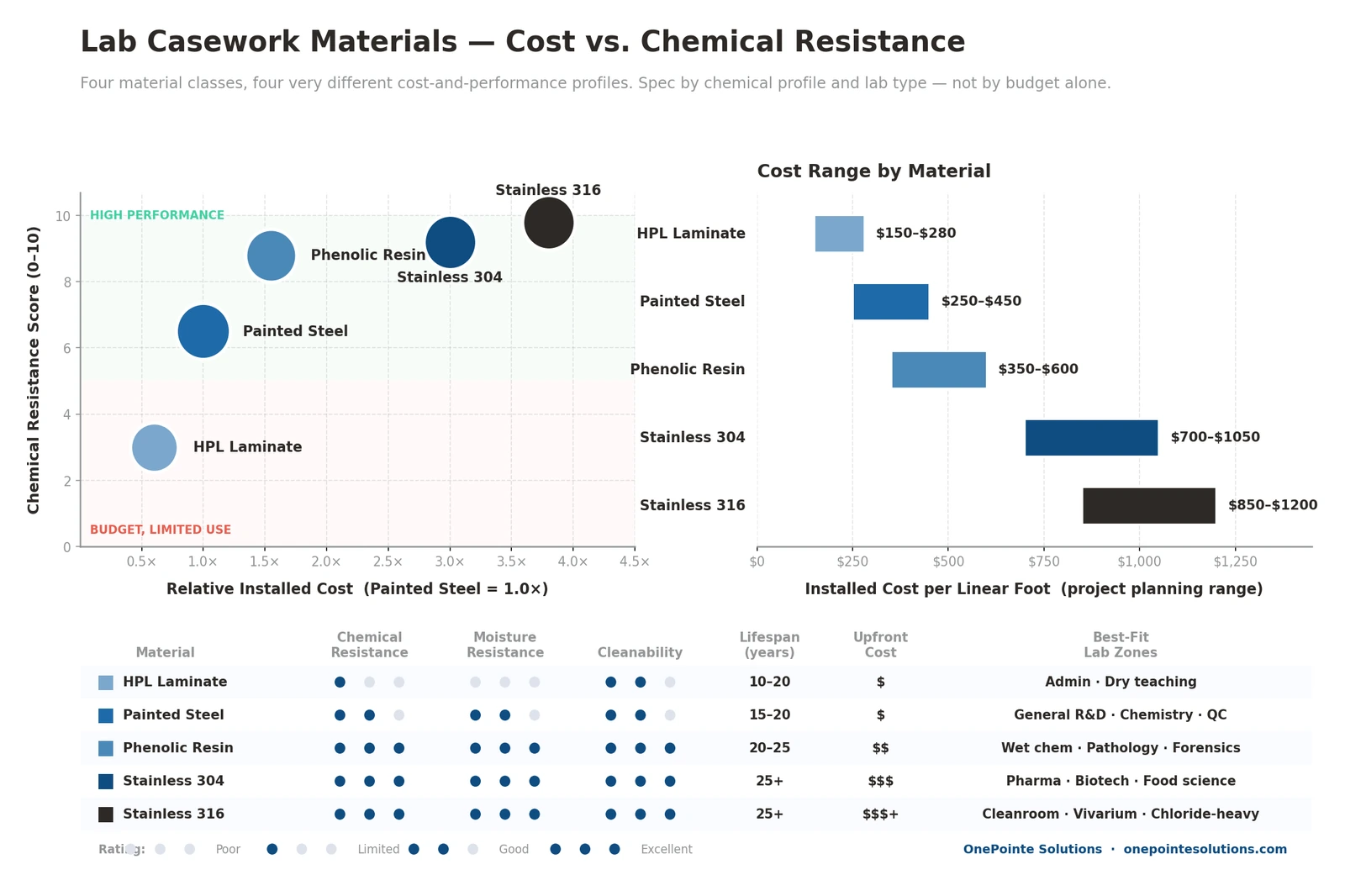
Walk through the specification options for any mid-size lab build and you will find the casework budget swinging from $150 per linear foot for plastic laminate to $1,200 or more per linear foot for stainless steel 316 — a range of 0.5x to 4.5x depending on the material class. On a project with the casework equivalent of a twenty-hood lab, that spread represents a six-figure decision made before the first cabinet is fabricated. Yet most specifiers default to the material they used on the last project without a systematic assessment of whether it fits the actual environment.
The right material depends on four variables: chemical profile, moisture and wash-down exposure, sterilization requirements, and target service life. Get those variables right and the material choice follows almost automatically. Get them wrong and you are either overbuilding — paying for stainless steel performance in a dry teaching lab — or underbuilding, installing laminate that will fail within five years of a wet lab opening.
At OnePointe Solutions, we manufacture custom lab casework across all four major material classes — powder coated (painted) steel, stainless steel, phenolic resin, and plastic laminate — at our facility in Elgin, TX. This guide covers the real performance specs, cost benchmarks, failure modes, and best-fit lab types for each.
Why Casework Material Is the Decision That Locks In Your Operating Reality
Unlike a fume hood you can swap out, casework is structural. It anchors to floors, attaches to walls, and routes utilities. Once installed, you live with it for 15 to 25 years depending on material — three to five budget cycles before the cabinets come out. A powder-coat chip on painted steel looks minor until moisture migrates beneath the coating and rust cascades outward along the substrate. A laminate edge seam that opens under chemical exposure exposes the particleboard core, swells it, and destroys cabinet integrity. Neither failure is repairable; both require full cabinet replacement.
Casework also drives contamination-control and compliance decisions. A non-porous phenolic or stainless surface can be decontaminated to GMP standards; a coated steel surface with coating imperfections cannot. According to CBRE’s 2024 Life Sciences Construction Benchmarks, casework typically represents 15 to 25% of total lab construction cost — one of the largest single line items in any lab fit-out budget.
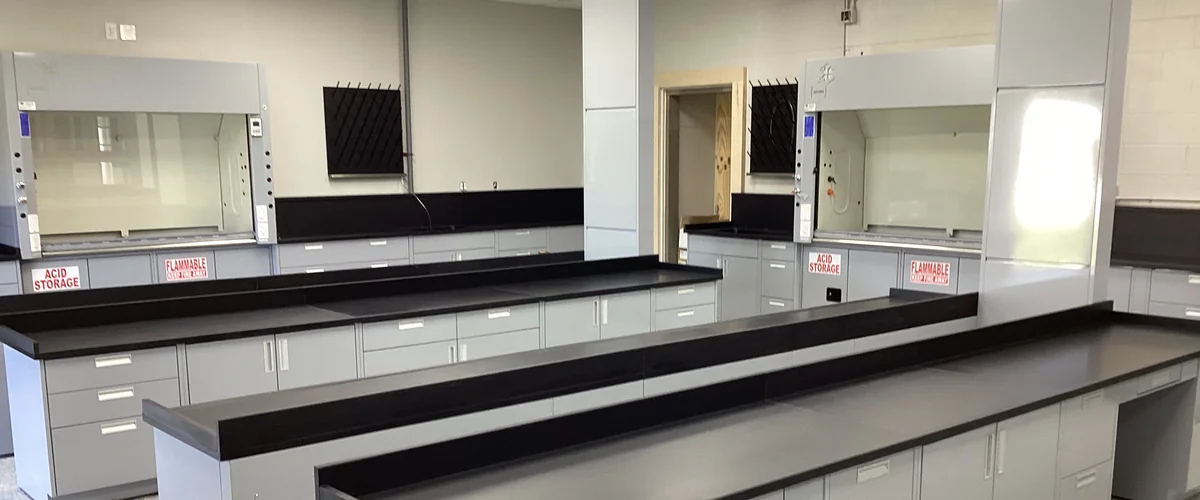
Painted Cold-Rolled Steel — The Workhorse
Painted steel is the most common lab casework material worldwide, and for general-purpose environments it remains the correct default. Cabinet bodies are fabricated from cold-rolled steel conforming to ASTM A366/72: 18-gauge minimum for sides and doors, 16-gauge for horizontal rails, 14-gauge reinforcement plates at high-load points. Finish is electrostatically applied urethane or epoxy powder coat baked to 1.5 mil average dry film thickness, 4H pencil hardness per ASTM D3363, and 200-hour minimum salt spray resistance. Base cabinet load capacity: 500 lbs. per linear foot.
Chemical resistance is good but coating-dependent. The governing benchmark is the SEFA 8M 49-chemical spot test: one-hour exposure to 49 reagents, with a maximum of 4 Level 3 results (pitting or coating erosion) allowed for certification. Known failures: concentrated HF, concentrated HCl, chromic acid, and chlorinated solvents. If the coating chips, exposed cold-rolled steel corrodes rapidly at any moisture contact.
Installed cost: $250–$450 per linear foot. Service life: 15 to 20+ years. Best-fit applications: general-purpose chemistry, R&D, university teaching labs, and industrial QC. Pairing steel bodies with phenolic or epoxy countertops delivers chemical resistance at horizontal surfaces where spills land while keeping system cost close to the steel baseline. See our steel lab casework configurations for details.
Stainless Steel 304/316 — The Sterile Gold Standard
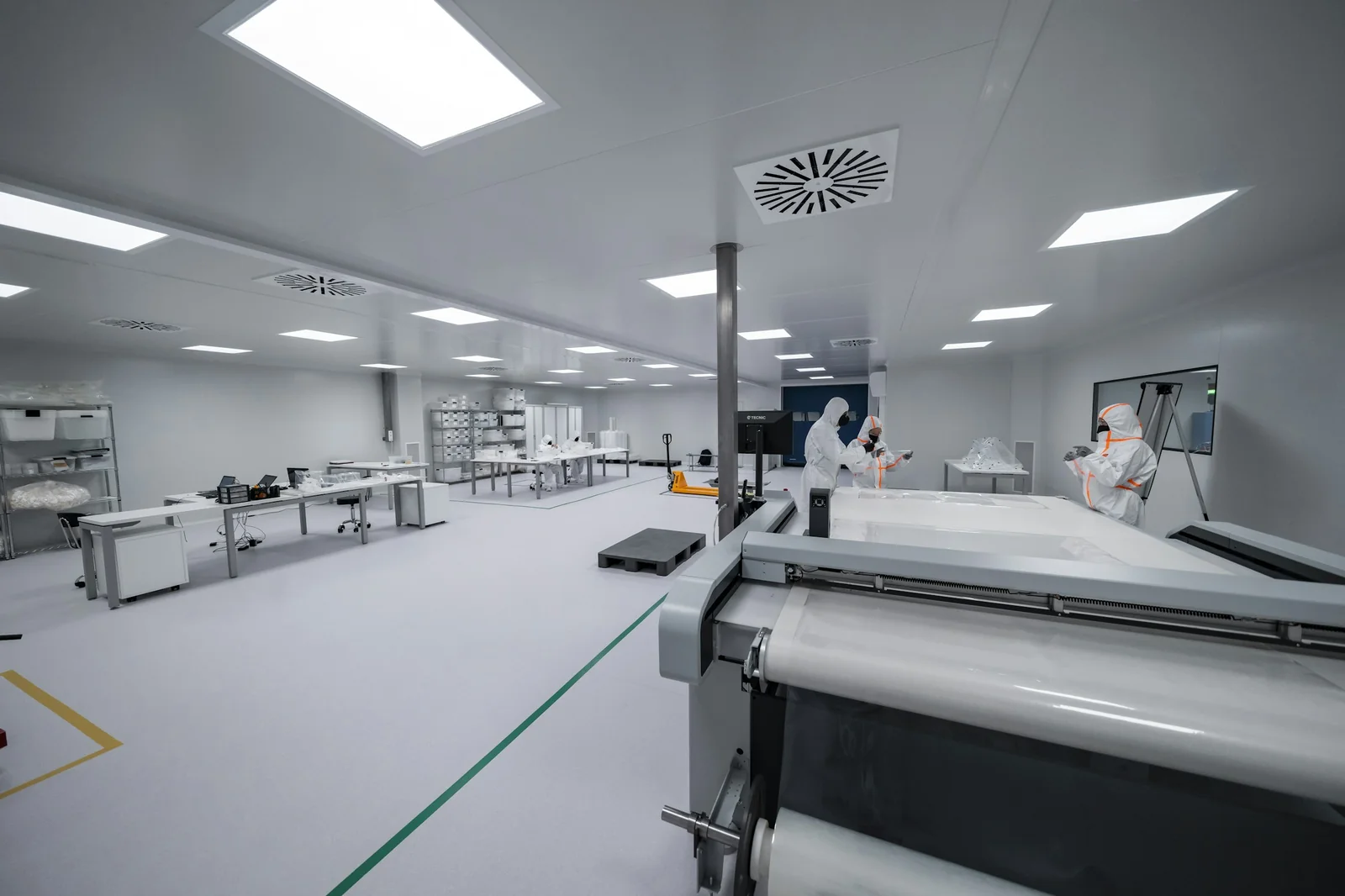
When cleanability, sterilization, and inherent chemical resistance matter more than budget, stainless steel is the specification. Grade 304 (18–20% chromium, 8–10.5% nickel) handles most lab chemical exposures well. Grade 316 adds 2–3% molybdenum, forming a self-healing passive oxide layer that resists chloride-induced pitting — the failure mode that compromises 304 wherever bleach-based disinfectants or chlorinated cleaners are routine. Per Kloeckner Metals, 316 costs 20–40% more than 304. The 316L (low-carbon) variant is preferred wherever welding is required.
Both grades are inherently non-porous, require no coating to maintain chemical resistance, and tolerate autoclave steam sterilization (121°C / 250°F) without degradation. No. 4 brushed satin finish is standard for lab casework. Installed cost: $700–$1,200+ per linear foot — 2.5 to 4.5 times painted steel. Service life: 25+ years. Best-fit applications: pharmaceutical and biotech GMP facilities, cleanrooms (Class 10–1000), vivariums, food science, and clinical diagnostics. Specify 316 wherever bleach-based disinfectants are routine, in coastal environments, or where chlorinated compounds are present.
Phenolic Resin — The Wet Lab Specialist
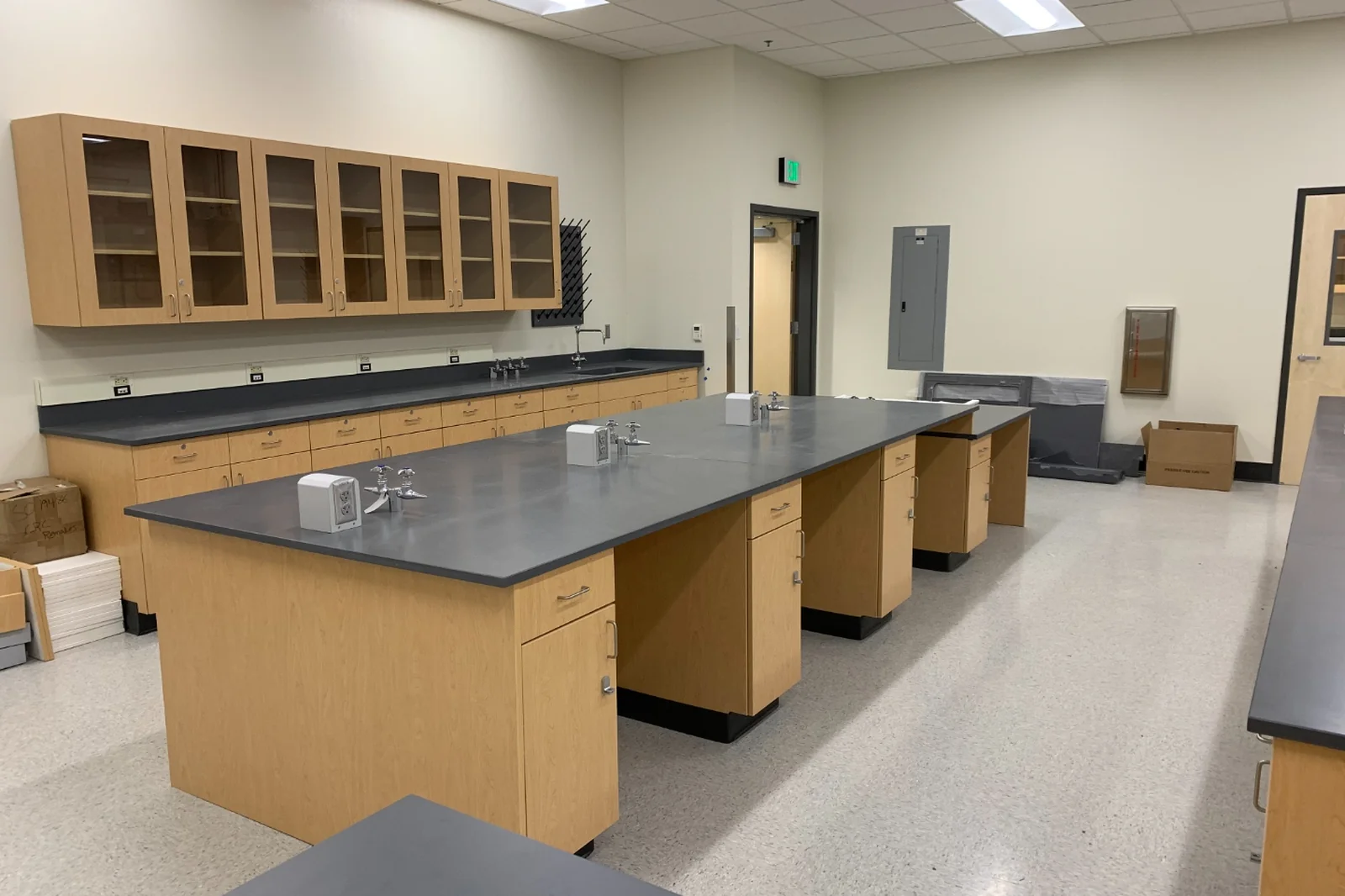
Phenolic resin casework is manufactured by impregnating layers of kraft paper with thermosetting phenol-formaldehyde resin and compressing the assembly under high heat and pressure into a monolithic, solid-through panel. There is no coating to chip and no seam through which moisture can infiltrate — a scratch does not compromise chemical resistance because the same material runs through the full thickness.
Published mechanical properties: 24,000 psi compressive strength per ASTM D695, 0.30% maximum water absorption per ASTM D570, and Class A fire rating under ASTM E84 (flame spread index ≤25). Chemical resistance testing by Fundermax on their Max Resistance² phenolic panel produced zero Level 3 results across all 49 SEFA reagents at 24-hour exposure — well beyond the 4-result maximum SEFA requires for certification. Key chemical limits: concentrated sulfuric acid, concentrated sodium hydroxide above 40%, HF, chromic acid, and sodium hypochlorite (bleach) all rate D (Not Recommended) per the K-Mac Plastics phenolic resistance chart. For labs where those chemicals are routine at high concentrations, epoxy resin is the better countertop choice.
Installed cost: $350–$600 per linear foot. Phenolic casework is much heavier than steel with regarding to installation but it’s also electrically non-conductive — a functional advantage in semiconductor and electronics labs. Service life: 20 to 25 years. Best-fit applications: wet chemistry, analytical chemistry, pathology and histology, forensics, and semiconductor labs.
Plastic Laminate (HPL) — The Budget Option with a Catch
High-pressure laminate (HPL) casework is the least expensive material class — installed cost runs $150–$280 per linear foot, or 0.5 to 0.7 times painted steel. The construction is a NEMA LD-3 laminate face bonded to a particleboard core (ANSI A208.1 Grade M-2) with rigid PVC edge extrusion per the NY State OGS master specification.
The defining failure mode is the edge. Once moisture penetrates an edge seam through a spill, wash-down, or sustained humidity, the particleboard core swells and separates the laminate face from the substrate — destroying structural integrity in a way that requires full replacement, not repair. The Woodwork Institute Lab Casework Guide is direct: “plastic laminate countertops are the least chemical resistant and least durable choice for laboratory use.” SEFA 8-PL-2020 includes dedicated edge-delamination and wear-resistance tests for this reason.
Chemical resistance is limited to fair. HPL is not rated for direct chemical exposure or wet lab work. Service life ranges from 10 to 20 years — the widest variance of any material class, because environment is the dominant factor. Best-fit applications: administrative and IT areas, dry teaching labs where chemicals are stored separately, and short-design-life renovation projects.
The Decision Framework — Match Material to Lab Type
The wrong default is choosing by budget alone. The right default is matching chemical profile and lifespan requirements first, then checking the budget impact.
| Lab Type | Recommended Material | Key Driver |
|---|---|---|
| General-purpose R&D | Painted steel | Cost-effective; handles moderate chemical exposure |
| University chemistry teaching | Painted steel body + phenolic countertop | High traffic; steel handles wear; countertop handles spills |
| Wet chemistry / analytical | Phenolic resin | Constant moisture and broad chemical exposure |
| Pharmaceutical / biotech GMP | Stainless steel 304 or 316 | Sterilization cycles; GMP cleanability requirements |
| Cleanroom (Class 10–1000) | Stainless steel 316 preferred; phenolic acceptable | Aggressive disinfectants; chloride-based cleaners |
| Vivarium / animal care | Stainless steel 316 | Frequent wash-down; ammonia; humidity and disinfectant exposure |
| Pathology / histology | Phenolic resin or stainless steel | Broad solvent and formalin use; non-porous surface required |
| Semiconductor / electronics | Phenolic resin | Non-conductive; ESD considerations |
| Forensics / crime lab | Phenolic resin | Broad chemical palette; non-porous prevents cross-contamination |
| Administrative / IT / light-use | HPL laminate | Low chemical exposure; aesthetic flexibility; cost |
Hybrid specifications are often the correct answer. Phenolic resin countertops on painted steel cabinet bodies is the most common combination — delivering chemical resistance at the horizontal work surface where spills land while keeping overall system cost well below an all-phenolic specification. That combination typically hits 80% of wet-lab performance at roughly 60% of the cost.
Any material can be configured for ADA compliance — it is a dimensional requirement, not a material one. The ADA 1991 Design Standards mandate accessible work surface heights of 28–34 inches, knee clearance, and aisle widths; all four materials meet these requirements through standard configurations. When specifying across multiple lab types in one facility, our laboratory design team can help you standardize without over-specifying.
SEFA 8 — The Standard That Separates Real Lab Casework From Office Furniture
SEFA (Scientific Equipment and Furniture Association) publishes performance standards governing laboratory-grade casework. The SEFA 8 family covers each major material class: SEFA 8M for metal casework, SEFA 8PH for phenolic resin, SEFA 8PL for plastic laminate, SEFA 8W for wood, and SEFA 8P for polypropylene — the strictest sub-standard, which allows zero Level 3 chemical test results compared to the maximum of 4 Level 3 results permitted under 8M and 8PH. Current editions are freely available at sefalabs.com/standards.
Each sub-standard includes structural load tests, dynamic cycling tests (door cycles to 100,000; drawer cycles to 50,000 per the SEFA 8M-2016 specification), and the 49-chemical spot test — all conducted by a SEFA-approved independent third-party laboratory; in-house testing does not qualify. SEFA 8PL adds dedicated edge-delamination and wear-resistance tests not applicable to metal or phenolic sub-standards.
A cabinet that has not been SEFA-tested is not lab casework — it is office furniture with a stainless top. Insurance requirements, laboratory accreditation standards, and pharmaceutical compliance frameworks routinely reference SEFA certification as a baseline performance requirement.
What This Means for Your Specification
- Inventory the chemical profile of every lab zone. Which reagents, at what concentrations, how often? Concentrated acids and oxidizers narrow options immediately. A lab handling only dilute buffers has far more flexibility.
- Identify wet and dry zones and cleanability requirements. Sustained moisture eliminates laminate. Sterilization or GMP cleanability requirements point toward stainless. Broad solvent and moisture exposure without sterilization requirements is the phenolic resin case.
- Default to painted steel unless specific constraints push you up the material ladder. For most general-purpose zones, painted steel is the correct choice, not a compromise. Apply premium materials only where genuinely required.
- Use hybrid specifications to optimize cost. Steel bodies with phenolic countertops, or phenolic cabinets with stainless sinks, match material performance to actual surface exposure rather than specifying the most demanding requirement across every component.
OnePointe manufactures complete lab furniture systems across all four material classes, matched to your specification.
A Note on Pricing
Per-linear-foot ranges in this guide reflect typical installed costs across the U.S. lab construction market, based on publicly available bid tabulations, manufacturer published material classes, and the construction estimating literature. Actual project pricing varies materially with regional labor rates, casework configuration (base versus tall versus suspended), finish package, accessory load, freight, and prevailing-wage requirements. Use these ranges for budget orientation early in design, not as a substitute for a project-specific quote.
OnePointe Solutions manufactures custom lab casework, fume hoods, and industrial workbenches at our facility in Elgin, TX. Whether you are specifying a single lab renovation or a full facility build, our team can help you match material choice to lab type, climate, and budget. Request a consultation →