


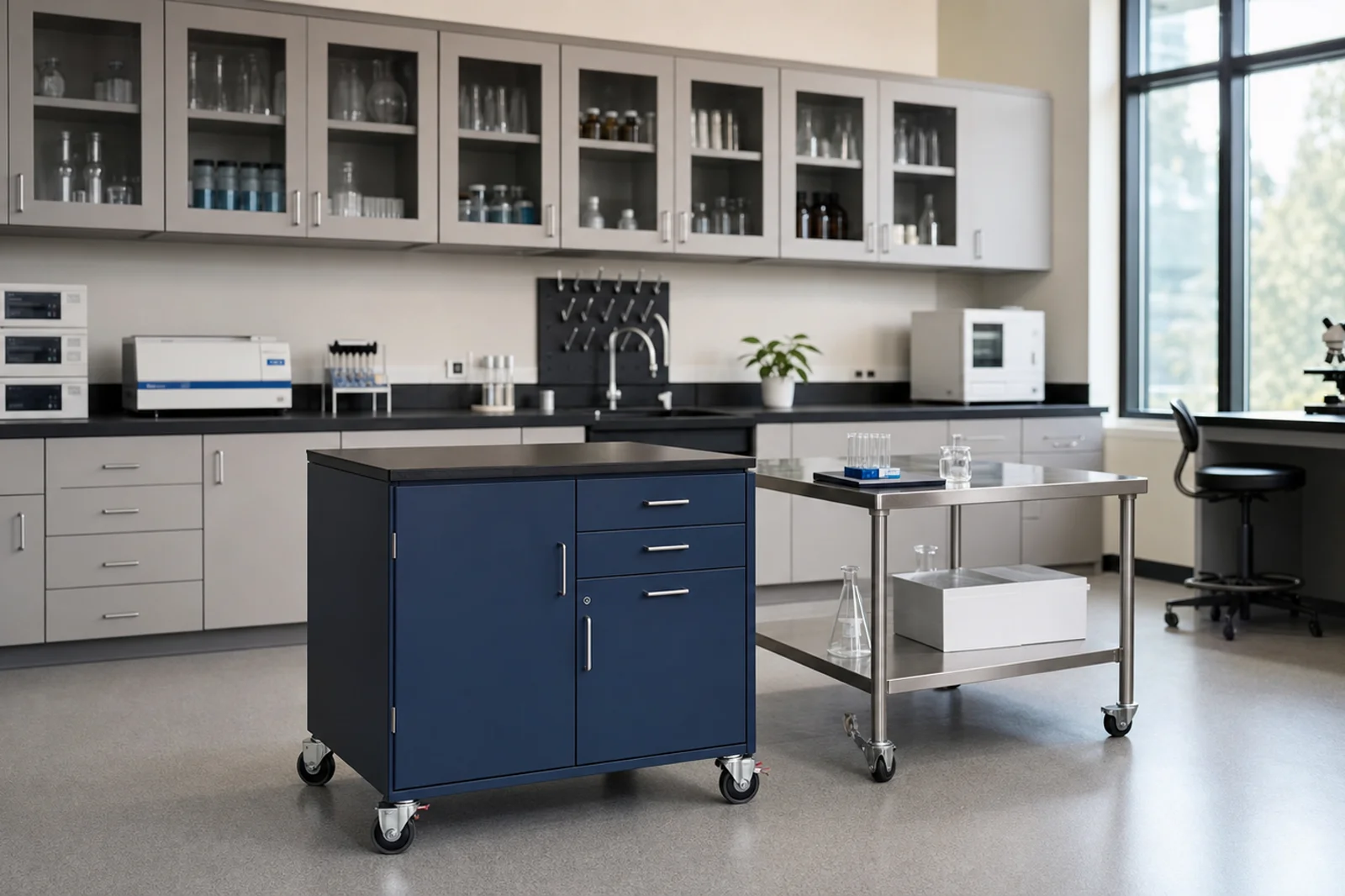
Mobile lab casework promises a renovation-ready lab. Roll the bench out, roll out the next, reconfigure on Monday morning. Simple, right?. The reality is more nuanced: most of a lab cannot move because the things that anchor it the work surface, the sink, the fume hood, the wall storage are by design fixed in place. The honest version of mobile lab casework is a hybrid: a fixed perimeter that delivers the services, and a mobile interior that adapts to the work. This guide walks the line between what you wish was modular and what actually can be, anchored to SEFA 8, NIH Design Requirements Manual, and the ANSI/BIFMA standards that govern mobile lab furniture testing.
What “Modular” Means in Lab Casework
The word modular gets used to mean three different things in lab projects, and the conflation is where most disappointment starts. First, modular can mean repeatable lab modules — a planning grid where every lab room is roughly 10 feet by 30 feet so the services and the casework lines repeat across floors. Second, modular can mean factory-built casework assemblies that ship as finished boxes and bolt together on site. Third, modular can mean reconfigurable mobile lab casework cabinets and tables on casters that the research team can move themselves.
All three are useful. None of them mean the whole lab moves. The NIH Design Policy and Guidelines describes the modular planning approach as a repeating lab module that lets the institution swap programs across the floor without rebuilding services. That is a building-level move. Mobile lab casework operates at the room level. Both layers matter, but they solve different problems.
What Has To Stay Fixed
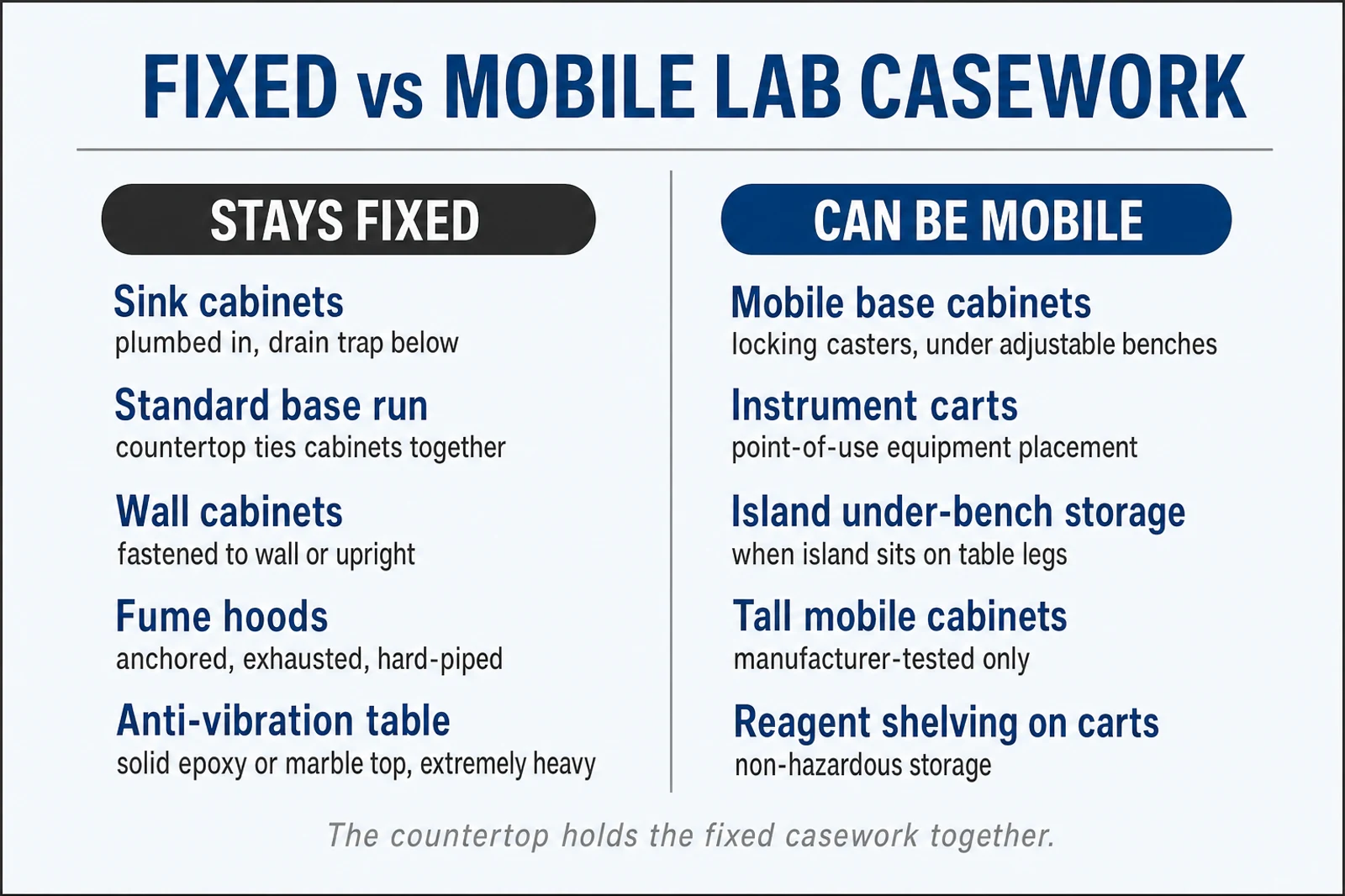
Some lab elements cannot move due to plumbing, ventilation, structure, and the work surface itself. Per Prudent Practices in the Laboratory, Section 9.B.5, current design practice locates fixed elements chemical hoods and sinks at the perimeter of the lab, with the mobile pieces in the interior. Translated to a casework run, that means the following stay anchored:
- Sink cabinets. The sink is plumbed in. The cabinet under it carries the trap, the supplies, and the cleanout. Sink cabinets stay fixed by definition.
- The standard base run that supports the work surface. A continuous lab worktop phenolic, epoxy, stainless runs as a single fabricated piece across multiple cabinets and ties them into one structure. The countertop is what holds the casework run together. The cabinets under it cannot leave.
- Wall cabinets. Wall cabinets fasten to the wall, to a wall-mounted upright system, or to the cabinet body below. They are not mobile in any meaningful sense.
- Fume hoods. Anchored. Exhausted. Hard-piped to gas, vacuum, and electrical. Moving a fume hood is a construction event, not a reconfiguration.
- Service spines and reagent racks. If services come down from a service spine or up from a chase, the cabinets and benches under them follow that geometry.
That is most of the casework in most labs. The work surface alone defines a fixed run on every wall it touches. Until the countertop comes off, the cabinets under it do not move.
What Mobile Lab Casework Is Actually Good For
Mobile lab casework solves a real problem, just not the one it gets pitched for. It is not a substitute for the fixed perimeter. It is the answer to the interior of the room the zone between the perimeter benches where the team needs to roll an instrument cart up to a power drop, stage a sample run, or open a knee space for a wheelchair user without rebuilding the lab.
The NIH DRM Desk Guide states the principle plainly for BSL-3 labs: “Mobile and movable units shall be used in lieu of fixed casework to the greatest extent.” The 2012 NIH ORF News to Use update is even more specific long runs of fixed casework shall be minimized, with racked equipment and mobile casework on wheels used in their place wherever the program allows.
That language is about decontamination and program flexibility. A mobile cabinet rolls out for floor cleaning, gets surface-decontaminated, and rolls back in. A fixed base requires the lab to be taken out of service to clean behind it. In a containment lab, that is the whole reason mobile matters.
The Mobile Base Cabinet — What SEFA 8 Says
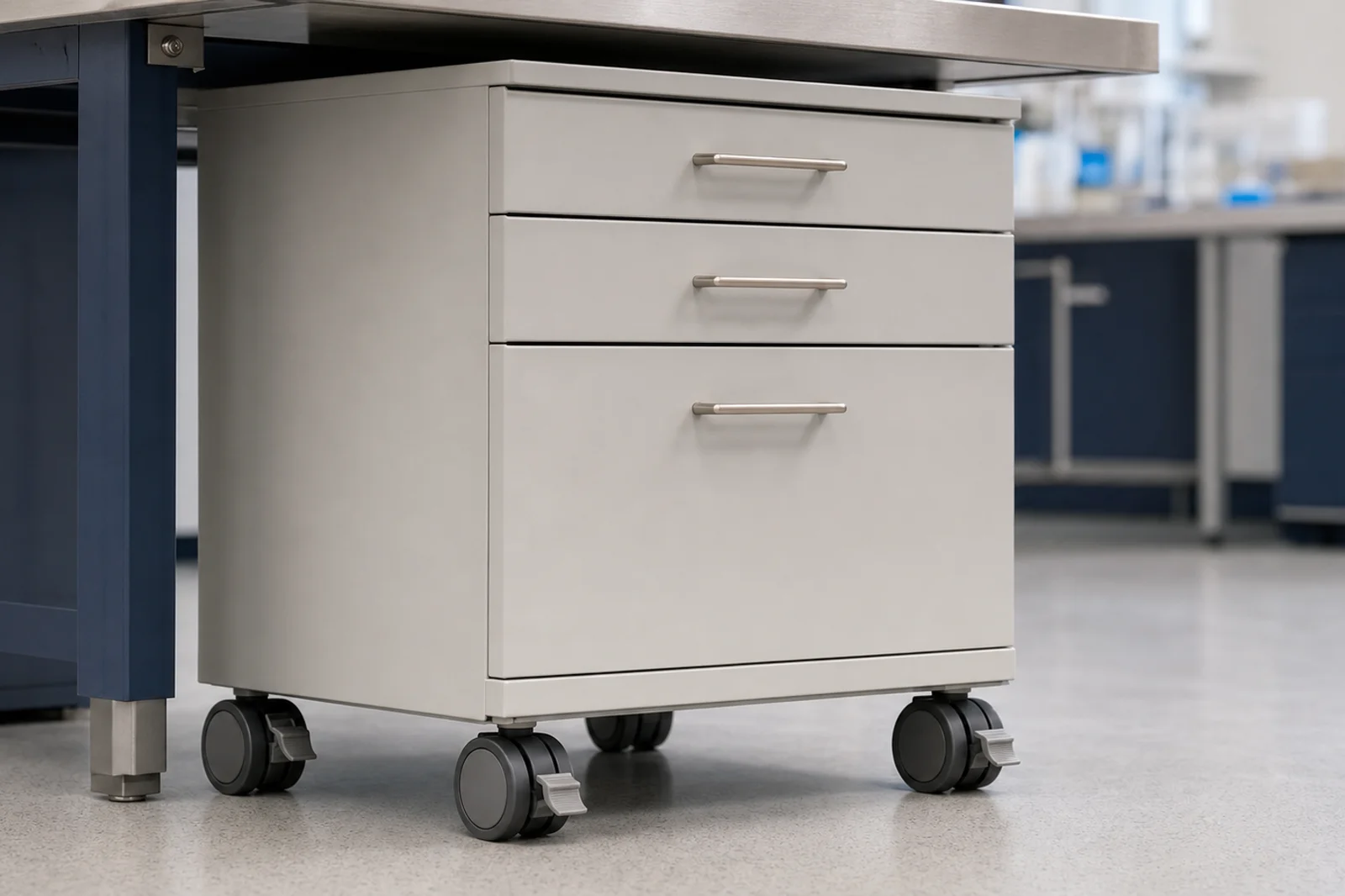
Mobile cabinets are a defined casework category, not a folding chair. The SEFA 8-PH-2025 standard defines a Mobile Base Cabinet as “a free standing storage cabinet mounted on casters specifically designed to be housed below an adjustable height bench/table and for movement within the room or space for optimal reconfiguration and flexibility and not to be used for transporting chemicals or instruments.“
That last clause is the one that gets missed on submittals. A mobile lab cabinet is a storage cabinet that can be repositioned within the room. It is not a transport cart. It is not rated to carry an unsecured chemical inventory down a hallway. If the program needs material movement across the lab, the answer is a transport cart with appropriate restraints, not a mobile base cabinet rolled out of position.
SEFA defines mobile tall cabinets the same way and flags them as “currently not tested by SEFA,” which means a mobile tall cabinet rests on the manufacturer’s load and stability data, not on a third-party performance test. That changes the submittal review. Ask for the test report.
Casters, Stability, and BIFMA X5.5 / X5.9
Mobile lab casework lives or dies on its casters and its stability under load. The relevant testing standards are ANSI/BIFMA X5.5 (Desks and Tables) for mobile work surfaces and ANSI/BIFMA X5.9 (Storage Units) for caster cabinet tipping. X5.5 covers stability under vertical load, durability cycling with a 200-pound top load for 10,000 cycles, drawer cycling for 50,000 cycles, and a caster durability test that runs the unit through 2,500 cycles along its length under functional load.
For specifiers, the practical implications fall into a short list:
- Casters. Three-inch double-wheel swivel casters are the laboratory standard, with brakes on at least the two front casters. Solid rubber or polyurethane treads. Stem mount, not plate, to keep the footprint compact.
- Brakes engaged in service. A mobile cabinet that does not have its brakes set is not a cabinet, it is a hazard. The spec should require brakes on the leading casters and the procedure should require them set whenever the cabinet is in position.
- Interlocking drawers. Mobile cabinets with multiple drawers should have interlocking tracks so only one drawer can be open at a time. Without the interlock, an open top drawer plus load behind it tips the cabinet.
- Counterweights. Tall mobile cabinets and any mobile unit with high drawer loads need a counterweight to pass BIFMA X5.9 stability. Ask the manufacturer to show the test result, not the marketing sheet.
- Top tied to the bench. The mobile cabinet should fit under an adjustable bench top with locating pins, brackets, or a captive locating shelf so the cabinet does not drift in service.
Where Mobile Actually Works in a Lab Plan
Mobile lab casework belongs in three zones of the lab plan.
Under adjustable-height benches or standard lab tables. Benches are normally on freestanding frames. The mobile cabinet rolls under it, slots into place, can engage brakes to lock. When the user needs a knee space, the cabinet rolls out. When the program changes, the cabinets reorganize without touching the bench.
Table center-room islands. An island bench system made from tables on casters in the middle of the lab is one of the few continuous surfaces that can be designed for mobility. A C-leg or H-leg table, no countertop bridging to a wall, and the cabinets underneath can be mobile. The island bench top still has to be a single fabricated piece for chemical resistance, but if it sits on table legs rather than on continuous cabinet bodies, the cabinets below are free to move.
Instrument and equipment carts. Mobile workstations and instrument carts power benches, monitor carts, laptop carts fit where a bench-mounted instrument would interrupt traffic. Anti-vibration tables for analytical balances stay fixed: the solid epoxy or marble top is engineered to be heavy and isolated from movement, so it is not a candidate for mobility. Per the NIH Building 50 Labs21 case study, the bench casework was specified at 40% rolling cabinets to allow the research team to adjust the bench layout themselves. That ratio is a useful starting point for any flexible lab program.
Where Mobile Does Not Work
The opposite list is shorter and easier to memorize. Mobile lab casework does not work under a continuous fixed work surface, under wall cabinets that share the same upright system as the base, in a sink run, adjacent to a hard-piped service spine, under any cabinet that takes a built-in instrument, or in a chemical storage role that needs ventilation. Mobile flammable-storage cabinets and mobile vented chemical-storage cabinets exist, but they need to be specified and listed as such and the listing comes from NFPA 30, not from the casework manufacturer’s catalog.
The most common mistake on a mobile-heavy lab plan is over-specifying mobility on the perimeter. The wall cabinet that holds glassware is not going to move. The base under the eyewash is not going to move. The sink base is not going to move. Trying to make those mobile costs money and delivers nothing. Spend the mobility budget in the interior of the room, where it actually buys flexibility.
The Containment-Lab Case for Mobile
The case for mobile lab casework is strongest in containment. CDC BMBL 6th edition guidance for BSL-2 and BSL-3 labs calls for surfaces and casework that can be cleaned and decontaminated. The NIH DRM Desk Guide goes further mobile units in lieu of fixed casework wherever the program allows. The reason is procedural: a BSL-3 lab gets surface-decontaminated. Anything that cannot be rolled out and wiped down on six sides is a cleaning liability.
That argument is not as strong in a standard chemistry teaching lab or a wet research lab. The cleaning protocol is different. The mobility return on investment is mostly about reconfiguration, not decontamination. Specifiers should match the mobile-vs-fixed ratio to the containment level and the realistic reconfiguration frequency, not to a brochure picture of a lab full of carts.
Specifying a Mobile-Friendly Lab — A Practical Approach
A mobile-friendly lab plan starts with the perimeter and works inward. First, lock down the fixed services: sinks, fume hoods, eyewash, safety shower, gas valves, electrical, data. Those locations dictate where the fixed casework has to live. Second, design the perimeter casework as a continuous work-surface run on standard bases and sink cabinets. That is the fixed half of the lab.
Third, design the interior with bench-and-mobile-base assemblies adjustable-height benches on uprights or freestanding frames, with mobile bases rolling under them. Fourth, add center-room island work zones if the program needs them, with island tops on table legs rather than continuous cabinet bodies. Fifth, build a mobile equipment inventory instrument carts, monitor carts, laptop carts, power benches that maps to actual workflows, not to a brochure. Anti-vibration tables for balances stay in the fixed-casework list because the mass is the function.
For a deeper read on how the casework spec section interacts with mobile and fixed cabinets, see our guide to reading a Division 12 lab spec and our lab casework materials guide. The spec sets the rules; the floor plan executes them.
The Honest Truth
Mobile lab casework is genuinely useful, and the lab industry oversells it. The fixed perimeter is not a compromise it is the spine that the lab depends on. The sink cabinet stays. The wall cabinets stay. The base run under the continuous work surface stays. The mobility lives in the center of the room, under the adjustable benches, and in the instrument carts that move where the work moves.
The right plan is the one that tells you which 30 to 40 percent of the casework can actually be mobile, sets the rest in place with intention, and uses the standards SEFA 8, BIFMA X5.5, BIFMA X5.9, NIH DRM, CDC BMBL to verify that the mobile pieces will hold up. If you are scoping a renovation or a new lab and want a second pair of eyes on the fixed-versus-mobile mix, reach out to start a planning review. The honest answer on what can move is usually a cost-effective answer too.
— OnePointe Solutions Lab Design Team