



If you have ever opened a Division 12 spec section and skipped to the manufacturer list, you have read it backwards. The division 12 spec is the part of the project manual that actually decides whether your lab casework will hold up, fit on schedule, and pass a punch list. The product list is the easy part. The hard part lives in Part 1, in the references, in the duty level you specified without noticing, and in the coordination clauses with plumbing and electrical that nobody read.
In our guide, we’ll walk through the sections the way a specifier reads it. First, mapping out where lab casework lives in the CSI MasterFormat. ThenPart 1 to Part 3 and call out the clauses that matter most. Finally we cover the AWI duty levels, the SEFA 8 reference, the red flags, the “or equal” clause, and the Division 22 and Division 26 coordination items that quietly cause the most RFIs on a lab project.
Where Lab Casework Lives in CSI MasterFormat
Division 12 is Furnishings. Inside it, laboratory casework has its own home: Section 12 35 53 — Laboratory Casework, with material subsets at 12 35 53.13 (metal), 12 35 53.16 (plastic-laminate-clad), 12 35 53.19 (wood), and 12 35 53.23 (solid-plastic) per the CSI MasterFormat structure.
But the lab spec is not just one section. The work spreads across at least four divisions, and the casework section has to point to all of them. Countertops often live in 12 36 (Countertops) or get rolled into 12 35 53 with their own paragraph. Fume hoods and lab equipment sit in 11 53 (Laboratory Equipment). Sink rough-in, lab waste piping, and service fittings are in 22 00 (Plumbing). Power, data, and emergency stops are in 26 00 (Electrical). When the casework spec is silent about these handoffs, the GC fills the gap with assumptions and the owner pays for the RFI.
So before you read the section, scan the table of contents. If 12 35 53 exists but 22 00 has no lab-waste paragraph and 26 00 has no casework-rough-in coordination clause, you already know where the field problems will land.
The Three-Part Section Format
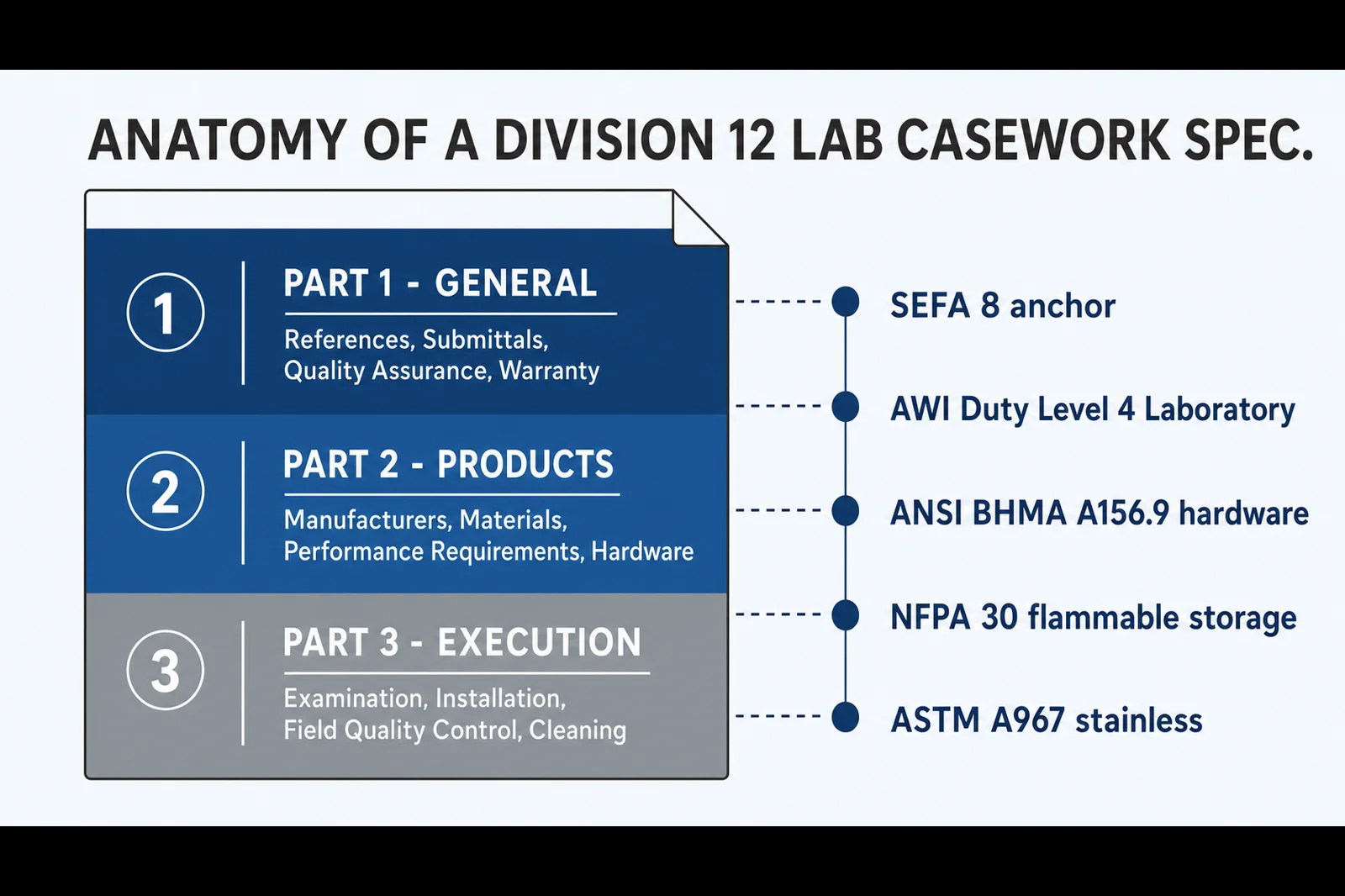
Every CSI technical section uses the same three-part structure called SectionFormat: Part 1 General, Part 2 Products, Part 3 Execution. The format is consistent across nearly all sections, which is why a strong reader can move fast once they know what each part holds.
Part 1 is administrative. It covers references, related sections, definitions, submittals, quality assurance, delivery and storage, warranty, and project conditions. This is where the section anchors to the standards that give it teeth. If Part 1 names SEFA 8, AWI 0641, ANSI/BHMA A156.9, and NFPA 30, the rest of the section can lean on those references.
Part 2 is what to buy. Manufacturers, products, materials, hardware grades, finishes, and performance requirements. This is the part most people read first, but it only works if Part 1 set the rules.
Part 3 is how to install it. Examination, preparation, installation tolerances, field quality control, adjusting, cleaning, and protection. On a lab project, Part 3 is where the SEFA 2 installation reference and the field-leveling tolerance need to appear.
Read in this order: skim Part 1 for the standards, then check Part 3 for the installation reference, then go back and read Part 2 against both. If Part 2 says “comply with SEFA 8” but Part 3 never names SEFA 2, the installer has no anchor and the punch list will pay for it.
Reading the SEFA 8 Reference
SEFA 8 is the performance standard most lab casework sections cite. But there is no single SEFA 8. The SEFA Standards page lists five material-specific versions: 8-M (metal), 8-PH (phenolic), 8-PL (plastic laminate), 8-P (polypropylene), and 8-W (wood), all updated to the 2026 edition. A spec that just says “comply with SEFA 8” without naming the variant is sloppy and gives manufacturers room to substitute material without breaking the letter of the clause.
SEFA 8 covers three test categories: mechanical load (cabinet, shelf, drawer static loads), dynamic performance (door and drawer cycle tests, impact), and chemical resistance (a one-hour spot test against 49 reagents on vertical surfaces). The chemical test uses the same 49-reagent list as SEFA 3, which covers horizontal worktops, but SEFA 3 uses a 24-hour exposure while SEFA 8 uses one hour because the work surface sees direct spills and the cabinet face does not.
So when you see “comply with SEFA 8” in a spec, ask two questions. First, which material version is it: 8-M, 8-PH, 8-PL, 8-P, or 8-W? Second, is the manufacturer providing a third-party certificate of performance from a SEFA-approved independent test lab, or a self-declaration? A real SEFA 8 submittal includes the lab report. A weak one does not.
AWI Duty Levels and Aesthetic Grades
For wood and plastic-laminate-clad lab casework, the project spec also points to AWI. The current standard is ANSI/AWI 0641, the Architectural Wood Casework Standard. AWI 0641 separates aesthetic from structural performance, and that distinction matters on a lab project.
Aesthetic grades describe how the casework looks: Premium, Custom, and Economy. Custom is the default if the spec is silent. Structural duty levels describe how the casework performs under load. There are four, and per the AWI standards summary they map this way:
- Duty Level 1: Light commercial
- Duty Level 2: Commercial
- Duty Level 3: Institutional (the default if the spec is silent)
- Duty Level 4: Laboratory — the highest structural performance tier
This is the single biggest miss in most academic and clinical lab specs. The section calls for Custom grade aesthetics and stops. The structural duty level defaults to 3 (Institutional). For a lab subject to heavy loads, repeated drawer cycles, and chemical exposure, the right call is Duty Level 4, which sets higher minimums on shelf load, drawer cycle, and impact tests per the published AWI 0641 structural requirements. If your spec says Custom but never names a Duty Level, you spec’d an office cabinet for a research lab.
Common Red Flags in Part 2
Part 2 is where copy-paste boilerplate causes the most damage. Run through this short checklist when you read a lab casework spec section.
- Proprietary lock-out language. A clause that names one manufacturer with no “or equal” and no salient features is a competition red flag. Owners set their own substitution policy, the City of Los Angeles, for example, requires an “or equal” path and written justification for any sole-source spec, per the LA city project delivery manual on substitutions. Check the front-end specs for your specific project’s rules.
- Missing third-party test references. “Chemical resistance shall be laboratory grade” with no SEFA 8 reagent list or test method is unenforceable. The right language names SEFA 8-M (or the relevant variant) and requires a certificate from an independent SEFA-approved lab.
- Vague finish language. “Durable powder-coat finish” tells you something, yet nothing. A proper clause should name the coating, the cure schedule, and the chemical-resistance acceptance criterion (no more than four Level 3 results out of 49 reagents on the SEFA spot test).
- Hardware grade missing. Hinges, drawer slides, and pulls should reference ANSI/BHMA A156.9 (American National Standard for Cabinet Hardware) and call out the grade. Without that reference, the contractor can fit residential hardware on a research lab.
- NFPA 30 silence on flammable storage. Any base cabinet labeled for flammable solvent storage must be listed and labeled as complying with NFPA 30, per the chapter on container storage and the standard’s safety-cabinet construction requirements.
The “Or Equal” Clause and How to Evaluate Substitutions
The “or equal” clause exists for two reasons. First, it keeps the bid pool open so the owner gets competitive pricing. Second, it gives a path when a specified product has a long lead time or quietly goes out of production. But the clause also creates work, because the design team has to decide whether a proposed substitution actually meets the requirements.
For lab casework, evaluate “or equal” against five things. First, does the substitute have the same SEFA 8 material certification (8-M for metal, 8-PH for phenolic, and so on) from an independent lab? Second, does it meet the same AWI Duty Level if the spec named one? Third, does its hardware meet the same BHMA A156.9 grade? Fourth, are the dimensions, service-chase layout, and rough-in points compatible with the Division 22 and Division 26 work already coordinated? Fifth, does the warranty match in length and coverage?
If the answer to any of those is no, the proposal is a substitution, not an “or equal,” and it should be processed under the substitution clause with a change order. Document the decision in writing. Verbal approvals create disputes, as the Primerus construction-specifications review notes for any contractor relying on substituted products. Test reports, not marketing claims, are the basis of an equality finding.
Submittals That Protect the Owner
The submittal list in Part 1 is where the owner’s quality program either holds or collapses. For a real lab casework section, the minimum submittal package should require all of the following.
- Shop drawings showing plans, elevations, sections, end views, service chases, countertop details, sink and fitting locations, and the location of blocking inside the walls for wall-cabinet support.
- Product data sheets for every cabinet type, countertop material, sink, fixture, and hardware item, including chemical-resistance data sheets keyed to the SEFA 8 reagent list.
- Third-party test reports: SEFA 8 certification of performance from a SEFA-approved independent lab, BHMA A156.9 hardware test data, and where flammable storage is specified, NFPA 30 listing documentation.
- Finish samples in the actual specified color, with chemical-spot test results attached.
- Mockup for any project of meaningful scale — typically one full base cabinet, one wall cabinet, one tall cabinet, and one section of countertop with sink, installed for owner review before production release.
- Manufacturer’s installation instructions referencing SEFA 2 (the installation standard), so Part 3 has a clear anchor.
If those items are not in the submittal list, the owner has no enforceable lever after delivery. The spec reads like a quality document but functions like an order form.
Division 22 and Division 26 Coordination That Gets Missed
This is where the field RFIs come from on lab projects. The casework section can be perfect on its own and still fail because nobody linked it to the plumbing and electrical sections.
Division 22 (Plumbing). Lab sinks, cup sinks, and service fittings live here. Per CSI MasterFormat, plumbing piping for water supply, sanitary waste, and lab waste sits in 22 10 00 Plumbing Piping. The casework section needs to call out who furnishes the sinks (often the casework manufacturer for integral epoxy or stainless), who furnishes the fittings (often referenced to SEFA 7), and who roughs in waste and supply at the centerlines shown on shop drawings. If the spec is silent, the GC will assume the plumber roughs in to a generic location and the casework will not align.
Division 26 (Electrical). Power outlets in service uprights, data drops at the bench, emergency stops, and any cord-and-plug lab equipment are Division 26 work. The casework section needs to identify which raceway, knockout, and grommet pattern the casework provides, and Division 26 needs to terminate at the casework manufacturer’s specified rough-in point. Get this wrong and the electricians arrive with no place to land the conduit.
On every lab project, the first read of the Division 12 spec should end with a Division 22 read and a Division 26 read. If the three sections do not name each other, the coordination problem is already in the contract.
A Quick Checklist for Reading the Section
Use this when you open the next Division 12 lab casework section. If any of these reads “no,” the section needs a redline before bid.
- Does Part 1 name the specific SEFA 8 variant (8-M, 8-PH, 8-PL, 8-P, or 8-W)?
- Does Part 1 require a third-party certificate of performance from an independent test lab?
- Does Part 1 name an AWI Duty Level for wood or laminate casework — and is it Duty Level 4 for a research lab?
- Does Part 1 reference ANSI/BHMA A156.9 for cabinet hardware grades?
- Does Part 1 reference NFPA 30 for any flammable solvent storage cabinets?
- Does Part 2 give an “or equal” path with salient features, not a single-source lock-out?
- Does Part 2 name SEFA 3 for worktops and SEFA 7 for service fittings, where applicable?
- Does Part 3 name SEFA 2 as the installation reference?
- Does the submittal list require shop drawings, third-party test reports, finish samples with chemical-spot data, and a mockup?
- Does the section coordinate with Division 22 and Division 26 in writing?
If you can answer yes to all ten, the spec is in good shape.
The Second Read Is the One That Pays
If you can only answer yes to half the questions above, you have a redline list and a productive conversation to have with the architect before bid documents go out. The Division 12 spec is the part of the project where decisions made in 30 lines of text run a lab for 30 years. Read it once, fast, for structure. Read it twice, slowly, against the checklist. The second read is the one that pays. And remember, not all specs are written equally and sometimes no or lack there of specs are available. If you come across projects such as those, have your RFI’s ready and sent out promptly. Asking questions in the beginning can save headaches, time and even bypass unforeseen issues down the line.
For a deeper look at the casework material decisions the division 12 spec has to make, metal versus phenolic versus plastic-laminate-clad versus wood and even cleanrooms and ISO classes, read our additional guides below:
And if needed laboratory design help, give us a call at (866)612-7312 or visit our lab design page for more information
By the OnePointe Solutions Lab Design Team