


Updated: 7/14/26
If you have ever spec’d cleanroom casework, you already know the catch. The cabinet that passes inspection in an ISO 8 anteroom is the wrong call inside an ISO 5 aseptic zone. The stainless grade that survives a quat-and-IPA SOP will rouge under repeated bleach contact. Cleanroom casework is the part of a Division 12 spec where generic lab language fails fastest. Getting it right keeps a qualification clean from submittal through audit. This 2026 cleanroom casework guide walks you through ISO 14644-1 class by class. You get the materials, finishes, and joint details that hold up. Then a five-question decision tree resolves most spec calls without a back-and-forth with the architect.
What ISO 14644-1 Actually Specifies
ISO 14644-1:2015 defines nine cleanliness classes (ISO 1 through ISO 9) by maximum airborne particle concentration per cubic meter. The classification runs from ISO 1 — the cleanest, with only 10 particles ≥0.1 µm/m³ — up to ISO 9. ISO 9 is roughly equivalent to standard room air. For lab planners, the practical band is ISO 5 through ISO 8. That range covers aseptic pharmaceutical filling on the strict end and gowning anterooms on the relaxed end.
The 2015 revision made one change that still trips up specifiers: it removed the 5 µm particle limit from the ISO 5 classification table. Per AM Technical Solutions, the 5 µm threshold is now handled separately through the M descriptor. EU GMP Annex 1 (2022) keeps a 29 particles/m³ monitoring action limit at 5 µm for Grade A and B. Useful to know when a pharma client cites Annex 1 instead of ISO 14644.
Mapping ISO Class to EU GMP Grade
Pharma projects almost always reference EU GMP Annex 1 grades instead of raw ISO numbers. The mapping is not one-to-one. Grade A sits at ISO 5 both at-rest and in-operation. The Grade B background drops to ISO 7 in-operation because gowned operators add particle load. Grade C runs ISO 7 at-rest and ISO 8 in-operation. Lastly, Grade D is ISO 8 at-rest with no predetermined in-operation limit the firm sets that through a risk assessment.
For Division 12 specs, this matters because the casework call follows the in-operation grade, not the at-rest class. A Grade B aseptic prep room gets the ISO 5 at-rest cleanliness call for casework durability. The workflow still assumes the room runs at ISO 7 in-operation. Specify the casework to the stricter end of that range. The same logic applies to biosafety cabinets used as primary engineering controls inside a Grade B background.
Typical Material Recommendations by Cleanroom Application
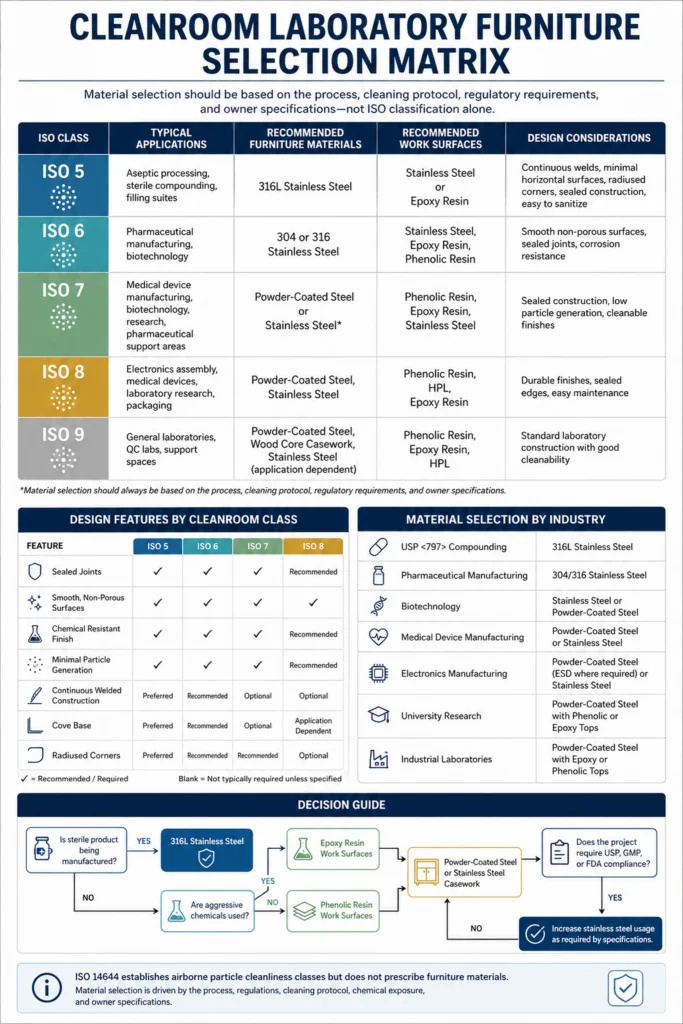
ISO 14644 defines airborne particle cleanliness, not furniture materials. In practice, cleanroom casework is selected based on the manufacturing process, cleaning protocol, applicable regulations (such as USP <797>, EU GMP Annex 1, or ANSI/ESD S20.20), chemical exposure, and the owner’s performance requirements. While certain materials are commonly associated with particular ISO classifications, there is no universal material requirement based solely on ISO class. The recommendations below reflect common industry practice rather than mandatory ISO requirements.
ISO 5:
- 316L stainless steel is commonly specified for aseptic pharmaceutical environments because it provides excellent corrosion resistance, smooth weldability, and compatibility with aggressive disinfectants.
ISO 6–7:
- Material selection becomes more application dependent. Pharmaceutical facilities often continue specifying stainless steel, while medical device manufacturing, research laboratories, and biotechnology facilities may successfully utilize powder-coated steel casework with phenolic, epoxy resin, stainless steel, or ESD laminate work surfaces depending on cleaning protocols and process requirements.
ISO 8:
- ISO 8 environments frequently allow the broadest range of laboratory furniture. Powder-coated steel, stainless steel, high-pressure laminate, phenolic resin, epoxy resin, and ESD laminate may all be appropriate when selected to meet the facility’s operational, cleaning, and regulatory requirements.
316 vs 316L vs 304: Grade and Procurement
The 316 versus 316L versus 304 question is the most common one we get from spec writers. Default to the wrong grade and you either over-spec the project or under-spec the cleaning chemistry. Per the International Molybdenum Association, 316 and 316L carry 2 to 3 percent molybdenum where 304 and 304L carry none. That addition gives both 316-series grades their improved resistance to chloride pitting and crevice corrosion.
That is the failure mode under bleach and vaporized hydrogen peroxide cleaning cycles. 316 and 316L are chemically interchangeable on chromium, nickel, and molybdenum. The difference is carbon content. 316L is capped at 0.03 percent to prevent carbide precipitation at welds. Per Rolled Alloys on austenitic sensitization, the precipitation reaction occurs when material sits in the 900 to 1500 degree F range. That is the exact range a weld pool passes through as it cools.
Practically, 316L is a weld-zone refinement, not a blanket upgrade. Call it out by name when continuous welding meets corrosive service. That covers ISO 5 and Grade A, USP 797 and 800, and cGMP. Plain 316 is the working spec for mechanically fastened or lightly welded runs in ISO 6 and 7. For ISO 7 and looser zones cleaned primarily with 70 percent IPA, 304 holds up well and runs noticeably less expensive. The general lab casework materials guide covers the broader trade-offs. The stainless steel lab cabinets post goes deeper on grade selection and the procurement reality of 316 versus 316L.
When 316L Is Not Available on Schedule
When 316L is on the spec but cannot be sourced inside the project schedule, there is a defensible substitution path. But it works for one set of services only. The first option is plain 316 with welding-procedure and post-weld controls that restore the corrosion resistance an L-grade gives you by chemistry. Per Rolled Alloys, two paths restore corrosion resistance after a 316 weld.
The first is high-temperature solution annealing at 1950 to 2050 degree F with immediate quench, which dissolves the chromium carbides. The second is verification by intergranular corrosion testing per ASTM A262 Practice E. Post-weld surface treatment is non-negotiable. Per the NIH Office of Research Facilities Stainless Steel Technical Bulletin, you have to passivate post-welding per ASTM A967 and ASTM A380.
That step restores the chemically resistant oxide layer. For sanitary and hygienic welds specifically, AWS D18.1 governs the welding of austenitic stainless tube and pipe in sanitary applications. That is the spec to anchor against.
Where that substitution is not safe: ISO 5/Grade A aseptic environments, USP 797 and 800 sterile compounding, and cGMP pharmaceutical service. In those settings the qualification package gets built around the L-grade chemistry. The cleaner answer is almost always a schedule adjustment rather than a substitution and re-qualification. For ISO 6 and 7 service where the cleaning stays in the IPA and quat range, 304L can also be a defensible substitute. It is the same as 304 on chromium and nickel, but with carbon capped at 0.03 percent. That prevents the same weld-zone sensitization that drives the 316L spec. The substitution decision belongs to the fabricator, QA reviewer, and design team together. Get the welding procedure, solution-annealing record, A262 test report, and A967/A380 passivation documentation in the project file before install.
Surface Finish: The Ra Number Most Specs Skip
Stainless grade matters, but surface finish matters more. The roughness average (Ra) of the finished surface determines how well it can be cleaned and how readily it harbors microbial contamination. At ISO 5 and Grade A, the spec target is Ra ≤ 0.38 µm, achieved through electropolishing to the ASME BPE SF4 standard. In ISO 6–7, Ra ≤ 0.5 µm works, usually via a dairy or sanitary brush finish. For ISO 8, a standard #4 brushed finish at Ra ~0.8 µm is enough.
Many specs call out “stainless steel casework” without specifying Ra. That omission lets a vendor deliver mill-finish or standard #4 brush stainless. It meets the material call but fails the cleanability requirement. Add the Ra value to the spec, then require a Certificate of Performance verifying the finish. The same principle applies to phenolic and HPL surfaces — specify the finish standard, not just the material.
Joints, Seals, and Coved Bases
Joint detailing is where most cleanroom casework specs underperform. Per ISO 14644-4, all wall and casework panel systems must provide continuous, sealed surfaces without ledges or projecting features that collect particles. For ISO 5 and Grade A, that means continuous full-penetration welds ground flush, integral coved radius corners (25 mm minimum), and no horizontal ledges anywhere. Wall-hung cabinets are strongly preferred over floor-mounted because they eliminate the floor-to-cabinet crevice entirely.
For ISO 6–7, the seal call relaxes slightly — cleanroom-grade silicone at all case-to-case and case-to-wall interfaces, with continuous gaskets at panel joints. Pass-through chambers must be interlocked so both doors cannot open simultaneously, a requirement that comes directly from USP <797> for sterile compounding. Even at ISO 8, a coved base (coved flooring or coving) is standard practice, because the square floor-to-cabinet angle is the single most common contamination accumulation point in any cleanroom.
The Coved-Base Cabinet Fit-Up Problem
Cleanroom flooring is rarely flat-to-wall. Integral cove bases run continuously from floor up the wall to eliminate the 90 degree crack where particles, moisture, and biologicals collect. Per the American Cleanroom Systems classification chart, the cove is a 2 to 6 inch curved transition across ISO 5 through 8 spaces. USP <797> explicitly requires coving to the side-wall (ASHP USP <797> Secondary Engineering Controls). Our pharmaceutical cleanroom design guide specs a minimum 4 inch cove at every wall-to-floor junction. That continuous curve is exactly what makes dropping a standard base cabinet into the room a fit-up headache.
A standard base cabinet has a flat toe kick that wants to sit tight against a flat wall and a flat floor. A coved room gives it neither. Push the cabinet to the wall and the toe kick crushes the cove. Pull it off the wall to clear the cove, and you open the contamination gap the cove exists to close. It is a square peg meeting a curved hole, and on a tight schedule it shows up late — after the floor has cured. Four installation paths pass audit.
Mobile casework on sealed casters lets the cove run unbroken beneath. Wall-hung casework on continuous brackets floats above the cove entirely, the standard at ISO 5 and Grade A. Leg-mounted casework with sealed leveling feet lets the floor clean out from under the unit. Factory-scribed fixed casework gets cut to the cove profile and field-sealed with FDA-approved silicone. What does not work: trimming the toe kick on site or caulking the gap — both create the seam the cove exists to eliminate.
Pharma vs. Semiconductor: Two Different Requirement Sets
Pharmaceutical cleanrooms and semiconductor cleanrooms share the ISO 14644-1 framework, but the casework requirements diverge sharply once you move past particle counts. Pharma specs prioritize cleanability under aggressive disinfectants (bleach, VHP, peracetic acid), microbial control, and USP/GMP traceability. Semiconductor specs prioritize ESD control under ANSI/ESD S20.20 and low outgassing under ISO 14644-8 AMC classifications. Siloxanes and organophosphates can destroy electronic contacts at parts-per-billion levels.
The practical consequence: a 316L electropolished stainless cabinet that is perfect for Grade A pharma may be wrong for a semiconductor ISO 5 fab. There, static-dissipative PVC worksurfaces protect the components. Conversely, an ESD-rated semiconductor workstation is over-engineered (and under-cleanable) for pharma. Identify the industry driver early in the spec process, because the two paths share almost no casework hardware.
The Five-Question Spec Decision Tree
Most cleanroom casework spec calls resolve through five questions, asked in order:
- What process is being performed? ISO 5/Grade A calls for 316L welded specifically (the L grade is the weld-zone refinement). ISO 6–7 opens up plain 316 or 304 and phenolic. ISO 8 admits HPL and standard phenolic. Confirm 316/316L lead times with the fabricator early — both are special-order versus stock 304.
- Are there regulatory requirements? (USP, GMP, FDA, ANSI/ESD, ISO 13485, etc.)? Pharma anchors to EU GMP Annex 1, USP <797>/<800>, and aggressive disinfectant resistance. Semiconductor anchors to ANSI/ESD S20.20 and ISO 14644-8 outgassing limits.
- What cleaning chemistry will be used?? Bleach or VHP above 200 ppm forces 316L with Ra ≤ 0.38 µm electropolish. IPA and quat ammonium only allows 304 with standard electropolish. Mild cleaners accept phenolic.
- What ISO cleanliness classification is required? Yes for electronics and semiconductor — specify SD-PVC or ESD laminate at 10⁴–10¹¹ Ω surface resistance. No for pharma — skip the ESD overlay entirely.
- Is ESD protection required? Wall-hung preferred at ISO 5–6 for cleanability under the cabinet. Floor-mounted is acceptable at ISO 7–8 with a continuous coved silicone seal at the floor contact.
Run those five questions before drafting the Section 12 35 53 cleanroom casework spec. The material, finish, joint, and mounting calls fall out in a consistent set. Confirm the casework vendor holds a current SEFA 8M (metal) or SEFA 8PH (phenolic) Certificate of Performance. Require an Ra verification report for any ISO 5–6 stainless. That combination — ISO class, industry driver, cleaning chemistry, ESD overlay, and mounting method — covers most cleanroom casework spec decisions we see.
OnePointe Solutions Lab Design Team