



This is the 2026 technical refresher of our original 2021 Fume Hood vs Biosafety Cabinet primer. The 2021 article still holds up as a foundation — what each device does, which class to consider, and the high-level airflow logic. Five years on, the spec questions we field are sharper: which Class II subtype, what face velocity, what placement clearances, and what the standard actually requires. This refresher answers those at the specification level.
The biosafety cabinet vs fume hood decision is a regulatory question, not a preference question. Place a biohazardous agent in a chemical fume hood and unfiltered aerosols exhaust through the building system with no HEPA stage. Run volatile solvents in an unducted Type A2 biosafety cabinet and recirculated vapor re-exposes the operator and creates a fire risk. Both errors are documented in CDC BMBL 6th Edition and ASPR/HHS guidance — and both are preventable with correct device selection.
This refresher covers the biosafety cabinet vs fume hood distinction at the spec line, all three BSC classes, the four Class II subtypes (A1, A2, B1, B2), face velocity and filtration standards from NSF/ANSI 49 and ANSI/ASSP Z9.5-2022, NIH DRM placement rules, and the four recurring specification errors we see most often. Every fact traces to a named primary source.
What Each Device Actually Contains
The biosafety cabinet vs fume hood distinction is a filtration distinction. A chemical fume hood exhausts 100% of captured air to the building system with no HEPA stage — air is diluted and expelled, not decontaminated. Consequently, a fume hood provides no protection against biological aerosols. Per ASPR/HHS: “A chemical fume hood protects the user while a biosafety cabinet protects the user, the environment, and the material. Biosafety cabinets have high-efficiency particulate air (HEPA) filters while chemical fume hoods do not.”
A biosafety cabinet is designed — per the WHO Laboratory Biosafety Manual 4th Edition — to protect “the operator, the laboratory environment and/or the work materials for activities where there is an aerosol hazard.” All exhaust passes through HEPA filtration rated at 99.97% efficiency at 0.3 µm. However, HEPA does not remove chemical vapors. Per NSF/ANSI 49 Annex I: “Because chemical vapors can freely pass through HEPA/ULPA filters, both Class I and Class II BSCs must be exhausted out of the laboratory when used with these types of chemicals.” That limitation drives the entire Class II subtype decision.
In practice: biological aerosol risk requires a BSC; chemical vapor risk requires a fume hood. Where both hazards coexist, a hard-ducted Class II Type B2 BSC is the answer — not a fume hood with biological agents present. For detail on fume hood selection, see the OnePointe Lab Fume Hoods Guide.
The Three Biosafety Cabinet Classes
NSF/ANSI 49-2024 defines three BSC classes that differ in protection mode and access configuration. Understanding which class applies is foundational to any biosafety cabinet vs fume hood specification.
Class I provides personnel and environment protection but no product protection. The front access opening draws room air inward at a minimum of 75 fpm; exhaust passes through a HEPA filter before release. Because no filtered downflow air washes the work surface, the product is exposed to unfiltered room air. Class I is appropriate for BSL-1 and BSL-2 non-aerosol procedures where product protection is not required.
Class II adds vertical HEPA-filtered laminar downflow across the work surface, which protects the product in addition to the operator and environment. This triple protection — personnel, product, and environment — makes Class II the standard BSC in clinical, research, and pharmaceutical labs. The CDC BMBL 6th Edition identifies BSCs as the primary safety equipment for work with microbial aerosols at BSL-2 and above.
Class III is a gas-tight glovebox for BSL-4 and maximum-containment work. Supply air is HEPA-filtered; exhaust passes through two HEPA filters in series before outdoor discharge. Workers access the interior through arm-length rubber gloves sealed at wall ports. Per the WHO LBM 4th Edition, Class III cabinets are airtight with high internal air-change rates maintained at all times.
Class II Subtypes: A1, A2, B1, B2
The four Class II subtypes differ in inflow velocity, recirculation percentage, exhaust mode, and chemical use permission. For any biosafety cabinet vs fume hood scenario where chemical adjuncts are involved, subtype selection is the controlling decision under NSF/ANSI 49.
- Type A1 — 75 fpm minimum inflow; nominally 70% recirculated, 30% HEPA-exhausted to room or canopy. NSF/ANSI 49 explicitly prohibits volatile chemicals and radionuclides. Use for BSL-1/BSL-2 microbiological work and cell culture with no chemical adjuncts.
- Type A2 — 100 fpm minimum inflow; nominally 70% recirculated, 30% HEPA-exhausted. Minute amounts of volatile toxic chemicals permitted only when hard-connected to external exhaust via canopy. Without the canopy, A2 is chemically equivalent to A1. A2 is the most common BSC in clinical and biotech labs.
- Type B1 — 100 fpm minimum inflow; nominally 30% recirculated, 70% HEPA-exhausted via hard-duct building exhaust. Small quantities of volatile chemical adjuncts permitted in the rear directly-exhausted work zone only — not the front recirculated zone.
- Type B2 (Total Exhaust) — 100 fpm minimum inflow; 0% recirculation; 100% of air hard-ducted outdoors. Per NSF/ANSI 49-2014: “Type B2 cabinets may be used for work with volatile chemicals and radionuclides required as adjuncts to microbiological studies.” B2 requires pressure-independent monitors and interlock alarms that shut off the internal blower if facility exhaust fails.
Notably, Type B2 provides equivalent biological containment to other Class II subtypes — not additional protection. Specify B2 only when concurrent biological and volatile chemical hazards exist in the same procedure; the 100% exhaust carries a meaningful energy cost that a canopy-connected A2 avoids.
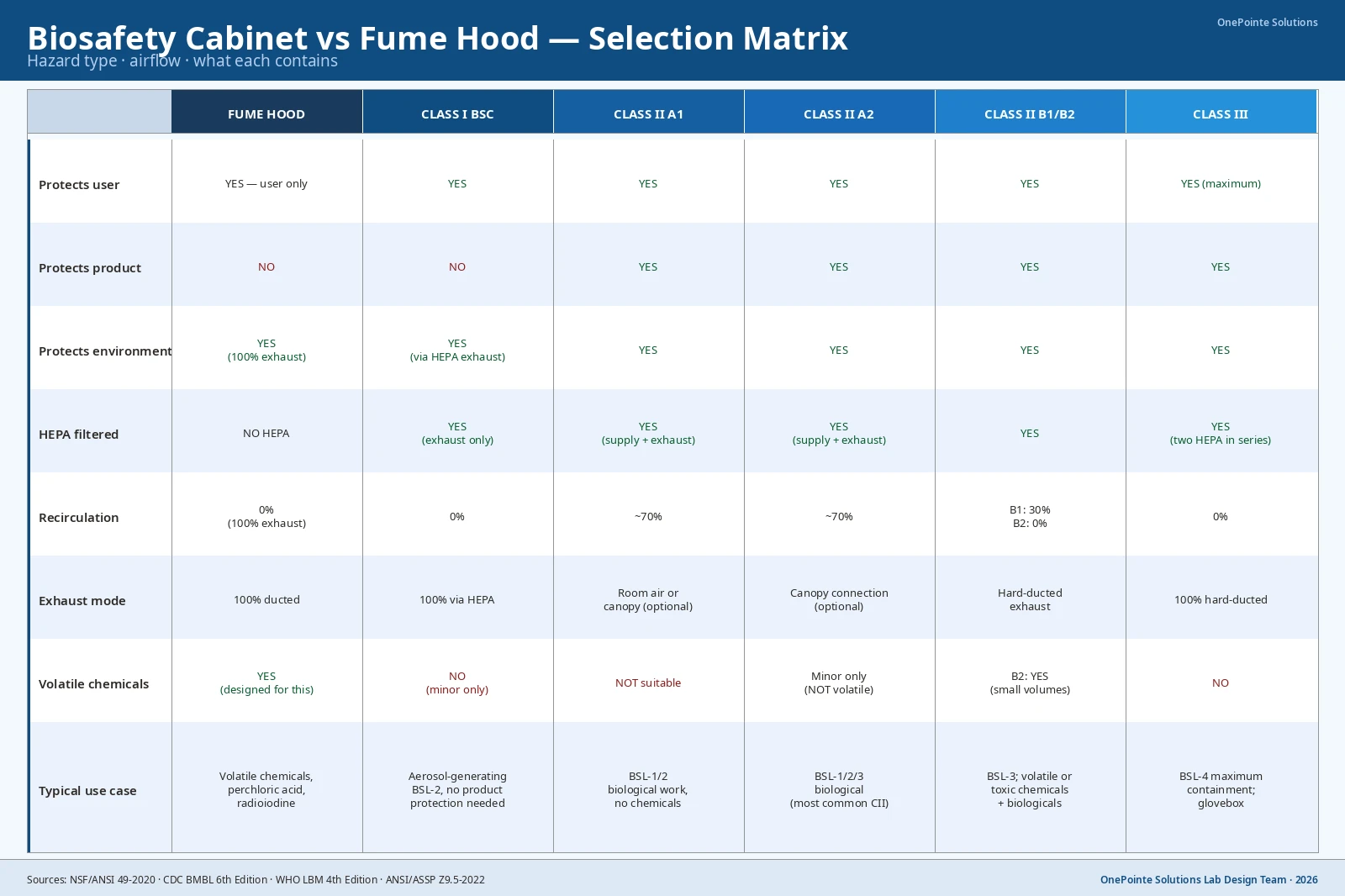
Where the rules bend: filtered hoods and exhausted BSCs
The matrix above holds at the extremes — a ducted general-purpose fume hood for open chemistry, a Class II Type A2 for routine BSL-2 microbiology. The boundary blurs in two specific cases, and both are recognized by the governing standards.
Filtered (ductless) fume hoods do exist. ANSI/ASSP Z9.5-2022 treats them as a distinct category from conventional ducted hoods. They use carbon — and in some configurations HEPA — media to handle limited, well-characterized chemistries before recirculating air to the room. They are not a substitute for a ducted hood on general-purpose chemical work. Radioisotope and perchloric-acid hoods also commonly require HEPA on the exhaust train, but for environmental release control, not user protection.
Several Class II BSCs are hard-ducted to outside. Per NSF/ANSI 49: Type B1 exhausts roughly 30% of cabinet air to outside and permits limited volatile chemicals and trace radionuclides; Type B2 is total exhaust (100% to outside, no recirculation) and is the correct spec when volatile toxic chemicals or radionuclides are unavoidable; Type C1 (added to NSF/ANSI 49 in 2016) can run either recirculating or exhausted depending on the chemistry; Class III is fully enclosed and always hard-ducted through double HEPA. For work that genuinely combines volatile chemistry with biological containment, the answer is a B2 or a C1 in exhaust mode — not a fume hood, and not a recirculating A2.
What ANSI/ASSP Z9.5-2022 and SEFA 1 Require of Fume Hoods
For fume hoods, the governing performance standard is ANSI/ASSP Z9.5-2022. Section 4.3.1 specifies a design face velocity of 80–100 fpm (0.41–0.51 m/s) for the broad majority of laboratory chemical hood applications. Operating below 60 fpm is explicitly not recommended: Z9.5-2022 notes that containment cannot be reliably quantified at low velocities. Any fume hood operating below that threshold is a compliance concern regardless of local practice.
SEFA 1-2010 governs fume hood construction — sash materials, sash stops, and position sensors. SEFA 1 establishes 100 fpm as the standard acceptable face velocity, with 75–125 fpm acceptable in specific circumstances. Sash management is critical: fume hoods must remain closed except when work is actively occurring inside. Raised sashes exceeding the designed working height compromise the inward airflow pattern, per OSHA 29 CFR 1910.1450.
Performance verification uses ASHRAE 110-2016 in three phases: As Manufactured (factory), As Installed (post-construction), and As Used (in-service). The test battery includes flow visualization, face velocity profiling with thermal anemometers, and tracer-gas containment measurement. ANSI/ASSP Z9.5 requires annual testing; OSHA 1910.1450 Appendix A recommends airflow monitoring at minimum every three months. For variable-air-volume fume hood controls that maintain face velocity as sash position changes, see the OnePointe VAV vs CAV Fume Hood Controls guide.
NIH DRM Placement Rules
The NIH Design Requirements Manual 2024 Appendix A establishes minimum clearances for BSC placement. Air turbulence at the face opening is the primary threat to Class II BSC personnel protection — and turbulence sources are architectural. Per the NuAire BSC Installation Guide, citing NIH DRM and NSF:
- 60 inches from the lab entry door — traffic patterns near doors generate turbulence that disrupts the BSC air curtain.
- 40 inches of unobstructed space in front of the BSC — required for safe operation and field certification access. This is the one clearance dimension on which NIH DRM, NSF, and other primary guidance documents agree.
- 80 inches between a BSC and the opposing wall — prevents exhaust plume recirculation back to the face opening.
- 14–18 inches overhead clearance — required for certification access and fire sprinkler compliance.
- 12 inches clearance to any side wall or column — prevents boundary effects from distorting exhaust airflow.
In addition, BSCs must not be placed near supply air diffusers, operable windows, chemical fume hoods, or high-traffic corridors — each creates cross-drafts that can breach the inward airflow barrier. The same turbulence-avoidance logic applies to fume hoods: ANSI/ASSP Z9.5 requires supply diffusers to be located well away from the hood face.
Where Specifiers Get the Biosafety Cabinet vs Fume Hood Decision Wrong
Three biosafety cabinet vs fume hood specification errors recur in primary guidance as documented examples of incorrect device selection.
Biohazardous agents in a fume hood. A fume hood has no HEPA filter. Per ASPR/HHS, the distinction is direct: “Biosafety cabinets have HEPA filters while chemical fume hoods do not.” Any BSL-2 procedure that generates aerosols — centrifugation, vortexing, pipetting of infectious suspensions — requires a Class II BSC per BMBL 6th Edition and the NIH Guidelines for Recombinant DNA Research. A fume hood provides no aerosol containment; it relocates the hazard.
Volatile chemistry in an unducted Type A2 or A1. Type A1 and uncanopied A2 BSCs recirculate nominally 70% of cabinet air into the room. Per NSF/ANSI 49 Annex I, HEPA filters do not remove chemical vapors — volatile compounds recirculate freely through the HEPA stage and re-enter the work zone. In addition, BSC electrical components are not explosion-proof, so flammable solvent concentrations above the explosive limit present a fire risk. The correct approach: use a fume hood for chemical-only work, or a hard-ducted Type B1 or B2 BSC when biological and chemical hazards coexist.
Skipping annual BSC certification. Per Applied Biosafety research on NSF/ANSI 49, BSC operation must be verified at installation and at minimum annually thereafter. The field certification battery covers downflow profiling, inflow profiling, HEPA filter integrity, airflow smoke patterns, and alarm calibration. The BMBL 6th Edition states: “A BSC that is not certified represents a potentially serious hazard to the laboratory worker.” Similarly, the WHO Laboratory Biosafety Manual 4th Edition confirms all HEPA filters must be tested and certified at least annually.
How OnePointe Approaches BSC and Fume Hood Integration
Most research labs require both devices. Consequently, the biosafety cabinet vs fume hood question is a layout and workflow question as much as a device-selection question. The two units compete for wall space, can sometimes share HVAC exhaust infrastructure, and require non-overlapping clearance zones. In particular, placing a fume hood and a BSC on adjacent walls without accounting for the NIH DRM 80-inch opposing-wall clearance and Z9.5 diffuser-placement rules creates a conflict that surfaces at commissioning.
For labs managing the energy cost of 100%-exhaust Type B2 BSCs alongside fume hood exhaust, the check out our Fume Hood Energy Cost Savings guide which addresses VAV exhaust control trade-offs.
A biosafety cabinet vs fume hood decision made at the procurement phase, rather than the design phase, almost always produces placement errors or exhaust infrastructure mismatched to the device’s duct requirements. Starting from the regulatory requirement and working forward to device selection avoids that sequence error.
— OnePointe Solutions Lab Design Team