


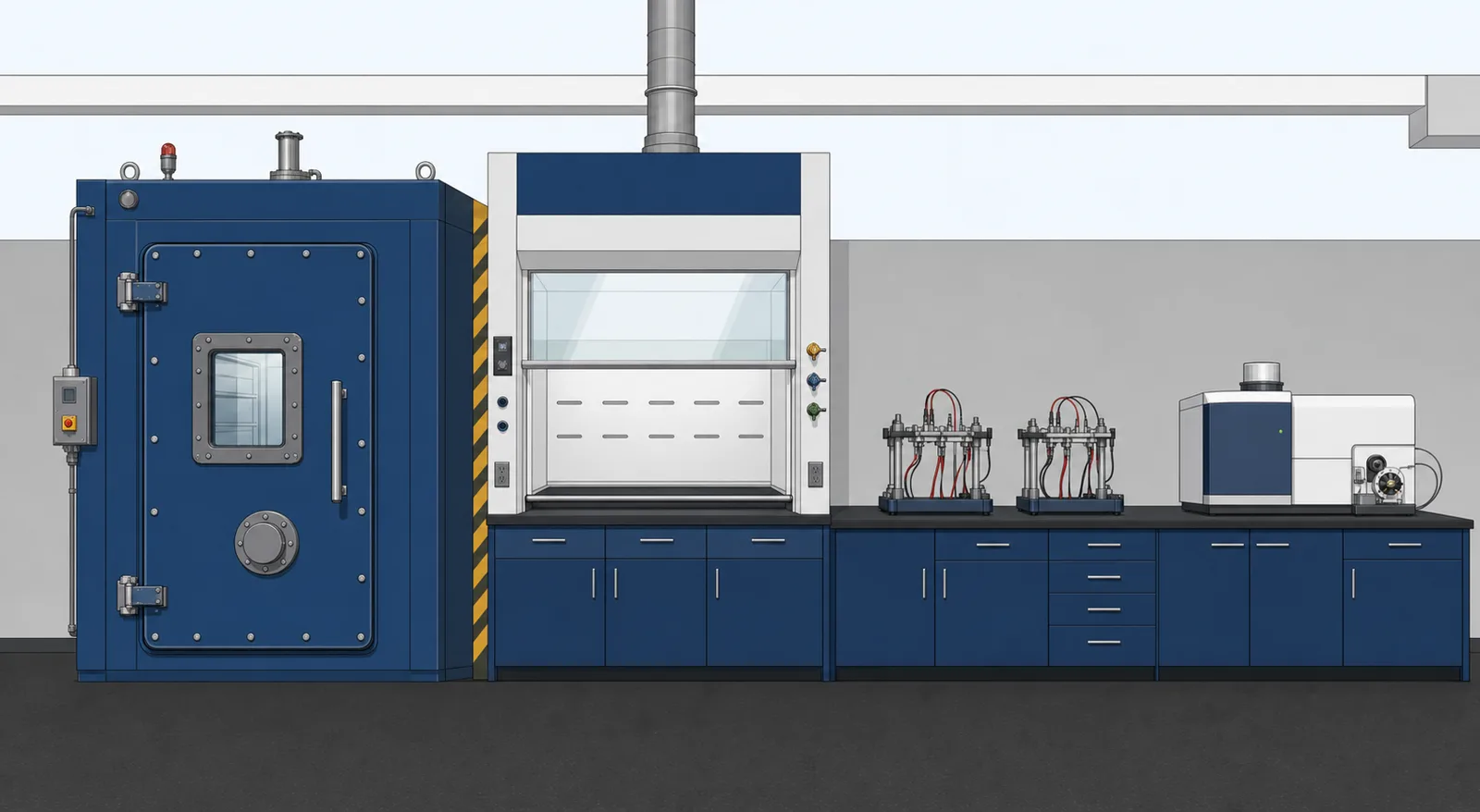
There are many kinds of labs that exist. Food, water, environmental, oil, gas, hot and wet labs. But did you know that battery testing labs exist? Battery testing labs offer prototyping, testing and certifying batteries across different applications and chemistries, varying from cloud-based remote testing to full-scale industrial laboratories, including academic.
So with all that, the question becomes this, how do you this kind of lab? Given their complexities, battery testing labs must also withstand thermal runaway, NFPA 855 fire code review, and UL 9540A test protocols at the same time. So, you start with treating the room as a fire-resistant containment shell. Not a typical lab bench room with a few extra outlets. A battery testing lab handles cells that can vent flammable gas, deflagrate, and sustain self-heating reactions. That being said, the design rules borrow more from explosion-protected process labs than from a traditional biology layout. Remember, safety first.
In our guide we’ll walk through what a working battery testing lab needs. First, the codes and standards that dictate decisions. Next, the room shell, ventilation, and gas detection. Moving on next to the bench, hood, and storage layout that keeps cells, modules, and units segregated. Then finally, the materials and finishes that survive electrolyte spills and post-test cleanup.
The codes that define a battery testing lab
These five documents sit at the center of battery testing lab designs:
- NFPA 855 governs the installation of stationary energy storage systems. ([NFPA 855 official page] 2026 edition – published September 2025 and effective for new permits
- ANSI/CAN/UL 9540A defines the thermal runaway fire propagation test method that NFPA 855 explicitly cites for large-scale fire testing ([UL 9540A overview]
- IEC 62133-2 covers cell and battery safety for portable lithium systems.
- UN Manual of Tests and Criteria Subsection 38.3 governs transport testing for any cell or battery shipped after manufacture (UN 38.3 reference).
- IEEE/ASHRAE 1635-2022 sets ventilation and thermal management practice for stationary battery installations including lithium-ion ([IEEE 1635-2022].
If incorrect, and the lab cannot operate. Or worse, a misread of NFPA 855 can force a costly retrofit once the room goes live. The 2026 NFPA 855 edition added two material changes that drive lab design directly. First, Hazard Mitigation Analysis is now mandatory for nearly every installation above 1 kWh. Second, NFPA 855 now requires both UL 9540A testing and large-scale fire testing, with intentional ignition of vent gases at the unit level when cell or module tests release flammable gases ([Energy-Storage.News NFPA 855 summary]
UL 9540A test levels drive the room layout
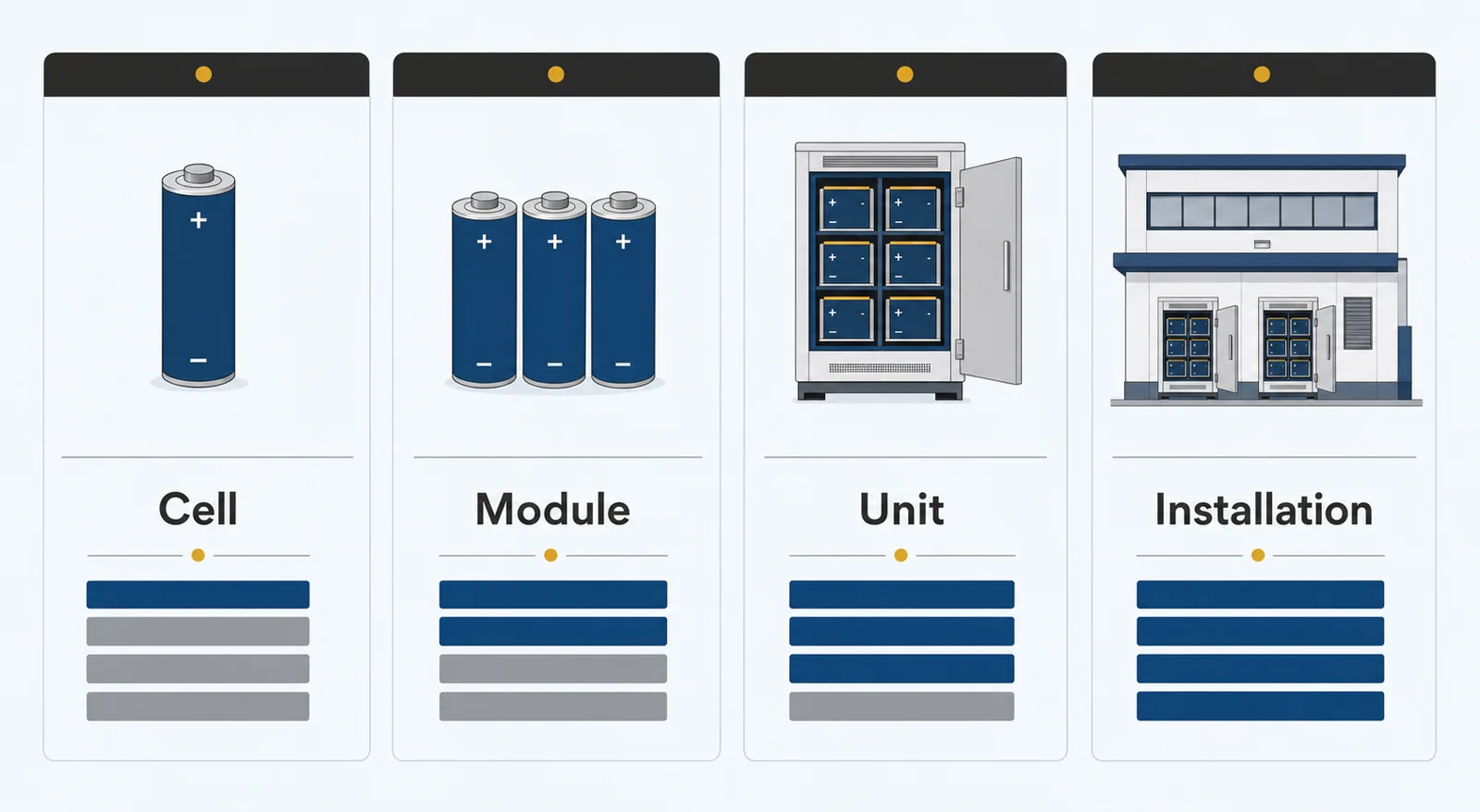
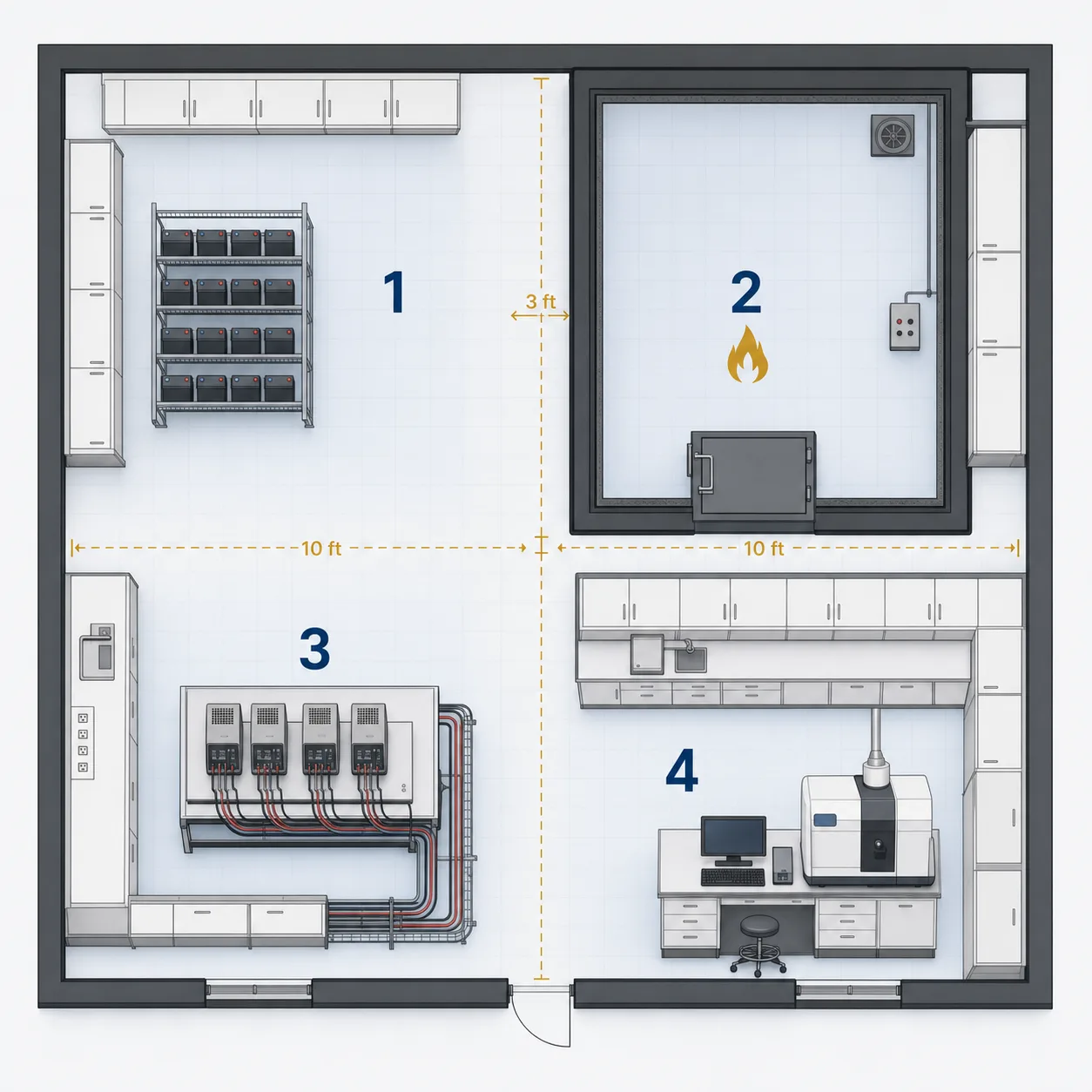
UL 9540A defines four subsequent test levels: cell, module, unit, and installation. Each level has its own performance criteria. If a cell or module passes, the test stops; if it fails, testing escalates to the next level ([UL 9540A test method]. Consequently, a competent battery testing lab needs four discrete work zones one for each level with clear physical separation between them.
At the cell level, the lab forces thermal runaway with short circuit, external heating, overcharge, or nail penetration. Testers record gas composition, vent temperature, lower flammability limit, and burning velocity. As a result, the cell test bay needs an explosion-rated containment chamber, a calibrated gas analyzer line, and a thermocouple harness. At the module level, the goal is to drive propagation between cells and measure heat release rate. The unit level, runs tests in an open configuration with full instrumentation for unit-to-unit fire spread. In contrast, the installation level test runs in a closed room with fire mitigation equipment ([Sandia UL 9540A briefing])
Room shell and fire-rated separation
The room shell is a containment shell first. Specifically, walls between the cell test bay and adjacent occupied space should be 2-hour fire-rated assemblies, and doors should be self-closing with intumescent seals. Floors should slope to a sealed drain so spilled electrolyte never reaches the corridor. Ceilings need to clear the tallest fixture by at least 36 inches to allow vent gas to rise and migrate to the exhaust pickup.
NFPA 855 Chapter 9 sets explicit minimum spacing for commercial ESS installations, which is the chapter that governs a battery testing lab. Specifically, NFPA 855 §9.4.2 caps each ESS group at 50 kWh of stored energy. In addition, each group must sit at least 3 ft (914 mm) from other groups and from the walls of the storage room or area (NFPA 855 TIA 23-1, §15.3.1 and references to 9.1.5; see also the NFPA 855 Errata 26-1). Closer spacing or larger group capacity is only allowed when the AHJ accepts UL 9540A large-scale fire-test data showing that thermal runaway will not propagate to adjacent units (Clean Power NFPA 855 brief). Note that Chapter 15 (residential) sets different rules — a 20 kWh per-unit cap and clearance from doors and windows — and does not apply to a commercial testing lab.
Ventilation, gas detection, and the 25% LFL threshold
Ventilation is the single most important system in a battery testing lab. Specifically, IEEE/ASHRAE 1635-2022 covers ventilation and thermal management for stationary battery installations including lithium-ion. The standard recognizes that hydrogen production is a concern with lithium-ion under thermal runaway conditions, even though it is not under normal operating conditions ([IEEE 1635-2022 scope]. As a result, the room exhaust must clear vent gases fast enough to keep concentrations below the lower flammability limit.
NFPA 855:2026 caps flammable gas concentrations at 25% of the LFL on average within the space, and the 2026 edition clarifies that a single localized area above the threshold does not automatically trigger explosion control requirements (Energy Storage News NFPA 855:2026 review; see also the NFPA 855 Errata 26-1). IEEE 1635 recommends 25% of the LFL as the design target for hydrogen, equivalent to 1% concentration. By contrast, OSHA 29 CFR 1910 instructs personnel to stay out of confined spaces with battery activity until testing shows explosive gases below 10% of the LEL, or 0.4% hydrogen (OSHA SHIB 01-18-19). Hydrogen detectors sit at the highest point in the room because hydrogen migrates upward.
For a 1,200-square-foot cell test bay with two propagation chambers, the exhaust system typically needs 12 air changes per hour at baseline, with a high-rate mode that triggers on hydrogen, carbon monoxide, or hydrocarbon detection. In addition, the design must match makeup air so the room stays at negative pressure relative to the corridor. The ventilation system should annunciate any failure ([IEEE 1635-2022 guidance].
Bench, hood, and chamber layout
A typical battery testing lab needs four bench zones. The cell test zone holds the explosion-rated chamber, the gas analyzer line, and the thermocouple harness. Next, the module test zone holds a larger chamber with instrumentation for propagation tests. Then, the unit test zone is an open bay with calibrated heat-flux sensors and high-speed camera mounts. Finally, the post-test analysis zone holds an ICP-MS or similar trace-metal analyzer for residue work.
NIOSH research shows that post-thermal-runaway residue continues to release gas hazards for hours after the event ([CDC stacks post-thermal-runaway gas study]. Therefore, the post-test bench needs its own canopy hood at 100 fpm face velocity, separate from the cell test exhaust. The hood ducts directly outside; it never recirculates. Bench surfaces in the post-test zone should be phenolic resin or welded stainless steel with coved edges. In addition, base cabinets need concealed Euro hinges and recessed pulls, never exposed butt hinges or knobs that trap acid mist from electrolyte cleanup.
Cell, module, and unit storage rules
Storage rules in a battery testing lab are stricter than in a chemistry lab. OSHA recommends four basics. Limit the quantity of stored lithium-ion batteries. Store them in dry, cool locations. Monitor storage areas continuously for flammable and toxic gases (OSHA 4480 lithium-ion battery safety). Consequently, a typical lab uses a dedicated battery storage room with steel cabinets, a hydrogen detector, and a sprinkler at 10 mm orifice with 0.30 gpm/sq ft minimum density.
Cells in transit between zones should travel in fire-resistant transport containers. Damaged cells must be removed from service immediately and placed in a fire-resistant container with sand or other extinguishing agent ([OSHA SHIB 011819]. Furthermore, batteries scheduled for shipment must already have passed UN 38.3 tests T.1 through T.8. The transport state of charge is capped at 30% for air shipment under IATA rules ([UN 38.3 reference].
Casework and material selection
Casework in a battery testing lab takes on a beating from three places. One, electrolyte spills are acidic and require chemical-resistant surfaces. Two, post-test residue cleanup uses dilute acid wipes. Finally, three, vent gas residue can deposit on horizontal surfaces and degrade finishes. As a result, you can see a combination of laboratory casework amount to epoxy resin or phenolic resin work surfaces with stainless steel base cabinets in the cell and module test zones (post-thermal runaway residue cleanup & sustained heat near test chamber). However, phenolic resin cabinets are great for post-test analysis, storage and general bench casework if needing to differentiate casework materials.
The Scientific Equipment and Furniture Association SEFA 8 standard sets the chemical-resistance baseline for lab casework. Stainless steel and phenolic resin cabinets cover the cell test bay and wet-chemistry stations that technicians wipe down with dilute acid after every batch. Additionally, they cover benches coming into contact with post-test residue.
Lighting, power, and data infrastructure
Lighting in the cell and module test zones uses sealed-fixture LED rated for hazardous locations. Specifically, fixtures should meet Class I Division 2 ratings where vent gases may accumulate. Furthermore, all switches and outlets in the test zones must be explosion-proof or installed outside the classified area. Emergency lighting must run for 90 minutes minimum on battery backup.
Power infrastructure is heavy. A six-bay cell test station running overcharge and short-circuit protocols can draw 200 amps per bench at 240 volts. As a result, the panel layout needs dedicated circuits with arc-fault protection. Data infrastructure runs in parallel: each test bay needs hardwired ethernet for the data acquisition system, plus a separate isolated network for the battery management system under test. In addition, the room should support optical fiber drops for high-bandwidth camera systems used in propagation tests.
Emergency response and first responder planning
Every battery testing lab needs an Emergency Response Plan documented and rehearsed. NFPA 855:2026 requires emergency operations plans, emergency response plans, and detailed safety system documentation as part of the AHJ submission ([Clean Power NFPA 855 brief]. EPRI recommends that storage owners share design and fire-protection information with local first responders. EPRI also urges ongoing training so crews are ready for an incident (EPRI BESS safety guidance).
First responder access is more than a paperwork problem, but a physical design problem. Specifically, the lab should have at least two exits, one of which leads directly outside without passing through occupied office space. Furthermore, permanent signage must mark fire department connections, emergency disconnects, and water-supply locations. In addition, the lab should maintain an incident database aligned with the EPRI BESS Failure Incident Database methodology. That way, root-cause analysis moves fast after any thermal event (EPRI BESS failure database).
Accreditation, documentation, and audit readiness
Accreditation rules documentation requirements in battery testing lab. ISO/IEC 17025 governs general competence of testing laboratories and overlaps with NFPA 855 documentation expectations. As a result, every cell, module, and unit tested should generate a calibration record, an operator log, a chain-of-custody entry, and a test report linked to a unique sample ID. EPRI’s BESS roadmap recommends that utilities identify a safety lead at each storage site to give first responders a knowledgeable contact ([EPRI BESS safety guidance].
Build the lab so an assessor can walk the room and see four things. First, segregated cell and module storage. Second, calibration records on every analyzer. Third, an explosion-rated cell test chamber with current UL 9540A documentation. Fourth, a ventilation system that meets the 25% LFL design target with annunciated failure modes.
Cost, lead time, and project planning
A battery testing lab is slower and more involved to build than a standard chemistry lab. NFPA 855 requires a Hazard Mitigation Analysis, a UL 9540A test data package, and an Emergency Response Plan as part of the AHJ submission, and each of those items needs review before a permit is issued (Clean Power NFPA 855 brief). In addition, IEEE/ASHRAE 1635-2022 expects the ventilation and thermal management design to be coordinated between the battery system designer and the HVAC designer before the room is built, which adds an upstream design step that a standard lab does not have (IEEE 1635-2022). For more on lab project planning, see our guide on lab furniture lead times and environmental testing lab design.
Casework cost in a battery testing lab runs higher than a typical chemistry bench because stainless steel and phenolic resin cabinets are high the wetted-surface zones. The Scientific Equipment and Furniture Association SEFA 8 standard sets the chemical-resistance baseline for lab casework, and the cell and module test bays sit at the most demanding end of that envelope. In addition, lighting and electrical packages must meet hazardous-location ratings where vent gases may accumulate, which adds a Class I Division 2 premium on top of the standard electrical scope. Owners planning a battery testing lab should budget time and cost above a standard wet-chemistry lab of comparable square footage, and confirm both the chamber and the gas-detection lead times with their selected vendors at program kickoff rather than assuming standard catalog ship dates.
Sources and citations
| # | Source | Type | Year | Key finding | Link |
|---|---|---|---|---|---|
| 1 | NFPA 855 — Standard for the Installation of Stationary Energy Storage Systems, 2026 edition | NFPA standard | 2026 | Hazard Mitigation Analysis mandatory above 1 kWh. UL 9540A and large-scale fire testing both required. Combustible concentration reduction systems must remain operational during failure scenarios. | NFPA 855 official page |
| 2 | ANSI/CAN/UL 9540A — Test Method for Evaluating Thermal Runaway Fire Propagation in Battery Energy Storage Systems | UL test method | 2024 (5th ed.) | Four sequential test levels: cell, module, unit, installation. Data drives fire and explosion protection design for BESS installations. | UL 9540A test method overview |
| 3 | IEEE/ASHRAE 1635-2022 — Guide for the Ventilation and Thermal Management of Batteries for Stationary Applications | IEEE/ASHRAE joint standard | 2022 | Bridge between battery system designer and HVAC designer. Hydrogen production is a concern with Li-ion under thermal runaway conditions. Best-practice ventilation rates and design criteria. | IEEE 1635-2022 |
| 4 | UN Manual of Tests and Criteria, Subsection 38.3 | UN transport standard | Rev. 8 (2023) | Eight tests T.1–T.8 for lithium cell and battery transport. Required before any shipment under UN 3090, 3091, 3480, 3481. | UN 38.3 PDF |
| 5 | OSHA Lithium-ion Battery Safety (OSHA 4480) | OSHA publication | 2025 | Hazard controls including LEV, process automation, dry cool storage, NFPA installation guidance, continuous gas monitoring, and emergency response planning. | OSHA 4480 PDF |
| 6 | EPRI Storage Wiki & BESS Failure Incident Database | Industry research | Active 2026 | BESS failure root-cause taxonomy, safety leading practices, and incident response planning aligned with NFPA 855. | EPRI Storage Wiki |
| 7 | NIOSH lithium battery research — persistent gas hazards from post-thermal runaway residue | NIOSH peer-reviewed | 2026 | Post-thermal-runaway residue continues to release gas hazards for hours after the event — drives the requirement for separate post-test hood ventilation. | CDC stacks PDF |
By the OnePointe Solutions Lab Design Team