


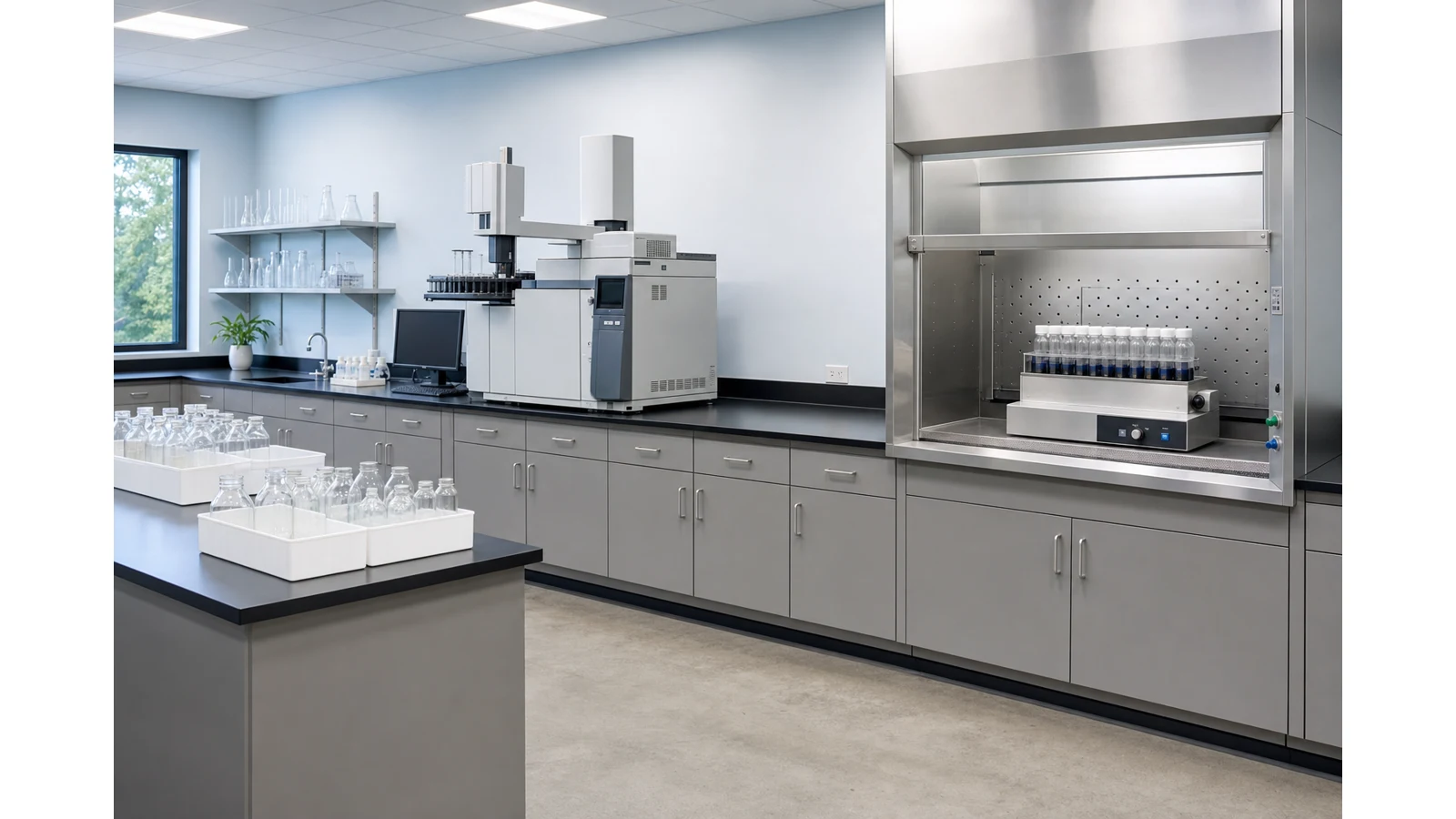
An environmental testing lab processes water, soil, air, and waste samples. These labs operate under accreditation standards that don’t accept shortcuts. The casework, fume hoods, sample storage, and bench layout need to defend the chain of custody from collection to final report. Get these incorrect, and the data gets thrown out. Worse, it gets accepted and then quietly fails an audit years later.
If you’re a specifier, lab manager, or project architect this will be a great resource. We’ll walk through what an environmental testing lab needs. First, the accreditation framework that drives decisions. Next, the bench and hood layout that supports EPA test methods. Then, the sample-storage rules that protect chain of custody. Finally, the casework finishes that survive nitric-acid digestion programs running every day.
Why environmental testing labs need their own design playbook
Most lab-design guides assume a research bench or a clinical workflow. An environmental testing lab is actually neither. It runs production-style sample throughput against fixed EPA, ASTM, and Standard Methods procedures. It carries an accreditation burden that research labs rarely face. The TNI 2026 standard, NELAP accreditation, and ISO/IEC 17025 all wrap around the bench. So the casework, fixtures, and ventilation have to support the standard not the other way around.
The TNI 2016 Standard Volume 1 Module 4 lays out detection-limit verification, calibration, and method-validation requirements that drive bench layout and storage decisions. Therefore, when a lab plans for accreditation, the room must give the analyst enough metal-free clean space. In addition, it needs segregated sample storage and ventilation capacity. As a result, the analyst can run those QC checks without cross-contamination (NELAC Institute, TNI 2016 Standard Summary).
Accreditation framework: TNI, NELAP, and ISO/IEC 17025
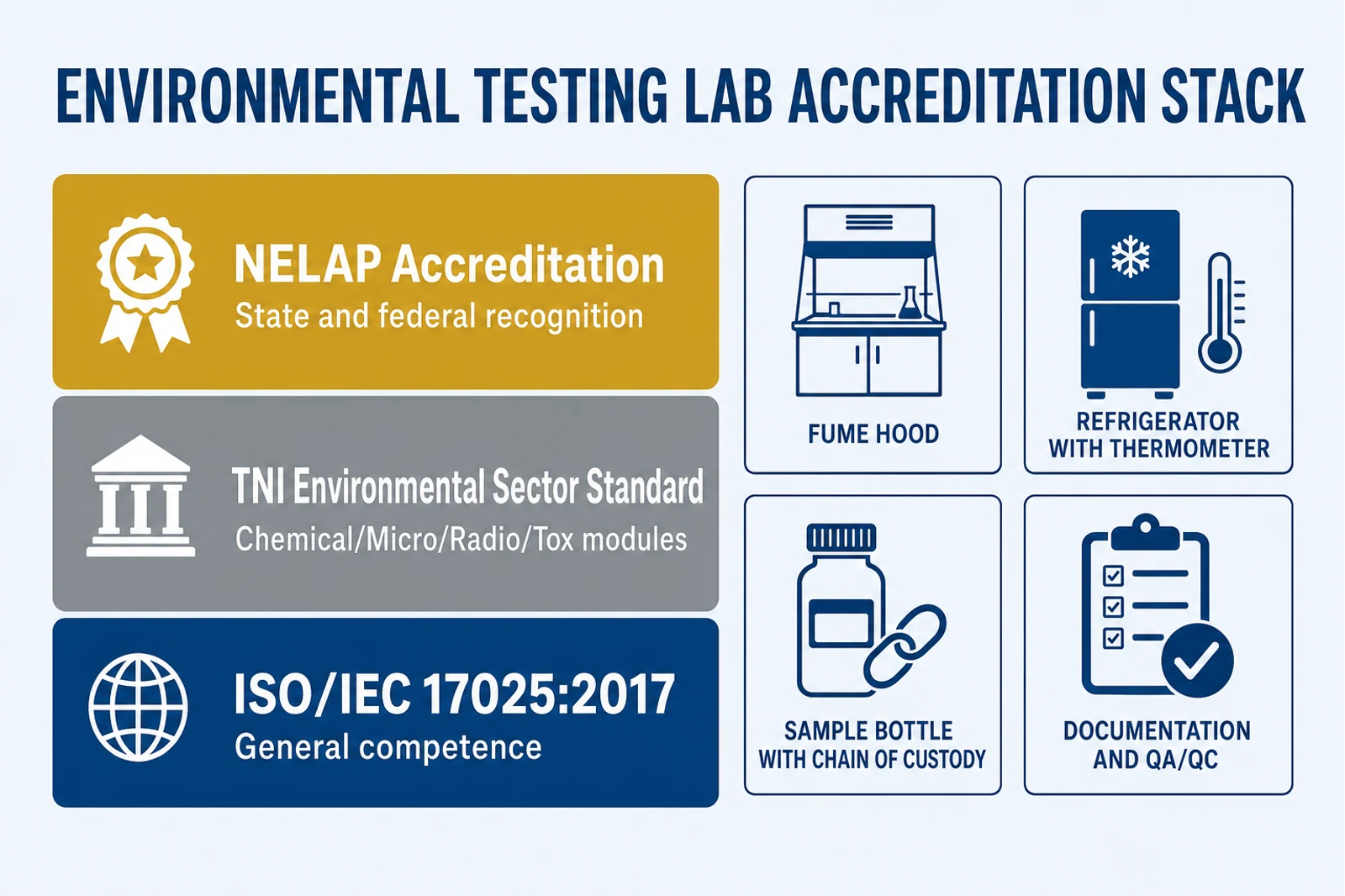
Three documents drive decisions in an environmental testing lab:
- First, ISO/IEC 17025:2017 sets the general competence requirements for testing and calibration labs.
- Second, the TNI Environmental Laboratory Sector standard extends ISO 17025 with specific chemical, microbiological, radiochemical, and toxicity testing modules.
- Third, NELAP (the National Environmental Laboratory Accreditation Program) is the recognition body. It grants accreditation when a state or federal client requires it.
The 2026 TNI revision tightens performance-based requirements. However, it reduces some of the prescriptive language from prior versions. Still, it requires segregated sample handling, controlled temperatures, calibrated support equipment, and documented method validation. As a result, the bench layout has to make those controls visible and auditable (TNI Draft Standard EL-V1M2-2026).
For specifiers, the practical takeaway is simple. Build the lab so an assessor can walk the room and see four things. First, segregated sample storage. Second, calibration records on equipment. Third, a dedicated trace-metal clean zone. Fourth, a fume hood program that meets ANSI/AIHA Z9.5 face velocity. If those four conditions are met, the rest of the accreditation gap-closure work happens on paper not in a renovation.
Casework and bench layout: the SEFA 8 baseline
An environmental testing lab bench faces nitric-acid digestion, solvent extraction, and frequent decontamination. The Scientific Equipment and Furniture Association (SEFA) 8 standard sets the chemical-resistance baseline for lab casework. In addition, SEFA 8-PH-2026 specifically tests phenolic resin against 49 chemical reagents under controlled conditions (SEFA 8-PH-2026 Phenolic Casework Standard).
For environmental work, the casework spec usually lands on one of three materials. Phenolic resin countertops gives the best chemical resistance for digestion benches. Epoxy resin lab tops are the workhorse where corrosive runoff is constant. Stainless steel covers the ICP-MS clean room. Additionally, it covers any wet-chemistry station that must be wiped down with dilute acid after every batch. Therefore, a typical layout pairs phenolic-resin work surfaces over lab base cabinets with concealed Euro hinges and recessed handles. As a result, no exposed hinges or hardware can trap acid mist.
Aisle clearance also matters. Allow at least 5 feet of clear aisle between opposing benches when both sides hold instruments. Additionally, allow 7 feet where carts have to pass. Consequently, sample-prep benches usually run 36 inches deep with knee space for seated work at instrument controllers. In contrast, wet-chemistry benches run 30 inches deep to keep the analyst close to the reagent line.
Fume hoods: face velocity, monitoring, and method fit
EPA Method 200.8 (ICP-MS trace metals) and EPA SW-846 Method 6020B both involve nitric-acid sample preparation at 95 °C. Therefore, every sample-prep station needs a dedicated chemical fume hood. ANSI/AIHA Z9.5 requires an average face velocity of 80–120 fpm. Additionally, no single point reading may be more than ±20% from the average. Furthermore, OSHA 29 CFR 1910.1450 confirms that 60–110 fpm is the typical acceptable range (Laboratory Design News, Guide to Fume Hood Codes).
For environmental labs, however, the design face velocity is rarely the controlling factor. The real spec issue is how many simultaneous digestions the room can support. A six-bay digestion block running EPA 200.8 needs roughly 1,000 cfm of hood exhaust at 100 fpm with an 18-inch working sash. In addition, matched makeup air keeps the lab at negative pressure relative to the corridor. Consequently, the mechanical engineer has to size the rooftop fan and the air-handler before the casework drawings get locked in.
NFPA 45 also requires a sign on each hood. It must list the inspection interval, last inspection date, average face velocity, fan location, and inspector name.
The trace-metal clean room: ICP-MS sample prep
EPA Method 200.8 explicitly states that “a clean laboratory work area designated for trace element sample handling must be used” (EPA Method 200.8, Trace Elements in Waters by ICP-MS). For specifiers, that means a separate room or a positive-pressure clean zone. It needs HEPA-filtered air, polypropylene labware storage, and benches that wipe down to a metal-free surface.
Stainless steel base cabinets dominate this room. The work surface is typically phenolic resin. For the most demanding programs, however, a fully welded stainless-steel top with coved edges is used. Sample bottles, autosampler tubes, and reagent storage all sit in polypropylene secondary containment. Trace-metal contamination from the bench itself is a real failure mode at sub-ppb detection limits.
Specify trace-metal-grade nitric acid storage in a dedicated acid cabinet next to the digestion hood. Then route the cabinet exhaust into the hood’s bypass airflow. Put the ICP-MS instrument on an isolation pad away from foot traffic. Plumb conditioned 18.1 MΩ deionized water directly to the instrument’s autosampler rinse station.
Sample storage and chain of custody
Chain of custody starts at sample login and ends at final report. The EPA Pesticide Product Laboratory Procedures Manual still sets the practical benchmark. One designated sample custodian. Locked storage. Recorded shelf location. And a documented hand-off every time a sample changes hands (EPA Pesticide Product Laboratory Procedures Manual).
Therefore, the design has to give the lab a dedicated sample-receiving room. It needs a locking pass-through window from the loading dock. Add a secure refrigerator bank holding 1–6 °C samples. Then a separate freezer bank at −20 °C for extracts and tissues. Plus a controlled-access archive for retained samples. Use commercial-grade laboratory refrigerators with digital temperature logging. High-temperature alarms must be wired to the building management system. Domestic appliances will fail an accreditation audit.
For metals analysis, EPA 200.8 allows 6 months from collection to analysis. The catch: samples must be preserved to pH less than 2 with nitric acid. So the sample-receiving room also needs acid-preservation supplies, a calibrated pH meter, and bench space. The bench space is for verifying preservation on every incoming container.
Ventilation and pressure relationships
An environmental testing lab needs negative pressure relative to office and corridor space. ANSI/AIHA Z9.5 requires that exhaust air not re-enter the building. Stack discharge must sit at least 10 feet above the adjacent roof line. Minimum upward velocity is 3,000 fpm. Therefore, the rooftop layout has to keep the fume hood stack separated from the building air intakes. Use enough horizontal and vertical distance to prevent re-entry under any wind condition.
Inside the lab, target 6–10 air changes per hour for general lab space, more for high-hood-density rooms. The makeup air system has to match hood exhaust within 10%. That keeps door pressure stable and hood face velocity steady. Consequently, variable-air-volume (VAV) controls become attractive. Specifically, they make sense when labs have more than four hoods in a single zone (OnePointe Solutions, VAV vs CAV Fume Hood Controls).
Instrument layout: ICP-MS, GC-MS, IC, and TOC
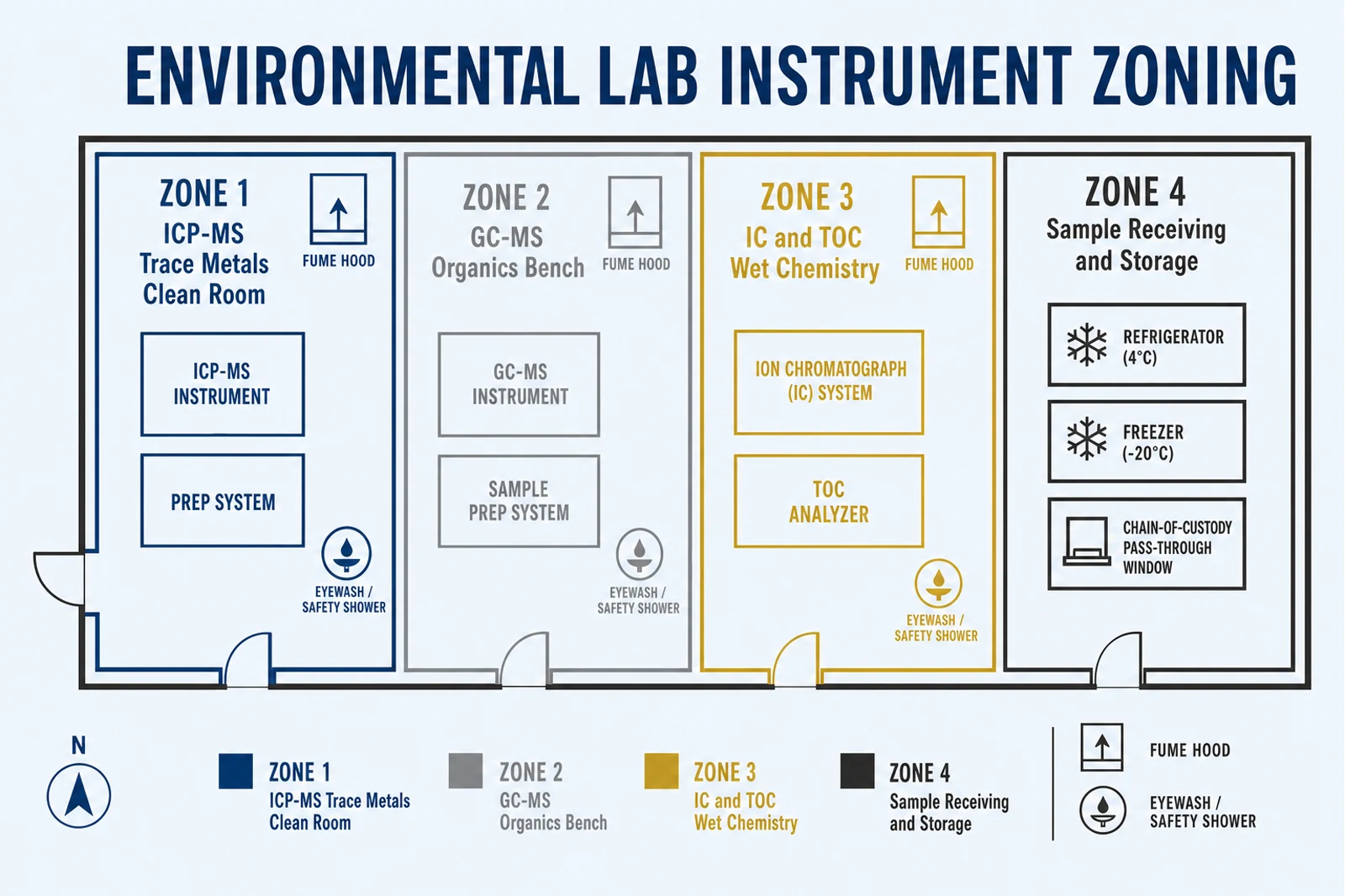
A typical environmental lab runs four instrument families. ICP-MS handles trace metals under EPA 200.8 and 6020B. GC-MS runs volatile and semi-volatile organics under SW-846 8260 and 8270. Ion chromatography (IC) covers anions and cations under EPA 300 and 9056. Total organic carbon (TOC) analyzers cover EPA 415.
Each instrument has its own service requirements. The ICP-MS needs argon delivery, dedicated 208 V single-phase power, and a chiller drain. The GC-MS needs helium and hydrogen lines, vibration isolation, and a vacuum-pump exhaust line. IC needs ultrapure water and a waste neutralization tank. TOC needs ultrapure water and CO2-scrubbed compressed air. Therefore, the bench layout has to bring those utilities to each instrument footprint without trip-hazard runs or unsealed penetrations.
Group like instruments together where possible. So put the two ICP-MS systems on the same gas manifold. Run the GC-MS pair off shared helium and hydrogen lines. Then reserve a single bench for IC and TOC. That cuts utility runs and simplifies the preventive maintenance calendar.
At OnePointe Solutions, we manufacture various models of mass spec benches to support MS operations.
Safety: showers, eyewash, and spill response
ANSI Z358.1 requires a safety shower and eyewash within 10 seconds of any hazardous chemical use. For an environmental testing lab running nitric acid digestions, that usually means one combination shower-eyewash for every two hoods. Tepid water at 60–100 °F. A 15-minute continuous flow capacity (OnePointe Solutions, Lab Sink & Fixture Materials).
Spill response gear sits at every sample-prep station. Stock acid neutralizer, solvent absorbent, and a chemical-resistant spill kit within arm’s reach of the digestion bench. Then mount a fire extinguisher and a flammable storage cabinet within 25 feet of the GC-MS solvent prep area. NFPA 45 sets the rule.
Lighting, power, and data
Lab benches need 80–100 foot-candles at the work surface. In addition, with color-rendering index of at least 80 for accurate sample inspection. Specifying LED fixtures with a 4000 K color temperature, mounted to avoid glare on instrument screens fulfills this. Add task lighting at each microscope station and at any titration bench where color change is the endpoint.
Each instrument bench needs at least four 120 V duplex outlets plus the dedicated 208 V circuits where required. Run a separate isolated-ground circuit for any analytical balance. Therefore, the electrical plan has to call out instrument locations, circuit numbers, and grounding details before the rough-in inspection. Retrofitting an environmental lab is expensive and disruptive. Best to avoid this at the beginning.
Data drops at every instrument feed the lab information management system (LIMS). Specify Cat 6A or fiber to each instrument controller. Plus a dedicated Wi-Fi access point for mobile barcode scanners used in sample login. A LIMS handoff fails when the network can’t reach the autosampler. That loses more billable hours than any other lab-infrastructure failure.
Build a defensible environmental testing lab
An environmental testing lab earns its accreditation in the bench, the hood, the storage room, and the ventilation plan. Not in the binder. Spec SEFA 8 casework, size the hoods to Z9.5, segregate sample storage from analysis. Document every calibration on every support instrument. When an assessor walks the room, those four things should be visible in the first five minutes.
OnePointe Solutions designs and builds environmental testing lab casework, fume hoods across the United States. Our team works with the architect and the lab manager from schematic design through punch list. Talk with a OnePointe Solutions lab designer about your next environmental lab build or renovation.
Sources and citations
Finally, the fixture-material, wetted-surface, and trace-metal claims in this guide are anchored to the following first-party and peer-reviewed sources. In addition, every entry was verified against the live source on June 26, 2026.
| # | Source | Type | Year | Key finding | Application to lab spec | Link |
|---|---|---|---|---|---|---|
| 1 | EPA Method 200.8 — Determination of Trace Elements in Waters and Wastes by ICP-MS, Rev. 5.4 | EPA reference method | 1994 | §6.10 requires a dedicated clean laboratory work area for trace-element sample handling and warns that sample containers leach and adsorb at trace levels. §7.2 specifies ASTM Type I water (ASTM D1193). Standard solutions stored in FEP fluorocarbon bottles. | Operating context for any ICP-MS lab — dedicated trace-element area, ASTM Type I water at point of use, and FEP/PTFE/polyethylene sample-contact surfaces only. | EPA Method 200.8 (PDF) |
| 2 | EPA Method 1669 — Sampling Ambient Water for Trace Metals at EPA Water Quality Criteria Levels | EPA reference method | 1996 | §4.2.2.3.1: “Metal must not be used under any circumstance.” Approved wetted surfaces are limited to fluoropolymer (FEP, PTFE), polyethylene, polycarbonate, polysulfone, polypropylene, or ultrapure quartz. §2.4 establishes clean-hands / dirty-hands sampling protocol. §9.3.5 requires equipment blanks before any field use. | The clearest EPA prohibition on metal-bodied sampling equipment (including brass) for trace-metal work. Cite when specifying PTFE/FEP/polyethylene wetted surfaces or equipment-blank QC. | EPA Method 1669 (PDF) |
| 3 | SEFA 7-2020 — Laboratory Fixtures (Service Fittings, Faucets, Valves) | Industry recommended practice | 2020 | §5.1 defines accepted brass alloys (ASTM B30, B124, B16) and chrome-plated finishes for general lab service. §11.2 requires that purified-water fitting bodies, goosenecks, and internal operating components be either (i) brass with an interior lining of an inert metal such as tin, or (ii) stainless steel. | Authoritative industry citation for fixture material. General lab service may use chrome-plated brass; purified-water and trace-metal-sensitive service requires tin-lined brass or stainless steel. | SEFA 2020 Desk Reference Ver 3.0 (PDF) |
| 4 | Lytle, Schock, Wait, Cahalan, Bosscher, Porter, Del Toral (2019) — Sequential drinking water sampling as a tool for evaluating lead in Flint, Michigan, Water Research | Peer-reviewed (EPA-authored) | 2019 | Abstract: “Sequential sampling indicated that brass fittings, brass fixtures, and galvanized pipes were lead sources.” Site dk recorded lead peaks of 87 µg/L co-occurring with zinc peaks of 220 µg/L in the first 0.125 L, attributed to a brass fixture adjacent to the faucet. | First-party peer-reviewed evidence that brass faucets contaminate the first ~125 mL of draw. Supports tin-lined brass, stainless, or PTFE wetted-surface specs for trace-metal labs. | PMC7350769 · DOI 10.1016/j.watres.2019.03.042 |
| 5 | Ng & Lin (2016) — Evaluation of Lead Release in a Simulated Lead-Free Premise Plumbing System Using a Sequential Sampling Approach, Int. J. Environ. Res. Public Health 13(3):266 | Peer-reviewed controlled experiment | 2016 | Abstract: “‘Lead-free’ brass fittings were identified as the source of lead contamination.” Lead levels far exceeding the WHO guideline of 10 µg/L persisted for five months; highest recorded: 83 µg/L on Day 31. System used all-new certified copper pipes, brass fittings, and stainless steel taps. | Critical citation: certified lead-free brass (compliant with the 0.25% wt/wt NSF 372 limit) still leaches lead well above WHO guidelines. Rebuts the assumption that NSF-372 brass is acceptable on trace-metal-sensitive water. | PMC4808929 · DOI 10.3390/ijerph13030266 |
| 6 | Fisher, Guo, Tracy et al. (2021) — Occurrence of Lead and Other Toxic Metals Derived from Drinking-Water Systems in Three West African Countries, Environ. Health Perspect. 129(4):047012 | Peer-reviewed field study | 2021 | “Brass components proved most problematic, with 72% (26/36) exceeding IPC limits” — the 0.25% wt/wt lead limit set by NSF 372 and the Reduction of Lead in Drinking Water Act. Overall, 80% of tested water systems contained at least one component exceeding 0.25% lead. | Supports supply-chain verification (XRF spot-check, mill certs) when brass is specified, or the case for eliminating brass entirely from trace-metal wetted surfaces. | PMC8057680 · DOI 10.1289/EHP7804 |
By the OnePointe Solutions Lab Design Team