


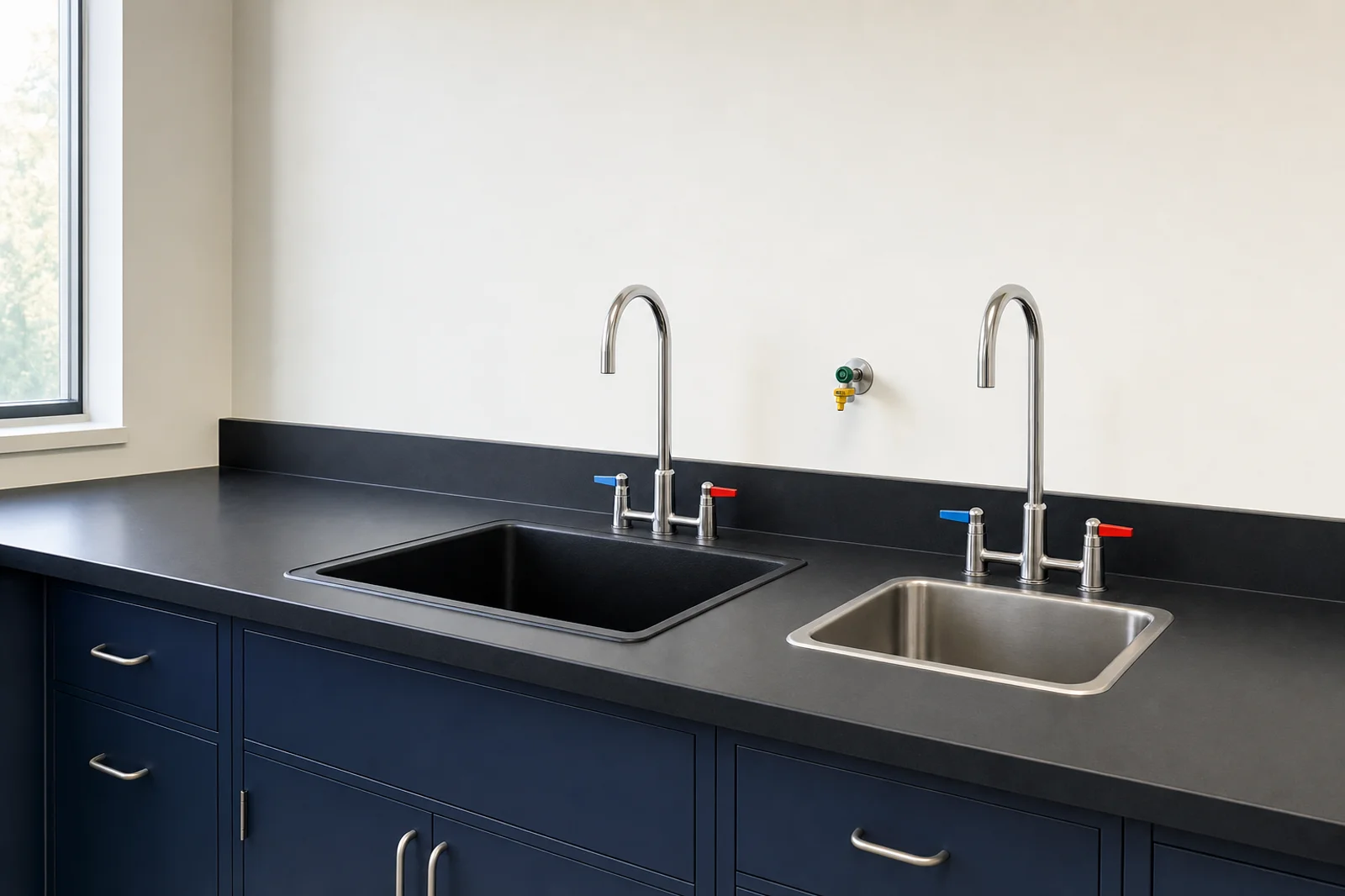
Lab sink materials and lab fixtures can get treated as a checkbox at the end of a casework spec: pick a basin, pick a faucet, move on. That type of treatment can put many labs in binds. Corrosion, drain failures, and scald incidents often follow after the ribbon is cut. The sink is where chemistry, biology, and plumbing all meet. The material the sink is made of decides how long that intersection holds up.
Our guide walks through what the standards actually say about lab sink materials and lab fixtures. For sinks, the recognized materials are epoxy resin, polyolefin (polypropylene), solid surface, and stainless steel. For fittings, the options are copper alloy, polypropylene, and brass-free bodies. In every case, the material choice should follow the chemistry, not the brochure.
Why Lab Sink Materials Are a Spec, Not a Style Choice
A laboratory sink is a different fixture from a kitchen sink or a janitor sink. It can look the same on a cut sheet, but the duty is different. According to SEFA 3: Laboratory Work Surfaces, the four recognized materials are epoxy resin, polyolefin (polypropylene), solid surface, and stainless steel. That is the entire approved palette. A residential porcelain sink or a cast-iron utility basin is not in scope for a lab.
SEFA also sets the structural and dimensional minimums. Per SEFA 3 §3.2, the drain outlet measures no less than 1-1/2″ diameter. The internal basin must fall no less than one degree for proper drainage. The load-bearing capacity must equal 1-1/2 times the maximum water weight the sink can hold. Those numbers are not preferences. They are pass-fail tests the sink has to meet before a spec writer can call it laboratory grade.
Epoxy Resin Sinks: The Workhorse for Chemistry Labs
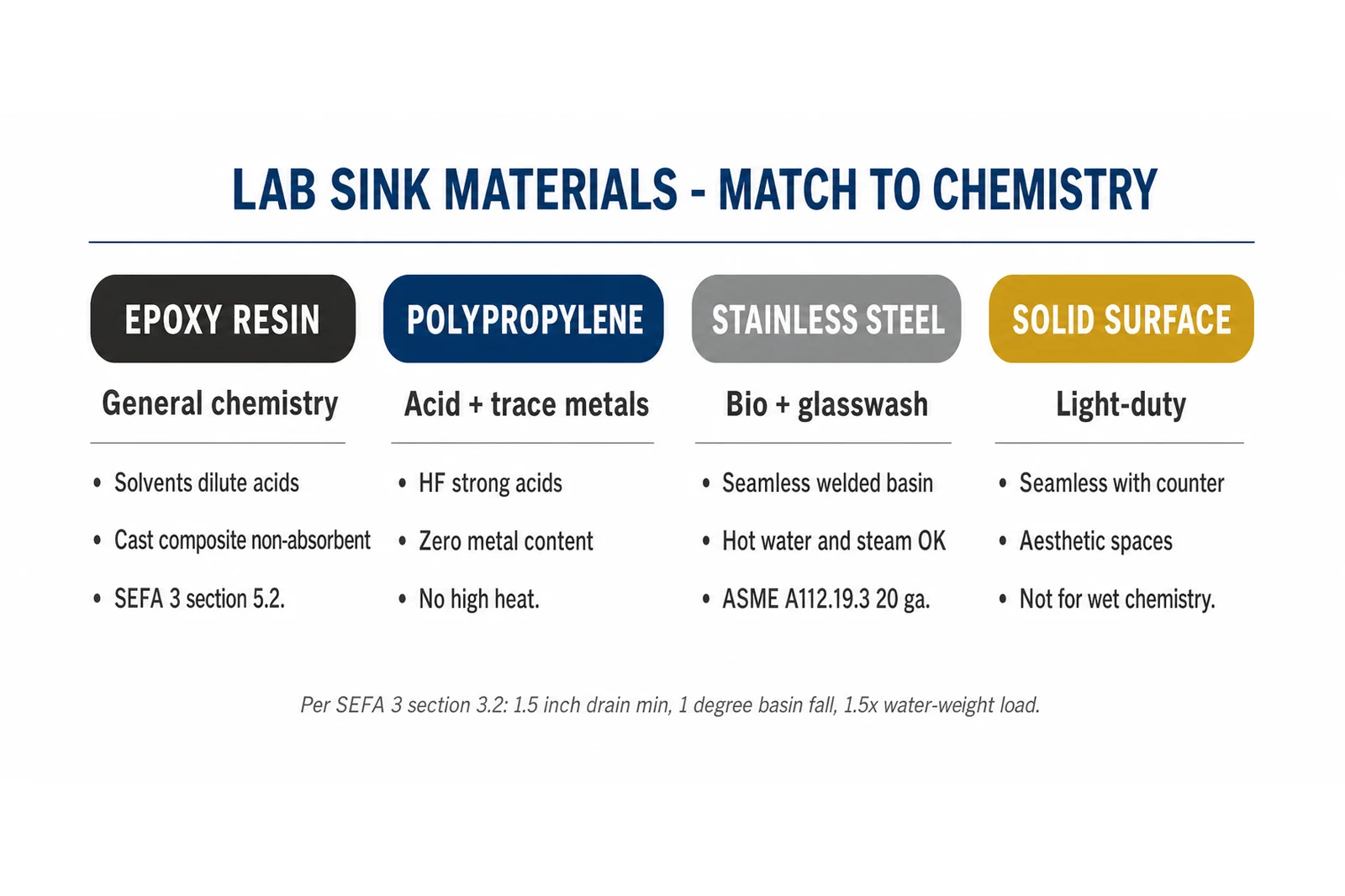
Epoxy resin is the most common lab sink material in chemistry programs. It carries the chemical resistance of an epoxy lab worktop into the basin. Per SEFA 3 §5.2, epoxy resin sinks are produced from a composite of epoxy resin, silica, inert fillers, and organic hardeners. The material is cast and cured in ovens at elevated temperatures. The result is homogeneous throughout and non-absorbent, which is why solvents and dilute acids do not soak into the basin wall.
An epoxy sink is the right call when the lab uses solvents, dilute acids, and routine reagent washing. The chemical resistance is broad. The basin tolerates moderate heat, though never thermal shock from dry ice. The common matte black finish (though epoxy resin sinks come in other colors) hides the day-to-day cosmetic wear that stainless cannot. The trade-off is weight — epoxy sinks are heavy and require supportive mounting beyond the sealant joint to the countertop. SEFA 2 §8.8 is explicit. Under-counter installations of epoxy, polyolefin, or other sink bowls shall include supportive means other than the sealant.
Polypropylene (Polyolefin) Sinks for Acid & Trace-Metal Work
Polypropylene: listed as polyolefin in SEFA documents – is the lab sink material that takes over where epoxy stops. The chemistry is straightforward: a homogeneous thermoplastic with no metal content, no surface coating, and no organic filler. That means strong mineral acids, hydrofluoric acid, and trace-metal sampling work all favor polypropylene. Nothing in the basin contributes contamination to the drain stream.
The same SEFA 3 §3.2 structural minimums apply: 1-1/2″ drain, one-degree basin fall, 1.5x water-weight load capacity. ADA-friendly cup-sink configurations are common in polypropylene because the material molds into shapes stainless cannot. The trade-off is heat. Polypropylene softens at lower temperatures than epoxy or stainless. That makes it the wrong basin for hot work, autoclaving residue, or boiling water disposal. Match the basin to the program.
Stainless Steel Sinks for Wet Labs, BSL Suites, and Glasswash
Stainless steel is the lab sink material for biology labs, glasswash, and any program where decontamination of the basin is part of the daily protocol. The reason is mechanical. A one-piece welded stainless basin has no seams, no porous filler, and no surface coating to wear off. NAVFAC PTS Section D20 calls for ASME A112.19.3 stainless basins at 20 gauge or heavier for laboratory and service-sink applications. The basin must include a ledge-back, an integral mounting rim, and a sound-dampening coating on the underside.
Stainless takes hot water and steam without deformation. It takes routine bleach and quaternary disinfection without surface change. It shows no permanent staining from biological residue. The trade-off is the wrong direction from chemistry. Stainless does not love concentrated acids, especially chlorides, and the surface scratches under heavy glassware. The exception that proves the rule is the perchloric-acid hood drain pan. It is one-piece welded type 316 stainless steel, no seams, no joints, designed specifically for the perchloric washdown cycle. A glasswash sink in a BSL-2 suite is 304 stainless. A perchloric-acid hood drain pan is 316 stainless in a single piece. Both are stainless, but the alloy and the fabrication are not interchangeable.
Solid Surface Sinks for Light-Duty and Aesthetic Programs
SEFA 3 §5 lists solid surface as an approved lab sink material. It is the right call for light-duty environments: teaching demonstration labs, support spaces and some clinical lab benches where the chemistry is light and the aesthetic matters. Solid surface allows seamless integration with a matching countertop. The result is a single, uninterrupted, easily wiped-down surface.
The catch is that solid surface is not a chemistry sink. It scratches under glassware. Stains under strong dyes and reagents. And not appropriate for solvent splash zones. If the program is wet chemistry, route the sink to epoxy or stainless. Use solid surface only on the auxiliary bench.
Lab Fixtures — What SEFA 7 Actually Specifies
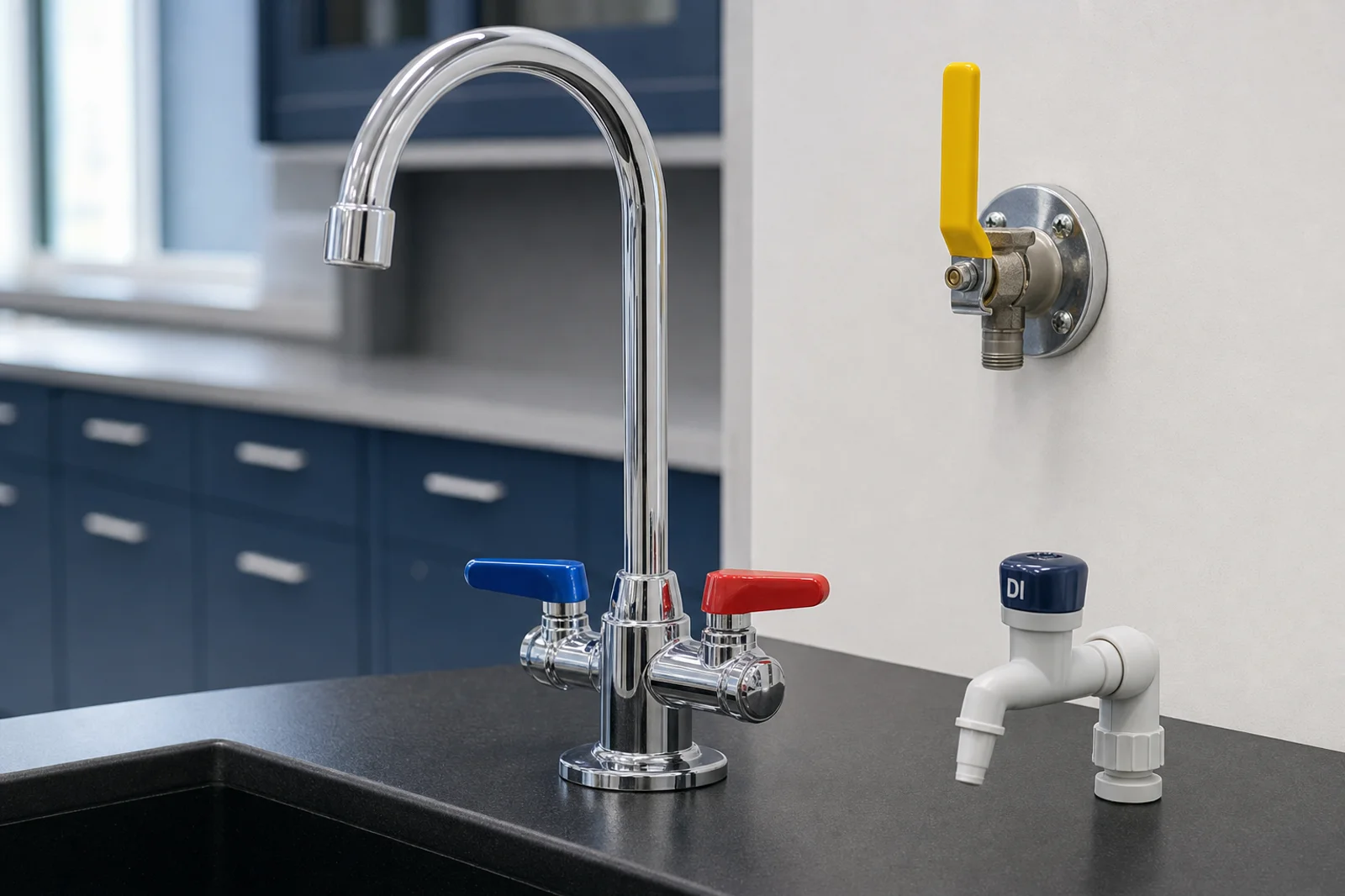
The fixtures that mount on the deck and the wall — faucets, remote-controlled valves, gas cocks, vacuum bibs, deionized-water taps — are governed by SEFA 7: Laboratory Fixtures. SEFA 7 sets performance requirements for valve operation, bending loads on the inlet, and spout strength. The pressure-test minimum is 200 psi for five minutes during valve closure. The bending-load tolerance is 30 ft-lb on 3/8″ supplies and 40 ft-lb on 1/2″ supplies. The spout-strength tolerance is 175 in-lb at the centerline for three minutes with no movement. Those numbers separate a laboratory faucet from a residential one.
The supply-side standard layered on top of SEFA 7 is ASME A112.18.1 / CSA B125.1: Plumbing Supply Fittings. ASME A112.18.1 sets the supply-temperature range (5 to 71 °C / 40 to 160 °F). It sets the rated supply pressure (140 to 860 kPa / 20 to 125 psi). It also sets the backflow-prevention method the fixture has to incorporate. Every lab faucet on the spec sheet needs to reference both — SEFA 7 for the lab-specific performance and ASME A112.18.1 for the plumbing-supply baseline.
Faucet Body Materials: Copper Alloy, Brass-Free, and the Lead Question
NAVFAC PTS Section D20 calls for ASME A112.18.1 copper alloy faucets on lab sinks. The spec includes swing spouts, aerators, and stainless steel drain outlets with cup strainers. Copper alloy is the default body material for general-purpose lab faucets. It machines well, takes a chrome plating, and meets the bending-load and spout-strength tests in SEFA 7 without trouble.
The wrinkle is lead content. NSF/ANSI/CAN 372 sets the lead-free requirement for any plumbing fitting in contact with drinking water. The limit is a weighted average of 0.25% lead across wetted surfaces. The Safe Drinking Water Act enforces it. So even a lab faucet on a non-potable bench loop needs to be specified as NSF/ANSI 372 compliant if there is any chance of cross-connection to the potable system. For deionized-water taps and trace-metal work, push past copper alloy entirely. Specify polypropylene-bodied or PVDF-bodied fixtures instead. No metal contacts the water stream.
Emergency Fixtures: ANSI Z358.1 and ASSE 1071
Emergency eyewash and emergency-shower fixtures are not lab fixtures in the SEFA sense. They are life-safety fixtures, and a different standard governs them. ANSI Z358.1 sets the minimum performance for emergency eyewashes, eye/face washes, and emergency showers. The standard covers water-flow rates, plume coverage, water-temperature range (tepid water between 60 and 100 °F), and 15-minute continuous-flow duration. Every lab sink spec that includes an emergency eyewash on the deck needs to flag the fixture as ANSI Z358.1 compliant. A SEFA 7 faucet with an eyewash attachment does not meet the requirement.
The tempering valve that delivers tepid water to the emergency fixture is a separate standard: ASSE 1071: Temperature Actuated Mixing Valves for Plumbed Emergency Fixtures. ASSE 1071 valves are mechanically different from a domestic mixing valve. They open under cold-water failure. They close under hot-water failure. Both fail-safe directions, so the user is never exposed to scalding or near-frozen water during an emergency event. A standard ASSE 1017 domestic mixing valve does not meet the requirement.
Drain Materials, Traps, and the Acid Waste Question
The waste fitting that connects a lab sink to the drain line is its own decision. ASME A112.18.2 / CSA B125.2: Plumbing Waste Fittings sets the performance requirements for the trap, the strainer, the tailpiece, and the overflow. For a standard lab sink, a 1-1/2″ adjustable P-trap with cup strainer per ASME A112.18.2 satisfies the general case.
For acid waste, the answer is different. Polypropylene drain piping with mechanical joints replaces the cast-iron or copper waste stack from the lab sink to the dilution tank. Borosilicate glass is the other option. The trap, the tailpiece, and the vent stack all change. This is the part of the lab fixture spec that most often gets defaulted to “match the existing building plumbing.” That is the wrong answer if the existing building does not have an acid-waste system. Spec the waste material to match the chemistry of the sink, not the wall behind it.
Specifying the Lab Sink Package: A Practical Approach
A complete lab sink package on a Division 12 / Division 22 spec sheet covers six lines: basin material, basin dimensions and drain size, faucet body material and standard, water-supply fittings standard, drain and trap material, and any emergency fixture per ANSI Z358.1. First, set the basin material to the chemistry. Use epoxy for general chemistry. Polypropylene for acids and trace metals. Stainless for biological work and glasswash. Use solid surface for light-duty support spaces.
Second, anchor the dimensions to SEFA 3 §3.2 — 1-1/2″ drain minimum, one-degree basin fall, 1.5x water-weight load capacity. Third, call the faucet to SEFA 7 plus ASME A112.18.1. Add NSF/ANSI 372 if there is any potable cross-connection. Fourth, name the waste-fitting standard. Use ASME A112.18.2 for the general case and polypropylene per acid-waste design for chemistry. Fifth, call out the emergency fixture and the ASSE 1071 tempering valve as separate line items. Sixth, route back to your casework guide and your Division 12 spec walk to make sure the sink and the casework are coordinated.
What it All Comes Down to
Lab sink materials are not a finish selection. They are a chemistry decision dressed as a fixture decision. Get the basin material right. Hold the fixtures to SEFA 7 and ASME A112.18.1. Route emergency water through an ASSE 1071 valve. Match the waste piping to what the sink will actually drain. Skip any of those and the sink becomes the part of the lab that fails first usually quietly, often expensively. For a deeper read on how the sink interacts with the casework that holds it, see our mobile and modular lab casework guide and our lab casework materials guide. The lab countertop holds the sink, and the sink holds the chemistry. Both need to be specified the same way: from the work backward, not from the catalog forward.
By the OnePointe Solutions Lab Design Team