


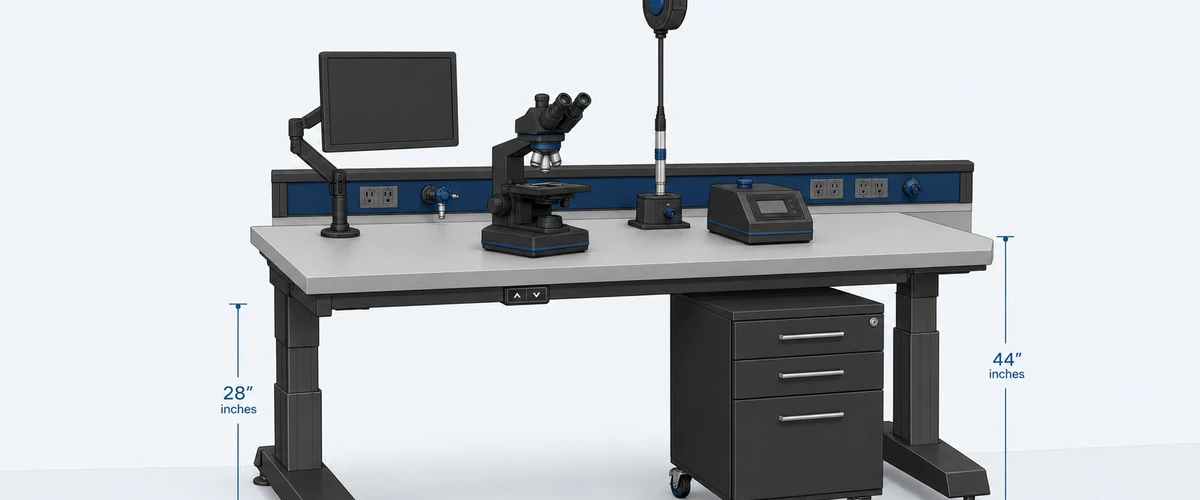
For decades, accessibility in laboratory planning generally meant meeting minimum regulatory codes. A single fixed 34-inch low bench in one corner. A knee-clearance sink somewhere on the far wall. Compliance checked, on to the next drawing set. That framing is starting to look expensive. Dedicated ADA-only stations often sit idle when the specific team member they were built for is not on shift. That effectively strands high-value laboratory square footage. Standard 36-inch fixed benches force taller researchers to hunch. They can also impede team members using mobility devices or seated for long-duration analysis.
Universal lab design shifts the goal from minimum legal compliance to broad operational usability. When most workstations adapt to most researchers, across height, mobility, physical capability, and hand dominance, more of the floor plan tends to stay active across shifts. Fewer stations sit reserved for a use case that only shows up part of the week. This guide covers the four engineering moves that generally drive that shift. It also walks through how each one lands on the shop drawing.
Direct answer: ADA compliance vs. universal lab design
ADA compliance establishes baseline legal minimums for disabled access. Universal lab design goes further, engineering the room so most occupants can use most workstations without special adaptation. Four core features generally do the work.
- Universal motorized workbenches. Push-button height-adjustable tables that move between 28 inches and 44 inches. They replace fixed 30-inch or 36-inch runs and transition between seated, mobility-device, and standing tasks.
- Mobile under-bench storage. Caster-mounted base cabinets that roll out on demand. They convert solid storage into an open knee-clearance envelope in seconds.
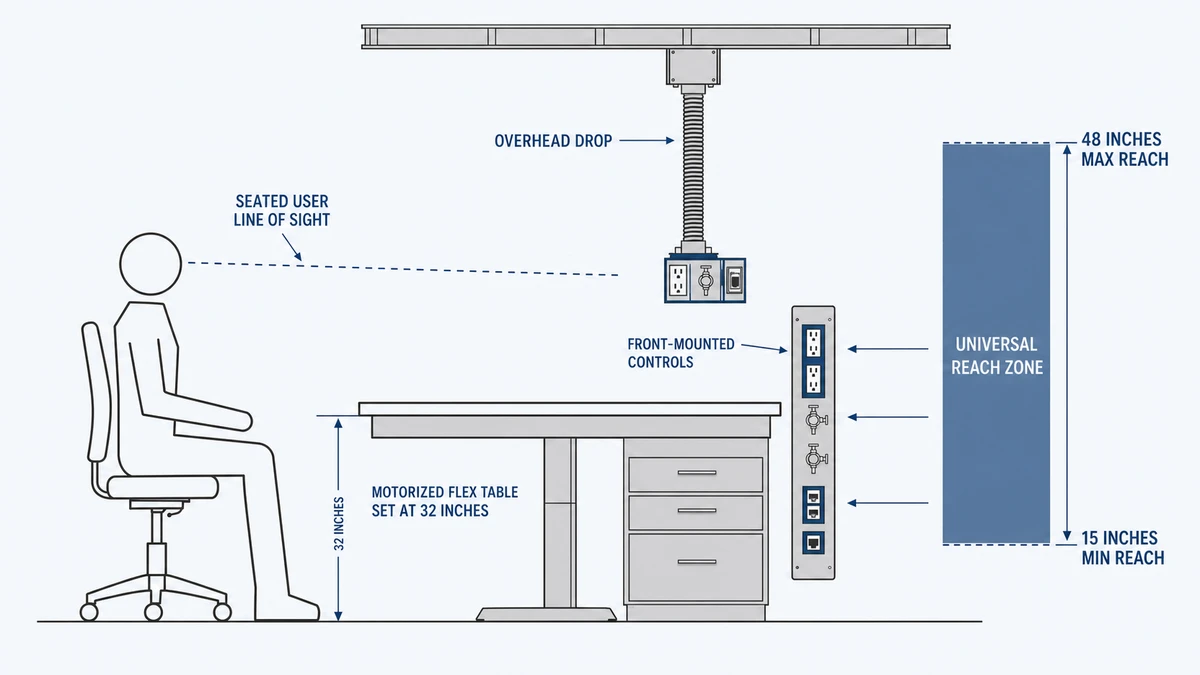
- Universal reach zones. Electrical outlets, gas valves, data ports, and overhead service carrier drops mounted within the 15-inch to 48-inch reach window.
- Ambidextrous, flexible fume hoods. Containment hoods outfitted with side-mounted low-reach controls, automated sashes, and clear side glass. Sightlines widen for seated and shorter users.
None of these moves are new They just have to be scoped together, not bolted on to an otherwise fixed room.
ADA compliance vs. universal lab design: architectural comparison
The shift from static compliance to dynamic universal design changes what shows up on the casework drawings. The matrix below tracks the five decisions that generally move.
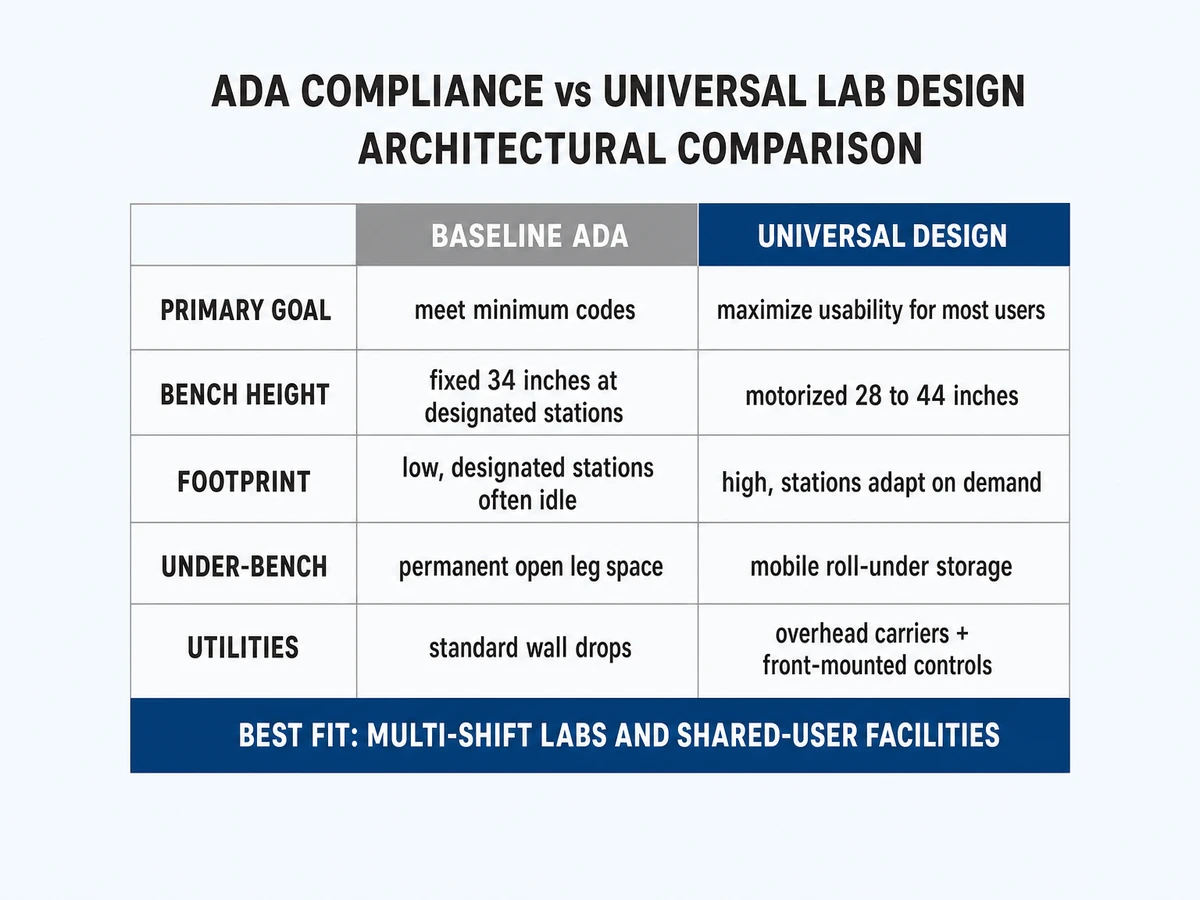
Reading the matrix left to right generally tells the same story on most projects. Static compliance protects the code review. Universal design protects the shift schedule.
Dynamic workstations: motorized push-button height adjustment
Static bench heights force technicians into compromised postures. 36 inches for standing or lab-stool work. 30 inches for seated tasks. Over a 12-hour shift, sustained poor ergonomics tends to drive fatigue. It can also raise error rates on repetitive tasks like pipetting or microscopy. The alternative is integrating electric linear-actuator lift systems into heavy-duty cold-rolled welded steel frames. A single table can then serve most of the room’s use cases.
- Seated and mobility access. Tables drop smoothly to 28 inches, meeting or exceeding the ADA knee-clearance envelope of 27 inches high by 30 inches wide by 19 inches deep.
- Standing ergonomics. Tables elevate up to 44 inches. Taller technicians work with straight spine alignment instead of a chronic forward hunch.
- Multi-shift transitions. Internal memory presets let operators return a station to their exact working height with a single touch. Changeover friction drops to seconds.
Pair the motorized frame with the anti-vibration considerations from our anti-vibration lab tables guide when the table also carries a precision balance or an optical instrument. Motorized frames and vibration-sensitive instruments can coexist. They just need to be scoped together.
Reconfigurable storage: mobile caster-mounted casework
Traditional fixed casework can create rigid barriers. A bench built with drawers running down to the floor may not accommodate a seated technician or a wheelchair user. Surface height does not fix that. The universal-design answer is mobile base cabinets that decouple storage from bench geometry.
- Roll-under compatibility. Base units sit on heavy-duty locking casters sized to glide under standard flex table frames.
- Instant conversion. When a seated task or wheelchair access is needed, the technician rolls the cabinet out to another wall run. A compliant knee-clearance zone opens in seconds.
- Storage retained. The lab keeps most of its storage capacity without locking any bench run into a single permanent configuration.
This pattern is a close cousin of the mobile modular casework approach we cover elsewhere. The difference: mobility is scoped around accessibility conversions, not just program flexibility.
Universal utility reach and control zones
Reaching across a 30-inch-deep epoxy countertop to adjust a gas needle valve or plug in an instrument is difficult for seated operators. It can also create tipping or spill hazards. The universal-reach approach relocates the interactive controls into a window that generally works for standing and seated users alike.
Front-mounted controls
Route gas valves, vacuum ports, and electrical receptacles to the front fascia panel of the workbench frame or the service carrier uprights. Not the back wall behind a deep worktop. The change is generally invisible in the elevation drawing and material on the ergonomic report.
Accessible height window
Keep interactive utility controls, monitor mounts, and shelf adjustment tracks within the universal reach zone of 15 to 48 inches off the finished floor. That window covers most seated and standing reach envelopes. No step stool or over-counter stretch needed.
Overhead service drops
Combine ceiling service carriers with retractable drop cords and quick-disconnect fittings. They extend down to working level with minimal force. The overhead architecture keeps utility drops mobile so they follow the bench when the layout changes.
Universal fume hood and containment integration
Fume hoods can present significant accessibility barriers. Sash mechanisms are heavy. Controls sit above the reach window. Base structures lack leg clearance. A few universal modifications generally close most of that gap without changing the containment envelope.
- Combination sash and auto-sash drives. Motorized sashes operated via push-button or proximity sensors allow hands-free opening and closing. Seated users and anyone with variable grip strength benefit.
- Low-profile front sills and flush airfoils. Ergonomically contoured armrests generally reduce wrist strain during long pipetting sessions inside the hood.
- Clear side sightlines. Side-glass panels give visibility into the containment chamber from a seated position or a lower eye line. That matters most on procedural work and student teaching.
Sash choice interacts with fume hood face velocity and containment class. Treat it as a coordinated decision with the ventilation engineer, not a late accessory upgrade. Our fume hood face velocity guide covers where those constraints usually land.
Frequently asked questions
What is the difference between ADA compliance and universal lab design?
ADA compliance focuses on meeting baseline legal minimums for accessibility. It generally allocates a small percentage of lowered benches and knee-clearance sinks. Universal lab design engineers the whole room so most benches, utilities, and storage modules adjust dynamically for most users, regardless of height or physical capability.
How do height-adjustable benches improve laboratory ergonomics?
Height-adjustable benches let technicians alternate between sitting and standing across a shift. They generally reduce spinal compression on long tasks. Bench height can also be tuned precisely to the task at hand. Lower for heavy equipment lifting. Higher for fine micro-pipetting.
How does universal lab design help lab square footage stay active?
Motorized benches and mobile roll-out cabinets let most workstations adapt to any technician on shift. That tends to reduce the number of idle specialty-only ADA stations and keeps more of the lab active across all shifts.
Do universal lab design features add cost over baseline ADA compliance?
Motorized frames and mobile casework generally carry a per-unit premium over fixed 36-inch benches and fixed base cabinets. The premium tends to be justified in three cases. Rooms that serve varied users. Multi-shift facilities. Labs that reconfigure between research programs over their life. For single-program labs with a stable team, baseline ADA compliance may be enough.
Related resources
- Mobile modular lab casework — caster-mounted base cabinets and reconfiguration workflows.
- Overhead service carriers — ceiling-to-bench utility delivery that pairs with universal reach zones.
- Anti-vibration lab tables — frame decisions when the flex table also carries a balance.
- Fume hood face velocity — sash and ventilation coordination for accessible containment.
- Academic accessible lab design – better framing to making science more accessible for students starting at the lab design.
Build an inclusive lab grid with OnePointe Solutions
Designing for universal access generally helps a facility stay flexible, safe, and productive as the research team grows. At, OnePointe Solutions, we can design and manufacture heavy-duty motorized height adjustable tables, mobile modular casework, and accessible utility delivery systems. Scoped around the actual mix of users on shift, not around a single fixed compliance persona.
Ready to move past baseline compliance and design a universal lab space? Contact our lab engineering team to schedule a 3D layout consultation or a custom quote walk-through.