


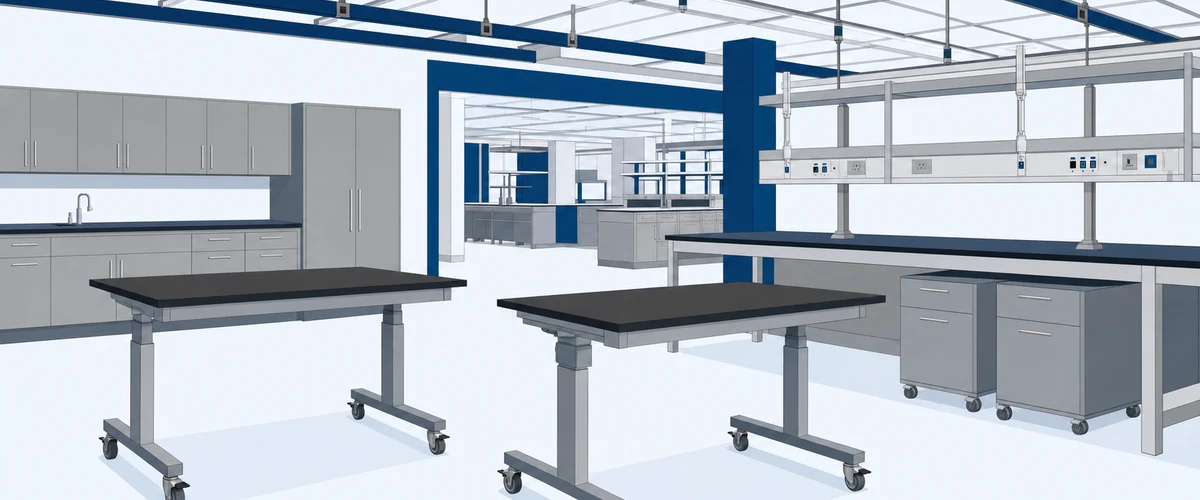
Modular lab furniture gets pitched as an infrastructure decision, but for most lab managers it’s really a workflow decision. The question isn’t “do we buy modular casework or fixed casework.” The question is: can the same square foot of lab bench serve three different researchers on three different projects this quarter without a construction ticket? That’s the hoteling and flex-lab problem, and it’s the reason the modular-furniture conversation has moved out of R&D specifications and onto operations agendas.
In our guide, we walk through four questions:
- What does “modular lab furniture” actually mean?
- Where does it earn its cost premium in hoteling and flex environments?
- Which specs separate genuine adaptability from marketing language?
- When is a modular buy the right call versus a fixed casework run?
If you’re wrestling with the casework-specific side of the decision, our mobile and modular lab casework guide is the companion piece. It covers mobile base cabinets, roll-under storage, and phenolic work surfaces. This guide focuses on the broader furniture ecosystem: tables, benches, carts, shelving, and seating. Specifically, how each plays in shared, reconfigurable lab space.
Also to learn more about how this type of furniture works within an actual modular laboratory, read our past blog on the subject- What is a Modular Laboratory?
What “modular lab furniture” actually means
First, the term gets used loosely. Nearly every casework vendor now claims a modular product line, and the definition tends to stretch to cover whatever they happen to sell. However, the industry standard that most closely defines the category is SEFA 10-2013, Adaptable Laboratory Furniture Systems. SEFA 10 treats modular furniture as a system of independent, interchangeable components: mobile cabinets on casters, freestanding workstations, mobile workstations, and adaptable shelving. Every component is designed to integrate with a broader furniture system, not as a one-off piece.
The NIH Office of Research Facilities frames the same idea in its March 2015 Technical Bulletin on flexible bench design. Fixed benches, NIH notes, mean that “any significant modification is a construction project.” Flexible systems change that math. Steel bench frames support adjustable-height benchtops. Base cabinets suspend from the frame. Frames sit on floor glides or locking wheels. Vertical extensions carry power and data. Together, these components let “most work” happen “quickly, with limited disturbance to lab operations,” as the NIH bulletin puts it. That phrase is what modular furniture actually sells. Not the wheels. The speed of change.
The five component families
For the purposes of this guide, modular lab furniture covers five component families:
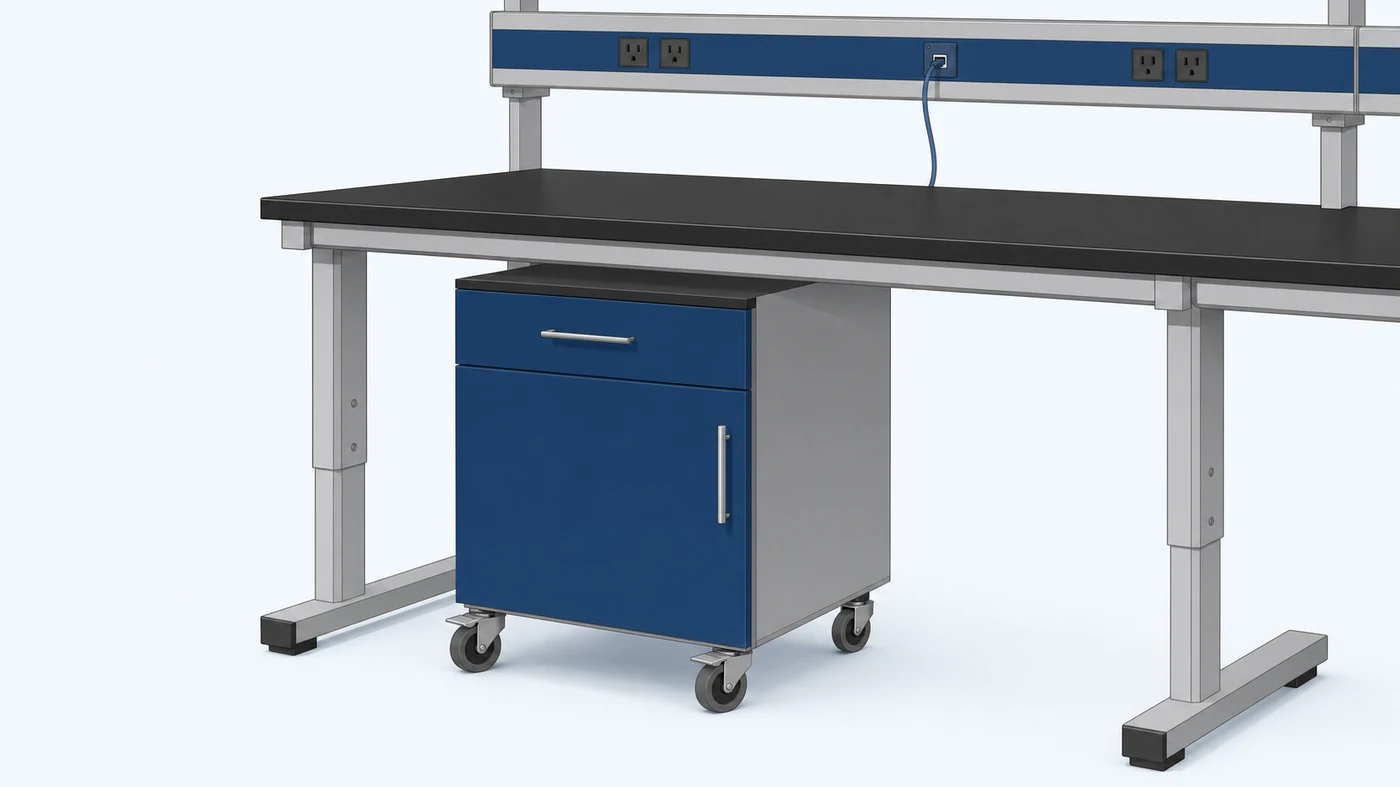
- Mobile lab tables and workbenches — freestanding, on locking casters, typically with adjustable-height frames. Rated for lab work surfaces (chemical-resistant tops, load-tested frames) but designed to move.
- Mobile base cabinets and instrument stands — freestanding storage on casters that rolls under a benchtop; distinct from fixed casework because it’s not anchored to the building structure.
- Modular shelving and overhead storage — adjustable, removable shelving that attaches to vertical bench-frame extensions or wall-mounted service spines rather than to fixed cabinets.
- Reconfigurable frame systems — the underlying steel bench frames with vertical service spines that carry power, data, and gas connections. These are what allow benchtops, cabinets, and shelves to move without breaking the utility feed.
- Modular lab seating — height-adjustable lab stools and ESD chairs that follow the researcher between stations rather than anchoring to one bench.
By contrast, what isn’t modular, despite marketing language: fixed casework with a few decorative touches, benches that must anchor to the wall for load rating, or “mobile” cabinets that need a certified technician to relocate. The test is whether lab staff or facilities maintenance can move a component without a construction ticket. If the answer is no, it’s fixed casework in a modular finish.
Where modular furniture earns its cost premium: hoteling and flex labs
First, modular lab furniture generally costs more per linear foot than equivalent fixed casework. Manufacturers engineer the frames to a higher structural standard because they carry loads without anchoring to walls. Casters and locking systems add cost. Utility connections also need to accommodate movement rather than hard piping. That premium is real. However, it pays back in one specific environment: labs where the same physical space serves different researchers, workflows, or instruments over time.
The WBDG Research Laboratory guidance frames this directly: “In today’s lab, the ability to expand, reconfigure, and permit multiple uses has become a key concern.” WBDG’s recommended tactics include equipment zones sized for future casework, generic lab modules, mobile casework, flexible partitions, and overhead service carriers. Together, they describe a lab designed for change from day one, rather than one that gets renovated every few years.
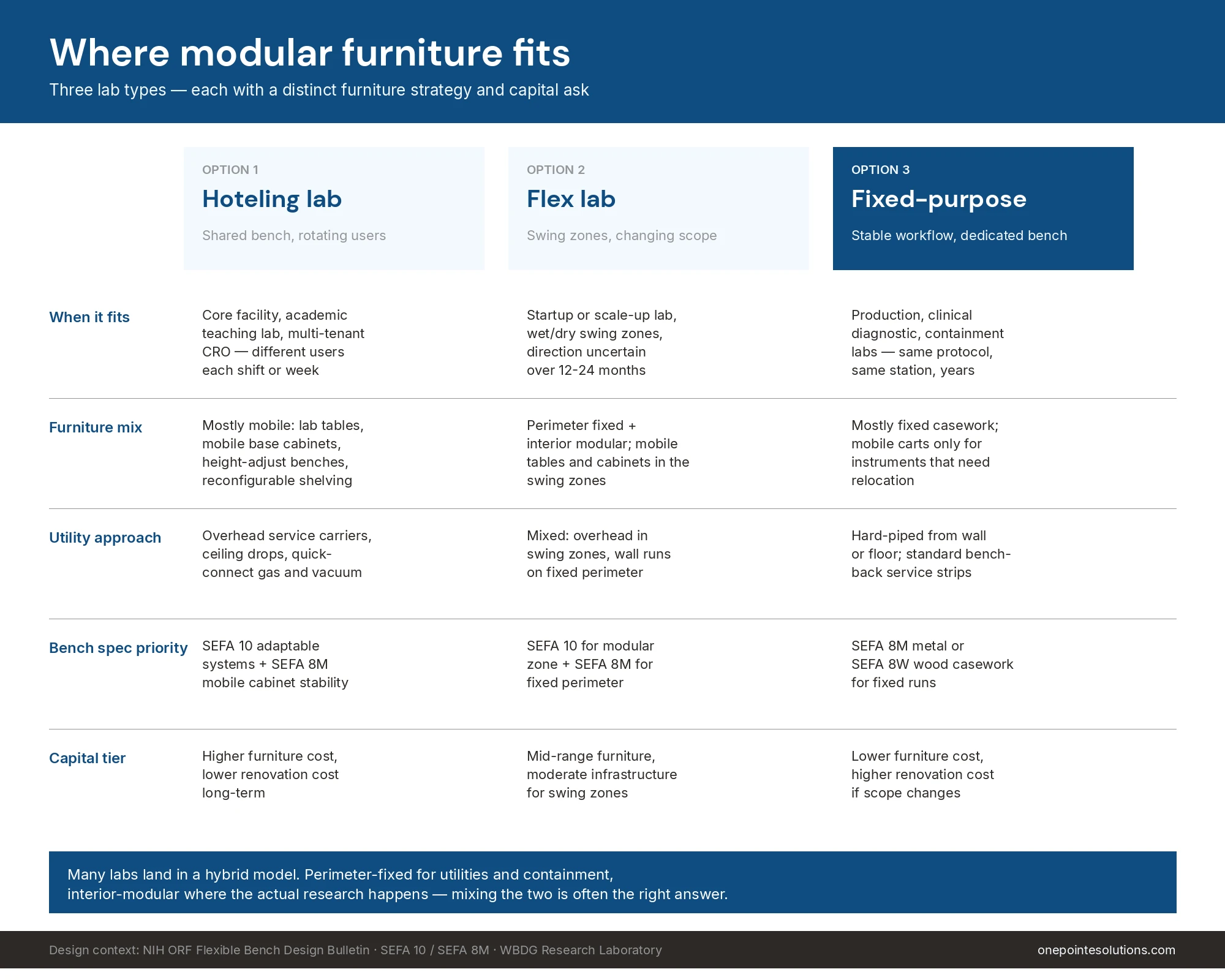
Hoteling labs
A hoteling lab is a shared research space where individual researchers or teams book bench time rather than owning a dedicated bench. It’s most common in academic core facilities, contract research organizations, and industry labs consolidating footprint after a merger or reorg. The workflow challenge is straightforward. A molecular biologist, a chemist, and a materials scientist may all use the same bench in the same week. Each needs a different set of tools, storage, and utility hookups.
Modular furniture is what makes hoteling work. Mobile base cabinets let researchers roll their own instrument and reagent storage into place at the start of a shift. Height-adjustable benches accommodate different working heights across a shift-rotation model. Reconfigurable shelving lets the next user swap overhead storage for a bench-mounted instrument mount when they need the vertical space. The alternative is either a lowest-common-denominator layout (which serves nobody well) or a bench turnover that eats into productive research time.
Flex labs and swing zones
Similarly, flex labs are single spaces designed to shift between wet and dry work, or between one research group and another, as projects come and go. Recent flexible-lab-design guidance from Lab Design News recommends designating “swing zones.” These are areas built to function as either wet or dry labs, with HVAC, drainage, and data density planned for the more demanding of the two uses.
The furniture in a swing zone has to do more than the furniture in a fixed-purpose lab. A dry-lab configuration needs open bench with data density and cable management. Converting the same square footage to a wet-lab week means rolling in mobile base cabinets with chem-resistant tops, quick-connecting a sink cart, and pulling down mobile shelving with acid-resistant storage. None of that is possible with a fixed casework run.
Multi-shift and multi-user environments
Meanwhile, labs running 16- or 24-hour operations face a related problem. Think clinical labs, contract testing, and environmental monitoring. The bench doesn’t change users between projects; it changes users between shifts. A day-shift tech may be 5’4″ and a night-shift tech may be 6’2″, both using the same station. The I2SL Smart Labs Design Guidelines recommend height-adjustable benches “in appropriate locations,” along with specific ergonomic cutouts (four-inch knee clearance, 15-inch by 20-inch minimum seated cutouts). None of these are practical to change on a fixed casework run. All come standard on modular frame systems.
The specs that separate real modular from marketing modular
The gap between well-engineered modular furniture and lightly-badged fixed casework shows up in the specification. Five specs are worth reading closely.
1. Load rating: bench frame and shelf, separately
SEFA 10 defines four worksurface load categories: Category 1 (200 lb), Category 2 (600 lb), Category 3 (1,000 lb), and Category 4 (1,200 lb). Each is tested with uniformly distributed steel bars. For example, in hoteling and flex labs that may see mass spectrometers, centrifuges, or analytical instruments, Category 3 or 4 is generally the right specification. In contrast, Category 1 is only appropriate for light bench work. Additionally, a separate shelf load rating also matters — SEFA sets shelf live load at 40 pounds per square foot, not to exceed 200 pounds per shelf. If a vendor won’t publish both bench and shelf load ratings, that’s a signal.
2. Mobile cabinet stability
Second, SEFA 10 flags mobile cabinet stability as a specific concern: cabinets can tip when loaded unevenly, when rolled with heavy contents, or when caster locks fail. Design mitigations SEFA recommends include lockable casters, counterweighting, anti-tip devices, and interlocking units. The SEFA 8M-2026 metal casework standard adds a mobile-cabinet top-load test: 250 pounds of steel bars distributed evenly across the top, cabinet supported only by casters, verified to remain stable and level. If a mobile base cabinet doesn’t cite SEFA 8M or SEFA 10 stability tests, ask for third-party test data before specifying.
3. Utility flexibility: the piece that fails first
Third, the NIH flexibility bulletin is explicit on this point: making benches mobile without addressing utility distribution defeats the purpose. Fixed sink lines and hard-piped gas connections mean the bench moves but the utilities don’t. NIH’s recommended tactics include outlets along walls at regular intervals, outlets at both high and low wall positions, outlets in the ceiling, and vertical bench-frame extensions that route power and data.
For hoteling labs specifically, overhead service carriers work better than wall runs. These are the ceiling-hung utility panels WBDG references. The advantage: a bench can roll anywhere in the room without breaking a utility feed. Quick-connect fittings for gas and vacuum, plus drop-cord power feeds from ceiling reels, round out the utility side of modular furniture. Skip them, and you’ll spec beautiful mobile furniture that can’t actually move.
4. Adjustability range and mechanism
Fourth, height-adjustable frames come in two general flavors. Manual crank or pin systems typically range 30″ to 36″, cost less than an electric frame, and change slower. Electric lifting columns range 28″ to 42″, change faster, cost more, and need power at the bench. In a hoteling lab where the bench height genuinely changes between shifts or users, electric is usually worth the premium. The manual version tends to stay in whatever position the first user set it to. For a lab where height changes are occasional (accessibility or ergonomic-injury accommodation), manual crank is usually sufficient. In addition, hand crank frames do not need a power source and are easier to change height in comparison to manual or pin systems.
5. Cable and data management
Finally, a furniture system that lets researchers roll a bench across the room but requires them to unplug 14 cables to do it is not actually mobile. Look for integrated cable troughs in the vertical bench extensions, cord retractors, and clear cable-management specifications on the frame. This is a common shortcut in bargain modular systems — the frame is mobile, but the cabling assumes the bench never moves.
When modular is the right call, and when it isn’t
Modular lab furniture isn’t universally the right answer. Instead, it’s a workflow-driven decision, not a materials decision. However, the following framework tends to hold across the projects we’ve seen.
Modular tends to earn its cost when:
- The space is genuinely shared: hoteling model, core facility, multi-tenant CRO, or academic teaching lab with rotating cohorts
- Research direction is uncertain, such as a startup or scale-up biotech where instrument mix will change every 12 to 24 months
- Compliance envelope is stable, meaning mostly BSL-1/2 or open chemistry work, not a high-containment or clinical-diagnostic setting
- The organization has internal facilities or maintenance capacity to handle minor reconfigurations rather than routing every change through a contractor
- Multi-shift operations where ergonomic accommodation between users is a real workflow issue
Fixed casework tends to be the right call when:
- The workflow is stable and the instrument mix is known, such as a dedicated production or clinical lab where the same protocol runs on the same station for years
- Containment or compliance requires anchored elements, such as BSL-3, radioactive, or clinical-diagnostic environments where regulatory expectations lean toward built-in casework
- The bench needs to support very heavy or vibration-sensitive equipment where a mobile base isn’t practical (large centrifuges, mass spec, electron microscopes)
- Budget is genuinely constrained and the flexibility premium isn’t recoverable through workflow gains
In practice, many labs land in a hybrid model. Fixed casework along the utility-heavy perimeter (sinks, fume hoods, cold storage, anchored biosafety cabinets) with a modular furniture zone in the open floor space — mobile lab tables, mobile base cabinets, height-adjustable benches. That perimeter-fixed / interior-modular split tends to give the containment and utility stability of fixed casework where it matters, and the workflow flexibility of modular furniture where the actual research happens.
For example, a short scope exercise up front usually pays for itself. Map the workflows the lab actually runs and the workflows it may run in the next three years, identify which benches will genuinely change users or workflows, and specify modular where that change happens and fixed where it doesn’t. Specifying every bench as modular when only 30% of the space actually changes wastes budget. Specifying every bench as fixed when 70% of the space needs to flex is what forces a renovation two years in.
For a tier-by-tier framework on when modular furniture solves a workflow problem versus when the lab needs a full renovation or relocation, see our lab redesign framework guide. Modular furniture tends to be the Tier 1 reconfigure move.
What to do this week
If you’re evaluating modular lab furniture for a hoteling or flex-lab application, three specific actions are worth taking this week:
- Walk the lab and count reconfiguration events. Over the past 12 months, how many times has your team repurposed a bench for a different researcher, instrument, or workflow? If the count is single-digit, fixed casework probably still fits. If it’s more than 10, the flexibility premium likely pays back.
- Pull the SEFA 10 and SEFA 8M standards. When you evaluate vendor proposals, compare their specs against SEFA 10-2013 for adaptable furniture and SEFA 8M for mobile cabinet load and stability tests. Any spec sheet that doesn’t reference these standards is a red flag.
- Check utility distribution before checking furniture. Modular furniture in a lab with hard-piped floor-mounted utilities is a very expensive way to buy a bench that can’t actually move. Overhead service carriers, ceiling-mounted power reels, and quick-connect gas fittings are usually where the real flex-lab investment sits — the furniture is downstream.
If you’re weighing modular furniture as part of a broader lab redesign or hoteling program, and want a second set of eyes on the specification, that’s the kind of scoping conversation we’re experts in. Reach out via our contact page — happy to walk through a specific layout or program.
OnePointe Solutions Lab Design Team