


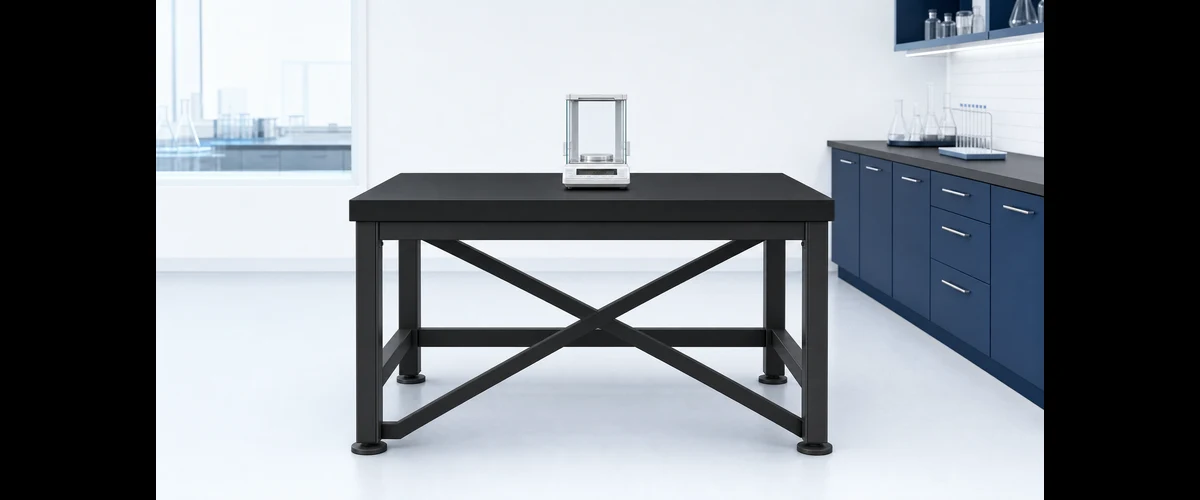
High-precision tools read the world at the micro-scale. Every tremor in the floor becomes signal noise on the bench. Foot traffic, HVAC pulses, and pumps all create tiny motion. Those tremors ruin balance readings. They blur optical images. They shift mass spec peaks. When data drifts, the retest schedule grows. So does the calibration bill.
Standard fixed benching is not built for this. Anti-vibration lab tables are. They keep the instrument still while the room moves. This guide walks lab planners, architects, and facility teams through how to spec them. It covers balances, mass spec setups, and optical work.
Anti-vibration lab tables: the direct answer
Anti-vibration lab tables isolate sensitive instruments from ambient building movement. They do this through three linked strategies. Each strategy targets a different frequency range and a different instrument class.
- High-mass inertial isolation for balances and mass spectrometers. Dense granite tops or heavy steel frames (often 500+ lbs) absorb high-frequency shock. That energy never reaches the instrument.
- Pneumatic or active damping for optical tables and laser setups. Air mounts cancel low-frequency motion in the 1–10 Hz range. That is where HVAC and foot traffic tend to live.
- Decoupled pump rigs for peripherals. Roughing pumps and chillers get their own dampened sub-frames. Their rumble never touches the main tabletop.
The physics: what vibration actually does to instruments
Every fine instrument has a frequency band that ruins its readings. Spot that band first. Then pick the isolation strategy that targets it. Three classes cover most lab work.
Analytical balances resolve mass down to 0.1 µg. Foot traffic and door slams cause sharp shock. That shock shows up as drift, slow settling, and rejected readings.
Optical tables and lasers hold micron-scale alignment across long beam paths. HVAC duct pulses and floor motion (usually 1–10 Hz) knock beams off center. That blurs images.
Mass spectrometers (LC-MS and GC-MS) carry heavy vacuum systems. The roughing pumps and chillers that support them also shake the table frame. That shake shows up as signal noise and peak distortion.
The through-line is simple. Without isolation, tiny motions move from the floor into the frame. From the frame, they move into the reading. The NIST guide on mass measurement lab design makes the same point in plainer terms. The room is often the biggest source of error.
Instrument-specific isolation matrix
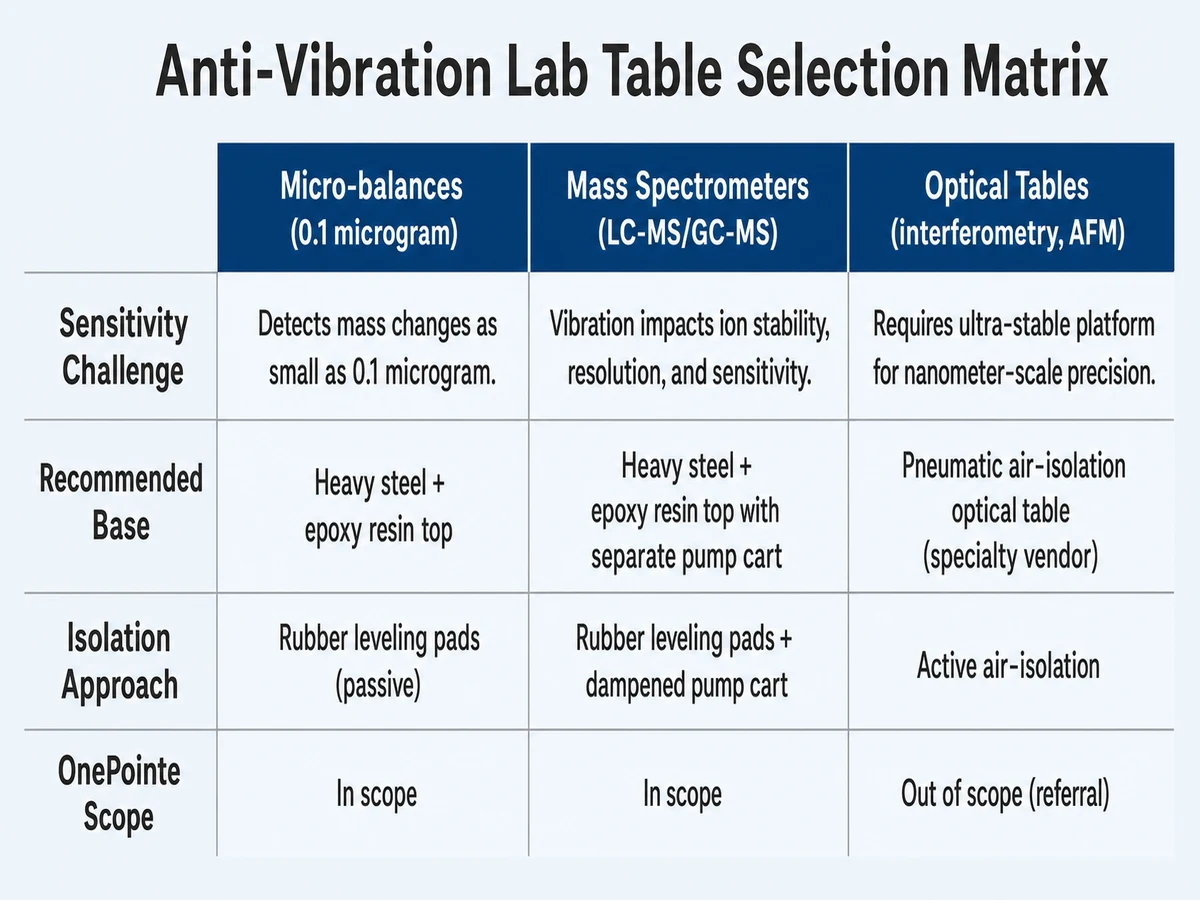
Picking the right anti-vibration lab table starts with the instrument. Sensitivity and mass drive the whole spec.
Micro-balances (0.1 µg resolution)
The core problem is high-frequency floor motion plus draft currents. The fix is a granite-inset balance bench. A solid granite block, 2 to 4 inches thick, sits on rubber mounts. The block sits apart from the outer work surface. A user resting a laptop on the bench never touches the instrument’s support.
Mass spectrometers (LC-MS and GC-MS)
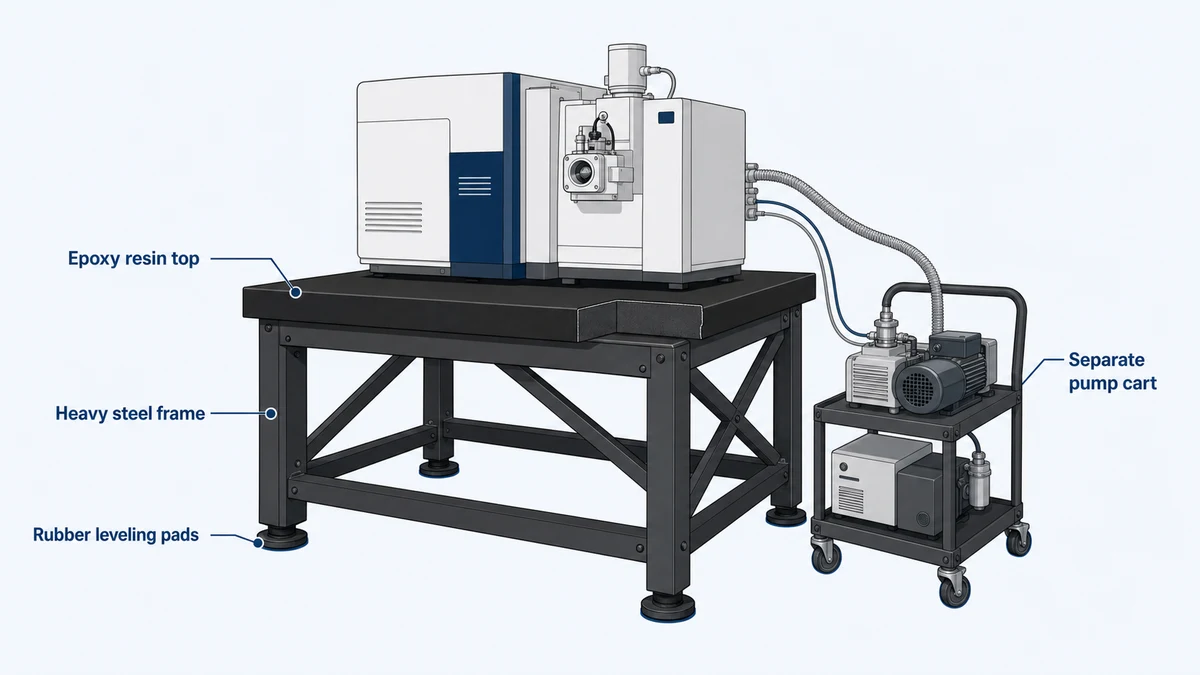
The core problem is low-frequency pump hum under heavy load. The fix is a heavy-gauge steel frame with a split pump box. Vacuum pumps live on separate mobile carts. Those carts use dampening casters and soundproofing. Flexible line connections keep the pump-to-instrument path as loose as possible.
Optical tables and lasers
The core problem is multi-axis low-frequency motion. The fix is an air-isolating table. Air leveling mounts, active or passive, target the 1.5–3 Hz range. That range covers most HVAC and floor sources in a typical building.
Three rules for specifying anti-vibration lab tables
Rule 1: Decouple the instrument from the operator
The top cause of drift is user contact stress. A hand or forearm resting on the work surface can throw off a reading. Well-built balance benches use a table-within-a-table design. An outer frame carries the user’s arms, laptop, and logbook. A separate inner core carries the granite slab and the instrument. The two systems never touch.
Rule 2: Separate mechanical vacuum pumps
Mass spectrometers run on heavy-duty roughing pumps. Those pumps create constant rumble. Setting a pump on the bench, or on the floor next to a table leg, sends motion straight into the flight tube. The fix is simple. Put the pump in a separate, sound-dampened mobile cart. Fit rubber (elastomeric) isolation mounts under the cart. Use flexible line connections between the pump and the instrument.
Rule 3: Match table mass to instrument dynamics
Lightweight frames amplify room motion. High-precision isolation needs mass. Heavy-duty cold-rolled steel frames paired with dense tops — solid granite or thick epoxy resin — form an inertial damper. That damper resists shocks by simple mass. The heavier the frame, the harder it is for the room to move it.
Passive vs. active isolation: which one to spec
Passive isolation uses dense mass, rubber pads, or static air springs to absorb motion. It handles high-frequency shock well. It is also cheaper and needs no power. Most balance benches and general-purpose bench stations do fine on passive alone.
Active isolation uses electronic sensors and actuators. The sensors read incoming motion. The actuators push back in real time. That approach works better against slow motion. That is where passive systems tend to lose ground. Optical tables running interferometry, confocal scopes, and AFM setups often need active isolation to hit spec.
The decision path is short. Is the instrument a balance or a bench-top unit? Start with passive. Is it a laser, an optical setup, or a probe microscope? Plan for active. Then confirm the target against the instrument’s own install spec sheet. Vendors publish vibration criteria (VC curves) and performance ranges for a reason.
Frequently asked questions
Why do analytical balances need anti-vibration lab tables?
Micro-balances resolve mass down to fractions of a milligram. Unshielded floor motion, HVAC pulses, and user contact all cause drift and slow settling. A dedicated anti-vibration lab table isolates the balance from those inputs. Readings settle faster and hold steady.
How does a granite balance table reduce vibration?
Granite has high density and natural mass damping. When the block sits on isolating mounts, its inertia absorbs high-frequency shock. Very little shock reaches the pan on top. Thicker blocks perform better because mass is the main lever.
What is the difference between passive and active vibration isolation?
Passive isolation uses dense materials, rubber pads, or static air springs to dampen motion. Active isolation uses electronic sensors and actuators. Those parts detect incoming motion and push back in real time. Passive is simpler and cheaper. Active handles low-frequency work that passive cannot.
Do anti-vibration lab tables need to be SEFA compliant?
The SEFA 8 casework standards cover structural performance for lab furniture. Anti-vibration lab tables built on heavy-gauge steel often follow the SEFA 8-M metal casework rules. Vibration performance itself is measured against the vendor’s spec sheet, not SEFA.
Protect your precision instrumentation
High-precision analytics start with physical stability. OnePointe Solutions builds custom anti-vibration lab tables, dampened mass spec pump carts, and modular steel workstations — heavy-gauge steel frames with thick epoxy resin or phenolic tops and rubber leveling pads for passive isolation. Everything ships from our Elgin, Texas plant. Our team scopes each build to the weight, footprint, and vibration limits of the equipment on your floor plan. Note: granite-inset balance benches and pneumatic air-isolation optical tables sit outside our scope. For those, we recommend working with a specialty vibration-isolation vendor.
Specifying casework alongside the vibration work? Our lab casework materials guide covers the SEFA 8 material families. The Division 12 spec walkthrough shows how these choices land in the build documents. Need anti-vibration lab tables built to your instrument’s spec? Reach out for a scoped quote.
Author: OnePointe Solutions Lab Design Team