


By the OnePointe Solutions Lab Design Team
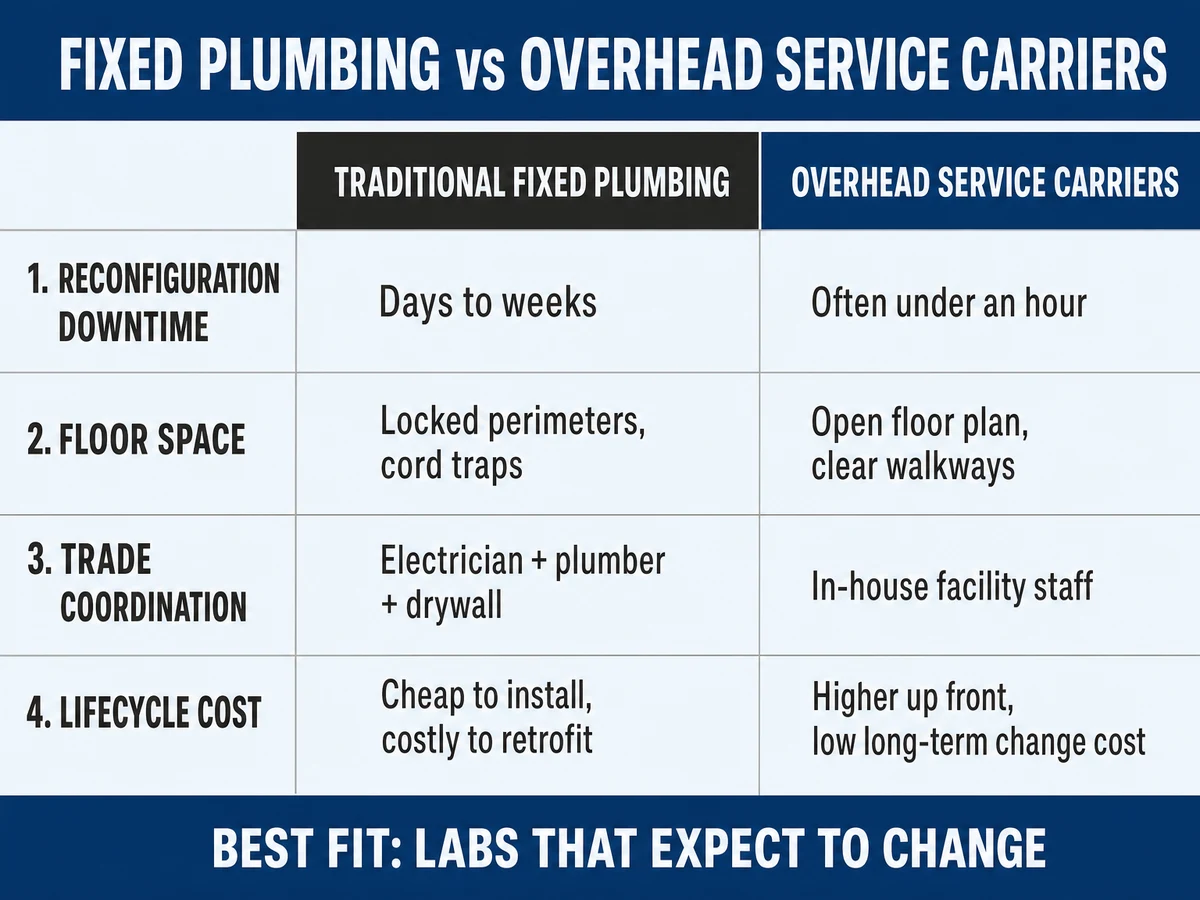
Traditional lab layouts tie utilities to fixed walls or floor plumbing penetrations. That works for a static workflow. It falls apart the moment research priorities shift. A bench reconfigure often means trenching concrete, opening drywall, and weeks of trade downtime.
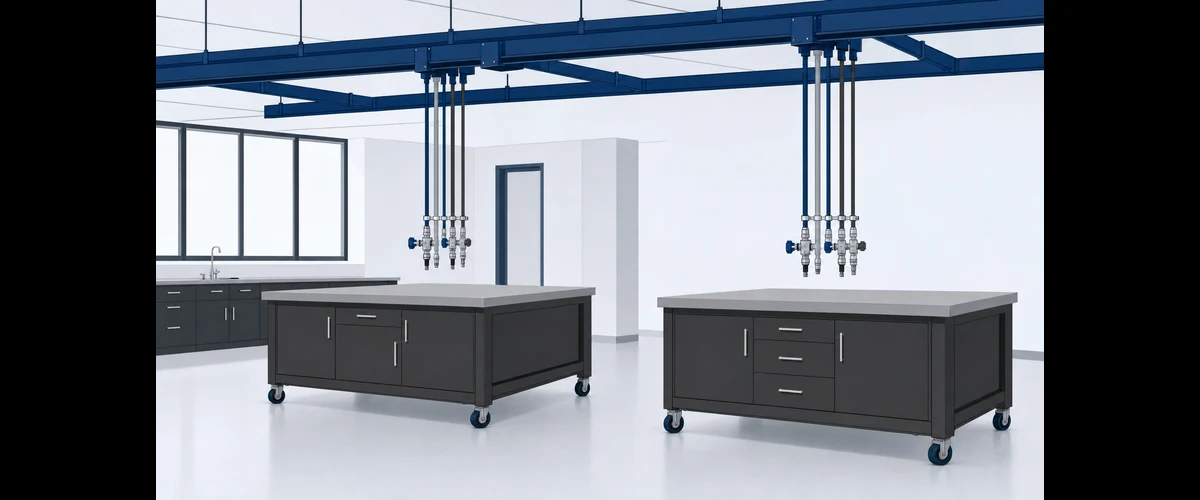
Overhead service carriers for labs pull those utility points off the walls and floor. Ceiling-suspended raceways bring electrical, lab gases, vacuum, and data down through flexible drops. Bench arrays roll into new positions. Instrument stations expand without a permit. Build-out capital stays protected across the life of the space.
Direct answer: what overhead service carriers do for a lab
Overhead service carriers for labs are ceiling-suspended or table-mounted utility systems. They deliver power, data, process gases, water, and vacuum through flexible drops with quick-disconnect fittings. Facilities use them to skip floor trenching, keep walkways clear, and reconfigure layouts in hours. Three mechanisms drive the payoff:
- Vertical overhead access. Circuits, data ports, and gas drops arrive above each workstation through ceiling raceways or table uprights.
- Dry and wet quick-disconnects. Color-coded self-sealing fittings let staff swap gas, vacuum, and water lines without cycling main valves.
- Mobile bench integration. Castered flex tables pair with the grid so entire arrays roll into place and reconnect in under an hour.
The cost of rigid utilities versus overhead adaptability
Fixed floor and wall utility lines impose steep spatial limits on any program that plans to grow. The comparison below reflects patterns across renovation and new-build projects.
Core engineering components of modern service carriers
Structural raceway and upright systems
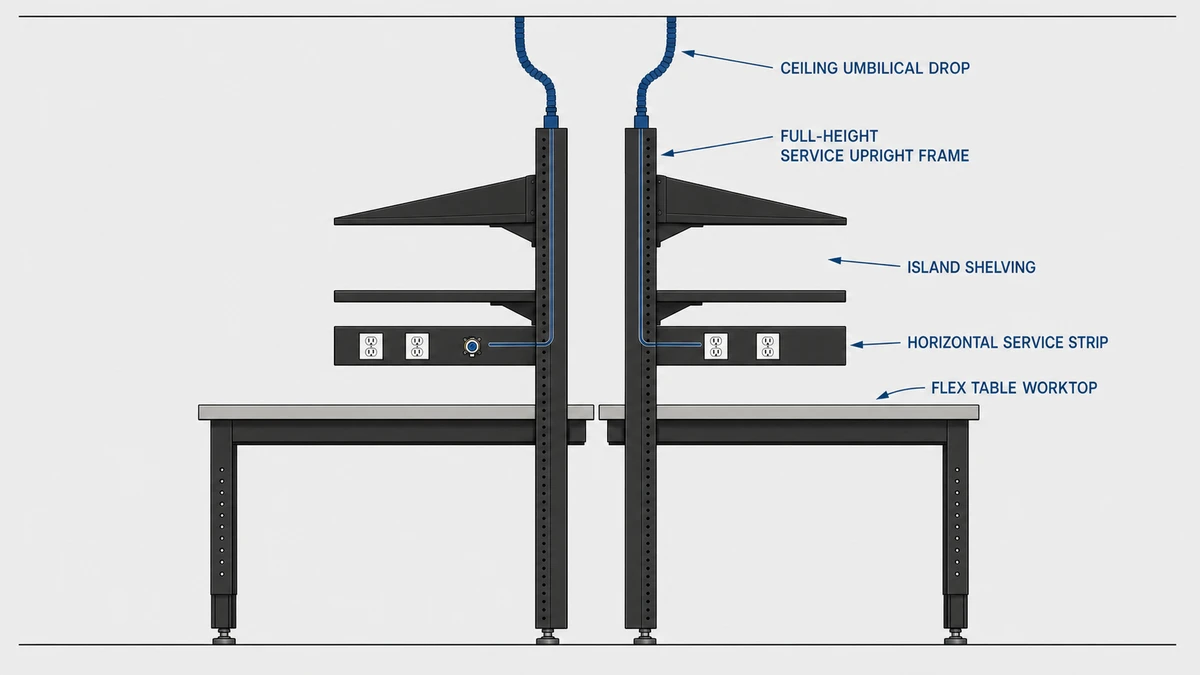
Most overhead carriers use heavy-gauge cold-rolled steel or aluminum raceway channels. Those channels mount to structural ceiling joists. On layouts that need extra flexibility, the carrier can mount as an accessory frame on the flex table itself. Heavy-duty uprights anchor to the table frame, and the utility drop moves with the workstation. Either approach handles the same trades. Routing decisions depend on ceiling access, seismic bracing, and drops per bench run.
Color-coded quick-disconnect valves
Quick-disconnect fittings do most of the safety work on an overhead grid. Self-sealing valves close automatically at uncoupling, so pressure and chemical containment stay intact through a fast layout change. The typical breakdown:
- Lab gases (nitrogen, argon, helium, compressed air) — chrome brass or stainless quick-connects, mechanically keyed to prevent cross-connection.
- Vacuum and process fluids — self-sealing chemical-resistant valved couplings sized to the line diameter.
- Power and data — twist-lock receptacles, drop cords, and Cat6a data ports mounted overhead to keep the work surface free of snags.
Articulating arms and dropline retractors
To keep benches clear, most carriers combine retractable umbilical hoses with tensioned drop lines. Operators pull utilities down when the process needs them, then push everything back up when a large instrument moves in. The bench stays uncluttered without losing access to any trade overhead.
How overhead service carriers pair with flex tables
Overhead service carriers for labs tend to earn their highest return when paired with modular, flex tables. Ceiling raceways carry the trades. Quick-disconnects meet the table at the drop. Casters or leveling feet let a bench move without contractor involvement.
When a workflow scales from two instrument stations to four, staff roll new flex tables under the grid, snap in the quick-disconnect lines, and resume testing. No trench, drywall or trade schedule.
Where the design pays off, and where it does not
Overhead delivery is not the right answer everywhere. On a small, stable casework refresh, floor-fed utilities are often more economical and easier to service. Where the overhead approach generally pays off:
- High-throughput analytical labs where instrument stations change every year or two
- Contract research and pilot-scale facilities that swap projects on tight cycles
- Multi-tenant or shared-user labs where different teams need different utility profiles
- Tenant improvements where trenching the slab is disruptive, expensive, or off the table entirely
- Fast-track builds where compressing trade sequencing saves more than the carrier costs
For long-life static workflows — a dedicated QC lab running the same assays for a decade — a well-planned fixed layout can still be the cleaner call. The choice generally comes down to how often the room is likely to change.
Frequently asked questions
What is an overhead service carrier in a laboratory?
An overhead service carrier is a ceiling-suspended or rack-mounted utility system. It delivers power, data, process gases, water, and vacuum to lab workstations through flexible drops with quick-disconnect fittings.
Can overhead service carriers be added to existing lab tables?
Yes. Overhead service carriers install as a ceiling raceway grid across the room, or as an integrated frame accessory on the flex table. Retrofits generally involve a site survey, an updated MEP layout, and coordinated ceiling access.
How do quick-disconnect fittings work for lab gases?
Quick-disconnect fittings use self-sealing mechanical shut-off valves that close automatically on uncoupling. Color coding and mechanical keying prevent operators from cross-plugging an inert gas line into a vacuum or process-water port.
Do overhead service carriers change how the lab is cleaned?
Generally yes, and for the better. Fewer floor drops and wall piping mean fewer horizontal surfaces to wipe around. Retractable drops go up out of the way during cleaning, which tends to reduce cross-contamination risk on wet workflows.
Related OnePointe resources
- Mobile modular lab casework — how castered flex tables and modular frames earn their fee.
- How to read a Division 12 lab spec — where casework, utility, and MEP coordination sit in the spec.
- Lab renovation checklist — the pre-build steps that make overhead delivery easier to install.
Design a flexible lab with OnePointe Solutions
Overhead service carriers for labs tend to earn back their cost the first time a research priority shifts. At OnePointe Solutions, we manufacture heavy-gauge steel modular casework, flex tables, and integrated overhead service carrier accessories. If your next lab build is likely to move more than once, it is worth a conversation before the utility drawings go final. Talk with our lab design team about a scoped overhead service carrier package.