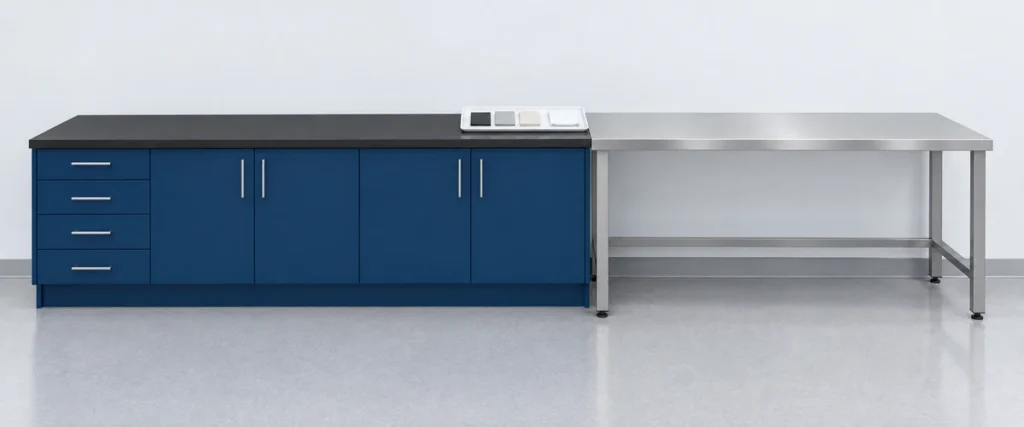


An honest 2026 guide to the HDPE countertop — an industrial-first material with narrow lab uses. Where it fits, and where phenolic or epoxy fits better.
Read More
An honest 2026 guide to the HDPE countertop — an industrial-first material with narrow lab uses. Where it fits, and where phenolic or epoxy fits better.
Read MoreWhat is an esd workbench, what it is made of, and which industries use one — a 2026 primer on grounding, materials, and applications.
Read MoreClassroom cabinets take abuse a working lab never sees. See how case construction, hardware grade, and finish systems keep school labs standing 15 years.
Read MorePersonal care lab design in 2026: the formulation and emulsion bench — high-shear mixing, jacketed kettles, stability chambers, and viscosity QC — anchored to FDA, MoCRA, ISO 22716, ASTM, USP, OSHA, and ICH standards.
Read MoreHistology lab design in 2026: how grossing, processing, microtomy, staining, and storage form one tissue processing workflow, anchored to OSHA, CAP, and NFPA.
Read MoreOur 2026 lab renovation checklist walks the 90-day pre-construction window: NFPA 45 hazard class, ANSI/AIHA Z9.5 ventilation math, OSHA 1910.1450 Chemical Hygiene Plan, CDC BMBL biosafety review, MEP cutover, casework and hood lead times, egress, and commissioning.
Read MoreLab tables and lab benches are the same product family — but ‘bench’ also gets used for cabinet runs and islands. Here is the SEFA and MasterFormat-aligned PO language that prevents RFP delays.
Read MoreADA laboratory design: what ADA means, where Title II/III apply to labs, dimensional rules from the 2010 Standards, and why schools drive demand.
Read MoreDesigning a battery testing lab is a containment problem, not a benchroom problem. This 2026 guide walks specifiers, lab managers, and project architects through what a battery testing lab actually needs: NFPA 855:2026 separation rules, UL 9540A four-level test layout, the 25% LFL ventilation threshold, IEC 62133 cell-level requirements, UN 38.3 transport tests, and casework specs that survive electrolyte exposure. Sourced from NFPA, UL, IEEE, OSHA, NIOSH, EPRI, and UN first-party documents.
Read More