


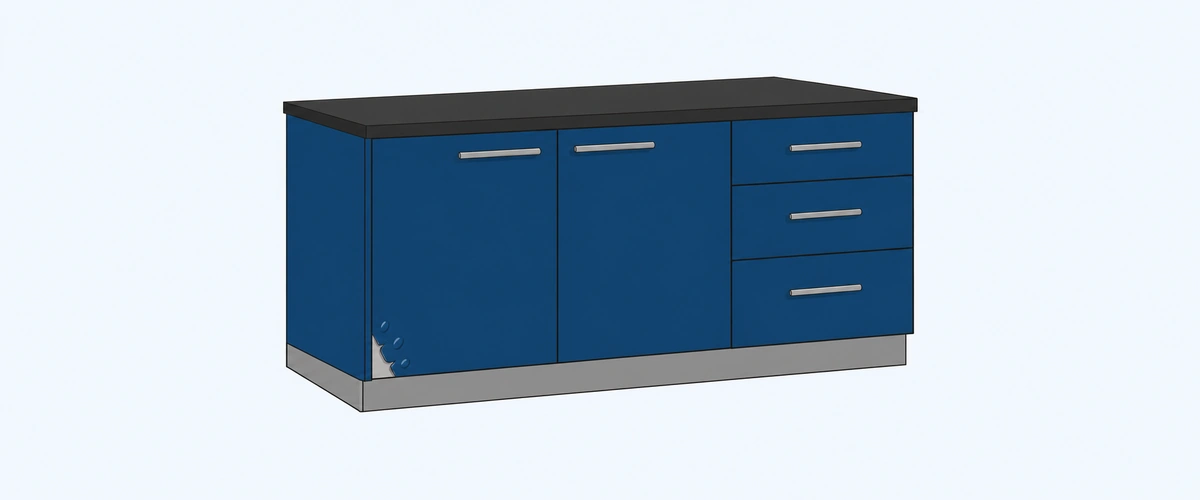
Why Laboratory Cabinet Finishes Fail: Causes, Prevention, and Material Selection
Laboratory cabinets should withstand years of daily use. But what happens when their finishes start peeling, bubbling, discoloring, or showing signs of corrosion? These are all examples of laboratory cabinet finish failure that can impact both appearance and longevity.
Many people immediately assume that poor manufacturing or improper powder-coating application caused the damage.
Sometimes they’re right.
However, several factors can cause laboratory cabinet finish failure, including chemical exposure, repeated cleaning, physical damage, environmental conditions, and improper material selection.
A cabinet that performs well in an educational laboratory may face very different conditions in a pharmaceutical cleanroom or chemical preparation area.
Understanding why finishes deteriorate helps laboratory managers, architects, and facility teams select appropriate materials, recognize early warning signs, and avoid premature replacement.
1. What Causes Laboratory Cabinet Finishes to Fail?
To understand laboratory cabinet finish failure, start with the coating’s purpose.
Manufacturers typically fabricate metal laboratory casework and apply a protective powder coating under controlled conditions.
The coating creates a barrier between the underlying metal and the surrounding environment. It also improves appearance, cleanability, and resistance to everyday wear.
However, powder coating cannot withstand every condition.
Several factors influence its performance:
- Coating chemistry and formulation
- Surface preparation and application quality
- Proper curing and coating thickness
- Chemical and disinfectant exposure
- Cleaning frequency and procedures
- Physical wear, impact, and abrasion
- Environmental conditions, including moisture and humidity
Problems in any of these areas can affect the finish.
The question isn’t simply whether a cabinet has powder coating. It’s whether the coating system can handle the laboratory’s operating conditions.
2. Chemical Exposure: Not Every Powder Coating Performs the Same Way
Laboratory environments expose furniture to a wide range of chemicals. Depending on the application, cabinets may encounter acids, bases, solvents, disinfectants, or residues from laboratory processes.
Some chemicals reach cabinet surfaces through occasional spills. Others come into contact with the finish during daily cleaning.
This distinction matters. A coating may tolerate brief chemical contact but deteriorate after repeated exposure over several months or years.
Chemical concentration, temperature, contact time, and rinsing procedures also influence performance.
Standard Polyester Powder Coatings
Manufacturers commonly use standard polyester powder coatings on metal laboratory cabinets.
These coatings can provide durable finishes for general laboratory applications, including many educational, research, and industrial environments.
However, their chemical resistance varies by formulation.
Project teams shouldn’t automatically assume that standard polyester coatings can tolerate aggressive disinfectants or repeated exposure to corrosive chemicals.
Enhanced Polyester Formulations
Some manufacturers develop enhanced polyester powder coatings to improve specific performance characteristics, including weathering or ultraviolet resistance.
These formulations may benefit laboratories with relevant environmental exposures.
However, improved UV resistance doesn’t guarantee better resistance to every laboratory chemical or disinfectant.
Always review the specific coating’s performance data.
Epoxy-Based Powder Coatings
Epoxy-based powder coatings may offer greater resistance to certain chemicals and demanding indoor environments.
Some formulations also undergo laboratory furniture performance testing.
For example, the Scientific Equipment and Furniture Association (SEFA) publishes standards that address laboratory furniture and equipment performance.
However, strong results under a particular test don’t guarantee compatibility with every chemical or cleaning regimen.
Project teams must compare testing conditions with the laboratory’s actual exposure.
Epoxy coatings may also respond differently to ultraviolet exposure than polyester coatings.
The best coating isn’t necessarily the one with the strongest general chemical-resistance claim. It’s the one whose tested performance matches the laboratory’s requirements.
3. Cleaning Procedures Can Cause More Damage Than Laboratory Processes
Cleaning regimens often contribute to laboratory cabinet finish failure.
A laboratory may use relatively mild chemicals during normal testing but disinfect its furniture several times per day.
Consider a facility that regularly uses sodium hypochlorite solutions, accelerated hydrogen peroxide, or peracetic acid-based disinfectants.
Each product has different chemical properties. Its effects on cabinet finishes depend on formulation, concentration, contact time, and frequency of use.
When project teams overlook cleaning procedures during material selection, they risk exposing cabinets to conditions the coating cannot tolerate.
Why Repeated Exposure Matters
Imagine two laboratories that purchase identical powder-coated metal cabinets.
The first laboratory cleans its cabinets with a compatible solution as needed.
The second laboratory performs multiple daily disinfection cycles using a stronger chemical formulation.
Although both facilities use identical cabinetry, their finishes may deteriorate at very different rates.
Repeated wetting, chemical contact, and drying create cumulative exposure that occasional-spill testing may not fully represent.
What Should You Review?
Before specifying laboratory cabinets, ask:
- Which cleaning and disinfecting products will staff use?
- What working concentrations will they apply?
- How often will staff clean the cabinets?
- What contact or dwell times do the procedures require?
- Will staff rinse or wipe the surfaces afterward?
- Will chemicals accumulate around cabinet edges, seams, or hardware?
- Does the coating manufacturer provide compatibility information for these products?
These questions help determine whether powder-coated metal suits the application or whether the project requires another material.
4. Physical Damage: When a Small Chip Becomes a Larger Problem
Chemical exposure doesn’t cause every finish failure.
Laboratory cabinets also experience physical wear.
Rolling equipment, carts, stools, chemical containers, and other objects can strike cabinet doors, corners, and drawer fronts.
Repeated abrasion can gradually wear away protective coatings.
When an impact chips or scratches the powder coating deeply enough, it may expose the underlying steel.
Moisture or corrosive chemicals can then reach the metal and initiate corrosion.
Depending on the conditions, corrosion may spread beneath the surrounding coating and cause bubbling, lifting, or additional deterioration.
Common High-Wear Areas
Cabinet finishes often experience greater wear around:
- Door edges and corners
- Drawer fronts
- Cabinet bases and toe kicks
- Areas near sinks
- Frequently handled surfaces
- Locations with frequent cart or equipment movement
Project teams should consider these areas during specification, and maintenance teams should inspect them regularly.
A damaged finish doesn’t automatically mean the entire cabinet has failed. However, exposed metal requires attention.
Early inspections and manufacturer-approved repair procedures may help prevent localized damage from spreading.
5. Moisture and Corrosion: What’s Happening Beneath the Coating?
Powder coating protects metal cabinetry, but the underlying steel can still corrode when moisture and corrosive substances reach it.
This becomes especially important in laboratories with frequent washdowns, wet processes, or persistent humidity.
For example, cabinets beneath sinks may encounter plumbing leaks, condensation, or repeated splashing.
Cabinet bases may also come into contact with wet floors or cleaning chemicals.
An intact, compatible coating can protect the substrate against these exposures.
However, physical damage, application defects, or vulnerable transitions may allow moisture to reach the metal.
Over time, corrosion can produce staining, bubbling, or coating separation.
Does Rust Always Indicate Poor Coating Quality?
It does not.
Several factors can cause rust, including coating damage, environmental exposure, inadequate surface preparation, and an unsuitable coating system.
Investigators should evaluate the affected area and its surrounding conditions before identifying the cause.
For example, localized rust around a damaged cabinet corner suggests a different issue than widespread coating separation across an otherwise undamaged panel.
The location and appearance of the damage provide useful clues, but they don’t establish the cause by themselves.
6. Application and Curing Quality Also Matter
Laboratory operating conditions influence cabinet durability, but manufacturing quality remains equally important.
Even a suitable coating can fail when manufacturers apply it incorrectly.
Successful powder-coating processes require proper substrate preparation, controlled application, and appropriate curing conditions.
Inadequate cleaning or pretreatment, improper film thickness, insufficient curing, and other process variations can affect adhesion and long-term performance.
Signs That May Require Further Investigation
Watch for:
- Widespread peeling or flaking
- Poor adhesion across multiple panels
- Unusual blistering without an obvious exposure source
- Premature coating separation
- Inconsistent performance between components that experience similar conditions
These problems warrant investigation rather than an immediate assumption about their cause.
Laboratory cabinet finish failure doesn’t always originate with the laboratory, and it doesn’t always originate with the manufacturer.
An accurate assessment considers the coating system, application quality, exposure history, and observed damage.
7. When Should You Consider Stainless Steel Instead?
Some laboratory environments place greater demands on cabinetry than powder-coated metal can reasonably handle.
Facilities with aggressive cleaning regimens, repeated chemical exposure, or demanding sanitation requirements may benefit from stainless steel casework.
However, stainless steel doesn’t resist every chemical or corrosion mechanism.
The alloy matters.
304 stainless steel serves many laboratory applications, while 316 stainless steel may provide improved resistance under certain corrosive conditions.
For example, chloride-containing cleaning products can create corrosion concerns for stainless steel.
Project teams should evaluate concentration, temperature, contact duration, and cleaning practices before selecting an alloy.
316 stainless steel may offer advantages in certain environments, but it cannot withstand every disinfectant or chemical without risk.
What About Phenolic Resin Cabinets?
Phenolic resin casework may suit laboratories that require moisture resistance and other material-specific characteristics.
However, phenolic resin also has chemical and cleaning limitations.
Repeated exposure to incompatible disinfectants, including certain bleach-based cleaning regimens, may contribute to deterioration or delamination.
The specific product and exposure conditions determine the risk.
Replacing powder-coated metal with phenolic resin doesn’t automatically solve a chemical compatibility problem.
A material change only helps when the alternative performs better under the laboratory’s actual conditions.
8. How to Identify the Cause of Laboratory Cabinet Finish Failure
Before repairing or replacing cabinets, investigate the conditions that may contribute to their deterioration.
The following observations can help guide your assessment.
| What You Observe | Possible Contributing Factors | What to Investigate |
|---|---|---|
| Discoloration or fading | Chemical exposure, UV exposure, coating formulation | Cleaning products, lighting, coating specifications |
| Peeling or flaking | Adhesion problems, chemical exposure, physical damage | Surface preparation, curing, exposure history |
| Bubbling beneath the finish | Corrosion, moisture intrusion, coating defects | Substrate condition, leaks, coating damage |
| Rust around edges or corners | Impact damage, moisture, corrosive exposure | Exposed metal, cleaning practices, nearby equipment |
| Deterioration near sinks | Repeated wetting, leaks, incompatible chemicals | Plumbing, moisture accumulation, coating compatibility |
| Scratches and chips | Carts, equipment, repeated impact or abrasion | Traffic patterns, equipment clearance, maintenance |
| Widespread premature deterioration | Coating suitability, application quality, environmental exposure | Manufacturing records, coating data, cleaning regimen |
These observations suggest possible causes rather than definitive diagnoses.
A qualified professional may need to evaluate the cabinets to determine whether localized damage, environmental incompatibility, or a manufacturing defect caused the problem.
9. How to Prevent Premature Cabinet Finish Deterioration
The most effective prevention strategies begin before the laboratory orders its cabinets.
Laboratory managers, architects, and facility teams should evaluate both laboratory processes and cleaning procedures.
Match the Coating to the Application
Don’t select a coating based only on appearance or broad chemical-resistance claims.
Review the manufacturer’s technical information and relevant test results.
Review Cleaning Procedures Early
Identify disinfectants, concentrations, contact times, and cleaning frequency before choosing cabinet materials.
A new cleaning regimen can introduce exposures that the original furniture specification never anticipated.
Consider High-Impact Areas
Identify locations where carts, equipment, or frequent handling may damage cabinet finishes.
Consider layout changes or protective measures that reduce repeated impacts.
Address Damage Promptly
Inspect cabinets regularly and follow manufacturer-approved procedures to repair damaged coatings.
Don’t assume that ordinary touch-up paint or sealant will provide equivalent protection.
Investigate Moisture Sources
Check for leaks, condensation, and locations where cleaning liquids accumulate.
Correct the exposure source rather than focusing exclusively on the damaged finish.
Avoid Unnecessary Upgrades
Not every laboratory needs stainless steel or a specialized powder-coating system.
Standard powder-coated casework may offer a practical solution when the exposure conditions support its use.
The goal is to match each material to its intended location and function.
10. Laboratory Cabinet Finish Selection Checklist
Before specifying new cabinetry, consider these questions.
| Specification Question | Why It Matters |
|---|---|
| What chemicals will contact the cabinets? | Identifies chemical-resistance requirements |
| What disinfectants will staff use? | Establishes routine chemical exposure |
| How frequently will staff clean the surfaces? | Helps assess cumulative exposure |
| Will cabinets encounter standing moisture? | Identifies potential corrosion risks |
| Will the laboratory expose cabinets to UV light? | Helps determine coating UV-stability requirements |
| Will carts or equipment frequently strike the cabinets? | Highlights physical damage risks |
| What coating system does the specification require? | Distinguishes between coating formulations |
| What performance-testing documentation can the manufacturer provide? | Supports material selection under defined conditions |
| Would stainless steel or another material perform better? | Helps evaluate alternatives for demanding environments |
| What maintenance procedures does the manufacturer recommend? | Supports long-term finish performance |
This review helps project teams avoid specifications that underestimate laboratory demands or introduce unnecessary costs.
The Bottom Line: Cabinet Finish Failure Isn’t Always a Manufacturing Problem
When laboratory cabinets begin deteriorating, many people immediately suspect a defective finish.
However, chemical exposure, cleaning procedures, physical damage, moisture, application quality, or several combined factors may cause the problem.
Powder coating alone doesn’t establish whether a cabinet suits the laboratory.
The coating formulation, performance testing, fabrication process, and operating environment all influence durability.
Similarly, upgrading every cabinet to stainless steel doesn’t necessarily provide the best solution.
The objective is to specify laboratory cabinets that can withstand the conditions they’ll actually encounter, rather than selecting materials based on perceived durability alone.
Understanding the causes of laboratory cabinet finish failure helps project teams make informed decisions, reduce avoidable maintenance, and extend the useful life of their furniture.
Selecting Laboratory Cabinets for Your Facility?
At OnePointe Solutions, we manufacture powder-coated metal laboratory cabinets, stainless steel casework, and phenolic resin cabinetry for a variety of laboratory applications.
Our team works with architects, facility managers, contractors, and laboratory end users to evaluate material selection, coating options, cleaning requirements, and project-specific considerations. And if needing a certain type of powder for your cabinets, let us know. We have access to various types of powders to make sure the right finish compliments the laboratory environment.
So whether you’re designing a new laboratory or replacing deteriorating cabinetry, we can help review the options that best suit your application.
Contact OnePointe Solutions to discuss your laboratory casework requirements.
Author: OnePointe Solutions Lab Design Team