


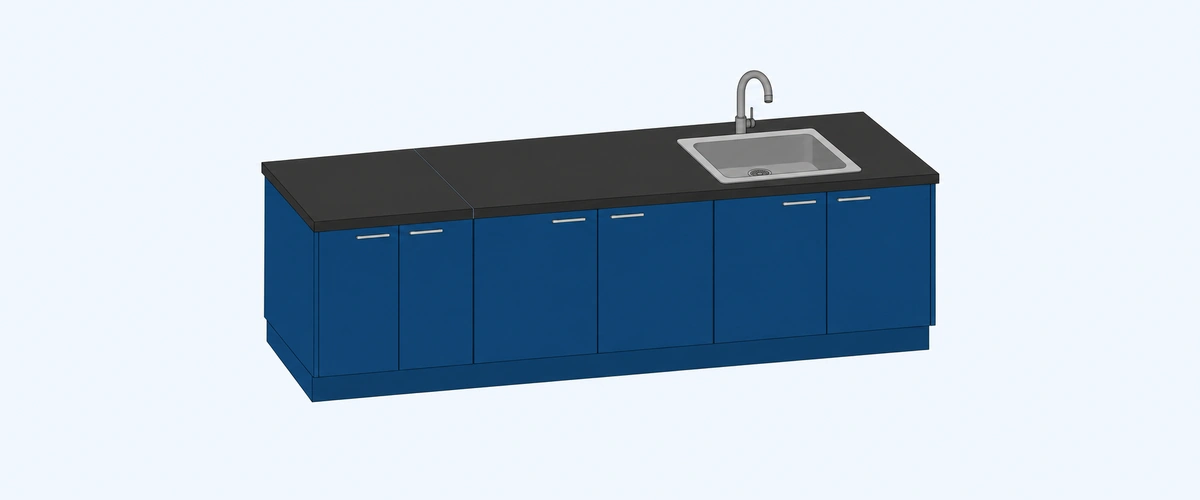
When selecting laboratory countertops, most conversations begin with the material. However, it’s also important to consider laboratory countertop seams and how they affect durability and functionality.
Should the laboratory use epoxy resin, phenolic resin, stainless steel, or another work surface? Which option will withstand the chemicals, cleaning procedures, moisture, and equipment used in the room?
Those are important questions. But even when the right material is selected, the installation details can introduce problems that weren’t anticipated during specification.
A countertop may perform well across its main surface while deterioration begins around a sink opening, at an exposed edge, or where two sections meet.
Laboratory countertop seams, joints, and cutouts deserve the same attention as the material itself.
These details influence how a work surface handles moisture, chemical exposure, cleaning, and daily operation.
Understanding where vulnerabilities can develop helps architects, laboratory managers, and facility teams make better decisions before manufacturing and installation begin.
1. Why Laboratory Countertop Seams Matter
A laboratory countertop isn’t always manufactured or installed as one continuous piece.
Long cabinet runs, room dimensions, transportation limitations, and installation conditions may require multiple sections.
Where those sections meet, a seam or joint is created.
The presence of a seam doesn’t automatically indicate poor construction. Properly designed and installed joints are a normal part of many laboratory furniture projects.
The concern is whether the joint is appropriate for the countertop material and the laboratory’s operating conditions.
Depending on the construction, joints may require compatible adhesives, sealants, mechanical support, or other installation details.
A poorly executed joint can create a location where liquids accumulate, cleaning becomes more difficult, or moisture reaches materials that aren’t intended for repeated exposure.
What should be evaluated?
When reviewing laboratory countertop seams, consider:
- Where the joints will be located
- Whether the joint is exposed to routine chemical handling
- How liquids and cleaning agents may contact it
- Whether the joint has appropriate structural support
- What installation and sealing methods the manufacturer requires
- Whether the joint can be inspected and maintained
The objective isn’t necessarily to eliminate every seam. It’s to place and construct joints appropriately for the laboratory’s use.
2. Sink Cutouts Can Introduce Additional Exposure
Sinks are among the most demanding locations in a laboratory countertop installation.
They introduce repeated moisture exposure, cleaning, plumbing connections, and potentially chemicals.
The opening itself also changes the countertop’s geometry. Material is removed to accommodate the sink, and the remaining surface must continue to provide adequate support.
The requirements depend on the countertop material, sink type, cutout dimensions, and manufacturer-approved fabrication details.
Why cutout details matter
A sink opening may introduce several considerations:
Exposed material. Some countertop constructions require particular treatment of cut edges to prevent moisture intrusion or deterioration.
Support. The area surrounding the opening must remain adequately supported.
Sealing. Sink-to-countertop connections must be compatible with the selected materials and anticipated exposure.
Cleaning. Joints and transitions should not create unnecessary locations for residue accumulation.
Chemical compatibility. Sealants and other joint materials may have different resistance characteristics than the main countertop.
A chemically resistant work surface doesn’t automatically mean every material used around its sink opening has the same resistance.
That distinction becomes particularly important in laboratories with frequent disinfection or chemical handling.
3. Epoxy Resin Countertops: Consider the Complete Installation
Epoxy resin countertops are commonly selected for laboratory applications requiring resistance to many chemicals and demanding work conditions.
However, the performance of an epoxy resin installation depends on more than the slab.
Sink configurations, joint placement, fabrication, and manufacturer-approved installation methods should also be reviewed.
For example, a laboratory may specify epoxy resin for a chemical preparation area because of its compatibility with the expected chemical inventory.
But the project still needs to determine how countertop sections will be joined and how sinks and service penetrations will be incorporated.
With epoxy resin, seams are joined by a color-match 2-part epoxy smooth-on kit. Check out our instruction video for more detail – How to Mix & Apply Epoxy Smooth-On for Laboratory Countertops – OnePointe Solutions
What about chemical exposure?
Even chemically resistant materials have limitations. The chemical, concentration, temperature, contact duration, and cleaning procedure can influence performance.
Repeated exposure to a particular disinfectant may also create different conditions than an occasional spill. The countertop manufacturer should be consulted for material-specific compatibility and installation guidance.
Laboratory countertop seams should be considered part of the chemical exposure review, not treated as an unrelated construction detail.
4. Phenolic Resin Countertops: Pay Attention to Edges and Moisture
Phenolic resin countertops are used in a variety of laboratory environments because of their physical properties and resistance to many common exposures.
But the material should still be evaluated against the laboratory’s specific chemicals and cleaning procedures.
Particular attention should be given to cutouts, edges, joints, and any locations where the material’s internal construction could become exposed.
Depending on the product and exposure, prolonged contact with incompatible chemicals or cleaning agents may contribute to deterioration.
For example, repeated exposure to certain bleach-based cleaning regimens can be problematic for some phenolic resin constructions.
That doesn’t mean phenolic resin is unsuitable for every laboratory using disinfectants. It means the selected product, concentration, frequency, contact duration, and fabrication details should be reviewed before approval.
Note: Phenolic resin join seams follow the same instruction as epoxy resin countertops. However, smooth-on will be black for black core phenolic or color-matched for color-through core (CTC) phenolic i.e. Fundermax
Why this matters at the sink
A sink opening may receive more frequent moisture exposure than other areas of the countertop.
If the cutout or surrounding joint isn’t fabricated and maintained according to the manufacturer’s requirements, that location may be more vulnerable than the uninterrupted work surface.
The countertop material and its exposed installation details must both be appropriate for the application.
5. Stainless Steel Countertops: Welds and Joints Matter Too
Stainless steel countertops are often selected where sanitation, cleanability, and particular chemical-resistance requirements are important.
But stainless steel isn’t a single universal specification. The alloy, finish, fabrication methods, and exposure conditions all influence suitability.
For example, 304 and 316 stainless steel have different resistance characteristics, and neither is immune to every chemical or cleaning agent.
Stainless steel installations also introduce considerations around welds, joints, corners, and sink integration.
What should be reviewed?
For stainless steel work surfaces, the project team may need to evaluate:
- The specified stainless steel alloy
- Welded versus mechanically joined construction
- Weld finishing and surface condition
- Sink integration and transitions
- Drainage and locations where liquids may remain
- Cleaning procedures and chemical exposure
Poorly finished joints or locations that retain aggressive cleaning chemicals can create maintenance and corrosion concerns.
A stainless steel countertop should therefore be evaluated as a fabricated assembly, not simply by the grade of metal listed on the specification.
6. The Location of a Seam Can Be as Important as Its Construction
Consider two laboratory countertop installations using the same material. In the first laboratory, a seam is positioned in a relatively dry area used primarily for documentation and equipment placement.
In the second, a similar seam is located directly beside a sink where liquids and cleaning agents are used throughout the day.
Even if the joint construction is identical, the exposure conditions may be very different. This is why laboratory countertop seams should be reviewed during layout development.
Where practical, joint locations should be coordinated with sinks, chemical handling zones, equipment footprints, and other demanding areas. The manufacturer may have limitations based on available slab dimensions, fabrication methods, and installation requirements.
Early coordination allows the design team to consider those limitations before the countertop layout is finalized. Seam placement should be a deliberate design decision whenever possible, not simply an outcome discovered during installation.
7. Equipment and Utility Cutouts Need Attention
Sink openings aren’t the only penetrations in a laboratory work surface.
Countertops may require openings for electrical services, plumbing fixtures, gas fittings, equipment connections, or specialized instruments.
Each opening introduces a fabrication detail that should be coordinated before manufacturing.
A cutout that’s too close to an edge, support, or another opening may create problems depending on the material and construction.
Changes made after fabrication can also introduce additional work or require replacement components.
For example, relocating a service fixture after the countertop has been manufactured may not be as straightforward as drilling a new hole.
The manufacturer may need to evaluate whether the modification is permitted and whether it affects structural support, chemical resistance, or warranty coverage.
Plan cutouts around the equipment
Before finalizing countertop drawings, confirm equipment dimensions, fixture locations, service clearances, and required openings.
That coordination can reduce field modifications and help ensure that the finished work surface supports the laboratory’s intended workflow.
8. Cleaning Procedures Can Affect Joints Differently Than Surfaces
A laboratory may select a countertop material based on chemical compatibility data.
But those test results don’t necessarily describe the performance of every adhesive, sealant, or joint material used in the installation.
Consider a laboratory that disinfects its countertops multiple times per day. The work surface may tolerate the approved cleaning procedure, while a particular sealant has different exposure limitations.
Over time, an incompatible joint material could deteriorate even though the main countertop remains serviceable.
That possibility should be evaluated during material selection. When reviewing laboratory countertop seams, ask whether the manufacturer has guidance for the complete installation under the expected cleaning regimen.
This includes the chemicals used, their concentrations, contact times, rinsing procedures, and cleaning frequency.
Chemical compatibility should be assessed for the materials actually exposed, not just the name of the countertop.
9. When Does a Countertop Joint Need Repair or Replacement?
Not every visible seam or surface imperfection indicates failure.
Some joints are intentionally visible, and their appearance may differ depending on the countertop material and installation method.
However, certain changes should prompt inspection.
Examples include:
- A joint that begins separating
- Sealant that is cracking, peeling, or missing
- Persistent moisture accumulation around a sink
- Swelling or deterioration near an exposed edge
- Staining or corrosion concentrated around a joint
- Movement or loss of support near a cutout
The appropriate response depends on the material, condition, and extent of the problem.
Some issues may be repairable using manufacturer-approved methods.
Others may require replacement of a countertop section or correction of the underlying installation conditions.
Applying an unapproved adhesive or sealant may not address the original cause and could create additional compatibility problems.
The countertop manufacturer or qualified installation professional should evaluate the condition before repairs are selected.
10. Laboratory Countertop Seams and Cutouts: A Planning Checklist
Before approving countertop fabrication drawings, use this checklist to review details that can influence long-term performance.
| What to review | Why it matters |
|---|---|
| Countertop material | Must suit the laboratory’s chemicals, cleaning, and equipment requirements |
| Seam locations | Exposure varies across wet, dry, and chemical-handling areas |
| Joint construction | Adhesives, sealants, and support details affect performance |
| Sink cutouts | Require appropriate fabrication, support, and installation |
| Exposed edges | May require material-specific treatment or protection |
| Utility penetrations | Must be coordinated with equipment and service locations |
| Stainless steel welds | Fabrication and finishing can influence cleanability and corrosion performance |
| Cleaning procedures | Joint materials may have different limitations than the main surface |
| Inspection and maintenance | Accessible details are easier to evaluate and maintain |
| Manufacturer instructions | Help establish acceptable fabrication, installation, and repair methods |
The best time to review these details is before the countertop enters manufacturing.
The Bottom Line: The Material Is Only Part of the Specification
Laboratory countertop performance depends on more than selecting epoxy resin, phenolic resin, stainless steel, or another work surface.
Fabrication, seam placement, sink integration, exposed edges, and installation details all influence how the finished countertop performs.
A material may be appropriate for the laboratory’s chemical and cleaning requirements while a poorly planned joint creates an avoidable vulnerability.
That doesn’t mean every laboratory needs seamless construction or the most expensive countertop available.
It means the complete installation should be designed around the work being performed.
Laboratory countertop seams aren’t just finishing details. They’re part of the work surface’s overall performance.
Planning a Laboratory Countertop Project?
At OnePointe Solutions, we work with laboratory managers, architects, contractors, and facility teams to evaluate countertop materials, configurations, sink openings, and project-specific requirements.
Whether you’re planning a new laboratory or replacing existing work surfaces, our team can help review the material and fabrication considerations that matter for your application.
Contact OnePointe Solutions to discuss your laboratory countertop requirements.
Author: OnePointe Solutions Lab Design Team