


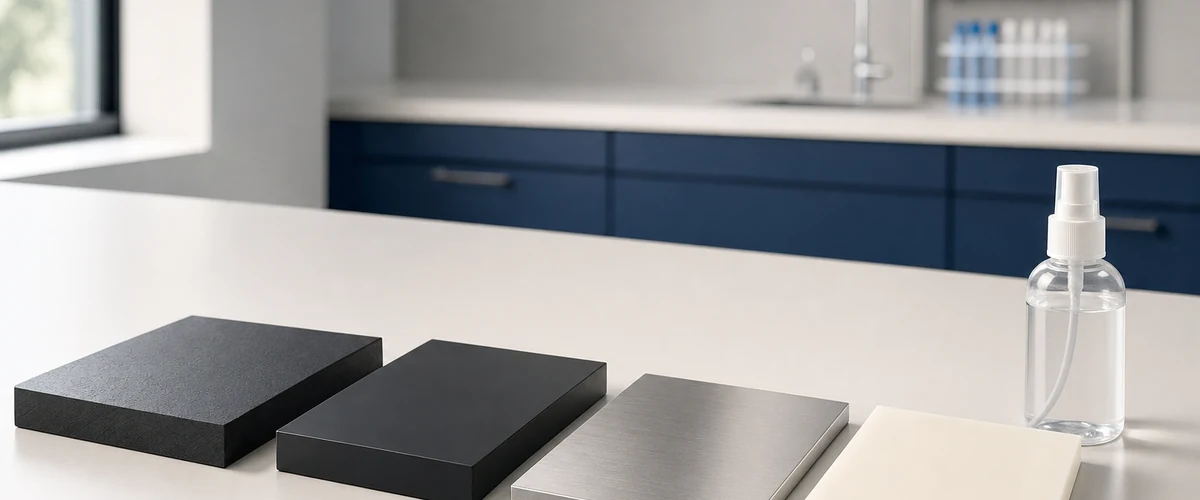
Sooner or later, a lab specifier get tasked with this scenario – Facilities want to switch to a stronger disinfectant. Infection control pushes for routine bleach wipe-downs on the benches. A biohazard spill triggers the 1:10 sodium hypochlorite line in the SOP. And so the question becomes this:
Which countertop material actually survives bleach?
The short answer is that lab countertop materials handle bleach differently, and a few materials struggle with it at higher concentrations. This guide compares four materials — phenolic resin, epoxy resin, 316 stainless steel, and polypropylene — against three realistic bleach-exposure scenarios, with each ranking anchored to a primary-source publication.
Understanding laboratory countertop bleach resistance generally is not a single-material decision. Furthermore, a lab countertop chosen for the wrong exposure band can degrade well before its expected service life. Consequently, our guide breaks laboratory countertop bleach resistance down against realistic use scenarios so the specifier can match the surface to the actual chemistry in the room.
The Three Bleach Scenarios That Matter
Before ranking laboratory countertop bleach resistance across the four candidates, define the exposure. Notably, the word “bleach” covers a wide range of concentrations, and material performance depends heavily on which one you actually use. Furthermore, published compatibility guidance changes dramatically across these bands. Therefore the first step in any specification conversation is naming the concentration and the frequency.
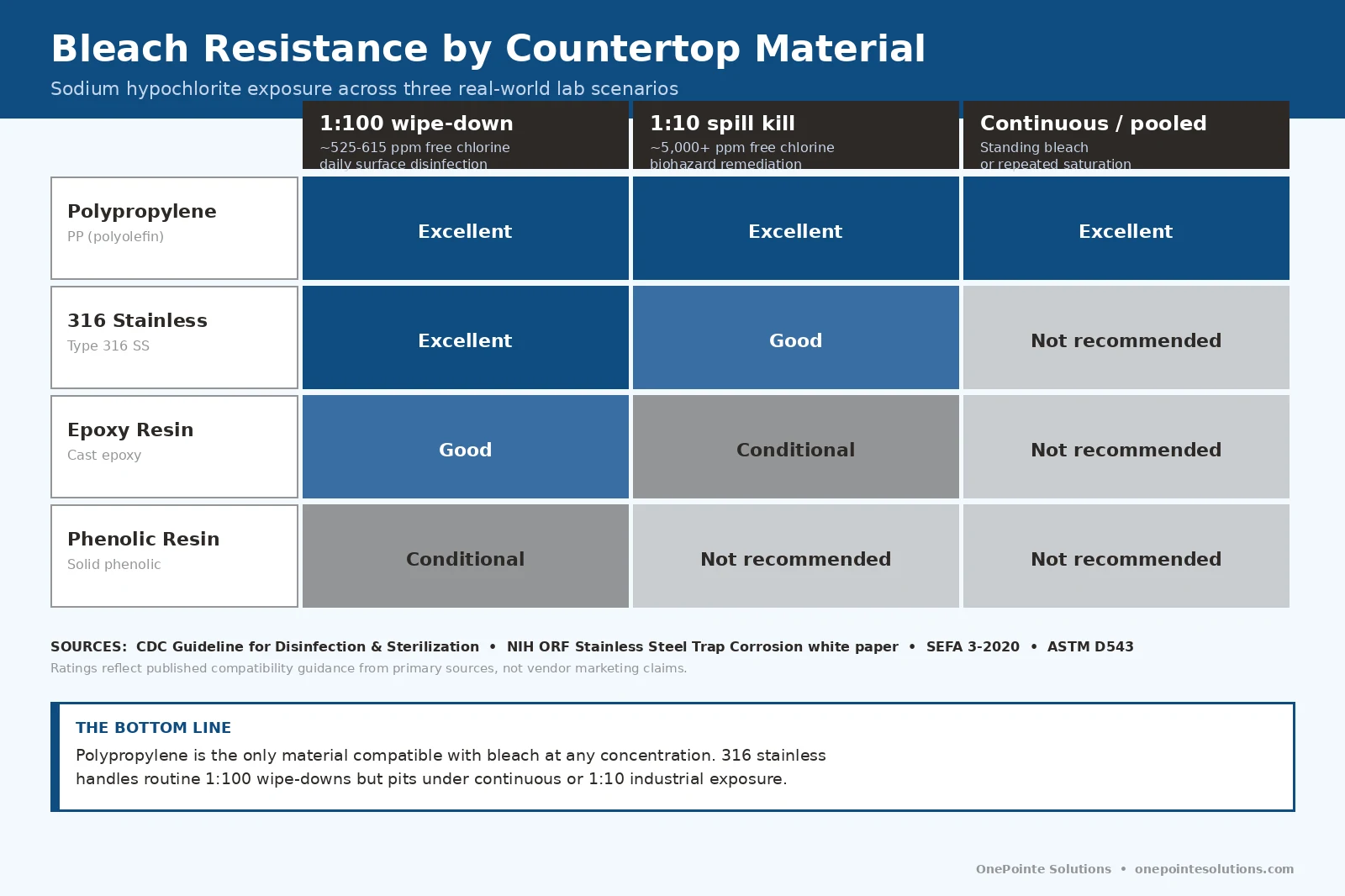
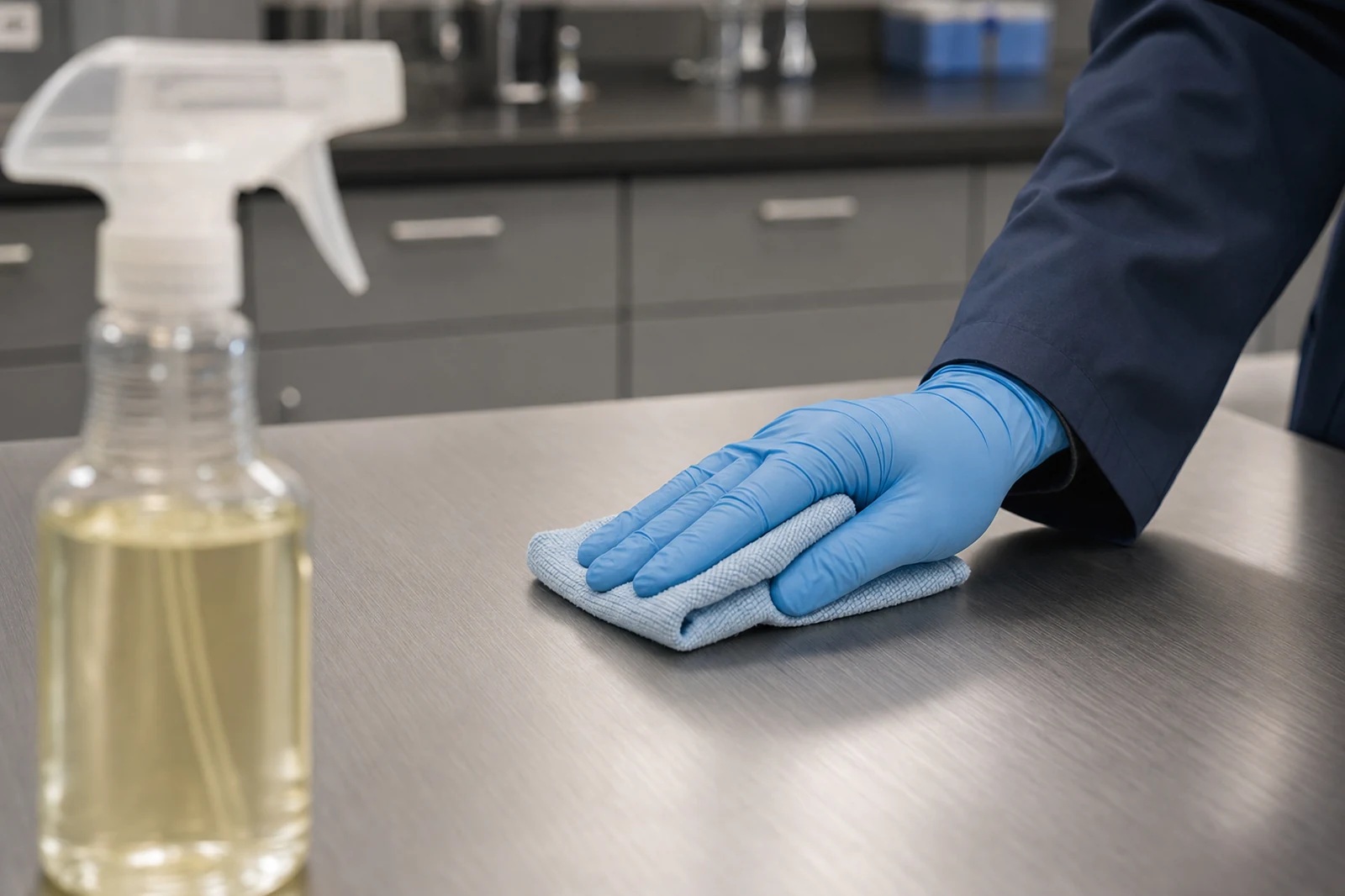
The CDC Guideline for Disinfection and Sterilization in Healthcare Facilities defines the routine range as a 1:100 dilution of household bleach, which delivers roughly 525 to 615 ppm of available free chlorine. This is the concentration used for daily bench wipe-downs and general surface disinfection. Exposure is brief. Contact time is measured in minutes. The surface gets rinsed.
Next comes the 1:10 dilution, roughly 5,000 to 5,250 ppm free chlorine. The CDC Chapter 12 Laboratory Methods document is explicit about this concentration and its cost: “A 1:10 (10%) dilution of bleach is corrosive and will pit stainless steel and should not be used routinely; however, it may be used to clean up spills of cultured or concentrated infectious material.” Consequently, this is the biohazard-remediation concentration, deployed occasionally and rinsed immediately.
Finally, the third scenario is continuous or pooled exposure. This means standing bleach, repeated saturation without full rinse, or process environments where hypochlorite sits on the surface for hours. Consequently, this is where materials separate. The NIH Office of Research Facilities Stainless Steel Trap Corrosion white paper documents exactly this failure mode in their own drainage system, where “high incidence usage of Ultra Clorox Germical Bleach as a disinfectant” caused pitting failure in 316L stainless traps.
Polypropylene: The Strongest Bleach Compatibility of the Four
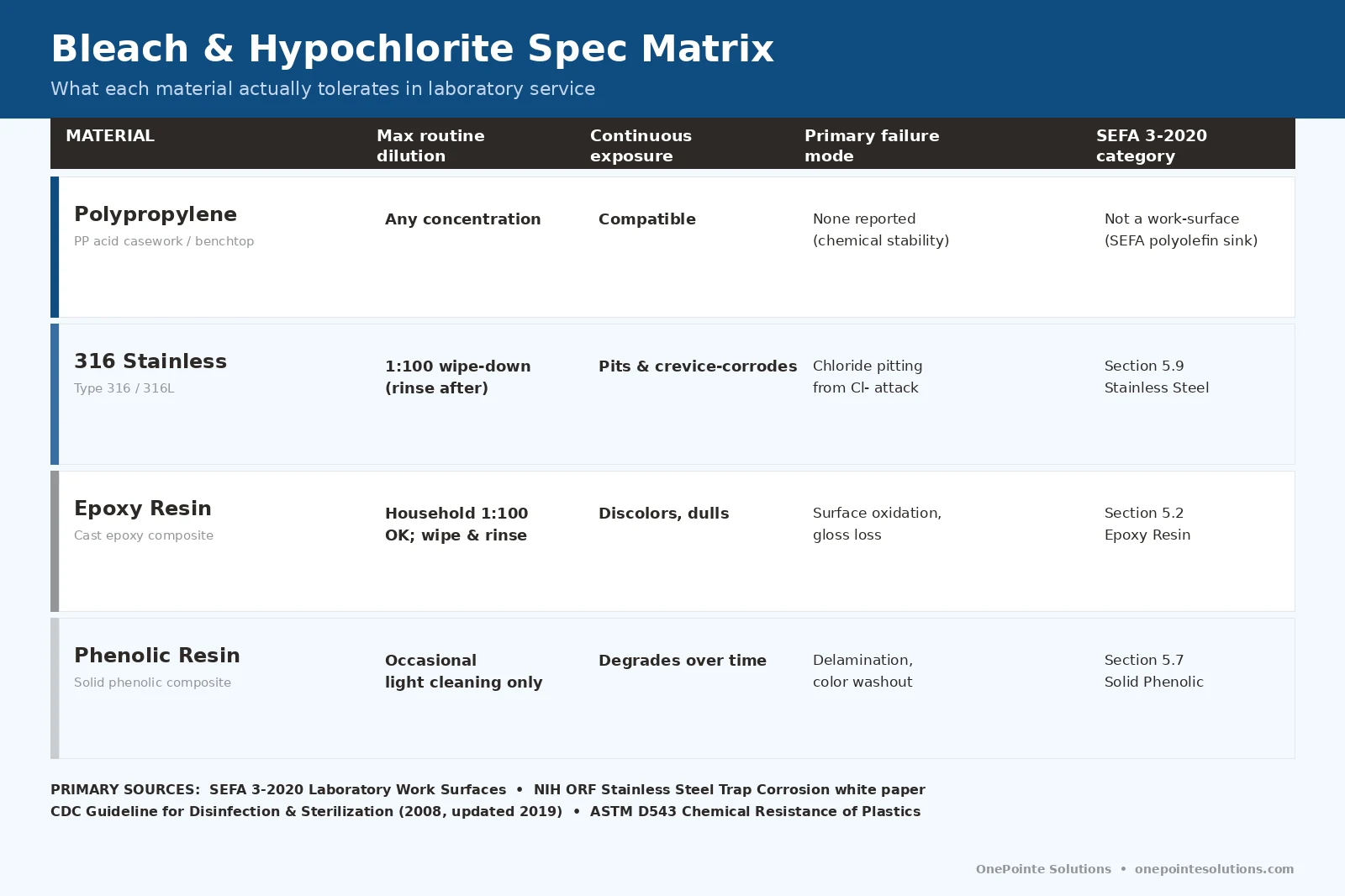
Polypropylene tends to sit at the top of published sodium hypochlorite compatibility charts. As a polyolefin, PP does not contain the reactive chemistry that bleach attacks. The NRC Addition of Sodium Hypochlorite compatibility reference lists polypropylene as “Compatible” with sodium hypochlorite, alongside polyethylene, PVC, and Teflon. Stainless steel 304 and 316 both appear on the “Not Compatible” side of the same table.
Consequently, polypropylene handles all three exposure scenarios well. Routine 1:100 wipe-downs cause no meaningful damage. Emergency 1:10 spill kill causes no meaningful damage. Moreover, continuous saturation is generally tolerated without surface breakdown. In water treatment, chlorination contact surfaces routinely use polypropylene for this reason. Additionally, the EPA guidance and NSF/ANSI 61 potable-water contact standards both recognize the polymer’s stability against chlorine chemistry. As a result, PP tends to deliver the strongest laboratory countertop bleach resistance among the four when the room requires continuous hypochlorite service.
However, polypropylene has one important limitation for lab countertop specifiers. SEFA 3-2020 does not list polypropylene among its nine work-surface material categories. Those categories are edge grain hardwood, epoxy resin, fiber cement, high pressure laminate, impregnated natural stone, solid phenolic composite, solid surface, stainless steel, and welded fiber. Instead, PP appears in SEFA 3 as a polyolefin sink material, and it is the standard material for acid-storage cabinets in laboratory casework.
So polypropylene comes out ahead on the bleach-compatibility test, but the specifier still needs to think about where it fits in the room. Full PP benchtops exist and work, though they are less common than PP sinks and cabinets. Therefore if continuous bleach exposure is a firm requirement, PP is usually the right answer. However, if bleach is one variable among many, the tradeoffs get more interesting.
316 Stainless Steel: Well-Suited to Wipe-Downs, Less to Heavier Exposure
This is where the story gets nuanced. Type 316 stainless steel handles the routine 1:100 daily wipe-down scenario very well. It is easy to clean, non-porous, and holds up under standard laboratory disinfection protocols. Notably, clinical labs, cleanrooms, and biosafety spaces often run 316 benchtops without bleach-related damage when their exposure stays at routine dilution and includes a rinse step.
However, the picture changes at higher concentrations. The CDC guideline states plainly that “hypochlorites are corrosive to metals in high concentrations (over 500 ppm) and can discolor fabrics.” A 1:10 dilution runs at ten times that threshold. Moreover, the NIH ORF white paper documented pitting failure of 316L stainless traps in their own facilities, and concluded: “In general, stainless steel is not recommended for use with sodium hypochlorite. Many grades of stainless steels will suffer from severe pitting and crevice corrosion when continuously exposed to sodium hypochlorite.”
The mechanism is chloride attack. Specifically, the molybdenum content in 316 gives it better chloride resistance than 304, but “better” is not “immune.” Chloride ions penetrate the passive chromium oxide layer at weak spots, initiate a pit, and then autocatalyze deeper. Additionally, standing bleach delivers all three worst-case conditions simultaneously: high chloride, elevated pH swings, and long dwell.
The practical laboratory countertop bleach resistance advice for 316 stainless is exposure-specific. It works well for daily 1:100 protocols. Rinse thoroughly after any 1:10 spill kill. Reconsider it for continuous hypochlorite zones. In particular, weigh alternatives to stainless drainage traps in bleach-heavy rooms — the lab sinks and traps conversation is where this shows up most.
Epoxy Resin: Household Bleach OK, Industrial Bleach Not
Epoxy resin is the most common laboratory countertop material in North America, and it handles bleach at household concentrations reasonably well. Cast epoxy tops are produced from “a composite of epoxy resin, silica, inert fillers and organic hardeners,” per SEFA 3-2020 Section 5.2. The material is homogeneous, non-absorbent, and cures dense enough to resist most routine chemistry.
Consequently, routine 1:100 daily wipe-downs are fine on epoxy resin. Its laboratory countertop bleach resistance holds up well at household dilutions, and the surface may show only minor gloss loss over time under aggressive protocols. Moreover, the NIH Design Requirements Manual endorses this use case, stating that “epoxy or phenolic resin countertops shall be used in laboratories where more intensive use of chemicals, reagents, and harsh disinfectants is anticipated.”
The story shifts at 1:10 and higher. Concentrated hypochlorite oxidizes the resin surface. First the gloss dulls. Then discoloration sets in, usually a chalky lightening that no amount of cleaning restores. Under continuous exposure, the surface can lose its non-porous character as the resin degrades in localized spots. Consequently, an epoxy top in a room running frequent 1:10 spill kills will look and behave differently in five years than one in a room running only 1:100 wipes.
For most laboratories, this tradeoff is acceptable. The majority of bleach use in labs is routine daily wipe-down at 1:100, and epoxy handles that well over the long term. Furthermore, epoxy resin holds a strong chemical resistance profile against acids, solvents, and most reagents. So if the goal is one material that handles a broad chemistry mix, epoxy is often the answer — provided bleach is not the dominant chemistry. Our epoxy resin countertop guide covers the full spec profile.
Phenolic Resin: Generally a Poor Fit for Bleach-Heavy Service
Phenolic resin countertops perform well across many lab environments. However, bleach service is generally not one of their strengths. Specifically, SEFA 3-2020 Section 5.7 defines solid phenolic composite as “a compression molded composite of a homogeneous core of organic fiber reinforced phenolic and may contain one or more integrally cured surfaces that are non-porous.” Notably, the material’s chemistry — organic fiber bonded with phenolic resin — is what limits its hypochlorite tolerance.
Sodium hypochlorite is a strong oxidizer, and it can attack the resin binder that holds the phenolic composite together. Occasional light cleaning with a heavily diluted bleach solution will not immediately damage a phenolic top. Repeated exposure tends to. Under continuous or pooled bleach contact, the surface can first show color change, then delamination at the surface layer, and eventually progressive degradation of the core material.
The takeaway is that specification depends on how much bleach the room will see. If bleach cleaning is a routine part of the SOP, phenolic laboratory countertop bleach resistance is generally not a strong fit. If bleach is occasional and the surface gets rinsed quickly, phenolic can tolerate that — though expect some cosmetic degradation. Notably, the NIH DRM’s endorsement of phenolic for chemical service does not extend to hypochlorite disinfection routines.
For labs that do not run bleach protocols, phenolic remains a strong choice — it generally outperforms epoxy on scratch resistance, holds up well in wet service, and costs less. Our phenolic resin countertop guide explains where it belongs. But if bleach is on the SOP, a material with stronger laboratory countertop bleach resistance is generally the better call.
The Specifier’s Decision Framework
Specifying the right laboratory countertop comes down to three questions. First, what concentration of bleach will actually touch the surface? Second, how often? Third, will it be rinsed?
If the answer is “only 1:100 routine wipes with a rinse,” any of the four lab countertop materials will serve. Consequently, epoxy is usually the best all-around pick because it handles routine bleach and everything else. Furthermore, 316 stainless works well in clinical and cleanroom settings where the aesthetic and hygienic character matters.
However, if the answer includes routine 1:10 spill kills, phenolic is generally a poor fit and stainless deserves careful review. Epoxy tends to handle it with some cosmetic degradation. Polypropylene tends to handle it without visible degradation.
Finally, if the answer is continuous or pooled bleach exposure, or standing hypochlorite in process environments, polypropylene is generally the strongest fit among these four materials for laboratory countertop bleach resistance. Specifically, this is the water-treatment chlorination-contact zone, the industrial decant bench, or the specialty room where bleach is the working chemistry rather than an occasional disinfectant.
Finally, remember that a lab is a system. The countertop is one of several surfaces exposed to bleach in the room. Consider the sink and fixture materials, the drainage traps, the cabinet exterior, and even the wall protection. A stainless benchtop in a bleach-heavy room may hold up, while stainless traps in that same room can pit under repeated exposure. Meanwhile, an epoxy top paired with polypropylene traps and PP cabinets in the wet zones tends to outlast a rigid all-stainless build.
Primary Sources and Cross-References
- CDC Guideline for Disinfection and Sterilization in Healthcare Facilities — routine 1:100 dilution range, over-500-ppm corrosion threshold
- CDC Chapter 12 Laboratory Methods — explicit 1:10 stainless pitting warning
- NIH ORF Stainless Steel Trap Corrosion white paper — documented 316L failure mode from hypochlorite service
- NIH Design Requirements Manual — material selection guidance for chemical and disinfection service
- SEFA 3-2020 Laboratory Work Surfaces Standard — 49-reagent chemical/stain resistance test protocol and material category definitions
- NRC Addition of Sodium Hypochlorite — materials compatibility reference chart
- ASTM D543 Standard Practices for Evaluating the Resistance of Plastics to Chemical Reagents — polymer chemical resistance test methodology
- ASTM G48 Standard Test Methods for Pitting and Crevice Corrosion Resistance of Stainless Steels — chloride attack test methodology
For more on how these materials compare across other performance dimensions, see our lab casework materials guide and our how to care for your laboratory surfaces guide.
Deciding which laboratory countertop has the best bleach resistance is rarely a single-material decision. It depends on the concentration, frequency, and duration of bleach exposure in a specific room. Match the material to the exposure, and the surface tends to hold up for the life of the lab. Mismatch it, and replacement can arrive years ahead of schedule.
— The OnePointe Solutions Lab Design Team