


Laboratory Furniture Performance Requirements: Beyond Chemical Resistance
Chemical resistance is often one of the first considerations when specifying laboratory furniture. But it’s just one aspect of the broader laboratory furniture performance requirements. And for good reason. Laboratories routinely expose cabinets, countertops, and workstations to chemicals, disinfectants, moisture, and demanding operating conditions.
But what happens when a chemically resistant countertop cracks under an equipment load? Or when a cabinet finish withstands routine cleaning but suffers damage from carts and equipment?
The material may perform well against chemical exposure while struggling with other demands of the laboratory.
At OnePointe Solutions, we work with architects, laboratory planners, and end users to select furniture for different laboratory environments. One challenge we regularly encounter is evaluating materials primarily by their chemical resistance without fully considering how the laboratory will use them.
Chemical resistance matters, but it doesn’t tell the whole story.
Understanding laboratory furniture performance requirements means evaluating everything the furniture will experience, from equipment loads and physical wear to cleaning procedures, maintenance, and future operational changes.
1. Why Laboratory Furniture Performance Requirements Go Beyond Chemical Resistance
Chemical resistance helps determine whether a material can tolerate exposure to specific substances under defined conditions.
However, it doesn’t necessarily tell you how well the same material will perform under mechanical stress, repeated impacts, temperature changes, or years of daily use.
Consider a laboratory where technicians frequently move equipment across countertops.
The work surface may offer excellent chemical resistance, but its resistance to scratching, chipping, or impact damage also matters.
Similarly, a laboratory cabinet may withstand occasional chemical splashes while experiencing significant wear from frequent door operation, heavy storage, and repeated contact with equipment carts.
These are different performance demands.
Chemical Resistance vs. Overall Durability
Although the terms sometimes appear interchangeably in specifications, chemical resistance and durability describe different characteristics.
Chemical resistance describes how a material responds to exposure to specific chemicals under particular conditions.
Durability encompasses a broader range of factors, including mechanical wear, impact resistance, structural performance, moisture exposure, and service life.
A material can perform exceptionally well in one category without being the strongest option in another.
That’s why laboratory furniture selection should begin with an understanding of the application rather than relying on a single material property.
2. Load Capacity: Can the Furniture Support the Equipment?
One of the most overlooked laboratory furniture performance requirements is load capacity.
Laboratory equipment varies significantly in size, weight, and operating conditions.
A workstation supporting small benchtop instruments has different structural requirements from one supporting a heavy analytical instrument or testing apparatus.
Static Loads vs. Concentrated Loads
Not all equipment loads affect furniture in the same way.
A uniformly distributed load spreads weight across a larger area.
A concentrated load applies significant force to a smaller area, such as equipment feet or mounting points.
A countertop or workbench may support a stated uniformly distributed load while requiring additional reinforcement for a heavy instrument with a small footprint.
When evaluating load requirements, project teams should consider:
- Total equipment weight
- Number and location of equipment support points
- Weight distribution across the work surface
- Dynamic loads from operating equipment
- Additional loads from supplies and accessories
- Manufacturer-rated load capacities
Don’t Forget the Cabinet or Frame
A durable countertop doesn’t automatically make the entire workstation suitable for heavy equipment.
The supporting cabinets, table frame, connections, and leveling components must also accommodate the intended loads.
For adjustable-height workstations, confirm the rated capacity at the intended configuration and account for any equipment or accessories attached to the system.
The performance of a laboratory workstation depends on the complete assembly, not just the countertop material.
3. Impact and Abrasion Resistance: What Happens During Daily Use?
Laboratories are active working environments.
Technicians move instruments, open drawers, reposition equipment, and transport materials throughout the day.
Over time, these activities can affect cabinet finishes, countertop edges, and exposed surfaces.
Why Impact Resistance Matters
Impact resistance becomes especially important in laboratories where employees frequently move equipment or carts.
A material may tolerate routine chemical exposure but still suffer damage from concentrated impacts.
For example:
- Powder-coated metal cabinets can experience scratches or chipped finishes from repeated impacts.
- Epoxy resin countertops offer useful chemical resistance but can chip or crack when subjected to excessive impact, particularly at vulnerable edges.
- Phenolic resin countertops can experience edge damage or surface wear depending on the application.
- Stainless steel surfaces resist many forms of damage but can scratch or dent under mechanical force.
No material is immune to physical wear.
Abrasion Is a Separate Consideration
Abrasion occurs when repeated contact or friction gradually wears a surface.
This can happen when technicians slide equipment, containers, or tools across a countertop.
A surface that resists chemicals may still develop visible scratches or wear patterns.
When evaluating laboratory furniture performance requirements, consider how frequently employees will move equipment and whether protective mats, specialized work surfaces, or different workstation configurations would better support the activity.
4. Cleaning Frequency and Moisture Exposure Affect Long-Term Performance
Chemical resistance charts provide valuable information, but they don’t always represent the actual conditions inside a laboratory.
A material may tolerate brief exposure to a disinfectant while responding differently to repeated applications over several years.
Cleaning frequency, concentration, contact time, temperature, and rinsing procedures can all influence material performance.
Occasional Exposure vs. Daily Disinfection
Consider two laboratories using the same cleaning chemical.
The first laboratory applies the solution occasionally and removes it after the recommended contact time.
The second uses the same solution multiple times per day, allowing moisture to remain around cabinet joints, countertop seams, and hardware.
Even though both facilities use the same chemical, their long-term exposure conditions differ.
Moisture Can Create Problems Beyond the Work Surface
Moisture can collect around:
- Cabinet bases and toe kicks
- Countertop seams
- Sink openings
- Door hinges and drawer slides
- Exposed substrate or core materials
- Damaged protective finishes
Repeated moisture exposure can contribute to corrosion, swelling, delamination, or hardware deterioration, depending on the material and construction.
For powder-coated metal cabinets, damage to the coating can expose the underlying metal to corrosive conditions.
For phenolic resin products, prolonged moisture or chemical exposure at vulnerable edges and joints may contribute to deterioration.
Stainless steel may offer advantages in demanding cleaning environments, but its performance still depends on the grade and chemicals involved.
The right material must withstand the laboratory’s cleaning procedures, not just an isolated chemical resistance test.
5. Comparing Laboratory Casework Materials Beyond Chemical Resistance
Material selection becomes more useful when project teams compare the actual demands of the laboratory.
At OnePointe Solutions, our common casework options include powder-coated metal, stainless steel, and phenolic resin.
Each offers different advantages and limitations.
Powder-Coated Metal Laboratory Cabinets
Powder-coated metal casework offers structural strength, a durable protective finish, and flexibility in cabinet configurations.
It works well in many educational, research, industrial, and general-purpose laboratory environments.
However, performance depends on the coating system and exposure conditions.
Repeated impacts can damage the finish, while aggressive cleaning chemicals may accelerate coating deterioration.
For environments with demanding chemical exposure, the specification should identify the coating’s tested performance rather than assuming all powder-coated finishes behave alike.
Stainless Steel Laboratory Cabinets
Stainless steel provides a nonporous metal surface and can be advantageous where frequent cleaning, moisture exposure, and sanitation requirements are priorities.
However, stainless steel isn’t automatically resistant to every chemical.
For example, chloride-containing cleaning solutions can cause localized corrosion, even on stainless steel.
The difference between 304 and 316 stainless steel becomes important when evaluating specific chemical and environmental exposures.
Stainless steel can also scratch or dent, and its higher initial cost may not be justified in every laboratory.
Phenolic Resin Laboratory Cabinets
Phenolic resin casework can offer useful chemical resistance and moisture-related performance characteristics for appropriate applications.
Its nonmetallic construction can be advantageous where corrosion of metal components is a concern.
However, phenolic resin isn’t immune to physical damage or deterioration.
Edge exposure, aggressive cleaning regimens, mechanical impacts, and material-specific limitations must be considered.
Laboratory Casework Material Comparison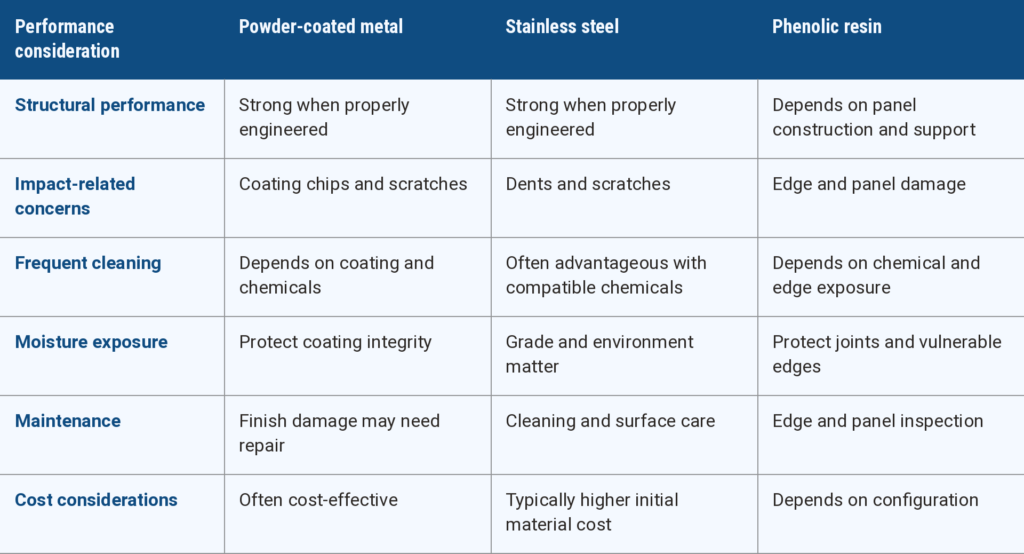
This comparison is qualitative. Actual performance depends on product construction, material grade, finish, chemical exposure, and manufacturer testing.
There isn’t one casework material that outperforms every alternative in every laboratory.
The better choice depends on how the laboratory operates.
6. Countertop Performance Requires More Than Chemical Resistance
Laboratory countertops experience a different set of demands from the cabinets supporting them.
They must accommodate equipment, chemicals, cleaning, and routine physical contact.
Common laboratory countertop materials include epoxy resin, phenolic resin, stainless steel, and specialized laminate surfaces.
Epoxy Resin Countertops
Epoxy resin offers broad chemical resistance for many laboratory applications and is commonly specified for demanding work surfaces.
However, epoxy is rigid and can chip or crack under excessive impact or improper handling.
Its fabrication limitations also matter when planning sink openings, countertop joints, and equipment cutouts.
Phenolic Resin Countertops
Phenolic resin provides a relatively thin, rigid work surface with useful chemical resistance for many applications.
It can be an effective option for laboratories that need durable work surfaces without the weight of some thicker countertop materials.
However, edge protection, moisture exposure, chemical compatibility, and support requirements remain important.
Stainless Steel Countertops
Stainless steel is frequently selected where cleanability, moisture resistance, and sanitation are priorities.
However, its resistance to specific chemicals depends on the stainless steel grade and exposure conditions.
Scratching, denting, and surface appearance should also factor into the decision.
Specialized Work Surfaces
Some laboratories require properties beyond conventional chemical resistance.
Electronics testing environments, for example, may need electrostatic discharge control.
Standard epoxy resin and phenolic resin countertops shouldn’t be assumed to provide ESD protection.
A properly specified ESD work surface offers different electrical performance characteristics, although it may provide less chemical resistance than conventional laboratory resin countertops.
The countertop should match the laboratory’s actual processes, not simply the most familiar material on the specification sheet.
7. Ergonomics and Flexibility Are Performance Requirements, Too
Laboratory furniture performance isn’t limited to material durability.
The furniture must also support the people using it.
A workstation can offer excellent chemical resistance and structural strength while still creating operational problems if it doesn’t accommodate the intended workflow.
Fixed vs. Adjustable Workstations
Fixed-height laboratory furniture may work well for standardized tasks and equipment arrangements.
However, laboratories with multiple users, changing procedures, or seated and standing activities may benefit from adjustable-height workstations.
When evaluating workstation flexibility, consider:
- Seated and standing work requirements
- User reach distances
- Equipment operating heights
- Under-counter knee clearance
- Accessibility requirements
- Power and utility connections
- Frequency of equipment changes
Planning for Equipment Changes
Laboratories evolve.
New instruments may require additional space, different utility connections, or alternative workstation heights.
A modular or freestanding workstation can offer flexibility when future equipment requirements remain uncertain.
However, flexibility should still align with structural loads, utility requirements, and operational needs.
A modular workstation isn’t automatically the best choice for every application.
The objective is to match the furniture configuration to the laboratory’s expected use and potential changes.
8. Maintenance and Repairability Influence Long-Term Value
Initial purchase price often receives significant attention during laboratory furniture selection.
But the initial cost represents only one part of the furniture’s long-term value.
A less expensive material may require more frequent repairs or replacement in a demanding environment.
Conversely, a premium material may offer limited additional benefit in a laboratory with relatively light exposure.
Questions Worth Asking
Before selecting laboratory furniture, consider:
- Can damaged components be repaired or replaced?
- Are replacement hinges, slides, and other hardware available?
- What maintenance does the finish require?
- How easily can technicians clean and inspect the furniture?
- Can the furniture accommodate future equipment changes?
- What is the expected operating environment over the next several years?
Don’t Overlook Hardware
Cabinet doors, drawer slides, hinges, and other hardware components experience repeated mechanical use.
A cabinet constructed from a highly resistant material may still require maintenance if the hardware isn’t appropriate for the application.
Heavy storage loads, frequent access, and exposure to moisture or cleaning chemicals can all affect hardware performance.
Evaluating the complete cabinet assembly helps project teams avoid focusing exclusively on the cabinet body.
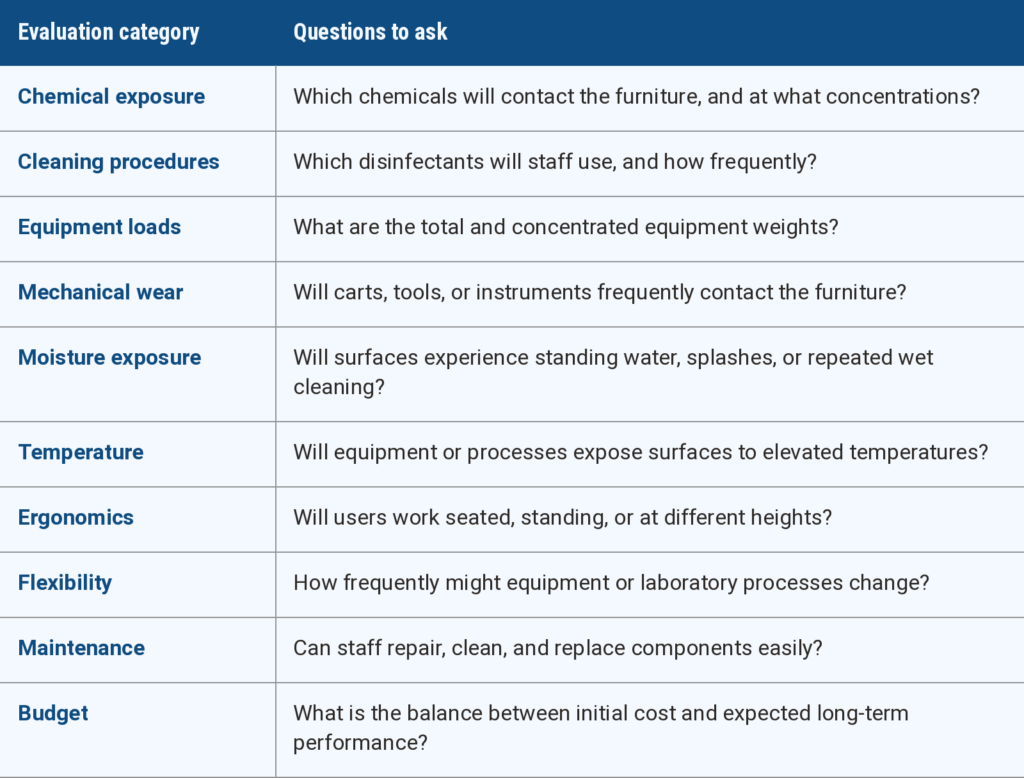
9. How to Evaluate Laboratory Furniture Performance Requirements During Design
The most effective material selection process begins with understanding how the laboratory will operate.
Rather than starting with a preferred material, architects and planners should gather information about the intended use.
Laboratory Furniture Performance Checklist
Consider the Entire Workstation
Laboratory furniture doesn’t operate as a collection of unrelated materials.
A complete workstation may include:
- Casework
- Countertops
- Sink assemblies
- Structural supports
- Hardware
- Shelving
- Utility connections
- Equipment mounting systems
Each component must work together to support the intended application.
For example, specifying a chemically resistant countertop doesn’t resolve concerns about equipment weight if the supporting cabinets lack the required load capacity.
Similarly, selecting stainless steel cabinets doesn’t eliminate the need to verify cleaning chemical compatibility or hardware performance.
A successful specification evaluates the complete furniture system.
10. Why Early Manufacturer Involvement Matters
Architects and laboratory planners often make preliminary material selections before a manufacturer becomes involved.
That approach can work for straightforward applications.
However, laboratories with specialized equipment, demanding cleaning protocols, or unusual operating conditions may benefit from earlier manufacturer input.
At OnePointe Solutions, understanding the intended application helps our team identify suitable materials and configurations before the project progresses too far into design.
For example, a manufacturer can help determine whether:
- A powder-coated metal cabinet is appropriate for the expected cleaning procedures
- A stainless steel upgrade provides a meaningful performance advantage
- A countertop requires additional structural support
- A freestanding workstation offers sufficient load capacity
- A specialized work surface is necessary
- The proposed configuration introduces maintenance or fabrication concerns
These discussions can help prevent over-specification, under-specification, and unnecessary revisions.
The goal isn’t to select the most expensive material, it’s to select the material and furniture configuration that make sense for the laboratory’s actual requirements.
Specifying for the Real Demands of the Laboratory
Chemical resistance remains an important part of laboratory furniture selection.
But it shouldn’t become the only performance requirement that matters.
Laboratory furniture must also withstand mechanical wear, equipment loads, cleaning procedures, moisture, daily operation, and changing laboratory needs.
A material that performs well against chemicals may still require additional consideration for impact resistance, structural support, maintenance, or ergonomics.
That’s why architects and laboratory planners should evaluate the complete application before selecting materials.
The best laboratory furniture specification isn’t necessarily the one with the highest chemical resistance. It’s the one that accounts for how the laboratory will actually operate.
Need Help Evaluating Laboratory Furniture Materials?
At OnePointe Solutions, we manufacture laboratory furniture for commercial, educational, research, and industrial applications.
Our product offerings include powder-coated metal, stainless steel, and phenolic resin casework, along with laboratory countertops, workstations, shelving, and other furniture solutions.
We work with architects, contractors, laboratory planners, and end users to evaluate material options, equipment requirements, and laboratory configurations.
Contact OnePointe Solutions to discuss your laboratory furniture project and determine which materials and configurations best support your application.