


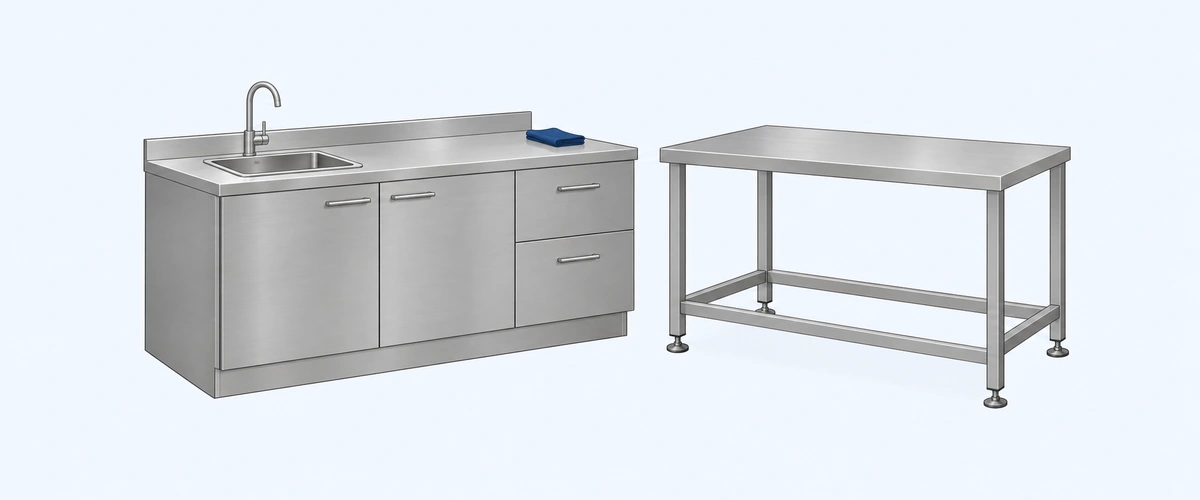
304 vs. 316 Stainless Steel for Laboratory Furniture: Which Should You Specify?
Stainless steel is often considered one of the most durable materials for laboratory furniture. When choosing 304 vs. 316 stainless steel for laboratory furniture, it’s important to understand the advantages each type offers in different lab environments. It offers a nonporous surface, supports routine cleaning, and eliminates the need for a protective powder-coated finish.
But not all stainless steel performs the same way.
When specifying laboratory cabinets, workstations, and countertops, architects and facility managers frequently encounter two options: 304 and 316 stainless steel.
Both offer corrosion resistance, durability, and practical benefits for laboratory environments. However, their chemical composition creates important differences in how they respond to certain exposures.
And those differences can significantly affect project costs.
So, when comparing 304 vs. 316 stainless steel for laboratory furniture, is the additional investment in 316 worthwhile?
The answer depends on the laboratory’s operating conditions, cleaning procedures, and chemical exposure.
1. Understanding the Difference Between 304 and 316 Stainless Steel
Both 304 and 316 belong to the austenitic stainless steel family.
They contain chromium and nickel, which help provide corrosion resistance and support the formation of a protective passive oxide layer.
The primary distinction is the addition of molybdenum in 316 stainless steel.
| Material characteristic | 304 stainless steel | 316 stainless steel |
|---|---|---|
| Chromium | Approximately 18–20% | Approximately 16–18% |
| Nickel | Approximately 8–10.5% | Approximately 10–14% |
| Molybdenum | No intentional addition | Approximately 2–3% |
| General corrosion resistance | Strong in many environments | Strong in many environments |
| Resistance to chloride-induced pitting | More susceptible | Generally better |
| Fabrication | Widely available and workable | Widely workable; may cost more |
| Relative material cost | Generally lower | Generally higher |
Composition ranges represent common specifications for these alloys. Exact limits depend on the applicable material standard.
Molybdenum improves resistance to localized corrosion in certain environments, particularly chloride-containing conditions.
However, 316 stainless steel isn’t immune to corrosion.
Both alloys can suffer damage when exposed to incompatible chemicals, high concentrations, elevated temperatures, or improper cleaning practices.
The decision between 304 and 316 should begin with the chemicals and conditions the laboratory will actually encounter.
2. Chemical Resistance: Where Does 316 Have the Advantage?
Chemical resistance often drives the conversation around 304 vs. 316 stainless steel for laboratory furniture.
While both materials resist many common laboratory exposures, neither provides universal chemical compatibility.
The difference becomes particularly important when chloride-containing substances enter the equation.
Chlorides and Localized Corrosion
Chloride ions can disrupt the protective passive layer on stainless steel.
Under unfavorable conditions, this may lead to localized corrosion, including pitting and crevice corrosion.
316 stainless steel generally offers better resistance to chloride-induced pitting than 304 because it contains molybdenum.
However, its performance still depends on factors such as:
- Chloride concentration
- Temperature
- Contact duration
- Surface condition
- Moisture retention
- Crevices and deposits
- Cleaning and rinsing procedures
A laboratory that occasionally encounters low levels of chloride may have different requirements from one that repeatedly exposes cabinetry to concentrated chloride-containing solutions.
What About Acids and Bases?
Neither alloy withstands every acid or base.
Some chemicals can attack both materials, even when the laboratory uses 316 stainless steel.
For example, hydrochloric acid can cause significant corrosion in conventional 304 and 316 stainless steel.
Other chemicals may produce different results depending on their concentration and temperature.
Project teams should evaluate the specific chemical inventory rather than relying on broad descriptions such as acid-resistant or chemical-resistant.
316 stainless steel offers an advantage under certain corrosive conditions, but it doesn’t eliminate the need for chemical compatibility reviews.
3. Your Cleaning Regimen May Matter More Than Your Laboratory Processes
Laboratories frequently evaluate furniture materials according to the chemicals used during testing.
However, the chemicals used during cleaning may contact furniture more often than the chemicals used during laboratory operations.
Consider a facility that performs relatively routine testing but disinfects its cabinets and workstations twice per day.
That repeated exposure can influence material selection.
Sodium Hypochlorite and Bleach-Based Disinfectants
Bleach-based products contain sodium hypochlorite and can create corrosion concerns for stainless steel.
The risk depends on the solution’s concentration, temperature, contact time, frequency, and whether the facility rinses the surface afterward.
316 stainless steel generally offers improved resistance to chloride-induced localized corrosion compared with 304.
However, 316 stainless steel is not bleach-proof.
Repeated exposure to incompatible bleach solutions, especially when residues remain on surfaces or accumulate in crevices, can still cause corrosion.
Laboratories should follow disinfectant instructions and review stainless steel compatibility before establishing cleaning procedures.
For more insight on bleach resistance regarding to stainless steel and other lab countertop options, review our supporting article:
Laboratory Countertop Bleach Resistance (2026 Guide)
Hydrogen Peroxide and Peracetic Acid
Facilities may also use hydrogen peroxide or peracetic acid-based disinfectants.
These products vary significantly in formulation and working concentration.
Some stainless steel systems tolerate certain oxidizing disinfectants under controlled conditions, while other exposures can create corrosion concerns.
A product’s commercial name alone doesn’t establish compatibility.
Project teams should review the actual formulation, concentration, contact time, temperature, and equipment or material manufacturer’s recommendations.
Why Cleaning Frequency Changes the Conversation
Consider two laboratories using identical stainless steel cabinets.
One facility cleans its cabinets with a compatible solution as needed.
The other performs several daily disinfection cycles with a more aggressive formulation.
Even though both facilities use stainless steel, their exposure conditions differ substantially.
For this reason, 304 vs. 316 stainless steel for laboratory furniture should be evaluated against the cleaning regimen, not simply the laboratory’s classification or industry.
4. When Is 304 Stainless Steel a Practical Choice?
304 stainless steel remains a practical material for many laboratory applications.
It provides corrosion resistance, durability, and cleanability without the higher material cost typically associated with 316.
Laboratories may consider 304 stainless steel for:
- General research environments
- Educational laboratories
- Certain food testing and preparation areas
- Routine analytical workstations
- Cabinetry exposed to compatible cleaning products
- Areas without demanding chloride exposure
However, these applications don’t automatically guarantee compatibility.
A food testing laboratory that uses aggressive chloride-containing disinfectants may require a different material evaluation than one that follows a milder cleaning regimen.
Similarly, a research laboratory with frequent corrosive chemical exposure may need more specialized materials.
Why Not Specify 316 Everywhere?
Upgrading every stainless steel cabinet to 316 may increase material and fabrication costs without providing a meaningful operational advantage in every location.
If 304 performs adequately under the laboratory’s actual conditions, the additional cost of 316 may not deliver a proportionate benefit.
The goal isn’t to select the most expensive stainless steel. It’s to select the alloy that meets the application’s requirements.
5. When Does 316 Stainless Steel Make More Sense?
316 stainless steel deserves closer consideration when the laboratory faces conditions that increase the risk of corrosion.
Potential examples include:
- Repeated exposure to certain chloride-containing substances
- Demanding cleaning and disinfection procedures
- Persistent moisture combined with corrosive residues
- Applications where localized corrosion could create significant operational problems
- Areas with challenging sanitation or environmental requirements
These conditions don’t automatically require 316.
Instead, they indicate that the project team should compare alloy performance carefully.
Cleanroom Applications
Cleanrooms often require frequent cleaning and strict contamination-control procedures.
However, an ISO classification doesn’t prescribe one universal cabinet material.
An ISO 7 cleanroom, for example, may use different disinfectants and cleaning frequencies depending on its processes.
Some facilities may use aggressive sporicidal products or vapor-phase decontamination procedures.
Others may follow less demanding cleaning regimens.
For projects with repeated chemical disinfection, 316 stainless steel may offer advantages over 304 under certain conditions.
But the project team still needs to verify compatibility with the actual products and exposure conditions.
The cleaning protocol—not the cleanroom designation alone—should influence stainless steel selection.
If you have a cleanroom or pharmaceutical lab with stainless steel lab furniture, check out our care guide for how to care and maintain stainless steel in these environments
Stainless Steel Care: Cleanrooms & Pharma Labs
6. What About Stainless Steel Countertops, Tables, and Sinks?
The choice between 304 and 316 extends beyond laboratory cabinetry.
Different furniture components experience different exposures.
Stainless Steel Countertops
Countertops may encounter direct chemical spills, repeated cleaning, standing moisture, and abrasion.
When selecting a stainless steel work surface, consider the chemicals used, surface finish, joints, fabrication details, and cleaning procedures.
316 may offer improved resistance in certain corrosive environments, but it won’t withstand every chemical.
Stainless Steel Laboratory Tables
Laboratory tables may have stainless steel frames, work surfaces, or both.
The appropriate alloy can vary by component.
For example, a laboratory may need a chemically resistant work surface while the supporting frame encounters only routine environmental exposure.
Project teams should evaluate each component’s exposure rather than assuming every part requires the same alloy.
Stainless Steel Sinks
Sinks often face more concentrated chemical and moisture exposure than surrounding cabinets.
They may also retain liquids around drains, seams, and fixtures.
This makes sink material selection particularly important.
However, the availability of 304 and 316 sinks depends on the manufacturer’s fabrication methods and product offerings.
A project should not assume that every sink configuration is available in both alloys.
When aggressive chemicals enter the waste stream, the team must also consider plumbing materials, drainage requirements, and approved chemical-disposal procedures.
7. Fabrication Quality Matters Just as Much as Alloy Selection
Selecting 316 stainless steel doesn’t guarantee that the finished cabinet or countertop will resist corrosion.
Fabrication and finishing practices also influence performance.
For example, welds, joints, crevices, and surface contamination can create areas where corrosion begins.
Poorly designed joints may retain cleaning chemicals or moisture.
Inadequate post-fabrication cleaning can leave contamination on stainless steel surfaces.
Similarly, damaged surfaces may require additional maintenance.
Important Fabrication Considerations
When reviewing stainless steel laboratory furniture, ask about:
- Material grade and certification
- Surface finish
- Weld quality and finishing
- Crevice-prone details
- Drainage and moisture retention
- Cleaning and maintenance recommendations
- Appropriate post-fabrication cleaning or passivation procedures
A well-fabricated 304 stainless steel cabinet may outperform a poorly fabricated 316 cabinet under some conditions.
Material grade matters, but fabrication quality and exposure conditions also determine long-term performance.
8. Cost Comparison: Is 316 Worth the Additional Investment?
Cost often becomes the deciding factor when comparing 304 vs. 316 stainless steel for laboratory furniture.
316 typically carries a higher raw-material cost because of its alloy composition and market pricing.
However, the final project cost depends on more than the metal itself.
Other factors include:
- Cabinet dimensions and configuration
- Material thickness
- Fabrication complexity
- Welding and finishing requirements
- Hardware and accessories
- Quantity
- Installation requirements
- Project-specific customization
Rather than relying on a universal percentage premium, project teams should request pricing for comparable configurations.
Consider the Total Cost of Ownership
The initial purchase price represents only one part of the decision.
A lower-cost material may become expensive if it corrodes prematurely and requires replacement.
Conversely, specifying 316 in a low-exposure area may increase the initial budget without delivering meaningful long-term savings.
Consider the following hypothetical scenario:
A laboratory contains 40 stainless steel cabinets.
Only 10 sit in areas with repeated exposure to demanding cleaning chemicals.
Rather than automatically upgrading all 40 cabinets to 316, the project team could evaluate whether those 10 locations justify the higher alloy grade.
The remaining cabinets might use 304 if their exposure conditions support it.
This approach allows the team to direct its budget toward the locations that need additional corrosion resistance.
9. 304 vs. 316 Stainless Steel: Specification Checklist
Before selecting an alloy, review the following questions.
| Specification consideration | Why it matters |
|---|---|
| What chemicals will contact the furniture? | Identifies potential corrosion risks |
| Are chlorides present? | Helps assess localized corrosion concerns |
| What disinfectants will the facility use? | Establishes cleaning-related exposure |
| How frequently will personnel clean the furniture? | Helps evaluate repeated exposure |
| What are the chemical concentrations? | Concentration influences compatibility |
| Will chemicals remain on surfaces? | Prolonged contact can increase risk |
| Will moisture accumulate around joints? | Crevices and standing liquids can promote corrosion |
| What surface finish and fabrication details are required? | Influences cleanability and corrosion performance |
| Are 304 and 316 available in the required configurations? | Confirms manufacturing feasibility |
| What is the cost difference for the actual project? | Supports a meaningful budget comparison |
| What are the consequences of premature corrosion? | Helps assess lifecycle costs |
The answers help determine whether 304 provides adequate performance or whether 316 offers a justified advantage.
10. Common Misconceptions About Stainless Steel Laboratory Furniture
Myth: 316 Stainless Steel Is Completely Chemical-Resistant
No stainless steel alloy resists every chemical.
316 performs better than 304 under certain corrosive conditions, particularly some chloride-containing environments, but both have limitations.
Myth: Every Cleanroom Requires 316 Stainless Steel
Cleanroom classifications don’t automatically dictate cabinet alloy selection.
Cleaning procedures, contamination-control requirements, and actual chemical exposure matter more.
Myth: Stainless Steel Cannot Rust
Stainless steel can corrode when environmental conditions compromise its protective passive layer.
Its corrosion resistance is substantial, but not unlimited.
Myth: 304 Is Always the Budget Option
304 generally costs less than 316, but it isn’t automatically the better value.
If the laboratory’s exposure conditions cause premature deterioration, replacement and downtime may outweigh the initial savings.
Myth: 316 Is Always the Safer Specification
Selecting a higher alloy grade doesn’t eliminate risks from incompatible chemicals, poor fabrication, or improper cleaning.
The appropriate specification depends on the application.
The Bottom Line: Choose Stainless Steel Based on Exposure, Not Assumptions
When comparing 304 vs. 316 stainless steel for laboratory furniture, the most important question isn’t which alloy has the higher corrosion resistance.
It’s whether the additional resistance provides a meaningful advantage under the laboratory’s actual operating conditions.
304 stainless steel can serve many laboratories effectively.
316 may offer important benefits in environments with certain corrosive exposures, especially where chloride-related corrosion presents a concern.
However, neither material is universally chemical-resistant.
Cleaning procedures, fabrication quality, moisture exposure, and long-term maintenance all influence performance.
The best stainless steel specification matches the laboratory’s actual conditions without introducing unnecessary costs.
Need Help Selecting Stainless Steel Laboratory Furniture?
At OnePointe Solutions, we manufacture stainless steel laboratory casework, workstations, and countertops for commercial laboratory projects.
Our team works with architects, laboratory managers, contractors, and facility teams to evaluate material selection, fabrication requirements, cleaning procedures, and project-specific considerations.
Whether you’re specifying 304 stainless steel or evaluating an upgrade to 316, we can help review the options appropriate for your application.
Contact OnePointe Solutions to discuss your laboratory furniture requirements.
OnePointe Solutions Lab Design Team