


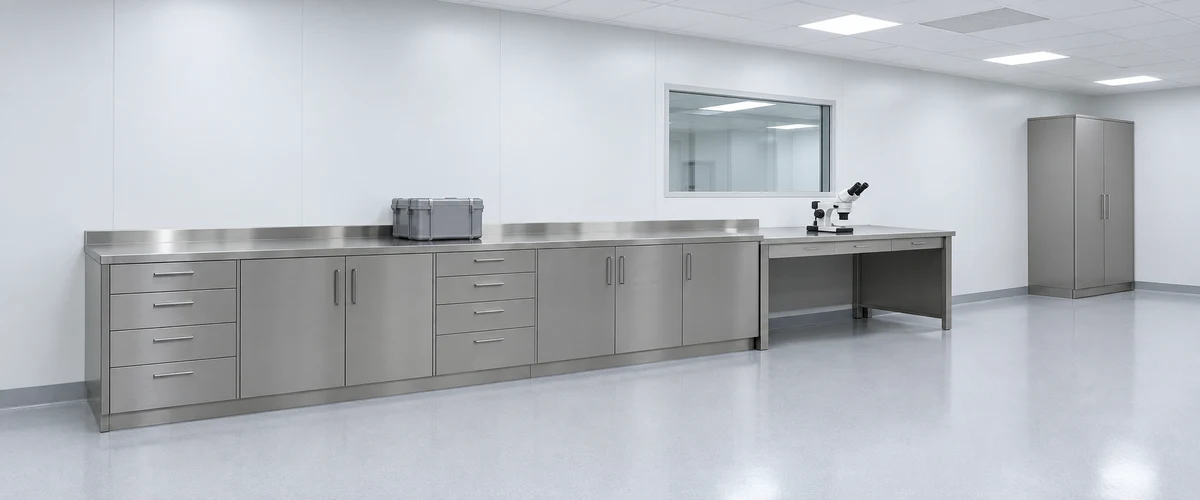
Semiconductor cleanroom casework should match the work at each station. When considering semiconductor fab casework, select cabinets around the cleanliness target, process chemicals, cleaning method, and electrostatic-discharge control plan rather than one universal material specification.
The former Class 100 designation closely corresponds to ISO Class 5 at the 0.5-micrometer particle threshold, although current specifications should use the applicable ISO classification and operating state (NIST guidance; IEST’s standards transition notice). FED-STD-209E was canceled in November 2001 and superseded by ISO 14644-1 and ISO 14644-2, as documented in the cancellation notice.
This guide translates those requirements into a semiconductor cleanroom casework specification. Use it to coordinate cabinets, lab tables, work surfaces, and utilities with the process owner and facility team.
What should semiconductor cleanroom casework specify?
For an ISO Class 5 or similar semiconductor work area, specify casework by zone rather than naming one material for the entire room. A complete basis of design should address:
Cleanliness: Smooth, accessible surfaces; limited particle traps; and sealed or closed construction where appropriate to the project.
Process chemistry: Work-surface, liner, sink, cabinet, and hardware compatibility with the actual acids, bases, solvents, developers, etchants, and cleaning agents used at that station.
ESD control: Static-dissipative worksurfaces where required, a common-point ground strategy, defined connection locations, and verification procedures.
Airflow: Casework geometry and placement coordinated with the room airflow model, local HEPA-filtered zones, wet benches, process exhaust, and return-air paths.
Maintenance: Access for cleaning, filter service, utility isolation, leak inspection, and equipment removal without unnecessary disruption to the clean zone.
Documentation: Material data, finish information, chemical-resistance evidence, and grounding details. Available particle-emission or equipment-suitability documentation when required by the project.
Identify which requirements apply to the room, process equipment, or furniture. Agree on the evidence needed for each rather than implying that each cabinet needs an ISO 14644-14 assessment.
Start with the process map, not the cabinet catalog
The casework schedule should follow the semiconductor process map. Photolithography support, solvent handling, wet etching, metrology, inspection, assembly, and equipment maintenance do not create the same furniture requirements.
A useful first step is to mark each station by four conditions:
The required room or local-zone cleanliness.
The chemicals and cleaning agents that can contact the furniture.
Whether exposed electrostatic-discharge-sensitive devices are handled.
The utility, exhaust, and maintenance access required by the process.
Stanford’s Nanofabrication Facility, for example, assigns different wet benches to “clean,” “semiclean,” and “flexible” process categories and restricts which chemistries or materials may be used at each station, as shown in its hydrofluoric-acid process guide. These labels describe Stanford’s process categories, not ISO air-cleanliness classes. The design lesson is to ask where material and process separation should shape the casework schedule rather than copying a facility’s local rules.
Compare a dry inspection station with a wet-process station. Review ESD control and cleaning access for the first; add the defined chemical exposure, containment, and exhaust requirements for the second.
Keep room classification and equipment assessment distinct
ISO 14644-1:2015 classifies room or clean-zone air by particle concentration. Equipment assessments address different questions: ISO 14644-14:2026 concerns airborne particles, while ISO 14644-15:2026 concerns airborne chemicals from equipment and materials.
Cleanability and cleaning-agent suitability fall outside these equipment-assessment scopes (Part 14 scope; Part 15 scope). Define the project’s documentation needs, then review chemical compatibility, ESD performance, and safety separately. Do not treat one assessment as a blanket furniture approval.
Specify cleanable construction without overstating “cleanroom rated”
Particle control begins with details that can be inspected and maintained. Casework for controlled environments generally benefits from smooth exposed surfaces, accessible corners, limited horizontal ledges, closed or capped members, and hardware that does not create unnecessary dirt traps.
Where the project requires testing, ask what method and configuration were evaluated. Confirm whether the results cover the complete assembly or only one component; do not substitute a general “cleanroom compatible” label for the agreed criteria.
Consider these details during design review:
Joints and seams: Define where continuous welds, sealed seams, or mechanically fastened joints are acceptable. A seamless appearance is not the same as a validated particle-emission result.
Cabinet interiors: Confirm that shelves, corners, hinges, and removable components remain reachable for the documented cleaning procedure.
Doors and drawers: Select configurations that suit the cleaning protocol and do not interfere with gowning clearances or process circulation.
Base conditions: Coordinate legs, mobile bases, recessed bases, or sealed toe spaces with floor cleaning and access below the casework.
Service penetrations: Detail utility openings so they are controlled, accessible, and coordinated with pressure and airflow requirements.
Our cleanroom cabinet overview identifies stainless steel as a common option and lists wall, tall, base, and mobile configurations. Use those options as a starting point, then request documentation for the proposed grade, finish, joints, and cleaning regimen. Do not select a stainless grade solely from the room’s ISO class or assume that a higher alloy designation resolves the full specification.
Separate general casework from chemical process equipment
Separate the general cabinet schedule from the wet-process equipment specification. For each station, ask the equipment supplier and EH&S team to define the wet-bench deck or work surface, sink or tank, containment, exhaust, filtration, fire-protection, leak-detection, and control requirements. Resolve those interfaces before selecting adjacent storage.
Stanford lists diluted hydrofluoric acid as an oxide etchant and assigns its use to specific equipment in the facility’s process guide. For a project using that chemistry, ask the process owner to define concentration, temperature, companion chemicals, sequence, and safety controls. A general note such as “corrosion-resistant countertop” leaves those questions unanswered.
At each chemical station, document:
Chemical name, concentration, temperature, duration, and frequency of contact.
Whether exposure is a routine process condition, intermittent splash, vapor, or cleaning event.
Work-surface, sink, liner, sealant, hardware, and cabinet-substrate compatibility.
Secondary containment and leak-detection requirements.
Exhaust and make-up-air coordination.
Emergency response and maintenance access.
If the process team proposes a polymer work surface or cabinet liner, request compatibility data for the stated exposure rather than relying on a general “acid-resistant” label. Review ESD behavior, loads, fire-safety criteria, and chemical emissions separately. The goal is a documented choice for that station, not a universal ranking of steel and polymer furniture.
Build ESD control into the workstation system
ESD control is not created by ordering a “static-safe” countertop in isolation. The worksurface, personnel-grounding method, equipment, fixtures, floor system, seating, and verification plan need to operate as one electrostatic protected area.
In its “CLEANROOMS” section, the ESD Association’s Fundamentals Part 3 states: “Many static control materials contain carbon particles or surfactant additives that sometimes restrict their use in cleanrooms.” Ask for evidence of both ESD performance and cleanroom suitability for the proposed components.
Show the common-point ground, bonding connections, wire routing, labels, and testing access. Have the electrical engineer define the connection to equipment ground and coordinate the arrangement with the facility’s ESD-control program.
Name the test method, acceptance limits, responsible person, and recordkeeping requirements. If the process uses ionization, include its placement and verification in the same review rather than treating it as a replacement for the grounding plan.
Our cleanroom and ESD seating overview describes options for controlled environments and ESD use. Verify the selected chair’s configuration, documentation, floor interface, and maintenance needs rather than applying a product-family claim to each option.
Coordinate airflow before fixing the casework layout
Review the furniture layout with the cleanroom mechanical engineer before fixing cabinet sizes. Ask the team to evaluate obstructions, return-air clearances, operator positions, and maintenance access using the actual assembly dimensions rather than a generic furniture block.
Key coordination points include:
The direction and uniformity of supply air over critical processes.
Clearance around low-wall or floor returns.
Heat loads from instruments and equipment housed on or inside the casework.
Local exhaust at solvent, acid, and wet-process stations.
Operator positions and material-transfer routes.
Maintenance openings that should remain outside critical airflow paths when practical.
Room classification and local process cleanliness can also differ. The UNLV cleanroom protocol describes ISO 5 working environments at HEPA-filtered wet benches within broader ISO 6 and ISO 7 room areas. That facility example should not be copied as a universal design, but it demonstrates why the cleanest required condition may exist at a process tool rather than across the entire room.
Before release, confirm that the final cabinet depths, overhead storage, service chases, and equipment footprints are included in airflow analysis or commissioning assumptions. A placeholder block in an early model may not represent the effect of the fabricated assembly.
Use a casework schedule that can be tested and reviewed
A useful semiconductor cleanroom casework schedule does more than list cabinet dimensions. It connects each station to its process and acceptance requirements.
This schedule creates a review trail. It also makes substitutions easier to evaluate because the proposed product must meet the same defined conditions rather than simply resemble the original selection.
Semiconductor cleanroom casework specification checklist
Define the ISO cleanliness class, operating state, and certification requirements for each room or clean zone.
Map dry, solvent, acid, photolithography, metrology, assembly, and maintenance functions.
Identify which stations are general casework and which require dedicated process equipment.
Document chemical exposure by concentration, temperature, contact type, and frequency.
Specify cleanable construction details and accessible service conditions.
Coordinate the casework footprint with supply air, returns, local exhaust, and operator positions.
Define ESD worksurfaces, common-point grounds, personnel grounding, labels, and verification tests.
Confirm loads, vibration sensitivity, anchorage, and equipment-removal paths.
Identify the required material, finish, chemical-compatibility, and grounding documentation; request particle-emission or equipment-suitability evidence when the project requires it.
Review the final schedule with process owners, facilities, cleanroom specialists, ESD coordinators, and EH&S before fabrication.
Frequently asked questions
Is a Class 100 cleanroom the same as ISO Class 5?
The former Class 100 designation closely corresponds to ISO Class 5 at the 0.5-micrometer particle threshold, as illustrated in NIST’s clean-air laboratory guidance. Use the applicable ISO classification and operating state in current specifications.
Does ISO Class 5 require stainless-steel casework?
ISO 14644-1 classifies airborne-particle concentration, not a mandatory cabinet material. Select the material through a separate review of the process, cleaning method, ESD plan, and assembly documentation.
Should all semiconductor cleanroom work surfaces be ESD dissipative?
Define the protected areas around handling of susceptible items, consistent with the ESD Association’s control principles. Have the facility’s ESD coordinator approve the surfaces, grounding arrangement, and verification method for each of those areas.
Can standard cleanroom cabinets be used under an acid wet bench?
Do not assume they can. Wet-process equipment may need specialized chemical-resistant construction, containment, exhaust, controls, and safety systems. Evaluate the complete process conditions and equipment standard rather than substituting general storage casework.
The takeaway: specify the station, not just the cabinet
The strongest semiconductor casework specifications begin with the process and end with verification. Before selecting a cabinet family, assemble the cleanroom criteria, process map, chemical inventory, cleaning SOP, ESD-control plan, equipment loads, airflow concept, and maintenance requirements.
Then review each station with the people responsible for using, maintaining, certifying, and approving it. That conversation helps distinguish a general storage cabinet from a grounded workstation, a cleanable lab table from dedicated wet-process equipment, and a room-level cleanliness requirement from a component-level performance claim.
A useful final check is simple: can the team explain why each station uses that material, that ground connection, that storage arrangement, and that cleaning method? Where the answer is unclear, keep the requirement open for review. Revisit the same questions when a process, chemical, or piece of equipment changes.
For more helpful information on cleanrooms, check out our supporting blogs below: