


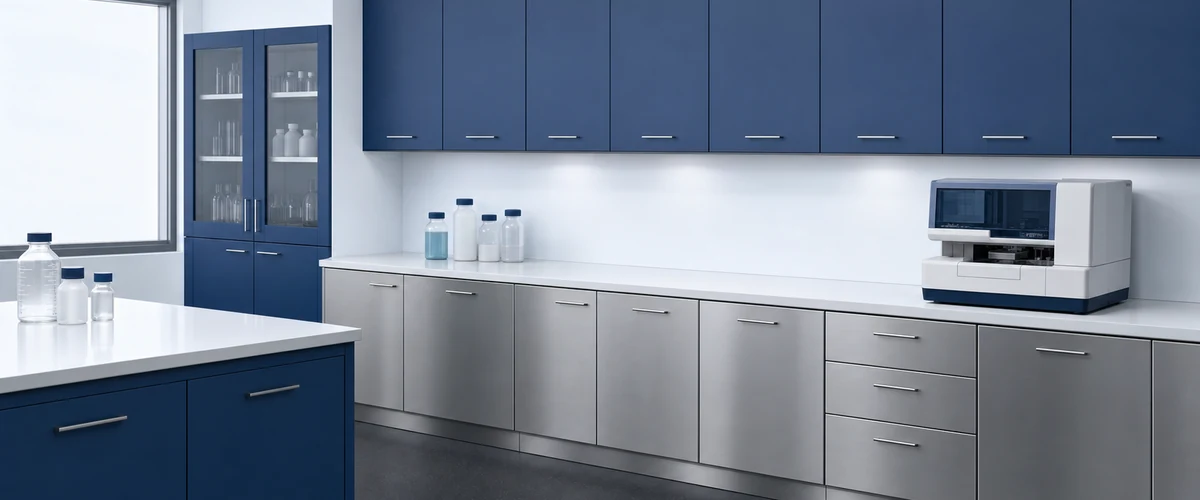
Medical-Grade Cabinets: What They Are, Where They Belong, and How to Specify Them
By the OnePointe Solutions Lab Design Team · Updated 2026
The phrase “medical-grade cabinets” sounds like a specification. It really isn’t. No single material carries that name. And no universal cabinet construction makes a product right for every healthcare environment.
The real question is simpler. What happens in the room, and can the materials handle it? A family clinic and a hospital pathology lab both sit inside medical facilities. Yet they place very different demands on the cabinetry.
One may only need durable, easy-to-clean storage that survives routine disinfecting. The other regularly sees blood, biological fluids, fixatives, aggressive cleaning protocols, and wet work. Calling both rooms “medical” does not mean they need the same cabinet material.
That is where many specifications go wrong.
Medical-Grade is Not a Material
The term means different things depending on who says it. A healthcare facility often focuses on cleanability and infection control. An architect looks for durable, professional casework that fits a clinical setting. A lab planner thinks about chemical exposure, biological materials, moisture, and specialized storage. Those are very different performance requirements.
The better question is not: “What makes a cabinet medical-grade?”
It is: “What does this cabinet need to withstand in this room?”
That distinction changes everything. Laboratory casework standards reflect the same approach. SEFA publishes separate performance standards for metal, phenolic, plastic laminate, polypropylene, and wood casework. No single material wins across laboratory or healthcare environments. The material needs to match the application.
Start With the Work Being Done
Before choosing a cabinet material, understand the environment. A few questions narrow the right options quickly:
- What work happens in the room?
- What chemicals, fluids, or biological materials may hit the surfaces?
- How often does the room get cleaned and disinfected?
- Do the cleaning chemicals run aggressive?
- Will the area see frequent moisture or wet work?
- Does the room carry specific regulatory or storage requirements?
- Does the cabinet mostly support people, equipment, supplies, or lab processes?
The answers matter more than the label on the room. A medical environment does not automatically mean a harsh one. And a room that looks like a standard lab may carry very specific material requirements depending on the actual work.
A Clinic and a Pathology Lab Are Both Medical Spaces — But They Shouldn’t Be Specified the Same Way
Consider two very different examples.
A Clinical or Outpatient Environment
Many clinics, exam rooms, and outpatient facilities need durability, cleanability, good appearance, and routine disinfectant compatibility. That is the whole list.
The cabinetry mostly stores:
- Medical supplies
- PPE
- Instruments
- Paperwork
- Basic clinical equipment
Surfaces get cleaned often. They rarely see aggressive chemicals, corrosive reagents, or constant biological exposure. In these rooms, plastic laminate casework often fits the job. It brings durability, a wide range of colors and finishes, and a warmer, less institutional feel than an all-metal install. And it pairs with the right countertop material for the actual work surface.
The goal is not the most chemically resistant material available. The goal is a material that performs well without over-specifying the project.
A Pathology Lab Is a Different Story
Now consider a pathology or hospital laboratory.
The room may see exposure to:
- Blood
- Biological fluids
- Tissue samples
- Formalin and other fixatives
- Cleaning and disinfecting chemicals
- Frequent wet work
That creates a very different set of material requirements. Here, the work surfaces need to match the fluids and chemistry the bench actually sees. Stainless steel often fits when hygiene, moisture resistance, and easy cleaning drive the spec. A common configuration pairs powder-coated metal cabinets with stainless steel work surfaces. Depending on the workload, a fuller stainless install may earn its keep. The point stays the same. The spec responds to the work, not to the fact that the room sits inside a hospital.
Different Materials Solve Different Problems
Remember, no material wins across the board in medical or laboratory casework. Each option brings different strengths.
Plastic Laminate
Plastic laminate often fits clinics, exam rooms, outpatient facilities, administrative areas, and other lower-severity environments.
Its advantages include:
- A broad range of colors and finishes
- A warmer appearance than metal
- Easy day-to-day cleaning
- Good durability for routine use
- A cost-effective option for the right environments
Do not dismiss plastic laminate simply because the project sits inside a healthcare facility.
SEFA even maintains a laboratory-grade performance standard for plastic laminate casework. That alone reinforces a key idea. Material selection depends on performance requirements, not on the name of the building.
Stainless Steel (Typically Type 304)
Stainless steel becomes the default when both cleanability and chemical resistance matter. Yale’s laboratory casework design standard specifies ASTM A240 Type 304 stainless with a #4 satin finish for sinks, tops, shelves, and casework in chemistry-adjacent applications. Type 304 handles routine disinfection well. Quaternary ammonium, light bleach dilutions, and alcohol-based cleaners do not corrode it. But long exposure to chlorides, especially undiluted bleach, can pit the surface. Heavy chloride environments usually call for Type 316 instead.
Even stainless steel does not fit everywhere. A standard outpatient clinic rarely needs an all-stainless install. Choosing it because a room is “medical” adds cost without a meaningful performance benefit.
Powder-Coated Steel
Powder-coated steel (urethane or epoxy powder coat, electrostatically applied) works well across many laboratory and clinical environments.
It offers:
- Strong structural durability
- A clean, professional appearance
- Good performance for routine laboratory and clinical use
- Flexibility to pair with different countertop materials
Powder-coated steel offers less chemical resistance than stainless. But it costs much less. And the coating tolerates most disinfectants that clinical teams use day to day. When a spec calls for “metal casework” with no other constraints, this is what usually shows up.
Phenolic Resin and Polypropylene
These materials solve specialty problems.
Phenolic resin cabinets fit cleanroom-adjacent and moisture-heavy applications. Note that cabinet-body phenolic differs from phenolic countertops, though the material family overlaps. Phenolic panel construction is inherently non-porous. It stays dimensionally stable in humid rooms. And it cleans well with the standard hospital disinfectant panel.
Polypropylene casework (SEFA 8-P) offers near-total resistance to acids, bases, and most solvents. Rooms that need to control trace-metal contamination often choose it. So do rooms where aggressive reagents would degrade steel or laminate over time. In medical settings, polypropylene shows up in histology grossing rooms, trace-metal analytical benches, and specialty acid-digestion rooms.
Again, the material should follow the work. A polypropylene cabinet may fit one lab perfectly and add unnecessary cost in another.
Treat the Countertop and the Cabinet as Two Decisions
One common spec mistake is assuming the cabinet body and the countertop must come from the same material family. Or that a matching family will hold up to whatever the room does. Neither is always true.
In many rooms, the best answer is a combination. Budget, cleaning regimen, and work-surface limits all shape that choice.
Plastic Laminate Cabinets + a Durable Work Surface
This pairing fits clinical or outpatient environments. Plastic laminate remains one of the more cost-effective cabinet choices on the market. Some labs simply do not have the budget to reach powder-coated or phenolic resin cabinets. However, laminate falls short as a countertop for strong disinfectants and reactive chemistry. It handles household-level cleaners well. Beyond that, pair the laminate body with a tougher top.
Powder-Coated Metal Cabinets + Stainless Steel Tops
A fully stainless lab runs expensive. Pairing powder-coated bodies with stainless tops trims the cost while preserving hygiene and durability where it matters most.
Metal Cabinets + Epoxy Resin Tops
Two variations fit here. Powder-coated bodies with epoxy resin tops. Or stainless steel cabinets with epoxy resin tops. If the room needs the hygiene of stainless bodies but the chemistry does not demand stainless tops, epoxy resin is a cost-effective alternative. It still delivers some of the highest chemical resistance available in a work surface.
Exceptions exist. Fully phenolic, fully stainless, or fully polypropylene environments (cabinets and tops) are all possible. If the work demands it and the budget supports it, those options are perfectly valid. Just note these fully specified environments sit at the higher end of the cost curve. The exception is phenolic resin as a countertop, which runs cheaper than epoxy or stainless.
Frame it this way. The cabinet body needs to survive the environment around it. The work surface needs to survive the materials and processes happening directly on top of it.
Related requirements. Not always identical.
Where they belong: clinical and life-sciences applications
Medical-grade casework tends to land in a handful of recurring environments. Each has a slightly different set of drivers, and the “right” cabinet in each room isn’t the same.
Clinical laboratories (hematology, chemistry, microbiology)
These are the rooms most people picture when they hear “medical-grade cabinets.” The drivers are cleanability, disinfectant compatibility, and durability across shift work. Base cabinets under analyzers, wall cabinets for reagent storage, tall storage for supplies, and integrated sink runs are all typical. Powder-coated steel or stainless bodies with epoxy tops covers most of it. The CDC Guidelines for Environmental Infection Control in Health-Care Facilities is the governing hygiene reference.
Pharmacy and medication storage rooms
Two overlapping requirements drive the spec here. First, drug storage conditions under 21 CFR 211.142. Drugs must sit in conditions that don’t affect identity, strength, quality, or purity. Second, DEA physical security rules for controlled substances under 21 CFR 1301.75. Schedule II–V substances go in a “securely locked, substantially constructed cabinet.” The regulation does not specify a material or a lock rating. It defines a functional standard. What passes review generally combines four things: heavy-gauge steel construction, a robust locking mechanism, hardware that can’t be removed with the door closed, and secure anchoring if the unit weighs under 750 pounds.
Pathology and histology
Grossing rooms, tissue processing benches, and cassette storage areas each get their own material treatment. Formaldehyde exposure and aggressive fixative chemistry push these rooms toward stainless or polypropylene bodies. Grossing stations often integrate downdraft ventilation into the cabinet run itself. The cabinet then has to accommodate ductwork penetrations without breaking its cleanability envelope.
Outpatient Clinic and Exam-Room Storage
Not every “medical-grade cabinet” lives in a lab. Exam-room base cabinets, procedure-room supply carts, and treatment-cart docking stations all get the medical-grade label too. The label signals two things. Surfaces have to tolerate disinfectants, and the construction has to hold up to repeated use. Chemistry burden here runs lower than a lab. But the disinfectant frequency runs higher. Plastic laminate cabinets with a laminate top show up most often. Stainless tops arrive as an upgrade when the budget allows.
Why they matter: cleanability, chemistry, and compliance
Medical-grade casework exists as its own category for a reason. Ordinary cabinetry fails in a clinical environment in three predictable ways.
Cleanability and infection control
Standard cabinet finishes absorb moisture. They harbor organic residue at seams. They degrade under repeated exposure to hospital-grade disinfectants. The CDC HICPAC guideline for environmental infection control calls for surfaces in patient-care areas that are smooth, non-porous, and compatible with the facility’s chosen disinfectants. Medical-grade casework aims to hold that standard across a decades-long service life — not for the first year, but for year fifteen.
Chemistry the surface has to survive
The reagent mix in a clinical lab differs from an R&D lab. But it isn’t gentle. Xylene, formalin, alcohols, quaternary ammoniums, bleach dilutions, and enzymatic cleaners all cross the surface routinely. A cabinet body that flakes, discolors, or swells under that exposure becomes a compliance and hygiene problem long before it becomes an aesthetic one. Materials chosen against SEFA 8 chemical-resistance testing tend to survive the mix. Residential-grade finishes generally do not.
Regulatory alignment
Medical-grade casework is often what makes a room passable during an accreditation visit. The Joint Commission, CAP, and state inspectors don’t audit cabinet brands. They audit outcomes. Are medications stored securely? Are surfaces cleanable? Does the infection-control plan show up in the space? Casework that meets the applicable standards makes those audits shorter. Casework that doesn’t turns each inspection into a remediation cycle.
Total cost over the service life
Medical-grade cabinets cost more up front than a residential or commercial-grade unit. Over a 20-year clinical service life, the difference tends to reverse. Residential-grade casework in a clinical setting generally needs replacement in five to seven years. That replacement cost includes lab downtime, workflow disruption, and re-commissioning. This is the trade specifiers weigh when they hold the line on medical-grade construction.
A Better Way to Specify Medical Casework
Instead of writing “medical-grade cabinets required,” define what the room actually needs. That vague phrase leaves too much room for assumptions about material, hardware, seaming, and top pairing that the RFP never states. A stronger specification hits five points.
1. The Type of Work
Describe the activities in the room. Is it patient care? Routine clinical testing? Pathology? Histology? Pharmacy? Chemical analysis?
2. Surface Exposure
Identify what the surfaces may encounter. That list could include:
- Routine disinfectants
- Blood or biological fluids
- Formalin
- Solvents
- Acids or bases
- Frequent moisture
- Other chemicals specific to the process
3. Call Out the Top Separately
Price and specify the countertop as its own line. Epoxy resin, phenolic composite, and stainless all count as legitimate choices. Each pairs differently with the cabinet below. Match the top to the chemistry. Not to the cabinet.
4. Cabinet Material
Specify the right cabinet construction for the environment.
That could mean plastic laminate, powder-coated metal, stainless steel, phenolic, or polypropylene.
5. Cleaning Requirements
The facility’s cleaning protocol matters. A cabinet that performs well with routine cleaning may not survive aggressive disinfectants applied multiple times per day.
If the facility uses bleach dilutions daily, name it. If quaternary ammonium is the standing choice, name that too. A manufacturer can pick the right coating chemistry or cabinet material only when they know what the surface will see. If the spec stays silent, the default finish may not survive the actual cleaning protocol.
The Bottom Line — Don’t Specify the Building. Specify the Environment.
The takeaway stays simple. Medical-grade cabinets do not exist as a single product. A hospital is not a single environment. Neither is a laboratory. A medical campus can hold everything from a quiet outpatient exam room, to a pathology lab processing biological specimens, to a pharmacy handling hazardous drugs. One definition of “medical-grade” never fits every one of those spaces.
Instead, start with the work.
Understand what happens in the room. Identify what the surfaces will encounter. Think about how often they get cleaned and which products the team will use. Then choose cabinet and work-surface materials that hold up under those conditions. Sometimes the answer is plastic laminate. Other times it is powder-coated metal with stainless steel work surfaces.
And other rooms will call for epoxy, phenolic, polypropylene, or a more specialized solution. The best material does not come from the label on the room. It comes from what the people inside that room actually do.
Need Help Selecting Materials for Your Space?
Choosing laboratory or healthcare casework should not start with a generic label. It should start with an understanding of the environment.
OnePointe Solutions works with architects, contractors, laboratory planners, and facility teams to match cabinet and work-surface materials to the actual requirements of the space. That applies whether the room is a welcoming outpatient clinic or a demanding pathology laboratory.
Talk with our team about your project. Let’s start with what the room needs to do.
Sources cited in this guide
- SEFA 8 — Laboratory Casework Performance and Recommended Practices
- NIH Office of Research Facilities — Design Requirements Manual
- 21 CFR 1301.72 — Physical security for controlled substances (manufacturers, distributors)
- 21 CFR 1301.75 — Physical security for practitioners
- 21 CFR 211.142 — Warehousing procedures for drug products
- CDC/HICPAC — Guidelines for Environmental Infection Control in Health-Care Facilities (2003)
- Yale University Design Standards — Section 12245: Laboratory Casework