


Walk into most working laboratories and you will see a flexible exhaust arm hanging over a bench somewhere — often above a gas chromatograph, a soldering station, or a small solvent dispensing area. That arm is a lab snorkel. It is one of the simpler pieces of laboratory ventilation equipment in the building, and also one of the most misunderstood. This guide walks lab managers, PIs, and facility leads through what a lab snorkel actually does, where it fits in a lab program, and the line where it stops being the right tool.
What a Lab Snorkel Is
A lab snorkel — also called a fume extractor arm, articulated exhaust arm, or elephant trunk — is a small ventilation hood at the end of a friction-jointed arm. The user pulls the hood down to within a few inches of whatever they want to capture, and an exhaust fan pulls the contaminated air away through the arm. SEFA 1-2010 Section 8.2.3 defines it as “a small, localized ventilation hood usually connected by flexible duct to an exhaust fan.”
By contrast, the basic difference between a snorkel and a chemical fume hood is straightforward. A fume hood works by containment — it puts a physical box around your chemistry and pulls air across an open sash. A lab snorkel does not contain anything. It works only by sucking air toward a point, and that only works if the point of capture is close enough and the room air is calm enough to cooperate.
Why Labs Use Snorkels
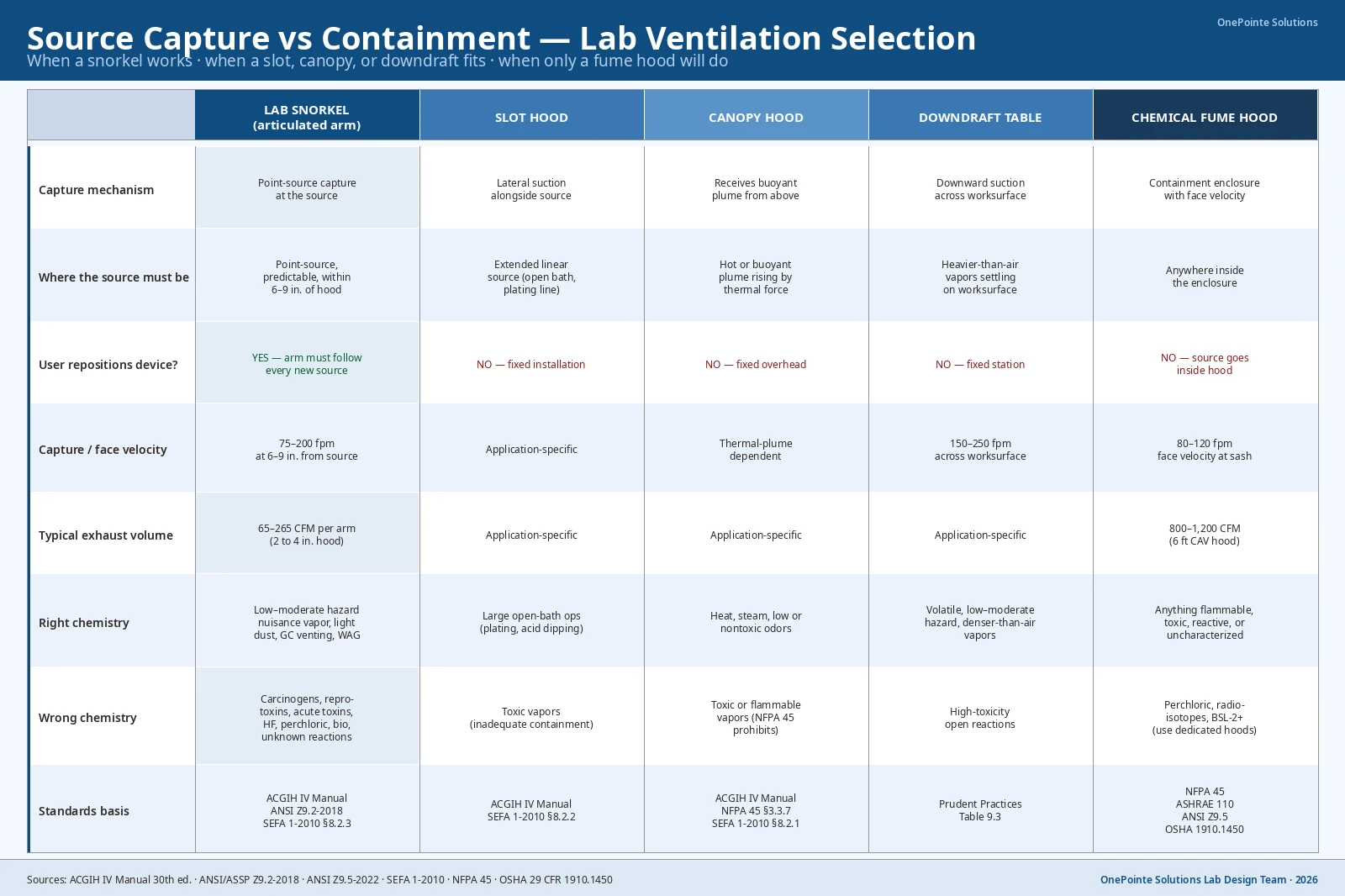
The short answer is energy. A 6-foot constant-volume chemical fume hood exhausts roughly 800 to 1,200 CFM of conditioned laboratory air every minute it is running. A typical lab snorkel arm runs between 75 and 265 CFM depending on hood size. For a single small instrument vent — a GC injection port, a vacuum pump exhaust, an HPLC waste port — that is an 80 to 90 percent reduction in exhausted air, which translates directly into lower heating, cooling, and makeup-air costs for the building.
In addition, the other reason is workflow. A snorkel can be repositioned freely above an open bench, which suits soldering stations, jewelry casting, dental work, light epoxy work, and instrument vent capture in ways a fixed fume hood cannot. The bench stays accessible, the technician is not reaching into an enclosure, and the visual sightline to the work is uninterrupted.
How Capture Velocity Works
Capture velocity is the speed of the air a snorkel pulls in at the source — not at the hood face. The ACGIH Industrial Ventilation Manual (30th edition) sets typical lab targets between 100 and 200 fpm at the source for light vapors and soldering fumes, and Stanford EHS specifies 80 to 100 fpm for gas chromatograph venting and waste anesthetic gas.
Here is the practical takeaway: capture velocity falls off sharply with distance. If a snorkel hood is 6 inches from the source, doubling that distance to 12 inches requires roughly four times the airflow to maintain the same capture performance. That is why every university EHS program — Stanford, OSU, Yale, MIT — limits snorkel positioning to 6 to 9 inches from the source. Beyond that, the device stops working.
Next, room air currents are the second factor. A nearby supply diffuser, an open doorway, or someone walking past at normal speed can produce cross-drafts of 20 to 30 fpm. That is enough to overwhelm a 100 fpm capture velocity at anything more than minimal working distance. The location of the snorkel within the room matters as much as the snorkel itself.
Where Lab Snorkels Fit
In practice, lab snorkels work well for low-toxicity, point-source applications where the contaminant location is predictable and the release rate is small. The applications that consistently show up in university EHS guidance as appropriate:
- Soldering and electronics rework
- Gas chromatograph injection port venting
- HPLC waste and vacuum pump exhausts
- Small-scale solvent dispensing or decanting
- 3D printer ABS or nylon fume capture
- Waste anesthetic gas capture
- Light epoxy and adhesive work
- Dental and jewelry laboratory work
In short, the common thread is that the source is a point, the location is predictable, and the hazard level is low to moderate. When any of those conditions breaks, the snorkel breaks with it.
Where a Fume Hood Is Required Instead
SEFA 1-2010 Section 8.2.3 is direct: “Do not use a snorkel hood for anything but heat or nuisance vapor removal unless otherwise certified by your Chemical Hygiene Officer.” That language is not a suggestion. It exists because snorkels do not contain — they only capture, and only if positioning is perfect.
The work that requires a chemical fume hood rather than a snorkel:
- Open beaker chemistry, because the contaminant disperses from an entire liquid surface rather than a point
- Carcinogens, reproductive toxins, and OSHA particularly hazardous substances per 1910.1450
- Perchloric acid, which requires a dedicated washdown perchloric hood
- Large-volume solvent work or anything with high vapor pressure
- Exothermic, splash-prone, or high-velocity-release reactions
- Biohazardous agents, which require a biosafety cabinet
What to Ask Before Buying
So if a lab snorkel is the right tool for the application, the buying decision comes down to a handful of practical questions a lab manager can walk through with the vendor or design partner.
- Where does it mount? Wall mount works for benches against a wall. Bench mount suits movable layouts. Ceiling drop is the only option for island benches with no adjacent wall.
- How far does it need to reach? Measure the farthest source on the bench from the proposed mount point, then add 10 percent. Standard arms run 36 to 70 inches.
- What hood size? A 3-inch hood at 65 to 140 CFM is the most common lab size. A 4-inch hood handles slightly larger sources at 120 to 265 CFM.
- What duct material? Standard galvanized steel handles general work. Polypropylene or PVC is needed for acid or corrosive vapors.
- Multiple arms on one fan? Multi-arm systems need blast gates at each branch, or the closest arm hogs the airflow.
- Where will the makeup air come from? Every CFM exhausted has to be replaced with conditioned outside air. The HVAC engineer needs to know.
Where Snorkels Fit in a Lab Program
Finally, in a well-designed lab, a snorkel is one of three or four ventilation tools that work together. The chemical fume hood handles open chemistry, hazardous materials, and anything requiring containment. The biosafety cabinet handles biological work. The lab snorkel handles the point sources that would otherwise either go uncaptured or force the lab to operate a full hood just for an instrument vent. Each does one job well, and using the wrong one for the job is where ventilation programs get into trouble.
At OnePointe Solutions, we can work with you to figure out what ventilation furniture works best for your lab. Whether you need snorkels, a biosafety cabinet, a fume hood, or a combination of all three, we understand this kind of decision is not something to easily gloss over.
For more helpful information on ventilation in a lab, check out our other guides below.
— OnePointe Solutions Lab Design Team