


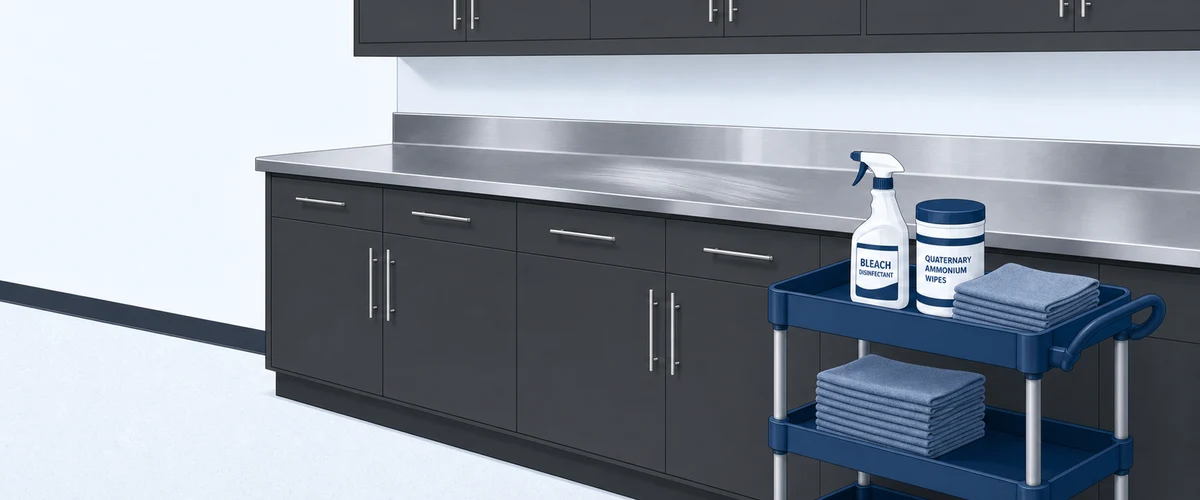
Your Lab Cleaning Regimen Should Determine What Furniture You Specify
Understanding laboratory furniture cleaning requirements is important for anyone managing a lab environment. The cleaning regimen is increasingly becoming one of the biggest drivers of furniture failure in a lab, not necessarily the work happening inside it which is still important to factor.
A lab may only handle relatively mild chemistry during normal operations. But if cabinets and work surfaces get wiped, sprayed, or fogged with a hospital-grade disinfectant several times a day, the cleaning regimen itself often becomes the primary source of wear on the room. That changes the conversation around material selection — the laboratory furniture cleaning requirements deserve the same weight in a spec as the process chemistry.
A specification shouldn’t only account for what happens on the work surface. It should also account for what gets repeatedly applied to every surface in the room.
Three variables behind every laboratory furniture cleaning requirement
Cleaning damage isn’t one thing. It’s the product of three variables acting on the same materials over time.
Chemistry. Different disinfectants attack different materials in different ways. Bleach tends to be hard on stainless welds and paint edges. Quaternary ammonium is generally mild but can build up residue over time. Hydrogen peroxide is aggressive on some polymers and gentler on others. Each chemistry has a personality.
Frequency. A surface wiped down once a shift lives a different life than a surface wiped down every hour. Cumulative dwell time matters, and it compounds fast in high-frequency environments.
Exposure method. How the chemistry reaches the furniture may matter more than the chemistry itself. Wiping is targeted. Spraying is not. Fogging reaches every hinge, seam, and drawer interior in the room.
Any single variable can be managed. All three, unmanaged, tend to find the weakest material in the room.
Cleaning chemistries that shape laboratory furniture cleaning requirements
The five chemistries most common in laboratory and healthcare settings each carry a different profile. The goal here isn’t to be exhaustive. It’s to help you recognize which family your regimen falls into.
Bleach and chlorine-based disinfectants
Sodium hypochlorite is the workhorse of infection control — fast, cheap, and effective against a broad range of pathogens. It’s also hard on materials. Chlorides can pit Type 304 stainless steel over prolonged exposure, especially in pooled or under-seam conditions, and bleach can etch anodized aluminum and eventually chalk powder-coated finishes. Facilities using bleach daily may want to consider Type 316 stainless in high-exposure zones, per the CDC HICPAC environmental infection control guideline.
Quaternary ammonium disinfectants (quats)
Quats sit on the mild end of the disinfectant spectrum and are widely used in clinical and outpatient environments. They’re generally compatible with most cabinet finishes. The trap tends to be buildup. Quats leave a residue that, over months and years without rinse steps, can soften finishes and dull surfaces. Common in EPA List N and List K registered products used in healthcare.
Hydrogen peroxide-based cleaners
Accelerated hydrogen peroxide (AHP) has become a common alternative to bleach. It’s generally less corrosive to stainless steel and kinder to painted finishes. But some polymers, certain thermoplastics and older phenolic formulations, may develop microcracking under repeated exposure. Vaporized hydrogen peroxide used in terminal decontamination cycles imposes an even higher bar on gaskets, cabinet interiors, and hardware inside a fogged room.
Alcohol-based disinfectants
70% isopropyl and ethanol are common for spot cleaning and equipment surfaces. Alcohol dries fast, which is a virtue for the microbiologist and a mixed blessing for the cabinet. It can extract plasticizers from some vinyl edge bands and dry out gasket materials over time. Generally fine on stainless, epoxy resin, phenolic, and most powder-coated finishes.
Acids and specialty decontamination chemicals
Sporicidal treatments, decalcification acids in histology, glutaraldehyde in older reprocessing rooms, and peracetic acid in some pharmaceutical suites are the aggressive end of the spectrum. These aren’t daily disinfectants, they’re targeted decontamination or process chemistry. When they contact cabinet fronts, hardware, or countertop-to-cabinet seams, the wear tends to be disproportionate to the frequency.
How cleaning frequency shifts laboratory furniture cleaning requirements
Frequency is where the specification gets interesting. The same cabinet material may perform perfectly well in a periodically cleaned research room and begin showing premature wear in a room disinfected multiple times a day.
A useful mental model can break lab environments into four tiers:
- Periodic (weekly or as-needed). Research labs, dry benches, storage-heavy rooms. Standard finishes generally hold up well.
- Daily. Clinical labs, teaching labs, most academic environments. Finish compatibility becomes a real design input.
- Multiple times per day. Pathology, healthcare-adjacent labs, outpatient exam rooms, pharmacy compounding areas. Cumulative dwell time drives material choice.
- Aggressive decontamination. BSL-3, sterile compounding rooms subject to USP General Chapter 800 cleaning protocols, vaporized hydrogen peroxide cycles, sporicidal wipe-downs. Hardware, gaskets, and interior finishes all matter.
The same drawing set — same layout, same equipment — can call for two completely different cabinet finishes depending on which tier the room lands in. The tier(s) should draft the spec.
Wiped, sprayed, fogged, or pooled?
Most people think about which chemical they’re using. Less think about how the chemical reaches the furniture. That’s often the difference between a room that ages well and one that doesn’t.
Wipe stays on the target. Spray finds hardware. Fog finds everything.
Wiped chemistry is the most contained mode. The chemistry contacts the intended surface, sits for its labeled dwell time, and then leaves — often on the same cloth it arrived on. Cabinet fronts, hardware, and seams that weren’t on the target list mostly stay dry. Wiping is generally the easiest cleaning mode to spec around.
Sprayed chemistry is where a lot of specifications quietly break. A spray bottle aimed at a countertop mists onto drawer fronts, pulls, hinges, and the underside of wall cabinets — surfaces the specifier may have assumed wouldn’t see disinfectant. Over months and years of daily spray-downs, that overspray tends to be where finish degradation first appears.
Fogged chemistry most commonly vaporized hydrogen peroxide used in terminal decontamination, reaches every exposed surface in the room simultaneously, including cabinet interiors if doors are opened during the cycle. Gaskets, elastomers, adhesives, and interior finishes all become part of the compatibility question. Fog is not a countertop problem. It’s a whole-room problem.
Pooled chemistry is the failure mode that pulls everything together. Any of the above modes can leave a puddle at a seam, corner, or countertop-to-cabinet joint. That puddle is where dwell time stops being an EPA label number and starts being an unbounded exposure and it’s where finishes tend to fail first.
Your countertop isn’t your cabinet body
The countertop may need one level of chemical resistance. Cabinet doors may need another. Cabinet interiors, hardware, seams, edges, and exposed metal each carry their own vulnerabilities. Spray-based cleaning is what changes the calculus chemistry intended for the countertop lands on drawer fronts, hinges, and the underside of wall cabinets.
Consider a histology lab. The bench needs an epoxy resin work surface because of direct exposure to xylene and decalcification acids during specimen prep. Powder-coated steel casework would normally be perfectly suitable for the surrounding cabinet body. But if that same casework gets repeatedly saturated with 10% bleach spray between cases, the cabinet specification may need to change too either to stainless bodies in the wet zones, to a more chemical-resistant coating system, or to sealed hardware that keeps disinfectant out of the joint. The countertop passes. The cabinet fails around it.
Three questions worth adding to the pre-spec conversation:
- Is the disinfectant being wiped, sprayed, or fogged?
- Is the surface being dried after contact, or is dwell time part of the protocol? EPA-labeled dwell times for many disinfectants run 3–10 minutes.
- Are cabinet fronts, hinges, and pulls specifically rated for the cleaning chemistry, or just assumed to survive it?
Matching laboratory furniture cleaning requirements to the right material
Ask ten manufacturers which casework material is best for a lab, and you’ll get ten different answers, each defending whichever material that particular shop specializes in. It’s the wrong question when the laboratory furniture cleaning requirements haven’t been described yet.
The right material depends on where the cleaning regimen falls across those three variables. Plastic laminate performs well in a clinic wiped daily with quats. Type 316 stainless earns its price tag in a room fogged nightly with peroxide or sprayed hourly with bleach. Powder-coated steel with the right coating chemistry covers a large middle ground. Phenolic and polypropylene each solve specific problems like moisture, trace-metal work, acid digestion, but aren’t drop-in replacements for one another.
Below is a compatibility view organized around the three variables above — a starting point for translating laboratory furniture cleaning requirements into a shortlist of casework materials, followed by the downloadable walkthrough that lays out the same data plus a pre-spec worksheet.
Laboratory furniture cleaning requirements × material compatibility matrix
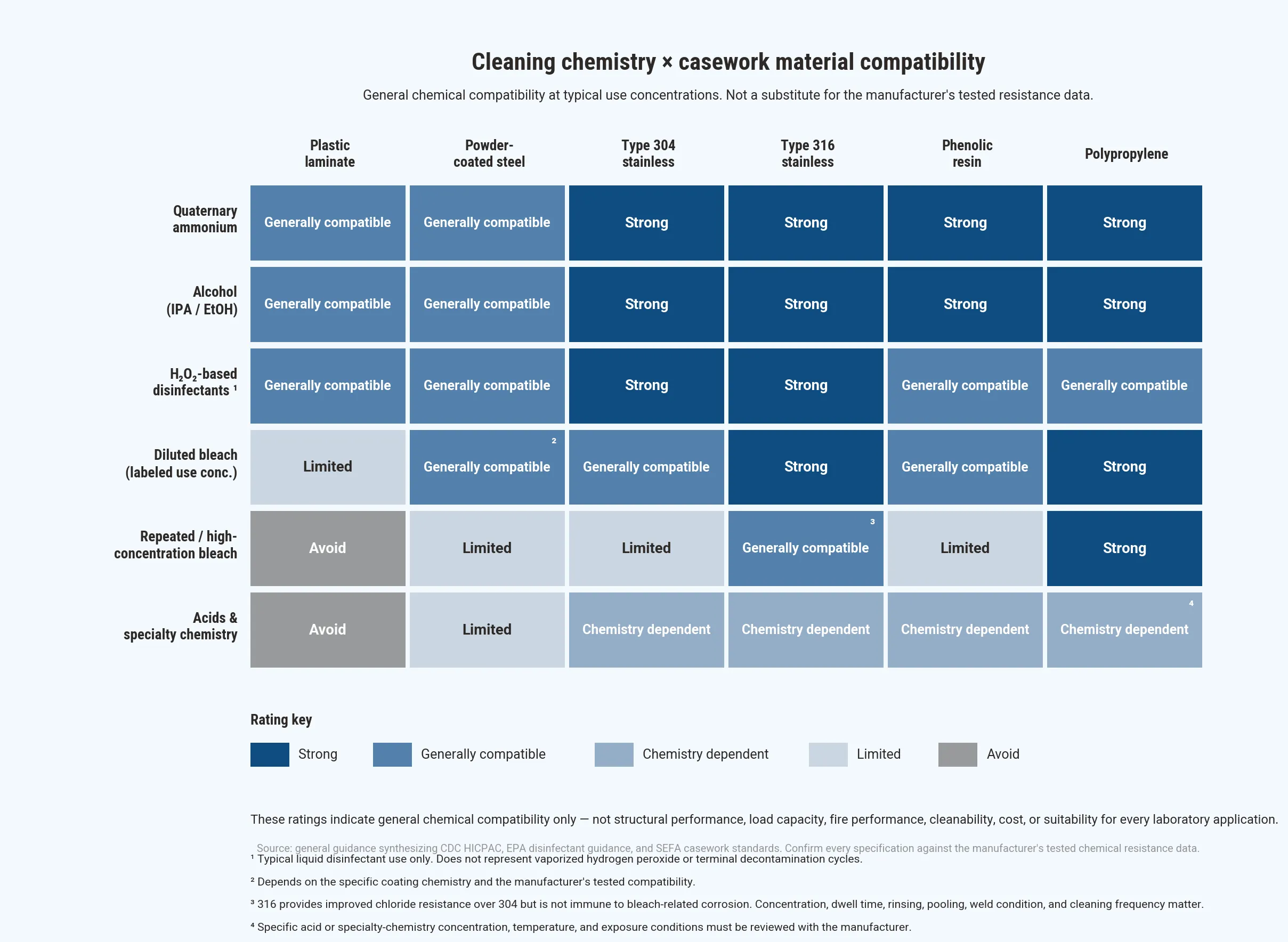
Compatibility grades on the matrix are general reference points intended for early-stage specification decisions. Confirm specific product-line performance against the manufacturer’s tested chemical resistance data before finalizing a spec, especially for the “limited” and “avoid” cells.
Download Our Cleaning Regimen & Furniture Compatibility Walkthrough Guide
If a lab uses substances that fall outside the disinfectants covered in the walkthrough or if the cleaning protocol involves aggressive decontamination cycles beyond routine hospital-grade disinfection the compatibility grid is a starting point, not a final answer. If needing helping selecting the appropriate furniture for you specialized lab, talk to us today.
Download our Lab Cleaning Regimen & furniture Compatibility Walkthough guide for a quick reference compatibility matrix and pre-specification worksheet to help start the conversation.
Sources for these laboratory furniture cleaning requirements
- CDC, Guidelines for Environmental Infection Control in Health-Care Facilities (HICPAC).
- CDC, Guideline for Disinfection and Sterilization in Healthcare Facilities.
- EPA, Selected EPA-Registered Disinfectants (Lists N, K, L, and others).
- USP, General Chapter <800> Hazardous Drugs — Handling in Healthcare Settings.
- SEFA, Recommended Practices & Standards (SEFA 8-M, 8-PL, 8-W, 3, and related casework standards).
- OnePointe Solutions, Medical-Grade Cabinets: What They Are, Where They Belong, and How to Specify Them.
- OnePointe Solutions, Bleach Resistance in Lab Countertops.