


By the OnePointe Solutions Lab Design Team.
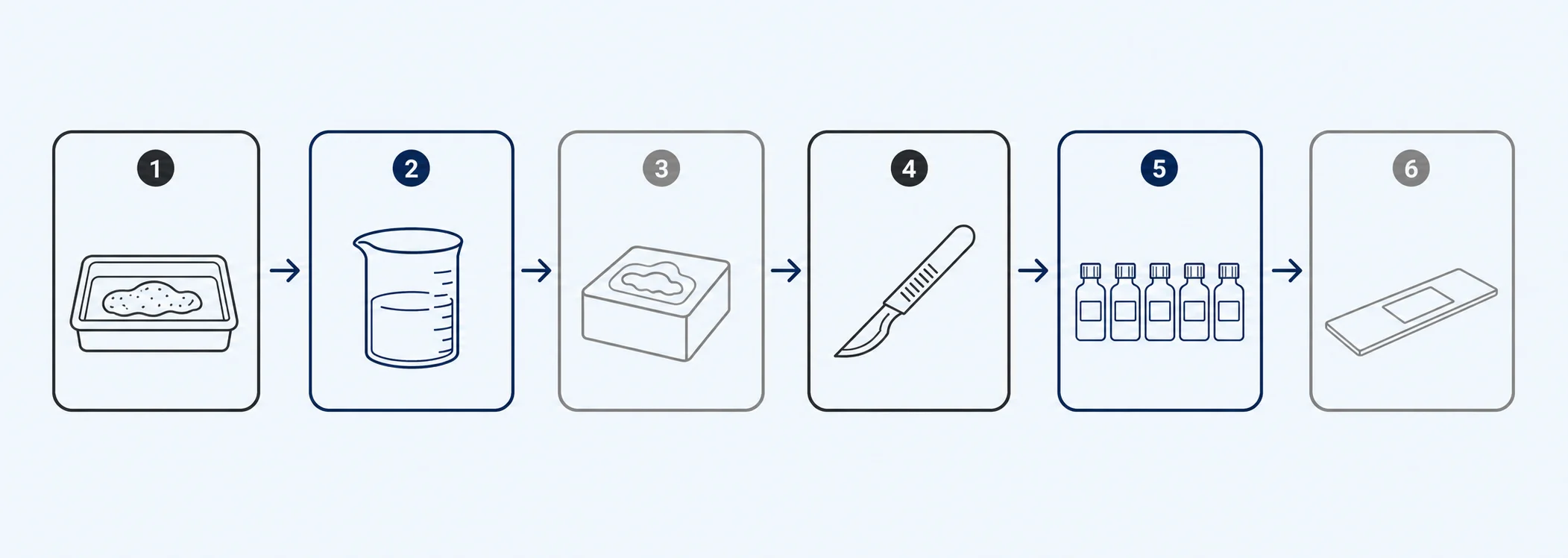
Histology lab design starts with one question. Where does the tissue go next? A specimen moves from grossing to fixation, to processing, to embedding, to microtomy, to staining, and finally to storage. So, every bench and hood in the room exists to move that specimen safely along. Good histology lab design treats this tissue processing workflow as the organizing principle. It is not a checklist applied after the walls go up.
A general wet lab designs around bench flexibility and hood count. Histology lab design instead designs around one dominant hazard that touches nearly every station: formaldehyde. The grossing bench, the tissue processor, the stainer, and the wet-tissue archive all handle formalin-fixed material all day, every day. That single fact drives ventilation, casework material, and life-safety placement differently than it would in a lab running occasional, varied chemistry. This guide walks the workflow station by station, anchored to OSHA, CAP, CLIA, NFPA, and ASHRAE.
The Grossing Station: Where Formaldehyde Exposure Is Highest
The grossing station carries the highest formaldehyde exposure risk in histology lab design. Tissue gets unwrapped, trimmed, and described directly over open fixative. OSHA 1910.1048 sets the permissible exposure limit (PEL) at 0.75 ppm as an 8-hour time-weighted average. The short-term exposure limit (STEL) is 2 ppm over any 15-minute period. The action level that triggers monitoring sits at 0.5 ppm. Those numbers are not abstract. A grossing bench with poor capture can push breathing-zone concentration past the STEL in minutes.
Also, NIOSH recommends a far stricter limit of 0.016 ppm TWA. NIOSH treats formaldehyde as a potential occupational carcinogen. So, defensible histology lab design does not stop at the OSHA PEL. It targets the lowest feasible concentration through engineering controls first. OSHA’s own guidance requires employers to “implement feasible engineering and work practice controls to reduce and maintain worker exposure… at or below the 8-hour TWA and the STEL.” Respirators come after those controls, not instead of them.
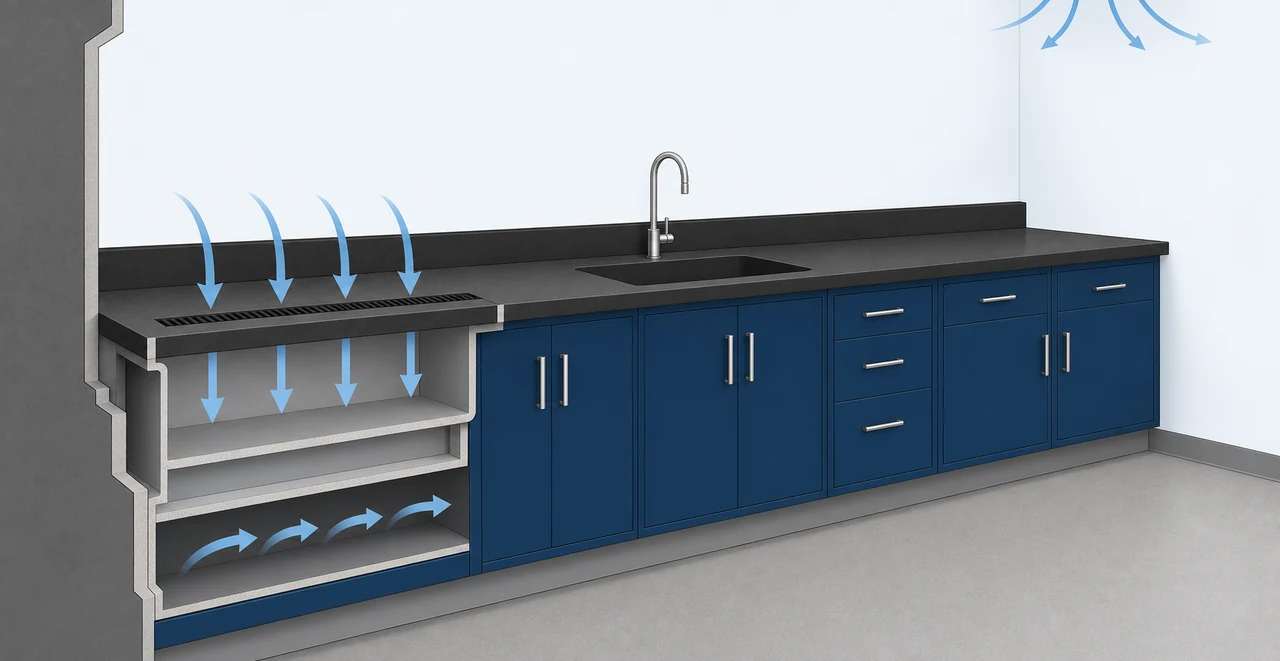
In practice, that means local exhaust capture at the point of generation. Room dilution alone is not enough. The National Society for Histotechnology states plainly that “dilution ventilation alone is not effective.” Capture devices “should be used to minimize exposure at the source.” A downdraft or backdraft grossing station pulls formaldehyde vapor away from the breathing zone, down through a rear or base plenum, instead of across the face like a standard hood sash. Face velocity still matters if a hood alternative is used instead. But downdraft geometry suits grossing work better, since the technologist works flat, hands over the specimen.
Tissue Processor and Embedding Station
The automated tissue processor runs xylene or a xylene-substitute clearing agent through a closed cycle. It then hands off to the embedding station, where paraffin infiltration finishes. Even a closed processor vents at load and unload. The embedding console itself works with open paraffin and residual clearing-agent vapor at the counter. So, this station needs local capture at the load door and at the embedding console, not just a room-level exhaust rate.
NFPA 45 applies to any laboratory unit handling chemicals with an NFPA 704 flammability rating of 2, 3, or 4. Xylene triggers this standard directly. So, the suite needs a defined fire hazard classification, Class A through D, based on flammable liquid volume in use and storage. Most histology processing rooms run modest solvent volumes. That typically lands the space in Class C or D. That classification then sets the maximum quantity for solvent at the bench versus in a storage cabinet.
On ducted versus ductless, a ducted enclosure over the processor load area gives a defensible, verifiable exhaust path. A ductless or carbon-filtration unit can work for small satellite processors. But filtration media saturates with continued xylene use, so it needs a documented change schedule tied to breakthrough data. Spill containment matters too. The processor and embedding bench should sit over a curbed, chemical-resistant surface with a contained sump, not an open floor drain. That way a reservoir leak stays local instead of spreading room to room.
Microtomy and Sectioning
Microtomy is the most physically repetitive station in the workflow. So, histology lab design has to treat it as an ergonomics problem first. A technologist sections for hours at a fixed bench height, advancing the specimen and clearing ribbons by hand. The bench needs a height that supports a neutral wrist angle. It also needs task lighting free of glare on the blade, and clear knee space for a seated posture that avoids forward head tilt.
The waterbath at the microtome runs heated, typically in the mid-40s to low-50s Celsius range, to float and flatten sections before mounting. That heat source needs clearance from paper, gloves, and reagent bottles on the same bench. It also needs a stable, vibration-isolated surface. Vibration matters even more at the cryostat, where section thickness runs thinner. Bench resonance from nearby equipment shows up directly as chatter in the ribbon. A dedicated, isolated bench base for the cryostat keeps mechanical noise from degrading section quality.
Sharps handling at microtomy falls under OSHA 1910.1030, the bloodborne pathogens standard. Microtome and cryostat blades count as contaminated sharps once they touch tissue. The standard requires “sharps disposal containers… that isolate or remove the bloodborne pathogens hazard from the workplace.” So, the layout needs a sharps container within arm’s reach of the blade-change point. It also needs a written exposure control plan naming that procedure.
Staining and Coverslipping
Automated slide stainers run a sequence of aqueous and solvent-based reagents. Most routine H&E and special-stain protocols still finish with a xylene-based clearing step before coverslipping. That means the stainer and coverslipper line needs local exhaust ventilation at the reagent stations. A general room exhaust rate is not enough, since xylene vapor releases continuously as the stainer cycles through open troughs.
Small chemical storage at the staining line should stay inside a vented, chemical-resistant cabinet sized to daily working volume, not a full-shift supply. Bulk xylene and alcohol belong in the flammable-liquid storage room, sized against the same NFPA 45 tables that govern processing. Drain compatibility at the staining sink matters as much as ventilation. Xylene and alcohol waste is not simply “down the drain” material. The sink, trap, and waste line should specify chemical-resistant materials consistent with applicable IAPMO Uniform Plumbing Code provisions for chemical waste, coordinated with hazardous-waste procedure.
Cryostat and Frozen Section Room
Frozen section work moves faster than routine histology and often runs during a live surgical case. That raises both the infection-control and throughput stakes at once. When tissue may carry an infectious agent, the cryostat should sit inside or adjacent to a biosafety cabinet appropriate to the risk, not an open bench. The CDC Biosafety in Microbiological and Biomedical Laboratories (BMBL) guidance notes that “flammable chemicals should not be used in Class II, Type A1 or A2 cabinets since vapor buildup inside the cabinet presents a fire hazard.” So, when infectious tissue risk pairs with a nearby flammable fixative, a ducted Class I cabinet is the safer fit than a recirculating Class II unit.
Temperature and humidity control inside the room affect both section quality and comfort. The cryostat chamber runs well below freezing while the room stays at normal working temperature. So, the room needs enough dehumidification capacity to prevent condensation fog at the cryostat window during a busy case run. The decontamination workflow, wipe-down, blade change, and disposal of contaminated sections, needs a written procedure. That procedure should follow BMBL containment practices and tie back to the same OSHA 1910.1030 requirements that apply at microtomy.
Storage: Slides, Blocks, and Wet Tissue
Storage is not an afterthought in histology lab design. It is a code-driven space with its own retention math. The federal floor comes from CLIA, 42 CFR 493.1105: histopathology slides at least 10 years, cytology slides at least 5 years, and specimen blocks at least 2 years from the date of examination. Wet tissue remnants must be preserved “until a diagnosis is made on the specimen.”
CAP accreditation raises the bar above that federal floor. The CAP Anatomic Pathology Checklist item ANP.12500 sets paraffin blocks at 10 years, not the CLIA minimum of 2. It confirms glass slides at 10 years, with the added requirement that slides “must remain readable for this period.” Wet tissue in a CAP-accredited lab is retained “at least 2 weeks after final report.” That sets the footprint of the wet-tissue archive: enough ventilated, formalin-compatible shelving to hold two to three weeks of stock bottles at peak volume, with odor control beyond the room’s general exhaust alone.
Slide and block archives should sit apart from the wet-tissue room. Slides need a dry, temperature-stable, low-light environment to protect stain intensity over a decade of storage. Blocks need less climate control. But they benefit from organized, accession-ordered shelving that supports fast retrieval for a consultation or legal request.
HVAC and Ventilation: The System That Ties It Together
Every station above depends on one ventilation system. So, histology lab design has to solve HVAC as a whole-lab problem, not a room-by-room patch. ASHRAE’s Laboratory Ventilation Design Level (LVDL) framework classifies spaces from LVDL-0 through LVDL-4 by hazard. Each level carries a target occupied air change rate. Grossing, processing, and staining carry the heaviest continuous solvent load. They typically sit at LVDL-3 or higher, targeting 8 or more air changes per hour occupied. Reading rooms and slide archives sit lower, closer to LVDL-1 or LVDL-2.
The National Society for Histotechnology confirms the histology-relevant range directly. OSHA’s Laboratory Standard sets a broad room air change rate of 4 to 12 exchanges per hour. ANSI guidance suggests 4 to 10. ASHRAE 62.1 governs general building ventilation but defers to ANSI/AIHA Z9.5 once hazardous chemicals enter the space, which every histology lab does by definition. So, mechanical design needs Z9.5’s risk-based approach layered on the 62.1 baseline, not 62.1 alone.
Pressure cascade matters as much as ACH count. Grossing and processing rooms should run negative to the corridor. That way formaldehyde and xylene vapor never migrates outward when a door opens. NSH describes this directly: a negatively pressurized laboratory “keeps contaminants from escaping outside the room” by pulling corridor air inward rather than pushing lab air out. Storage and reading rooms can run closer to neutral, since they carry a lower continuous vapor load.
Casework and Surfaces
Formalin resistance drives the material decision at nearly every histology bench. Phenolic resin countertops resist formalin, xylene, and staining reagents without pitting or delaminating over years of exposure. That makes phenolic the standard choice at grossing, processing, and staining benches. Epoxy resin is a reasonable alternative where a heavier chemical load or higher heat resistance is expected. But phenolic remains the more common histology specification, since it is lighter, easier to install on standard casework spans, and easier to detail around the sink cutout.
Sealant and cove base matter as much as the countertop material. A chemical-resistant sealant at every seam closes off the gaps where spills would otherwise migrate under casework. Coved base at the floor-to-wall transition does the same at the floor line. Sinks at a histology bench are typically molded epoxy resin. They drop in or undermount to the phenolic top. Epoxy sinks resist formalin and xylene. The most important detail is the sink-to-countertop seam. A chemical-resistant sealant bead at that joint, correctly detailed and inspected during commissioning, is what protects the substrate from fixative pooling over time.
Hardware matters too, and not only for chemical resistance. Powder coated metal cabinets is great and universal option to have. You can have phenolic resin casework and stainless steel but should only be included where necessary. For example, have phenolic in wet zones and stainless where cleanability is driving the decision. For material selection at scale, see our lab casework overview and our laboratory fume hood guide for hood selection at the grossing and processing stations.
Life Safety and Emergency Response
ANSI/ISEA Z358.1 sets the eyewash and shower placement standard every grossing and staining station has to meet. It must be reachable within 10 seconds, roughly 55 feet of unobstructed travel, on the same level as the hazard. A grossing bench splashing formalin, or a staining line handling open xylene troughs, both qualify as the hazard this standard addresses. OSHA’s general duty at 29 CFR 1910.151(c) backs the requirement with a citable federal obligation.
NFPA 45’s maximum allowable quantity tables cap how much xylene, alcohol, and other flammable liquid the suite can hold in use and storage. Exceeding that cap triggers a higher fire hazard classification, added fire separation, or a dedicated flammable-storage room. Most histology processing suites run modest solvent volumes relative to a synthesis lab. That typically keeps the space at a Class C or D classification. But that classification still sets a hard ceiling on bench-top solvent volume the layout has to respect.
Finally, OSHA 1910.1200 requires that “chemical-specific information must always be available through labels and safety data sheets.” A histology lab handling formalin, xylene, and a rotating list of special-stain reagents needs SDS access at every station. A binder in an office down the hall does not meet that bar. A wall-mounted or terminal-based SDS system at the grossing, processing, and staining stations keeps the requirement practical.
Building a Defensible Histology Lab Design
Histology lab design succeeds when the tissue processing workflow reads clearly in the floor plan. Grossing feeds processing. Processing feeds embedding. Embedding feeds microtomy. Microtomy feeds staining, and staining feeds storage. Each handoff carries its own ventilation target, casework material, and life-safety requirement, all traceable to a first-party standard. OSHA 1910.1048 sets the formaldehyde limits that size the grossing station’s exhaust. CAP and CLIA set the retention periods that size the archive. NFPA 45 and ANSI/AIHA Z9.5 set the fire and ventilation math that ties the whole suite together.
For related planning guidance, see our Lab Fume Hoods 2026 Guide for hood selection principles that also apply at the grossing bench. Also see our Lab Renovation Checklist for the pre-construction sequence a histology suite retrofit should follow. If your histology lab design project needs a workflow review, from grossing station ventilation to slide archive planning, contact our lab design team to start the conversation.
— OnePointe Solutions Lab Design Team