


By OnePointe Solutions Lab Design Team
Someone in a laboratory planning meeting has probably asked this question:
“What about HDPE? Isn’t it a less expensive alternative to phenolic or epoxy?”
The answer surprises most people.
HDPE (high-density polyethylene) isn’t an inexpensive substitute for traditional laboratory work surfaces. It’s an engineered industrial polymer designed for highly specific applications where contamination control, corrosion resistance, or seamless fabrication outweigh other performance considerations.
For most laboratory countertops, phenolic resin, epoxy resin, or stainless steel remain the better choice. However, there are a handful of applications where HDPE is the superior material—and understanding that distinction can save both money and specification headaches.
This guide explains where HDPE belongs, where it doesn’t, and how to determine whether it’s the right surface for your project. Every recommendation references primary industry standards so you can verify the data yourself.
What HDPE Actually Is (and Isn’t)
HDPE stands for high-density polyethylene, a member of the polyolefin family. Density is what defines it. Under the cell-classification system in ASTM D3350, density cell classes run from “0.925 or lower” at class 1 up to “>0.955” at class 5. The companion material specification, ASTM D4976, sorts polyethylene the same way and calls classes 3 and 4 high density, meaning above 0.940 g/cm³. Federal regulation sets the same floor. FDA, citing 21 CFR 177.1520, defines high density polyethylene as having “a density not less than 0.94 gram per cubic centimeter.”
Test methods matter too. Density is measured by ASTM D1505, tensile properties by ASTM D638, and chemical-reagent resistance by ASTM D543. Notably, D543 splits into immersion testing and a splash-or-wipe practice, which maps neatly onto how a bench surface really gets used.
Now the part people get wrong. HDPE is not polypropylene. PP cabinets form a recognized lab casework category, used for acid storage and wet chemistry. HDPE is a different polyolefin with a different property profile and a different primary market. In addition, HDPE is not UHMW, the ultra-high-molecular-weight polyethylene used for wear parts. Three different materials, three different specs. Consequently, a spec that says “polyolefin” tells you almost nothing on its own. Ask which polymer, which grade, and which test data backs it. An hdpe countertop and a PP acid cabinet are not siblings in a product line. They are separate purchases, sourced from separate supply chains, and they solve separate problems.
HDPE Is Not a Cheap Option, Here’s Why
The assumption that plastic means low cost comes from grocery bags and milk jugs, not from lab or industrial sheet. Chemical-grade and food-grade HDPE gets extruded or compression molded to tight tolerances, then machined to size. That work costs money. Consequently, an hdpe countertop priced honestly rarely undercuts a phenolic top by much, if at all. If price is the reason someone raised HDPE, they raised the wrong material. Furthermore, thickness drives cost fast, because a polymer top needs mass to stay flat across a span.
Instead, judge HDPE on engineering merit. It holds dimensional stability in wet and caustic service. It resists a wide chemical panel: an independent SEFA 3-2010 test report on high-density polyethylene recorded “zero (0) Level 3 conditions evident” across the 49-chemical panel, with Level 0 results for sodium hydroxide at 10, 20, and 40 percent, plus hydrochloric, nitric, sulfuric, and phosphoric acids. That panel follows the methodology published in SEFA 3-2010.
Moreover, HDPE machines cleanly and welds. Hot-air and extrusion welding produce continuous, seamless polymer joints, which is exactly why containment fabricators reach for it. It also stays non-leaching in contact with dilute reagents, which matters enormously for trace work. Therefore the value case for an hdpe countertop is technical, never economic. Buy it for chemistry, weldability, and longevity in aggressive service. Do not buy it to save money. In short, treat an hdpe countertop the way you would treat a corrosion-resistant alloy. It is a performance selection, and it belongs on the drawing only when performance demands it.
Where HDPE Dominates: Industrial Applications
Outside the lab, HDPE is everywhere, and this is where the material genuinely earns its keep. These industrial applications, not benchtops or countertops, drive the sheet market.
- Chemical processin: Tank liners, containment vessels, splash guards, and secondary containment curbing all rely on HDPE. Specifically, strong bases, chlorine, and brine sit well inside the tolerance the SEFA 3 panel above documents.
-
Wastewater and water treatment: Clarifier components, chemical feed troughs, and chlorination contact surfaces use HDPE routinely. Polyethylene material qualification for potable-water contact runs through NSF/ANSI 61.
Food processing: Cutting surfaces, conveyor rails, and wash-down tables use FDA- and USDA-grade sheet. The food-contact basis is 21 CFR 177.1520, and food-equipment material qualification runs through NSF/ANSI 51. -
Plating and finishing shops: Chrome, nickel, and zinc lines put HDPE on bench tops, tank tops, and drip trays. As a result, the same material runs from the tank to the work surface.
Marine and dockside. Dock bumpers, hatch covers, and structural boards take constant water and impact without rotting. -
Semiconductor and cleanroom substrates: DI-water contact surfaces, wet-station backing panels, and low-particulate polymer benches use HDPE for its low extractables.
Agriculture and animal handling. Sorting benches, wash surfaces, and feed troughs survive daily hosing and disinfectant.
Notice the pattern. Every one of these industrial applications involves aggressive water chemistry, wash-down, or containment. That is HDPE in its native habitat. Because these industrial applications buy sheet by the truckload, they also set the grades, the tolerances, and the pricing that a lab later inherits when it orders an hdpe countertop.
The Narrow Lab Use Cases That Still Justify HDPE
HDPE does have real lab uses. However, they are specific, and they are few. In each case below, the driver is contamination control or corrosion, so an hdpe countertop shows up as a deliberate exception to the house material.
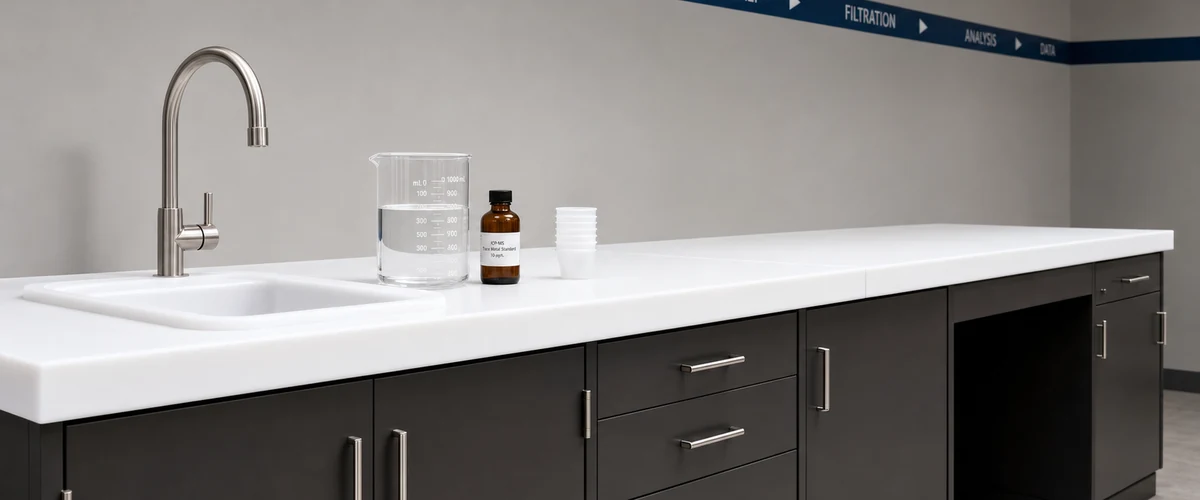
Trace-metals work comes first. EPA SW-846 Chapter Three lists polyethylene among the preferred non-contaminating materials for ultra-trace element work, though “suitable for storage only, not for acid digestion.” The same chapter warns that container materials “can introduce either positive or negative errors in measurement, particularly at low or ultra-trace levels.” Similarly, EPA Method 200.7 names polyethylene among acceptable reusable labware. FDA is blunter still. Its Elemental Analysis Manual instructs labs to “use plastic polymer utensils and containers when feasible instead of glass, ceramic, or metallic materials.” Labs running EPA Method 200.8 by ICP-MS work in exactly that world.
Ultra-low-leachate contact surfaces come second. Where a resin binder or a metal surface could contaminate the sample, a polymer surface removes that variable.
Strong-base and hypochlorite zones come third. HDPE posted Level 0 against sodium hydroxide at every tested concentration in the independent SEFA 3 report cited above.
Aggressive corrosion pockets come fourth. Think one decant bench, one sink return, or one splash zone, not a whole room. These four cases are exceptions. For general benchtops, phenolic and epoxy still own chemistry labs, and stainless still owns glassware wash, cold rooms, and wet BSL space. In other words, an hdpe countertop earns a place in a lab program as a targeted fix, never as a house standard.
Where HDPE Does NOT Belong (Phenolic, Epoxy, or Stainless Wins)
The NIH Design Requirements Manual is explicit about the default. It states that “epoxy or phenolic resin countertops shall be used in laboratories where more intensive use of chemicals, reagents, and harsh disinfectants is anticipated.” It adds that “epoxy countertops shall be used for synthetic chemistry laboratories and other applications requiring the use of corrosive chemicals,” and that “stainless steel or phenolic resin shall be used for glassware wash areas, cold rooms, and other areas where high moisture levels are anticipated.” Notably, none of those sentences mention HDPE. The NIH countertop list names plastic laminate, solid surface, natural stone, stainless steel, epoxy resin, and phenolic resin. HDPE appears in that manual only for piping.
The technical reasons are straightforward. HDPE carries no fire rating comparable to solid phenolic composite. It is less stiff, so it needs more support at open spans. Its surface is softer, so it scratches and dents under tooling and glassware. Thermal expansion runs higher, which complicates long runs and tight scribes. It also cannot take sustained heat contact. EPA states plainly that polyethylene “does not have a thermal-use temperature appropriate for digestion,” and it “is also not sufficiently inert to be useful as a digestion vessel or vessel liner.” In contrast, fluoropolymers hold “the highest range of use temperatures for most plastics, ranging from 270–300°C.” Finally, HDPE is not a standard work surface for classified fume-hood installations.
So for general chemistry, biology, histology, and teaching labs, specify phenolic, epoxy, or stainless. An hdpe countertop in those rooms solves a problem the room does not have. Our lab casework materials guide walks through those defaults in more depth.
HDPE vs. Polypropylene: Two Polyolefins, Two Different Products
This conflation shows up constantly, so let us kill it directly. Yes, both materials are polyolefins. SEFA 3-2010 uses that exact taxonomy in its sink-material section, defining polyolefin as “thermoplastic polymers, derived from simple olefins, most predominant are polyethylene and polypropylene for laboratory use.” Family resemblance ends there, though.
Polypropylene occupies a defined lab position. PP is the recognized material for acid-storage cabinets and for specific sink bodies, with its own chemical-resistance profile and its own casework category. HDPE holds no such position. In fact, SEFA 3’s official work-surface categories run to nine materials: edge grain hardwood, epoxy resin, fiber cement, high pressure laminate, impregnated natural stone, solid phenolic composite, solid surface, stainless steel, and welded fiber. HDPE is not among them.
Therefore an hdpe countertop is not a SEFA countertop category, and it is not a stand-in for PP casework. If a Division 12 spec calls for a polypropylene acid-storage cabinet, HDPE does not satisfy it. The reverse holds too. Two materials, two markets, two spec lines. Meanwhile, an hdpe countertop still has to be justified on its own evidence, because SEFA’s category list will not do that work for you. For help decoding that section of a bid set, see our guide on how to read a Division 12 lab spec.
When to Actually Spec an HDPE Countertop
Here is the decision frame in one place. An hdpe countertop is a technical answer to a technical problem, so it should appear in a spec only when a named condition drives it. Otherwise the standards-recognized materials win. Spec an hdpe countertop only if one of these is true:
- You run a trace-metals or ultra-low-leachate program where polymer contact is a documented requirement, consistent with EPA SW-846 Chapter Three and the FDA Elemental Analysis Manual.
- You have an aggressive strong-base or hypochlorite exposure zone where phenolic’s own spec sheet reads marginal.
- You are matching an industrial process line already running HDPE, such as plating benches or chemical decant tables.
- You need a welded, seamless polymer surface for containment reasons.
If none of those apply, phenolic, epoxy, or stainless is a better call. Remember the baseline too: OSHA’s chemical hygiene appendix asks only that “work surfaces should be chemically resistant, smooth, and easy to clean,” and several materials clear that bar. Meanwhile, GSA P100-2022 puts chemical-resistant and stainless tops in its top construction tier without naming HDPE at all. For a heat-and-chemistry benchmark, compare against our phenolic lab countertop guide. As well as if you need more guidance on selecting the right work surface and how to care for them, also review are complimentary blogs below:
HDPE is neither a budget alternative nor a universal laboratory work surface. It is a specialty material designed to solve specific problems involving contamination control, corrosion resistance, and seamless fabrication. For most laboratories, phenolic resin, epoxy resin, or stainless steel remain the better long-term solution. The best work surface isn’t the one with the longest feature list, it’s the one that matches how the laboratory actually operates.
— The OnePointe Solutions Lab Design Team