


By the OnePointe Solutions Lab Design Team.
Classroom cabinets fail differently than working-lab cabinets, and the difference is all about the user. A research technician opens a drawer with purpose and closes it with care. A ninth grader slams a door, drops a backpack against a base cabinet, and leaves a Sharpie cap wedged in a hinge. Therefore, the abuse profile is not gentle nor occasional. It’s repetitive every day, for years.
Meanwhile, schools expect a 15-year service life on a budget built for 3-to-5-year replacements. So the cabinets have to outlast the funding cycle by a wide margin. This guide focuses on the cabinets themselves, not on the whole lab. Consequently, it looks hard at case construction, hinge and slide cycle ratings, and finish systems. It also covers storage design and the compliance checkboxes that school procurement teams must satisfy. Every recommendation ties back to a first-party standard, from SEFA 8 to BHMA A156.9 to NFPA 45. In short, durable classroom cabinets are engineered, not assumed.
The Classroom Abuse Profile Is Different
Start with the numbers, because they drive every hardware choice. A busy classroom cabinet door opens and closes roughly 20 to 40 times per school day. Multiply that by 180 school days, and a single door sees 3,600 to 7,200 cycles a year. Over a 15-year life, that lands between 54,000 and 108,000 cycles for one door. Some high-traffic supply doors run higher still. So a hinge rated for casual home use simply will not survive the math.
Furthermore, the abuse is not only mechanical. Students bring wet hands, dry-marker and paint contamination, and dilute chemical spills at low concentrations. They bang backpacks into base cabinets, drop stools against toe-kicks, and occasionally leave food behind. As a result, the failure points are predictable. In bargain casework, particleboard edges swell first where wet hands and spills reach the substrate. Next, thin edge banding peels. Then loose hinges sag, drawer slides bind, and back panels rack out of square. Consequently, the cabinet loses alignment long before its finish wears out. Good classroom cabinets attack each of those failure points on purpose.
Case Construction: What Actually Lasts
The case is the skeleton, so it decides how the cabinet ages. First, the core material matters most. Three-quarter-inch plywood holds screws, resists moisture, and stays flat far better than particleboard. By contrast, particleboard crushes at screw points and swells when a spill reaches an unsealed edge. Therefore, a plywood case gives a classroom cabinet a structural head start it never loses.
Next, joinery decides whether the box stays square. Dado joints seat each panel into a machined groove, which locks the case against racking. Glue-and-screw or dowel-and-glue connections then add clamping strength at every corner. Meanwhile, thick edge banding protects the vulnerable panel edge from the wet hands and impacts that classroom cabinets face daily. A thin, heat-glued strip peels; a thicker, firmly bonded band survives. Additionally, a full-thickness back panel captured in a groove keeps the case from twisting when a student leans on an open door.
Finally, the toe-kick earns its keep in a classroom. Students kick it, mop water pools against it, and stools scrape it. So a reinforced, sealed toe-kick resists both impact and moisture at the one spot that takes the most floor-level abuse. SEFA sets the performance bar for this kind of casework. The association establishes standards for “laboratory grade casework and fixtures,” per SEFA. It also publishes SEFA 8 editions for metal, phenolic, plastic laminate, and wood cases alike. A case built to that bar stays square and tight for the long haul.
Hinge, Slide, and Lock Grade
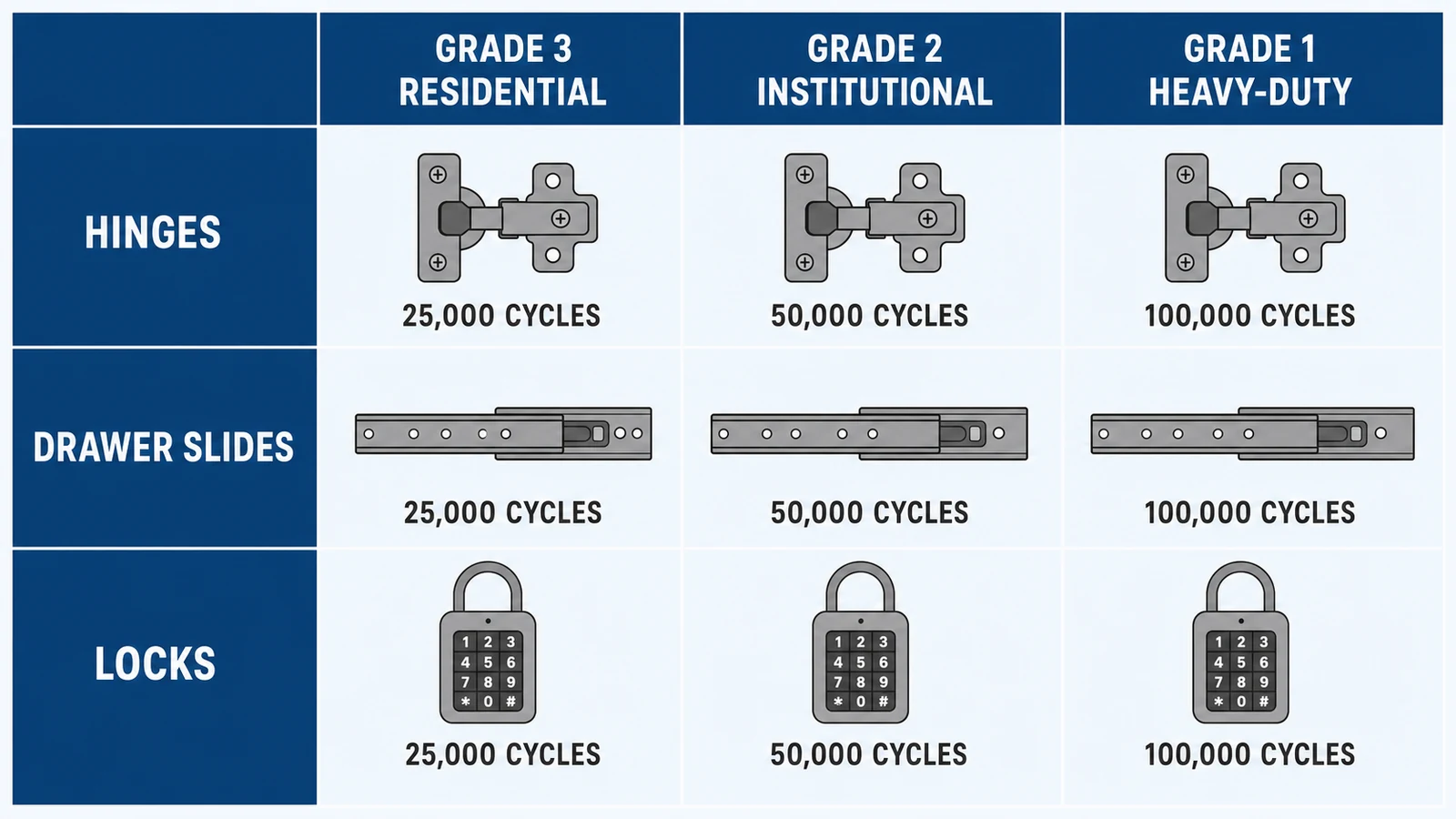
Hardware is where classroom cabinets live or die, and grade is the honest signal. ANSI/BHMA A156.9 governs cabinet hardware. It “contains requirements for cabinet hardware and includes hinges, knobs, pulls, catches,” plus “drawer slides,” with “performance tests covering operational, cyclical, strength, and finish criteria,” per ANSI/BHMA A156.9. The standard sets three grades for most products. Notably, “100,000 cycles are required for a Grade 1 hinge,” while lower grades clear fewer cycles.
Match that number to the classroom math above. A 15-year door can exceed 100,000 cycles, so a Grade 1 hinge is the sensible floor for classroom cabinets, not an upgrade. Drawer slides follow the same logic. A156.9 is the only ANSI method that tests drawer slides on their own. It cycles a loaded drawer, then confirms the slide “shall be completely operable after cycle life test,” per BHMA. For heavy classroom loads, the standard adds 1HD heavy-duty slide grades. Therefore, spec the grade to the load, and specify soft-close where fingers are at risk.
Soft-close is a safety feature in a K-8 room, not a luxury. It stops the slam that pinches small fingers, and it also spares the case from repeated shock loading. Locks round out the hardware plan. Chemistry rooms need keyed or keypad locks on reagent storage, and AP setups benefit from master-keyed systems that let one teacher key open many cabinets. As a house style, OnePointe pairs concealed Euro hinges with slim brushed-steel bar pulls for a clean, snag-free face. Still, the durability decision rests on the cycle rating, not the look.
Finish Systems Ranked for Classroom Use
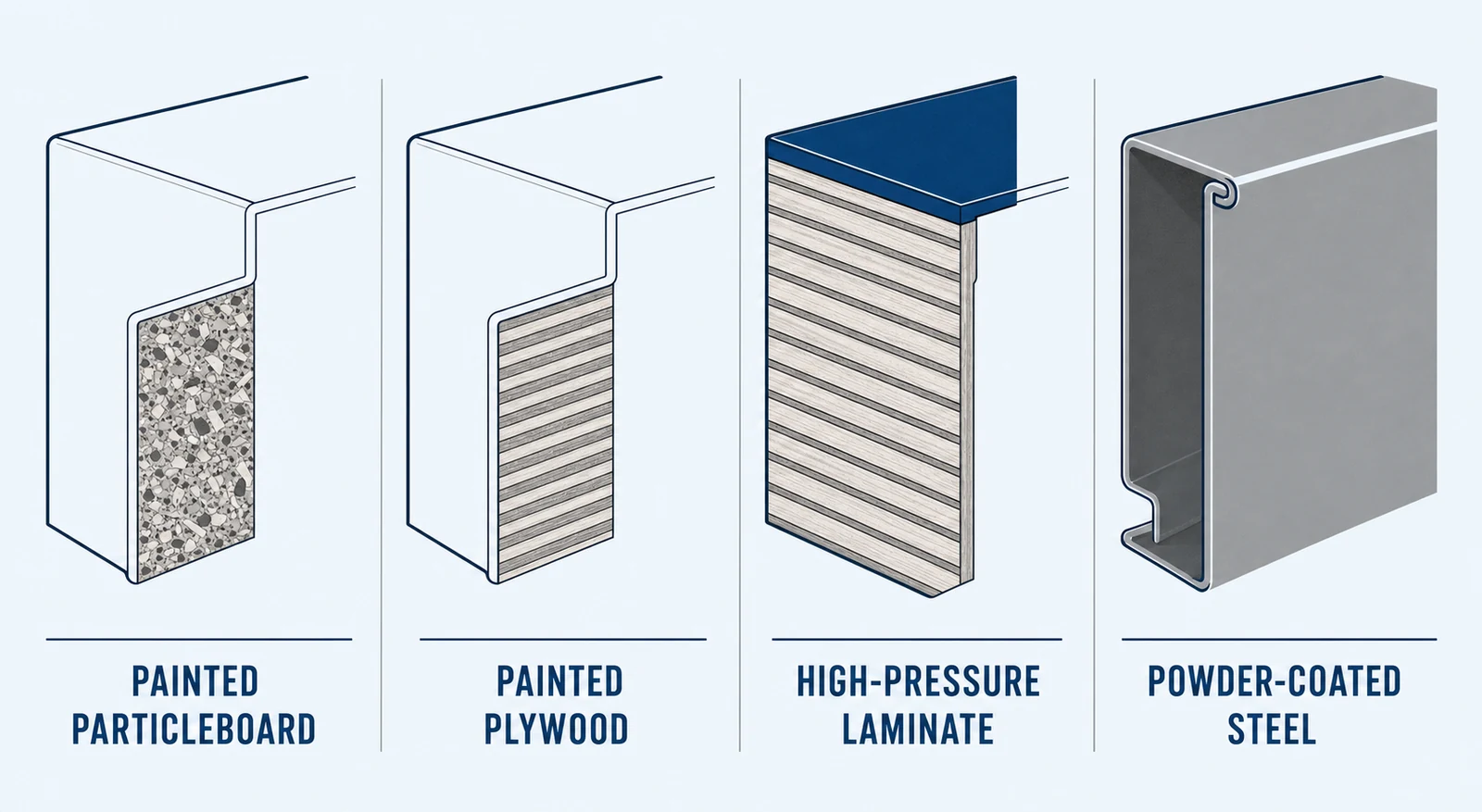
The finish is the daily battleground, so it deserves a ranking. Powder-coated steel leads for classroom cabinets. It shrugs off Sharpies, watercolor, and dilute acids from biology prep, and it cleans with a simple wipe. Moreover, it resists scratches and, when marked, repairs cleanly. Consequently, powder-coated steel holds its look under the roughest student use.
High-pressure laminate over plywood ranks a strong second. The laminate face is hard, cleanable, and chemical-tolerant for common classroom exposures, while the plywood core supplies structure. However, a chipped laminate edge exposes the substrate, so edge detailing matters here. Phenolic composite comes next, and it excels where moisture and chemicals concentrate, such as a wet-prep base cabinet. It handles spills and cleaning agents without swelling, which makes it a smart choice under a classroom sink run.
Painted wood ranks last for heavy student use. It looks warm, yet it scratches, chips, and shows marker faster than the alternatives, and it needs touch-up sooner. The right finish is a room-level decision, not a brand-level one. A high-traffic middle school prep room and a quiet high school biology bench live different lives, and the correct spec follows the traffic and the chemistry of the room. Match the finish to the actual daily load, not to a preference, and the classroom cabinets will still look right at year fifteen. That is the whole point of grading finishes before you order.
Cost Rank: What You Pay for Durability
Durability and cost usually track together, so here is the honest ranking for classroom cabinets from lowest to highest first cost. Painted wood sits at the bottom of the price ladder, and its finish is why. It is the cheapest to build, and it is also the fastest to look tired under student use.
High-pressure laminate over plywood comes next. The plywood core and the laminate face together cost more than painted wood, yet the assembly holds up far better under wipe-downs, marker, and daily impact. The WBDG Dry Laboratory guidance pairs plastic laminate counters with metal casework as a standard configuration, which is a useful reference point when a school room needs a durable mid-tier finish. For most classrooms on a normal budget, this tier is the practical starting point and most opted solution.
Phenolic composite lands next up. Its uniform resin core is a full step more expensive to fabricate than laminate over plywood, and the price reflects the chemical and moisture resistance you gain. Phenolic earns its cost in wet-prep areas, sink surrounds, and chemistry base cabinets, where laminate edges would eventually swell. In a dry general-science classroom, phenolic is an overkill option, especially in a K-12 setting. You’re more likely to see it more prominently in independent and public labs, and some times in high education depending on the lab type.
Where Steel Belongs on the Cost Ladder
Powder-coated steel is mid tier option. It’s more on par with plastic laminate casework being just above that material option. Case construction shifts from wood substrate to formed sheet metal, and finishing shifts from paint or laminate to a fused powder coat. Powder-coated steel is the WBDG-referenced spec for flexible dry labs, and its higher first cost is offset by the longest useful life of the common finish systems. In a classroom that runs full periods every day for 15 to 20 years, that longer service life is where the math actually pays back.
Stainless steel sits at the top of the price ladder. Type 304 stainless per ASTM A666 is the standard reference for stainless casework, and 16-gauge construction with reinforced work surfaces is common per federal casework specifications. In a K-12 setting, stainless is rarely the right answer for whole rooms. However, it is the right answer for a specific surface or run where corrosion, heat, or cleanability drives the spec, such as a chemistry demonstration bench, a fume hood interior, or a food-science lab. Ordering stainless where powder-coated steel would suffice is a first-cost hit you rarely need to take.
The takeaway is simple. For classroom cabinets, do not buy the cheapest finish for the room that gets the hardest use, and do not buy the most expensive finish for the room that will never see the load. Match the tier to the exposure profile, and the total 15-year cost lands well below what over-specifying looks like on the first invoice.
Storage Design for What Students Actually Store
Durable classroom cabinets still fail the teacher if the storage does not fit real use. So start with the actual inventory. A science room stores glassware, microscopes, safety goggles by class period, textbooks, and teacher supplies. Each item wants a different home. Glassware needs shallow, padded, adjustable shelves that flex as kits change. Microscopes need deep, stable bays with clearance for cords and covers.
Goggles deserve special attention, because they move every period. A goggle drawer or a ventilated goggle cabinet, organized by class period, keeps them counted and quick to hand out. Meanwhile, pull-out trays bring back-of-cabinet items to the front without a scramble, and adjustable shelves let a teacher retune the space each semester. Additionally, backpack stowage below the bench keeps bags off the floor and away from aisles, which cuts the impact that base cabinets otherwise absorb. In short, good storage design turns durable classroom cabinets into cabinets a teacher can actually run.
Chemistry Room Add-Ons
Chemistry classrooms raise the stakes, so a few specialized cabinets join the plan. Flammable storage comes first. NFPA 45 provides “basic requirements to protect life and property through prevention and control of fires and explosions involving the use of chemicals in laboratory-scale operations,” per NFPA 45. Therefore, a listed flammable-liquid storage cabinet belongs in any room that stocks solvents.
Acids need their own home too. A dedicated acid storage cabinet, sited under the fume hood, keeps corrosives separate and vented. Finally, PPE belongs near the emergency equipment. A PPE cabinet placed close to the safety shower and eyewash puts gloves and aprons within reach when seconds count. Each of these units is a purpose-built classroom cabinet, not a repurposed supply box.
ADA and Accessible Storage
Accessibility is a code requirement, so it shapes at least part of every storage plan. The ADA 2010 Standards set reach ranges in Section 308. An unobstructed forward reach caps at 48 inches high with a 15-inch low minimum, and an unobstructed side reach follows the same 48-inch and 15-inch limits, per the 2010 ADA Standards. Consequently, accessible classroom cabinets keep everyday contents within that window.
Scoping matters as well. At least 5 percent of storage, but no fewer than one unit, must be accessible for non-employee use. So plan a lowered, reachable cabinet run with clear floor space in front of it, and place operable hardware within the reach range. For a deeper walkthrough of accessible academic storage, heights, and clearances, read our companion guide on accessible academic science lab design. That piece is the accessibility complement to this durability-focused one.
Indoor Air Quality: GREENGUARD, ASTM D5116, ASTM E84
Schools care about the air children breathe, so indoor air quality becomes a procurement checkbox. EPA frames the stakes plainly. Its IAQ program helps schools “reduce absenteeism, improve test scores and enhance student and staff productivity,” per EPA Indoor Air Quality Tools for Schools. Therefore, low-emitting classroom cabinets support both compliance and learning.
GREENGUARD Gold is the certification schools look for. It “includes safety factors to account for sensitive individuals (such as children and the elderly)” and confirms a product “is acceptable for use in environments such as schools and healthcare facilities,” per UL GREENGUARD. Behind that mark sit test methods. ASTM D5116 “provides direction on the measurement of the emissions of volatile organic compounds (VOCs) from indoor materials and products using small-scale environmental test chambers,” per ASTM D5116.
Flame spread rounds out the checklist. ASTM E84 is the “standard test method for surface burning characteristics of building materials,” and it reports a flame spread index and a smoke developed index, per ASTM E84. A Class A rating sits at the top of that scale. Together, these standards feed LEED v4.1 for Schools, which asks that classroom products meet low-emitting criteria under the classroom scenario, per the USGBC LEED v4.1 Low-Emitting Materials credit. In practice, powder-coated metal and GREENGUARD Gold finishes help classroom cabinets clear these boxes.
What to Ask a Manufacturer
Procurement officers get better classroom cabinets by asking sharper questions. Use this short list before you sign.
- What is the BHMA A156.9 grade and cycle rating for the hinges and drawer slides?
- Is the case core three-quarter-inch plywood with dado joinery and thick edge banding?
- Which finish system is used, and how does it resist markers, watercolor, and dilute acids?
- How long does the warranty cover the case, the hardware, and the finish?
- Are replacement parts, especially hinges and slides, stocked and available years from now?
- Which certifications apply, such as SEFA 8, GREENGUARD Gold, and Class A flame spread under ASTM E84?
Honest answers to those six questions separate durable classroom cabinets from bargain casework that fails on schedule. Notably, replacement-part availability often decides the true 15-year cost, so do not skip it.
Building Classroom Cabinets That Last
Durable classroom cabinets are a system, not a single part. A plywood case with dado joinery holds the box square. Grade 1 hardware survives the cycle count. A powder-coated, laminate, or phenolic finish beats the daily marker, spill, and impact. Smart storage fits real inventory, accessible units meet ADA reach ranges, and GREENGUARD Gold finishes clear the IAQ checkbox. In short, each layer defends a known failure point, and every choice traces to a first-party standard.
For the vertical view of the whole space, see our guide on how to design a STEM lab, which sets the room-level context these cabinets live in. Ready to spec classroom cabinets that outlast the budget cycle? Then contact our lab design team for a classroom lab casework consultation. We build to the standards above, and we plan storage around the way students actually use a science room.
— OnePointe Solutions Lab Design Team