


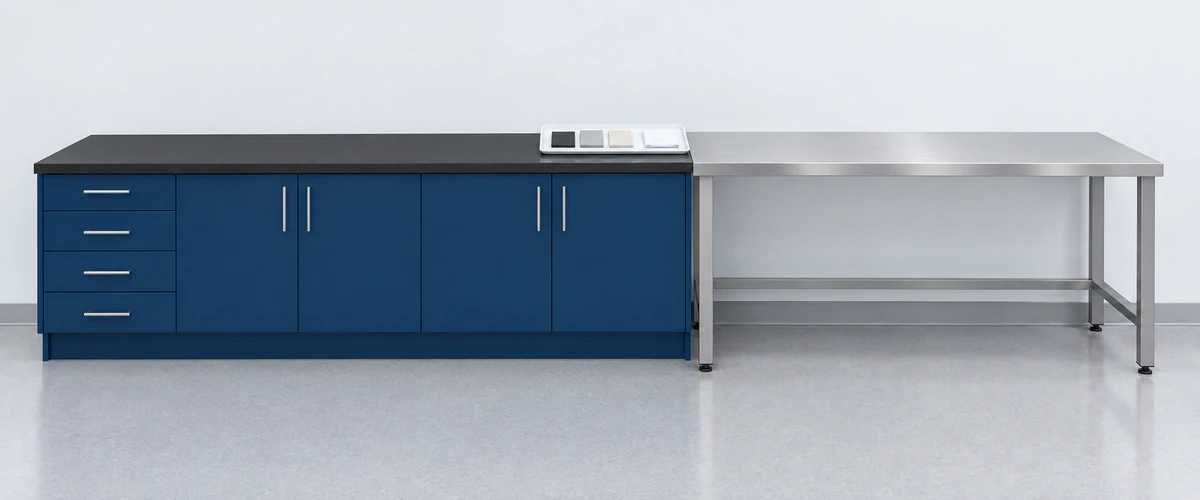
In cleanrooms, compounding pharmacies, cGMP manufacturing suites, and biosafety labs, environmental hygiene protocols are uncompromising. Facilities routinely deploy aggressive sterilants, sporicides, and phenolic disinfectants to maintain microbial control. This makes laboratory surface chemical compatibility a critical consideration in these settings.
However, repeating daily wipe-downs or vaporized decontamination cycles with harsh chemical agents can cause severe surface degradation. Selecting the wrong worksurface material leads to micro-pitting, surface blistering, discoloration, and structural delamination, creating porous micro-fissures that harbor bacteria and compromise sterility.
Building a durable, compliant laboratory workspace requires matching specific disinfectant formulations to tested surface materials: resin matrices, stainless steel alloys, and specialized powder coatings.
Chemical Resistance Matrix: Disinfectants vs. Worksurface Materials
Evaluating worksurface performance against standard healthcare and cGMP sterilants ensures long-term ROI and cleanroom compliance.
| Worksurface / Casework Material | Bleach (Sodium Hypochlorite, 10%) | Spor-Klenz / Sporicides (Peracetic Acid + H2O2) | Vesta-Syde / Phenolic Disinfectants | Recommended Rinsing & Maintenance Protocol |
| Epoxy Resin | POOR
(Causes chalking, finish dulling, and surface binder erosion) | FAIR
(Tolerates short-term contact; unrinsed build-up leads to micro-pitting) | FAIR
(Leaves stubborn residue layer; causes long-term yellowing) | Mandatory Deionized (DI) or distilled water rinse after contact to stop chemical oxidation and prevent residue film. |
| Phenolic Resin | POOR / NOT RECOMMENDED
(Severe surface hazing, discoloration, and polymer embrittlement) | FAIR
(Oxidizes top seal coat; causes localized finish clouding) | POOR
(Heavy residue build-up and dulling due to similar resin chemistry) | Wipe immediately after sanitization with isopropyl alcohol (IPA) or water to prevent permanent hazing. |
| Passivated 304 / 316 Stainless Steel | FAIR (Requires strict rinsing)
(Causes chloride pitting and rust staining if left unrinsed) | FAIR (Requires strict rinsing)
(Peracetic acid attacks surface passivation layer if allowed to dry) | EXCELLENT
(Non-reactive; easily disinfected without surface degradation) | Strict Rinsing Required: Must rinse thoroughly with sterile water or IPA within 10 minutes to prevent pinhole pitting. |
| Polypropylene (Poly) | EXCELLENT
(Impervious to bleach oxidation; no surface chalking or pitting) | EXCELLENT
(100% non-reactive to strong sporicides and oxidizing agents) | EXCELLENT
(Seamless chemical resistance; easy to wipe clean without staining) | Standard wipe-down; no risk of chemical pitting, surface hazing, or structural degradation. |
1. Degradation Mechanisms: How Disinfectants Fail Surfaces
Understanding the chemical pathways of material failure prevents catastrophic workspace degradation:
Chloride Pitting & Stress Corrosion Cracking: Strong oxidizers like sodium hypochlorite release free chloride ions. On stainless steel, chlorides break down the passive chromium oxide ($\text{Cr}_2\text{O}_3$) protective layer, causing microscopic pinhole pitting that compromises structural integrity.
Resin Matrix Oxidation: Prolonged exposure to concentrated peracetic acid can oxidize weaker organic binders in low-grade laminates, leading to surface hazing, chalking, and micro-cracking.
Blistering of Coated Surfaces: If sterilants penetrate chips or micro-scratches in standard powder coatings, liquid migrates beneath the finish, causing bubbling, flaking, and exposed raw steel oxidation.
2. Worksurface Material Selection Guidelines
- Type 316 Stainless Steel – Best for VHP decontamination & liquid sporicides
- Lab Grade Solid Epoxy Resin – best for heavy chemical resistance & bleach pooling
- Solid Phenolic Resin – best for high impact, moisture & routine 70% IPA.
Type 316 vs. Type 304 Stainless SteelWhile Type 304 stainless steel is common in general casework, high-sterility environments demand Type 316 stainless steel. The addition of 2–3% molybdenum in 316 stainless dramatically increases resistance to chloride pitting from bleach and peracetic acid formulations.
Epoxy Resin vs. Phenolic Resin
Epoxy Resin: A monolithic, thermosetting polymer cured with silica fillers. Because it is completely non-porous and homogeneous throughout its thickness, it resists severe chemical pooling, standing bleach, and extreme thermal loads without delaminating.
Phenolic Resin: Constructed from saturated cellulose fibers fused with phenolic resin under extreme heat and pressure. It offers exceptional impact strength and chemical resistance, though prolonged exposure to aggressive oxidizing agents may require routine rinsing to prevent surface dulling.
3. Best Practices for Maintaining Surface Integrity
To maximize the service life of laboratory casework under rigorous sanitation regimes:
Implement Mandatory Rinse Protocols: When using aggressive oxidizers (e.g., sodium hypochlorite or peracetic acid), follow contact-time requirements with a sterile water or 70% IPA rinse to remove corrosive chemical residues.
Specify Radiused & Seamless Construction: Eliminate 90-degree internal corners on stainless steel sinks and tops. Coved corners and continuous welds prevent disinfectant accumulation and bacterial harboring.
Inspect Sealants & Gaskets: Ensure all seams between casework and countertops are sealed with non-sagging, chemical-resistant silicone or polyurethane sealants to prevent fluid migration into sub-framing.
Frequently Asked Questions (AEO / Voice Search)
Q: Can you use bleach on stainless steel lab countertops?
A: Bleach (sodium hypochlorite) can be used on 316 stainless steel for disinfection, but it must be rinsed immediately with sterile water or 70% isopropyl alcohol after the required contact time. Leaving bleach to air-dry causes chloride pitting and rust formation.
Q: Which countertop material is best for Spor-Klenz and peracetic acid?
A: Type 316 stainless steel and solid epoxy resin offer the highest chemical resistance to Spor-Klenz and peracetic acid formulations, maintaining surface smoothness without pitting or hazing.
Build Sterility-Compliant Workspaces with OnePointe Solutions
Selecting the proper worksurface material is critical to passing facility audits and avoiding premature replacement costs. At OnePointe Solutions, we design and manufacture tailored lab furniture to support both your cleaning routine and experimentation process. We offer powder-coated metal casework, stainless steel tables, solid epoxy countertops, phenolic casework, and chemical-resistant workstations.