


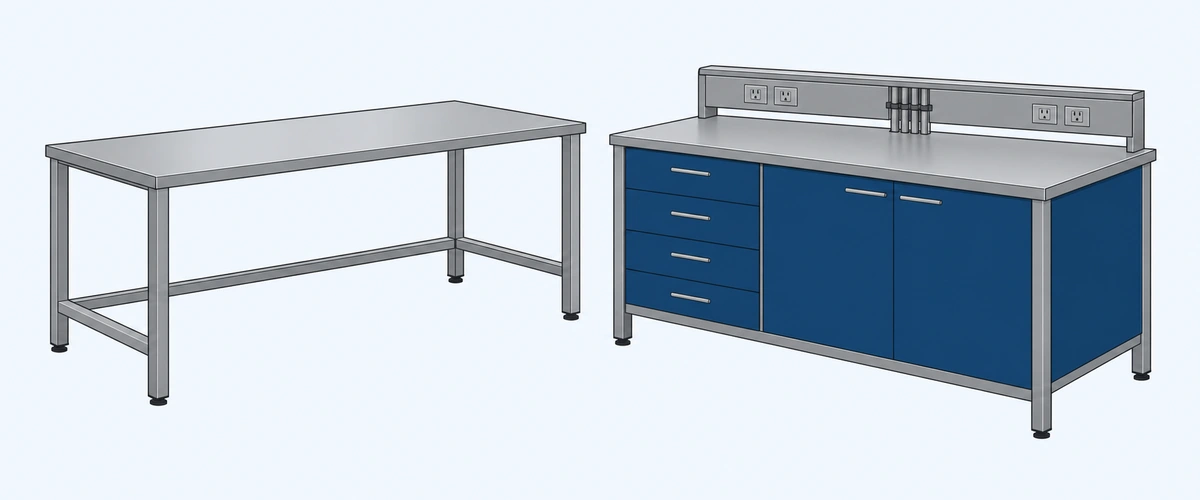
You’ve been tasked with purchasing furniture for a new laboratory. One of the first questions you’ll probably have is about laboratory furniture costs.
You start researching online and find stainless steel tables, cabinets, and workstations with published prices. Some appear reasonably affordable, and you begin building your project budget around what you’ve found.
Then you contact a laboratory furniture manufacturer. The quote comes back considerably higher than expected.
Naturally, your first question is: Why does laboratory furniture cost so much more?
It’s a reasonable question, especially when the products appear similar.
But what isn’t always visible in an online listing is the difference in materials, construction, performance requirements, customization, and project coordination.
A commercial stainless steel worktable may be suitable for one application but fail to meet the specifications of another laboratory.
Similarly, two laboratories can have identical layouts and require completely different furniture packages based on their processes, chemicals, cleaning procedures, and equipment.
Laboratory furniture costs aren’t determined by appearance alone. They’re influenced by what the furniture needs to withstand, support, and accomplish.
Understanding these differences can help laboratory owners, architects, and facility managers establish realistic budgets without paying for unnecessary features or overlooking essential requirements.
Why Online Laboratory Furniture Costs Can Create Unrealistic Expectations
For many end users, purchasing laboratory furniture starts with an online search.
They need a stainless steel table, laboratory cabinet, or workstation, so they begin comparing available products and prices.
Within minutes, they may find commercial worktables from suppliers such as Uline, along with other e-commerce retailers offering industrial furniture. The published prices create an immediate reference point.
But when the same customer contacts a laboratory furniture manufacturer, the quote may be considerably different. Understanding laboratory furniture costs means looking beyond the advertised price. Why?
Because purchasing a commercial worktable online and specifying a workstation for a laboratory aren’t necessarily the same transaction, or the same product.
What Are You Actually Comparing?
E-commerce suppliers typically sell predefined products with established dimensions, materials, and configurations.
The customer reviews the product specifications, selects an available option, and completes the purchase.
This model works well for many commercial applications, including certain laboratory support areas where the product meets the facility’s requirements.
Laboratory furniture manufacturers may offer standard products too, but they also frequently work from project-specific specifications.
A manufacturer may need to determine:
- What activities will take place at the workstation?
- Which chemicals and cleaning agents will contact the furniture?
- What equipment loads must the workstation support?
- Are particular structural or performance requirements specified?
- Does the workstation need integrated electrical, plumbing, or gas services?
- Are custom dimensions or configurations necessary?
- What testing or material documentation must be provided?
These considerations influence the materials, engineering, fabrication, and overall price.
An online price tells you what a particular product costs. It doesn’t necessarily tell you what a workstation designed for your laboratory requirements will cost.
A Stainless Steel Table Isn’t Always the Same as Another Stainless Steel Table
Let’s say a laboratory needs a stainless steel worktable.
An online search produces several options at different price points.
At first glance, they look similar: metal surfaces, metal legs, and comparable overall dimensions.
But their specifications may tell different stories. One table may have a 304 stainless steel top with galvanized or other metal components beneath it.
Another may use stainless steel throughout its construction. A third may require 316 stainless steel, particular surface finishes, welded construction, or a specified load capacity.
These differences can affect laboratory furniture costs because the term stainless steel table doesn’t necessarily describe every component. Consider a laboratory where furniture is repeatedly exposed to particular disinfectants.
The project team may need to evaluate the alloy, frame construction, exposed components, welds, joints, and compatibility with approved cleaning procedures.
If the specification requires stainless steel throughout the workstation, a table with only a stainless steel top may not meet that requirement.
In regulated environments, the laboratory may also need documentation demonstrating that the selected furniture is suitable for its intended use.
A product being advertised as stainless steel does not automatically establish that it meets every laboratory’s material, performance, or documentation requirements.
For additional background on stainless steel grades and their properties, the British Stainless Steel Association provides technical resources on stainless steel selection and applications.
The Difference Between a Catalog Product and a Laboratory Furniture Project
Another distinction is the amount of work involved before the furniture is manufactured.
An e-commerce product is typically offered in an established configuration.
A laboratory furniture project may require coordination among the end user, architect, laboratory planner, engineer, contractor, and manufacturer.
For example, a manufacturer may need to:
- Review laboratory layouts and equipment schedules.
- Confirm cabinet and workstation dimensions.
- Evaluate equipment loads and service clearances.
- Coordinate utility openings and connection locations.
- Prepare detailed shop drawings.
- Obtain approvals before manufacturing.
- Coordinate delivery and installation requirements.
These activities contribute to the overall project cost even though they may not be visible in the finished furniture.
This doesn’t mean every laboratory needs custom products.
Standard laboratory cabinets and tables can be entirely appropriate when they meet the intended application. The important distinction is understanding when standard products are sufficient and when the project requires additional engineering, fabrication, or coordination.
When Is Buying Laboratory Furniture Online Appropriate?
Buying from an e-commerce supplier isn’t inherently a poor decision.
Commercially available tables, shelving, or storage products may be suitable for certain laboratory applications.
A dry support area, packaging station, or general-purpose workspace may not require the same furniture construction as a chemical preparation laboratory or controlled manufacturing environment.
The important step is verifying suitability before purchasing.
End users should review the complete specifications rather than relying on the product name, appearance, or advertised material alone.
Ask whether the stated material applies to the entire product or only certain components. Confirm the load capacity, chemical compatibility, cleaning limitations, and any documentation required by the facility.
A lower-priced product that meets the laboratory’s requirements can be a reasonable purchasing decision.
A lower-priced product that must later be replaced because it doesn’t meet those requirements may become the more expensive option.
The question isn’t simply, “Why does this laboratory table cost more than the one I found online?”
It’s:
“What differences exist between these products, and which of those differences actually matter for my laboratory?”
1. Material Selection: One of the Biggest Laboratory Furniture Cost Drivers
The materials specified for laboratory cabinets, countertops, and workstations are among the biggest factors influencing laboratory furniture costs.
Different materials require different manufacturing processes, fabrication techniques, and finishing procedures.
Powder-Coated Metal Casework
Powder-coated metal cabinets are commonly used in research, educational, industrial, and analytical laboratories.
They provide a durable construction option and can be paired with several countertop materials.
Pricing varies based on steel gauge, cabinet construction, coating specifications, configuration, and quantity.
A standard powder-coated cabinet may cost less than a comparable stainless steel cabinet, but specialized coatings or custom construction can change that comparison.
Stainless Steel Casework
Stainless steel cabinets generally have higher initial costs than comparable standard powder-coated steel casework.
Material prices, fabrication, welding, finishing, and construction requirements contribute to the difference. Even within stainless steel, the selected alloy matters.
304 stainless steel is commonly used in laboratory environments, while 316 stainless steel may be specified where additional resistance to certain corrosive exposures is needed.
However, upgrading an entire laboratory to 316 stainless steel may not be necessary if only specific areas experience those conditions.
The material should be selected based on the laboratory’s actual chemical and cleaning exposure.
Phenolic Resin Casework
Phenolic resin cabinets can provide moisture resistance and compatibility with many laboratory environments.
Their cost depends on material thickness, machining, hardware, construction methods, and fabrication complexity.
The selected grade should also be evaluated against the laboratory’s chemical inventory and cleaning procedures.
Laboratory Countertops
Countertops introduce another significant pricing variable.
Epoxy resin, phenolic resin, stainless steel, plastic laminate, solid surface, and other materials have different raw material and fabrication costs.
Pricing also depends on thickness, dimensions, edge details, sink openings, cutouts, and installation requirements.
Where can you control costs?
Rather than specifying the highest-cost material throughout the entire laboratory, evaluate each workstation based on its actual exposure.
A chemical preparation area may need a more resistant surface than a documentation station.
Using different materials in different zones can be appropriate when each selection meets the application’s requirements.
2. Standard Dimensions vs. Custom Fabrication
Customization is another factor that can increase laboratory furniture costs.
Manufacturers often have established cabinet sizes, table configurations, and construction methods that support repeatable production.
When a project requires dimensions or features outside those configurations, additional engineering, programming, fabrication, and quality checks may be necessary.
Consider a laboratory with an unusual wall length. One approach may be to use standard cabinet widths with a properly designed filler.
Another may be to manufacture several custom-width cabinets to fit the wall exactly. Both approaches can work, but the second may require more manufacturing effort.
Customization can also include specialized drawers, unusual countertop cutouts, custom equipment supports, nonstandard finishes, or integrated utilities.
Where can you control costs?
Use standard configurations where practical and reserve custom fabrication for situations where it improves workflow, equipment fit, accessibility, or another defined requirement.
3. Cabinet Construction and Hardware
Not all laboratory cabinets are constructed the same way.
Two cabinets with similar exterior dimensions may differ in steel thickness, reinforcement, internal construction, and hardware. These differences affect both laboratory furniture costs and long-term performance.
For example, a cabinet designed to support heavy equipment may require additional reinforcement compared with one intended for general storage.
Drawers can also introduce additional components and fabrication requirements compared with open shelving or simpler door configurations.
Hardware selections matter as well. Hinges, drawer slides, locks, handles, and other components vary in construction and performance.
A laboratory requiring locking storage across numerous cabinets may have different costs than one using standard nonlocking configurations.
Where can you control costs?
Specify the performance each cabinet needs rather than applying specialized features uniformly throughout the laboratory.
4. Integrated Electrical, Plumbing, and Utility Services
Integrated building services are another reason laboratory furniture costs can vary from one project to another.
A basic freestanding table may require relatively little coordination.
A workstation with integrated electrical raceways, plumbing fixtures, gas connections, or specialized service panels introduces additional components and manufacturing requirements.
These features can also affect how the furniture interfaces with the building.
For example, a laboratory island with integrated plumbing requires coordination between the furniture manufacturer, plumbing contractor, and design team.
The furniture may need service access panels, designated connection points, or specialized construction. Electrical distribution introduces similar considerations.
Depending on the design, a laboratory may use wall-mounted receptacles, overhead service carriers, or integrated workstation raceways.
Each option has different equipment, coordination, and installation implications.
Where can you control costs?
Determine where integrated services are necessary. Not every laboratory table needs built-in power distribution, and not every cabinet run requires plumbing.
Coordinating utility locations early can also reduce costly revisions after manufacturing begins.
5. Fixed Casework, Modular Systems, and Adjustable-Height Tables
Furniture configuration can influence laboratory furniture costs as well as long-term flexibility.
Fixed Laboratory Casework
Fixed casework provides permanent storage and work surfaces for laboratory areas with stable layouts.
Its cost depends on cabinet configuration, materials, countertops, and installation requirements.
Modular Laboratory Furniture
Modular systems may incorporate specialized frames, adjustable components, removable storage, or integrated services.
These features can affect initial pricing but may provide value in laboratories expecting future changes. However, modular furniture doesn’t automatically mean lower long-term costs.
The benefit depends on whether the laboratory will actually use that flexibility.
Adjustable-Height Workstations
Adjustable-height tables introduce additional mechanical or electrical components compared with fixed-height tables. Manual, hand-crank, and powered adjustment systems can have different price points.
The appropriate selection depends on workstation use, ergonomics, equipment requirements, and how frequently height changes are needed.
Where can you control costs?
Avoid assuming every workstation needs the same level of flexibility. A permanent instrument station may not need powered height adjustment, while a shared workstation used by multiple technicians may benefit from it.
6. Specialized Testing, Certifications, and Documentation
Laboratory furniture may be specified to meet particular performance standards or project requirements.
Depending on the product and application, these can involve structural testing, chemical resistance testing, safety requirements, or documented performance criteria.
For example, the Scientific Equipment and Furniture Association (SEFA) publishes standards addressing different categories of laboratory furniture and equipment.
The applicable requirements depend on the product and the performance being evaluated.
A request for specialized testing or documentation may affect laboratory furniture costs, particularly when it falls outside a manufacturer’s established testing program.
Project documentation can also influence the engineering and administrative work involved.
Some projects require detailed submittals, custom shop drawings, additional approvals, or specific quality records.
Where can you control costs?
Identify required standards and documentation early. Avoid broad specifications that request certifications or testing unrelated to the actual furniture application. The goal is to confirm relevant performance rather than pay for unnecessary requirements.
7. Project Size and Manufacturing Quantity
Order quantities can influence laboratory furniture costs on a per-unit basis.
Manufacturing involves setup, programming, material handling, finishing, assembly, and quality control. When a project includes multiple identical or similar components, some activities can be repeated more efficiently.
A project requiring twenty identical laboratory tables may have a different unit cost than one requiring twenty tables with unique dimensions, finishes, and utility configurations.
Small orders may carry proportionally higher costs for certain activities because setup and administrative work are spread across fewer products.
That doesn’t mean large orders always receive lower pricing.
Complexity, materials, manufacturing capacity, and delivery requirements still matter.
Where can you control costs?
Standardize cabinet and table configurations where possible.
Reducing unnecessary variations can simplify manufacturing and make future replacement or expansion easier.
8. Delivery, Installation, and Site Conditions
The furniture itself is only one part of a laboratory project.
Freight, delivery access, installation labor, and site conditions can influence total installed laboratory furniture costs.
Consider two projects with identical furniture packages.
One is located in a new building with a loading dock, freight elevator, clear access routes, and an empty installation area.
The other is in an occupied facility where furniture must be delivered through narrow corridors, carried to an upper floor, and installed around ongoing operations.
The second project may require more coordination, labor, and time.
Other factors include long-distance freight, phased deliveries, restricted working hours, existing furniture removal, and site readiness.
These expenses may not appear in the furniture’s unit price, but they affect the overall project budget.
Where can you control costs?
Discuss site conditions, delivery restrictions, and installation responsibilities before finalizing the quote. A lower furniture price doesn’t necessarily mean a lower installed project cost.
9. Compressed Manufacturing Schedules and Late Changes
Project schedules can influence laboratory furniture costs, particularly for custom laboratory furniture.
Custom manufacturing requires time for engineering, material procurement, fabrication, finishing, assembly, quality checks, and shipping.
When a project requests an accelerated schedule, the manufacturer must determine whether it can accommodate the timeline without compromising quality or existing production commitments.
Expedited materials, additional production coordination, or other measures may affect pricing when available.
Late changes can also introduce costs. Changing cabinet dimensions after drawings have been approved may require revised engineering and manufacturing work.
Changing countertop materials or sink configurations can affect procurement and fabrication.
Where can you control costs?
Finalize equipment requirements, utilities, material selections, and shop drawings before releasing the order. A coordinated specification helps reduce avoidable revisions and schedule disruptions.
10. The Lowest Initial Price Isn’t Always the Lowest Long-Term Cost
To understand laboratory furniture costs over time, evaluate each product against its intended use and expected service life.
A lower-cost material may be appropriate for one laboratory application but unsuitable for another.
For example, selecting a work surface that cannot tolerate the laboratory’s cleaning procedures may lead to premature deterioration and replacement.
On the other hand, specifying highly specialized materials throughout an entire facility may increase costs without providing meaningful benefits in every area.
This is where application-specific material selection becomes valuable.
For laboratory environments subject to particular regulations, the project team should also verify which requirements actually apply.
For example, 21 CFR 211.42 addresses design and construction features for drug manufacturing operations within its scope, including suitable space for operations, cleaning, and maintenance. It does not establish a universal requirement that all laboratory furniture must be stainless steel.
The goal isn’t to purchase the most expensive furniture or the least expensive furniture.
It’s to choose materials, construction, and features appropriate for the work being performed.
How to Compare Laboratory Furniture Costs and Quotes Fairly
When reviewing quotes, don’t compare only the total price.
Two proposals may look similar while including different materials, construction details, services, and installation responsibilities.
Use the following comparison checklist.
| What to compare | Why it matters |
|---|---|
| Material composition | A stainless steel top doesn’t necessarily mean stainless construction throughout. |
| Steel gauge and construction | Thickness, reinforcement, and assembly can affect performance and cost. |
| Countertop specifications | Different materials provide different levels of chemical, moisture, and physical resistance. |
| Chemical compatibility | Furniture should be evaluated against the laboratory’s actual exposure. |
| Load capacity | Workstations must support the intended equipment and operations. |
| Testing and documentation | Some projects require specific evidence of performance. |
| Customization | Nonstandard dimensions and configurations can increase manufacturing work. |
| Integrated utilities | Electrical, plumbing, and gas services introduce components and coordination. |
| Freight and installation | A delivered product price may not represent the complete installed cost. |
| Warranty and support | Coverage, replacement components, and service arrangements may differ. |
End users – this checklist helps establish whether the products are truly comparable.
Architects – helps identify specification differences.
Facility managers – helps evaluate the total project cost and long-term suitability.
How to Build a More Cost-Effective Laboratory Furniture Specification
Before requesting quotes, focus on the decisions that have the greatest impact on laboratory furniture costs.
Define the laboratory processes. Identify what happens at each workstation, including chemicals, cleaning procedures, equipment loads, and storage requirements.
Separate requirements from preferences. Determine which materials, configurations, and performance characteristics are essential.
Standardize where possible. Use repeatable cabinet sizes, table configurations, and finishes when they meet the laboratory’s needs.
Coordinate equipment and utilities early. Confirm equipment dimensions, service clearances, and connection locations before finalizing the layout.
Review the complete project cost. Consider delivery, installation, maintenance, and expected service life, not just the initial furniture quote.
These steps won’t eliminate every cost difference, but they help the project team understand what is driving the budget.
The Bottom Line: Pay for the Performance Your Laboratory Needs
Laboratory furniture costs vary because laboratories have different requirements.
Materials, construction, customization, integrated services, testing, quantity, delivery, and installation all influence the final price.
For end users, online prices can be helpful starting points, but only when the products being compared have equivalent specifications.
For architects and laboratory planners, clearly defined performance requirements help prevent unnecessary upgrades and ensure the right materials are selected.
And for facility managers, understanding the full project scope helps establish realistic budgets and reduce unexpected expenses.
Laboratory furniture doesn’t need to be the most expensive option to be the right option. But it does need to meet the requirements of the laboratory where it will be used.
The best value comes from understanding which features are necessary, why they’re needed, and where they should be applied.
Planning a Laboratory Furniture Project?
At OnePointe Solutions, we manufacture laboratory casework, tables, workstations, and related furniture for a range of laboratory applications.
Our team works with architects, facility managers, contractors, and laboratory end users to review furniture requirements, material options, configurations, and project considerations.
Whether you’re developing a new laboratory or renovating an existing space, we can help evaluate furniture options based on your application and project scope.
Contact OnePointe Solutions to discuss your laboratory furniture requirements.
Author: OnePointe Solutions Lab Design Team