


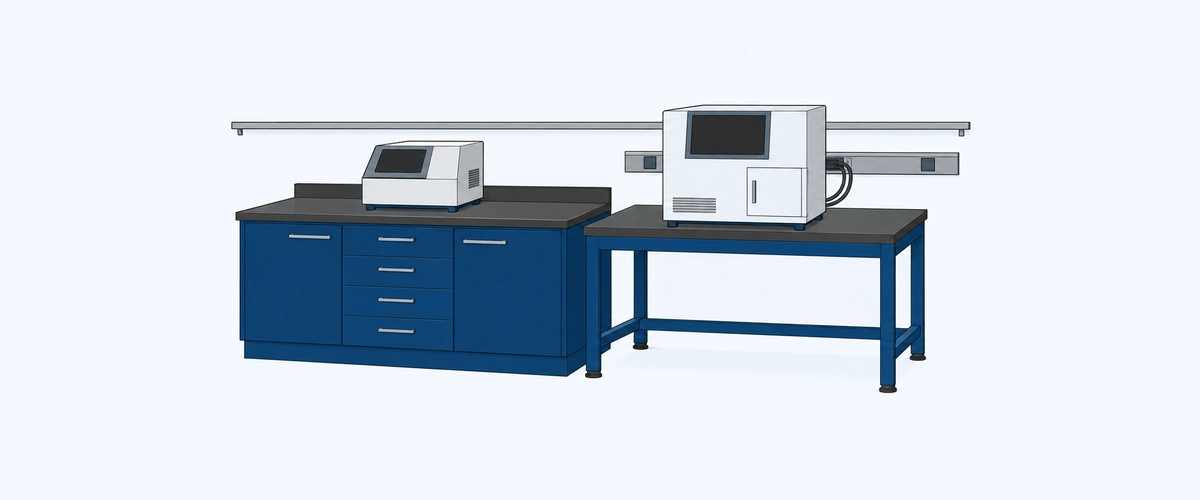
It may or may not be common knowledge but laboratories are constantly evolving. Laboratory equipment upgrades happen regularly as a research team purchases a new analytical instrument. A quality control department introduces an additional testing method. A university upgrades equipment to support a new curriculum.
The equipment changes, but the laboratory furniture often stays exactly where it was installed years earlier. At first, that may not seem like a problem.
After all, a laboratory table is still a table, and a cabinet is still a cabinet.
But what happens when the replacement instrument is larger, heavier, generates more heat, or requires different utility connections?
Suddenly, a workstation that once supported the laboratory’s operations may no longer be suitable. And from here you mind may automatically default to procuring new furniture to support the new equipment.
However, laboratory equipment changes don’t always require new furniture. Yet, they should trigger a review of whether the existing furniture can still support the work.
Understanding that relationship is an important part of laboratory design planning, equipment replacement, and long-term facility management.
1. How Laboratory Equipment Upgrades Affect the Original Layout
Imagine a laboratory that installed its casework and workstations ten years ago. At the time, the layout was designed around specific instruments, storage requirements, and testing procedures.
The laboratory has since expanded its capabilities, but the furniture remains largely unchanged. Now the team wants to replace an older instrument with a newer model.
The new equipment may have a similar purpose, but that doesn’t mean it has the same physical requirements.It could be wider, deeper, taller, or significantly heavier. It might need additional clearance for ventilation or maintenance.
The equipment may technically fit on the existing countertop while still creating problems for the laboratory. For example, an instrument placed beneath overhead shelving may have sufficient space for its main enclosure but not enough clearance to open its service panel.
Or a replacement instrument may fit between two cabinets while leaving insufficient room for technicians to access its connections.
Equipment fit should be evaluated by more than the instrument’s overall dimensions. Laboratory planners should consider its operating footprint, service requirements, access points, and the space needed for technicians to use it safely.
What to review before installing replacement equipment
Here are some key points to look over in this scenario:
- Overall equipment dimensions, including doors and moving components
- Required side, rear, and overhead clearances
- Maintenance and service access
- Equipment weight and load distribution
- Operator access and working height
- Utility connections and cable routing
- Environmental requirements, including heat and vibration
These considerations help determine whether an existing workstation remains appropriate or needs modification.
2. The Workstation May No Longer Support the Equipment Load
Not all laboratory workstations are designed to support the same loads. A table originally intended for small benchtop instruments may not be appropriate for heavier analytical equipment.
Similarly, a cabinet-supported countertop may have different load characteristics than an independent laboratory table or reinforced equipment stand.
When equipment changes, the laboratory should review more than its total weight. The way the load is distributed matters during laboratory equipment upgrades.
A heavy instrument supported by four small feet places weight differently than equipment with a broad, evenly distributed base. Vibration, dynamic forces, and operational movement may also affect the suitability of a workstation.
Consider a laboratory replacing a compact instrument with a larger piece of equipment. The existing countertop might have sufficient surface area, but the supporting structure may not have a documented load capacity appropriate for the replacement.
In that situation, the correct solution isn’t necessarily a thicker countertop. The laboratory may need to evaluate the entire support system, including the work surface, cabinet construction, table frame, and floor conditions.
A workstation should be evaluated as a complete support system, not just a surface large enough to hold the equipment.
3. Laboratory Equipment Upgrades Can Introduce New Utility Requirements
One of the most common complications when upgrading laboratory equipment is discovering that the existing utility arrangement no longer works.
An instrument that previously required a standard electrical connection may be replaced by one with different voltage, amperage, or dedicated circuit requirements.
Other equipment may introduce new needs for compressed air, specialty gases, water, drainage, or exhaust. Even when the same services are required, the connection locations may change.
A utility outlet positioned conveniently for the original instrument may now be blocked by the replacement equipment. This can create problems when laboratory furniture was designed around fixed service locations.
Fixed services vs. adaptable furniture
A laboratory can have movable tables and still have relatively inflexible utility arrangements.
For example, a workstation on casters may appear easy to relocate. But once connected to water, drainage, gas, or other building services, moving it may require disconnecting and reconfiguring those connections. This is an important distinction during laboratory planning.
Furniture mobility and utility flexibility are not the same thing.
Depending on the application, overhead service carriers, accessible utility raceways, or planned connection locations may make future equipment changes easier.
However, these systems also require coordination with the building’s infrastructure and appropriate engineering.
Not every laboratory needs integrated services at every workstation.
The objective is to place utilities where they support the laboratory’s current operations while considering reasonably foreseeable changes.
4. Equipment Upgrades Can Change the Laboratory’s Environmental Requirements
A laboratory may replace equipment to improve testing capabilities, increase throughput, or introduce a new process.
But the new equipment can also change the conditions required within the room. Some instruments generate additional heat. Others are sensitive to vibration, temperature fluctuations, humidity, or nearby airflow. Certain processes may require local exhaust or other engineered controls.
For example, adding multiple instruments to an existing analytical laboratory could increase the room’s heat load. The furniture layout might still look functional, but the building’s HVAC system may need to be evaluated to determine whether it can maintain the required conditions.
Likewise, a vibration-sensitive balance or microscope may need a workstation or location selected specifically for its operating requirements. Moving it onto an available countertop isn’t necessarily an appropriate solution. When equipment requirements change, the surrounding laboratory environment may need to change as well.
This is why laboratory equipment upgrades should involve facility and engineering teams when they affect ventilation, electrical capacity, environmental control, or other building systems.
5. Fixed Laboratory Casework: When Does It Become a Limitation?
Fixed laboratory casework can be an effective solution for laboratories with established workflows and permanent utility requirements.
Cabinets provide storage, support work surfaces, and can accommodate sinks and other services. However, fixed configurations may become restrictive when equipment needs change.
Consider a laboratory with a continuous run of base cabinets beneath a countertop. The original layout may have been ideal for sample preparation and general bench work.
Years later, the laboratory purchases equipment that requires open knee space, a lower operating height, or a dedicated support frame.
The existing cabinet arrangement may no longer be suitable. The laboratory could potentially modify a portion of the casework, replace selected cabinets, or introduce an independent workstation.
But those changes need to be evaluated against the countertop construction, support requirements, and existing utility connections.
Does that mean fixed casework is a poor investment?
Not at all.
Fixed casework remains appropriate for many laboratory applications, particularly where the layout and services are unlikely to change frequently.
The challenge is identifying which areas need permanence and which may benefit from adaptability.
A laboratory doesn’t need every workstation to move. It needs the right balance between permanent infrastructure and areas that can accommodate change.
6. Where Modular Furniture Can Help With Laboratory Equipment Upgrades
Laboratories expecting frequent equipment changes may benefit from furniture that can be reconfigured without replacing an entire cabinet run.
Depending on the system, modular laboratory furniture may allow users to reposition shelving, change storage configurations, or modify workstations as their needs evolve.
Freestanding tables can also provide flexibility when equipment needs to be relocated or replaced. For example, an analytical laboratory may use independent instrument tables rather than installing permanent base cabinets beneath every work surface.
If an instrument is replaced, the team may have more options for adjusting the workstation arrangement. Adjustable-height laboratory tables can also be useful when equipment or operator requirements change.
However, height adjustment isn’t a universal solution. An instrument may require a fixed, stable support surface or have utility connections that limit how the workstation can move.
The appropriate furniture should be selected based on the equipment manufacturer’s requirements and the laboratory’s workflow.
Flexibility should have a purpose
Modular and adjustable furniture may carry different initial costs than standard fixed casework. The investment makes the most sense when the laboratory has a realistic need for future reconfiguration.
A permanent wet chemistry station may benefit from fixed cabinetry and dedicated services. An evolving analytical testing area may benefit from independent workstations.
A shared research environment may need a combination of both. The best solution is often a hybrid layout rather than a laboratory built entirely around one furniture type.
7. The Countertop Material May No Longer Match the Process
Equipment changes can introduce new chemical exposures, cleaning procedures, or operational conditions. A work surface selected for the original laboratory processes may not be suitable for the new ones.
For example, a laboratory that previously performed primarily dry testing may introduce wet chemistry procedures involving solvents, acids, or other reagents.
The existing countertop may have been appropriate for the original application but require reevaluation. Similarly, changes in cleaning protocols can affect material suitability.
Phenolic resin, epoxy resin, stainless steel, and other laboratory work surfaces have different resistance characteristics.
No single material is ideal for every chemical, concentration, exposure duration, or cleaning procedure. The laboratory should evaluate the new process against the countertop manufacturer’s compatibility information and any relevant project requirements.
This review should also consider sinks, joints, exposed edges, cabinet finishes, and other components that may come into contact with chemicals. An equipment upgrade can change the demands placed on the furniture, even when the furniture itself hasn’t moved.
8. When Do Laboratory Equipment Upgrades Require Furniture Replacement?
Not every equipment change justifies replacing an entire laboratory furniture package. In many cases, existing furniture can continue to serve the laboratory effectively.
The key is identifying what has changed and whether the current configuration can accommodate it.
Consider three possible scenarios.
A: The Equipment Changes, but the Requirements Stay Similar
A laboratory replaces an older instrument with a newer model that has comparable dimensions, weight, utility connections, and operating requirements.
If the existing workstation meets the new equipment’s specifications, furniture modifications may be unnecessary.
B: The Equipment Changes and the Workstation Needs Minor Adjustments
A new instrument requires additional clearance or a different storage arrangement.
The laboratory may be able to remove adjustable shelving, change nearby storage, or relocate the equipment to another suitable workstation.
These changes may be possible without replacing the entire furniture system.
C: The Equipment Changes and the Existing Furniture Is No Longer Suitable
A laboratory introduces equipment that exceeds the workstation’s documented load capacity, requires a different operating height, or needs utilities that the existing layout cannot accommodate. In this situation, replacing or redesigning the workstation may be the more appropriate solution.
The decision should be based on the equipment requirements and the condition and capabilities of the existing furniture—not simply its age.
9. Plan for Equipment Replacement Before It Happens
Laboratories don’t need to predict every instrument they will purchase over the next decade. But they can identify where change is most likely.
During laboratory design planning, architects, facility managers, and end users should discuss laboratory equipment upgrades, replacement cycles, anticipated growth, and potential changes in testing methods.
Questions worth asking include:
- Which instruments are expected to remain in place for several years?
- Which workstations support equipment that changes frequently?
- Could the laboratory introduce larger or heavier instruments?
- Are additional utility connections likely to be needed?
- Can technicians access equipment for maintenance without removing surrounding furniture?
- Would independent workstations make future equipment replacement easier?
- Which parts of the laboratory should remain fixed?
These conversations help determine where adaptable furniture may provide value and where permanent installations are more practical.
The objective isn’t to design a laboratory around every possible future scenario.
It’s to avoid creating unnecessary limitations in areas where change is reasonably foreseeable.
10. Before Purchasing New Equipment, Review the Furniture
Equipment purchasing decisions are often driven by research capabilities, testing performance, or operational needs.
Furniture compatibility can become a secondary consideration.
But reviewing the existing workstation before finalizing an equipment purchase can help identify potential problems early.
A coordinated equipment review should include the laboratory manager, equipment supplier, facility team, and any relevant design or engineering professionals.
Laboratory Equipment and Furniture Compatibility Checklist
| What to review | Why it matters |
|---|---|
| Equipment dimensions | Confirm the instrument fits with required operating and service clearances. |
| Weight and load distribution | Verify the complete support system can accommodate the equipment. |
| Workstation height | Evaluate operator access, ergonomics, and equipment requirements. |
| Electrical requirements | Confirm power availability, capacity, and connection locations. |
| Plumbing and gases | Identify required services and whether existing connections are suitable. |
| Ventilation and heat | Determine whether additional exhaust or environmental control is needed. |
| Vibration sensitivity | Evaluate the workstation and surrounding environment. |
| Chemical exposure | Confirm countertop and cabinet materials remain appropriate. |
| Maintenance access | Ensure equipment can be serviced without unnecessary disruption. |
| Future flexibility | Consider whether further equipment changes are likely. |
Completing this review before the equipment arrives can help avoid discovering that the laboratory needs furniture modifications after installation is already scheduled.
The Bottom Line: Laboratory Furniture Should Support the Equipment, Not Limit It
Laboratory equipment will continue to change as technology, testing methods, and operational requirements evolve. That doesn’t mean laboratory furniture must be replaced every time a new instrument arrives.
But it does mean the furniture should be reevaluated when the equipment’s requirements change. A well-designed laboratory balances permanent infrastructure with appropriate flexibility.
Some workstations will benefit from fixed casework and dedicated services. Others may be better served by modular systems, independent tables, or adjustable-height furniture.
The goal isn’t to make every piece of laboratory furniture adaptable. It’s to avoid letting yesterday’s furniture decisions limit tomorrow’s laboratory capabilities.
Planning a Laboratory Upgrade or Equipment Replacement?
At OnePointe Solutions, we manufacture laboratory casework, tables, workstations, and modular furniture for research, analytical testing, educational, and industrial laboratory environments.
Our team works with laboratory managers, architects, contractors, and facility professionals to evaluate furniture layouts, materials, equipment requirements, and future adaptability.
Whether you’re replacing individual workstations or reconfiguring an existing laboratory, we can help identify furniture options appropriate for your application.
Contact OnePointe Solutions to discuss your laboratory furniture requirements.
Author: OnePointe Solutions Lab Design Team