


By OnePointe Solutions Lab Design Team
ESD stands for electrostatic discharge. In plain terms, it is the tiny spark that jumps when you touch a doorknob after walking across carpet. You feel that one. However, a much smaller charge that you cannot feel at all can still ruin a modern chip. Because parts keep shrinking, the voltage it takes to hurt them keeps dropping too. So a shock far below your sense of touch can quietly damage a part or, worse, leave it to fail weeks later in the field.
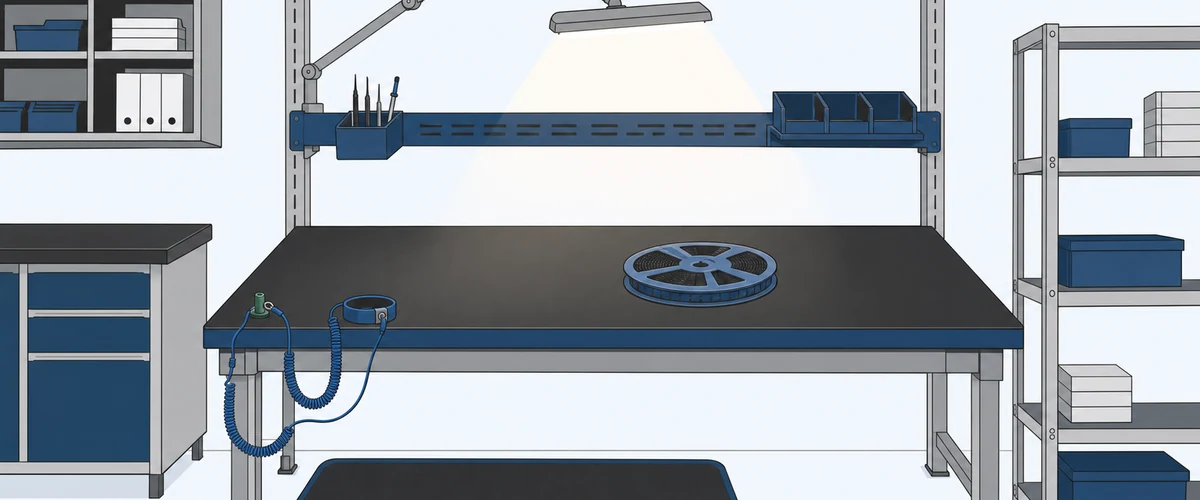
An esd workbench is built to handle that concern. It is a workstation designed so a static charge never has anywhere unsafe to go. Instead of letting charge build and jump, the bench gives it a slow, controlled path to ground. As a result, people, tools, and parts all stay at the same voltage. In this guide, we will walk through what an esd workbench is, what it is made of, how it actually protects a part, and who uses one.
What Is an ESD Workbench?
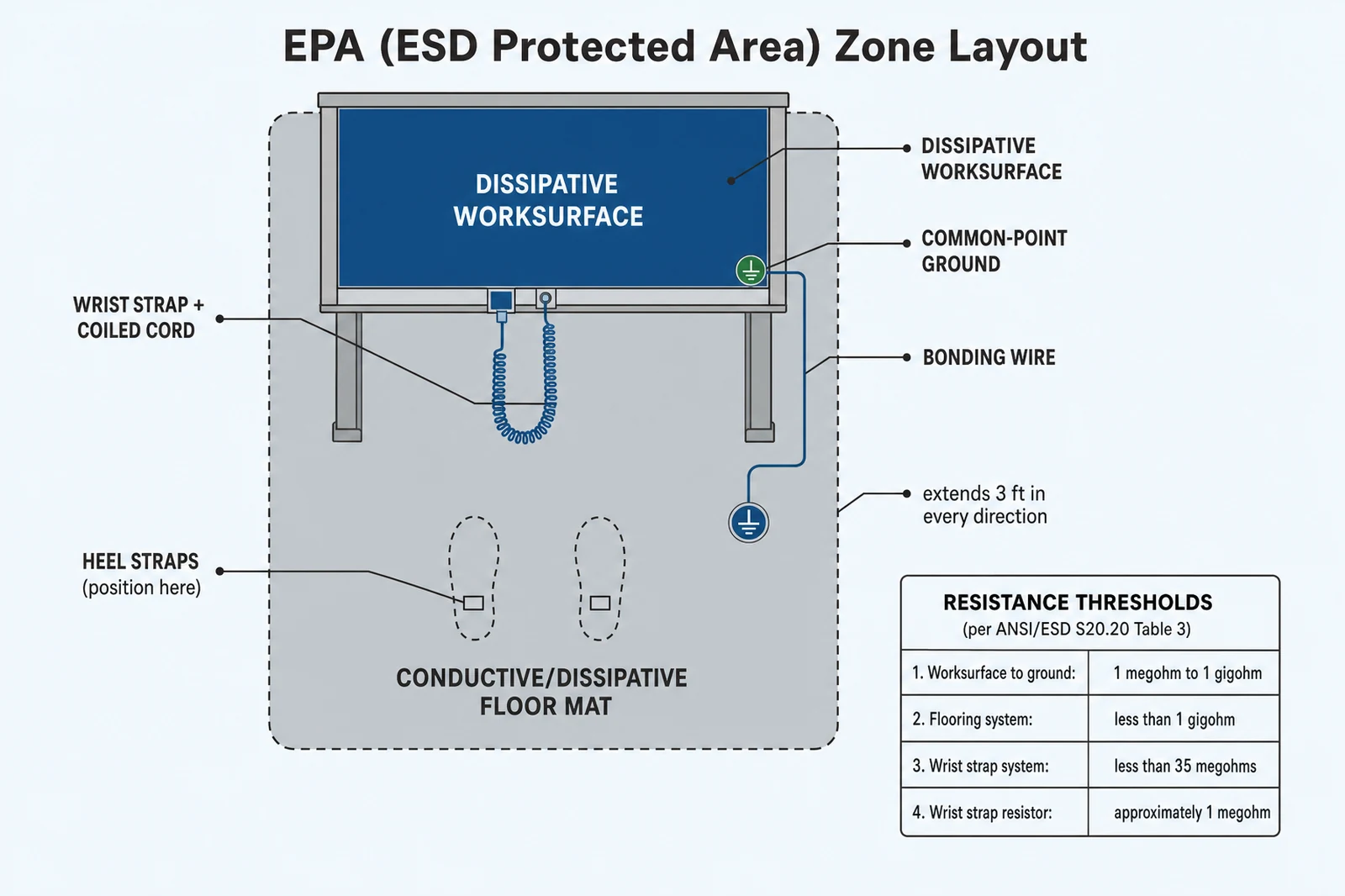
At heart, an esd workbench is a table where every conductive thing is tied to the same ground. Because they share one ground, charge cannot jump from one item to another. The industry frames this idea as an EPA, short for ESD Protected Area. Under the main program standard, handling sensitive parts without protective packaging “shall be performed in an EPA,” and that area “shall have clearly identified boundaries,” per ANSI/ESD S20.20-2021 §6. Notably, an EPA can be one bench, a whole room, or a building. Therefore the esd workbench is the smallest building block of that safe zone.
So how do you know a part even needs this care? The industry uses two sensitivity tests. The first is HBM, the Human Body Model, which mimics a charged person touching a part. The second is CDM, the Charged Device Model, which mimics a charged part discharging on its own. A device is treated as sensitive when it can be hurt at 100V HBM or 200V CDM, per the ANSI/ESD S20.20-2021 scope. For example, most modern chips sit well inside that band. Consequently, they need an EPA and a proper esd workbench. The international rule agrees, since IEC 61340-5-1 uses the same 100V and 200V triggers.
Typical Components of an ESD Workbench
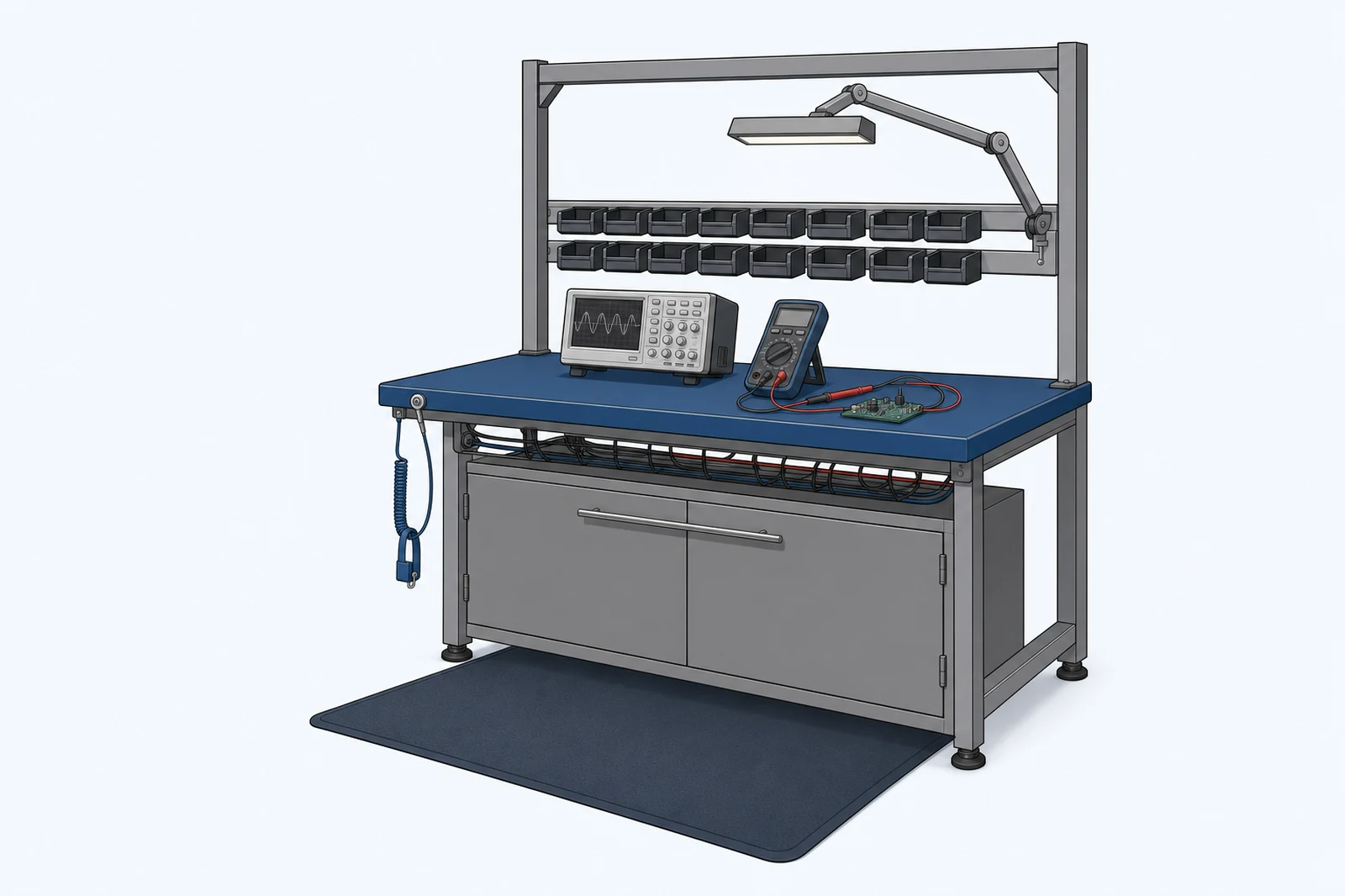
Picture yourself standing at the bench. Here are the parts you would see, and what each one does. Together, they make up the core of a piece of electronics lab furniture built for static control.
- Dissipative worksurface — a matte laminate top or a rubber mat that lets charge bleed away slowly instead of sparking.
- Wrist-strap jack and coiled cord — a snap point where a worker plugs in a wrist strap so their body stays grounded.
- Common-point ground lug — the single fitting where the surface, mat, strap, and tools all meet, so they share one voltage.
- ESD floor mat or dissipative flooring — a grounded path under standing workers, useful when they move around.
- Grounded task light — lighting whose metal body ties back to the same ground.
- Ionizer — a fan that neutralizes charge on plastics and other insulators, which cannot be grounded directly.
- Dissipative storage bins — parts trays made from static-safe material, so stored components stay protected.
- Cable management — trays and clips that keep power cords clear of the work zone and the ground paths.
You do not always need every item. The worksurface is non-negotiable, with the wrist-strap connection, and the common-point ground following close behind, if needed. The rest scales with the work. For example, a bench that handles bagged plastics may add an ionizer, while a bench with lots of cables leans harder on cable management. Notably, the ionizer earns its place because plastics cannot be grounded. Instead, they build charge that a fan must neutralize in the air. So the mix of parts on any given esd workbench really depends on the job in front of it.
Grounding: How the Bench Actually Protects a Part
Grounding is the heart of the whole system. In fact, the standards body calls grounding “the single most important concept in the field of static control,” per the ANSI Blog on S6.1. The core rule is simple. Every conductive item at the station “shall be connected to the same common point ground,” per ANSI/ESD S6.1-2019. In other words, the bench, the mat, the wrist strap, and the tools all meet at one lug.
Why one point? Because when everything shares a single ground, everything sits at the same voltage. As a result, charge has no reason to jump from one item to a part. The program standard puts it plainly: grounding must keep items, people, and other conductors “at the same electrical potential,” per ANSI/ESD S20.20-2021 §8.1. Therefore the design lesson is to route every ground path back to one lug, not several.
The wrist strap shows the logic nicely. Its full system must read under 3.5×10⁷ Ω, which is 35 megohms, per S20.20 Table 2. That range is a deliberate compromise. It is conductive enough to bleed a person’s charge safely, yet resistive enough not to shock the worker if they touch live voltage. Specifically, the current-limiting resistor in the strap cord comes from ANSI/ESD S1.1, the wrist-strap standard. So the number is not arbitrary. Instead, it balances part safety and personal safety at once.
Materials: Why Dissipative, Not Conductive or Insulative
The word “dissipative” is the key to the whole materials story. A dissipative surface lets charge bleed away slowly enough to be safe, yet fast enough to protect the part. In contrast, a conductive surface drains charge too fast, while an insulative surface holds it and lets it build. Therefore the bench needs a middle ground, not either extreme.
There are real numbers behind that middle. Under S20.20 Table 3, the worksurface must read under 1.0×10⁹ Ω, measured with the method in ANSI/ESD STM4.1-2017. Moreover, the ESD Association cites a usable band from 1×10⁶ to 1×10⁹ Ω that keeps a surface at the same potential as the rest of the station, per ESDA Part 3. In short, too low and charge dumps too fast; too high and it lingers. Therefore the goal is a slow, steady leak, not a quick jolt.
Why not simply use metal, which is very conductive? Because a fast dump of charge can itself damage a delicate part. A dissipative surface slows the drain to a safe rate. Meanwhile, a plastic or painted top would trap charge and let it build. So the industry settled on the dissipative middle as the safest choice for a worksurface. This is exactly why an esd workbench feels different from an ordinary bench, even though it looks similar.
In practice, two paths dominate. First, a dissipative laminate can be built right into the worktop. Second, a dissipative rubber mat can lie over a standard top and bond to the common point. Both hit the same target. Similarly, an ESD-safe base cabinet or frame follows the same principle, so the whole piece of electronics lab furniture stays in the safe band. Flooring adds one twist. It must meet a dual limit: under 1×10⁹ Ω per STM97.1 and under 100V body voltage per STM97.2, per S20.20 Table 2. Consequently, a floor path cannot skip the body-voltage check.
Who Uses ESD Workbenches? Industries and Applications
An esd workbench shows up anywhere sensitive electronics get built, tested, or repaired. Because the sensitivity trigger is so low, the list is broad. Here is where these benches earn their keep, and what happens at each one.
- Semiconductor fabrication and assembly — wafer handling, die attach, and wire bonding all touch bare silicon, so a single stray discharge can scrap a costly part.
- Electronics manufacturing and PCB assembly — SMT rework, hand soldering, and inspection put people in direct contact with boards, where static control keeps yields high.
- Aerospace and defense electronics — avionics, radar, and satellite subassemblies demand tight control. Notably, the old MIL-STD-1686 was canceled on January 12, 2021 and superseded by S20.20, per the ESDA cancellation notice, so readers may still see outdated references in old drawings.
- Medical device manufacturing — implantables, monitoring devices, and hearing-aid work involve tiny, high-value parts that cannot be allowed to fail.
- Automotive electronics — ECU and controller assembly, sensor manufacturing, and EV battery-management boards all rely on chips that sit inside the sensitive band.
- Contract electronics (EMS) and rework depots — general-purpose ESD-safe stations handle a changing mix of customer boards, so consistent control matters.
- Research and university labs — teaching benches and prototyping stations protect parts while students learn safe handling.
- Data-center and IT hardware handling — server board swaps and GPU or memory installs happen fast, so a grounded bench guards pricey hardware.
Across all of these, the acceptability of the finished assembly is judged against IPC-A-610, whose scope covers “visual quality acceptability requirements for electronic assemblies,” per the IPC-A-610J scope. In general, the more critical the product, the more the esd workbench matters, per the IPC-A-610 product page.
When Fire and Explosion Enter the Picture (NFPA 77 / OSHA)
So far, the goal has been protecting parts from damage. However, some benches also see flammable liquids, such as isopropanol for cleanup, flux, and adhesives. As soon as those show up, a second and very different static hazard appears: fire and explosion. Because of that, a whole separate framework kicks in.
That framework is NFPA 77, which “offers guidance on identifying, evaluating, and controlling static electric hazards for the purpose of preventing fires and explosions.” In practice, NFPA 77 §7.4 covers bonding and grounding so charge bleeds off before it can ignite a vapor. Furthermore, the regulatory backing sits with OSHA. Under federal rule, “static electricity shall be controlled where it presents a fire or explosion hazard by bonding, grounding, or other suitable means,” per 29 CFR 1910.304(f)(8).
Keep the two jobs separate. S20.20 protects the chip from a discharge that ruins it. In contrast, NFPA 77 and OSHA protect people from a discharge that lights a solvent. Therefore a bench that handles both flammables and sensitive parts needs both layers. In short, two problems, one bench, two standards. Do not treat one as a substitute for the other.
How ESD Workbenches Fit into Electronics Lab Furniture
An esd workbench is one member of a larger family. That family is electronics lab furniture, and it includes test benches, rework stations, inspection tables, and sit-stand configurations. Consequently, the ESD workbench is not a separate species so much as a static-safe version of the same core bench. For a closer look at how these terms line up, see OnePointe’s guide on lab tables versus benches.
OnePointe supplies both ESD-forward workbenches and non-ESD benches where the work allows it. Importantly, the deciding factor is component sensitivity, not preference. If the parts fall inside the 100V HBM and 200V CDM band, the bench must be ESD-safe. Otherwise, a standard electronics bench may be fine. For related surface and cabinet choices, OnePointe’s lab casework materials guide is a helpful next read if needing more furniture in your electronics labs.
Not sure whether your work needs an esd workbench or a standard bench? Our team can help design the ideal workbench for your workflow. We can also supply ESD seating for further protection. Contact the OnePointe Solutions Lab Design Team to talk through your electronics lab furniture options.
— The OnePointe Solutions Lab Design Team