


Personal care formulation is not general chemistry, and it is not pharma R&D either. A lotion, a serum, or a cream is usually an emulsion. Oil and water do not want to stay mixed, so the formulator forces them together and then fights to keep them together. That fight happens at the bench. Consequently, personal care lab design has to start with the emulsion itself, not with a generic wet-lab floor plan.
Emulsions live or die at the bench. A batch can look perfect on Friday and then separate, cream, or crack by Tuesday. Therefore, the room around the formulator matters as much as the recipe. Heated phase vessels, a high-shear mixer, a viscometer, and a stability chamber all shape whether that emulsion survives. This guide walks the formulation bench station by station. Moreover, it anchors every decision to a first-party standard, from ISO 22716 to ASTM to OSHA to ICH. It centers on the R&D bench, so it deliberately hands quality control off to a companion guide rather than repeating it.
Why Personal Care Formulation Bench Design Is Different
Personal care lab design differs from general chemistry in four practical ways. First, many ingredients are thermolabile. Actives, fragrances, and certain preservatives degrade when they sit too long at process heat. So the bench must let the formulator hold, then cool, a hot phase quickly and predictably. Second, emulsions have a narrow instability window. The oil and water phases must meet at matched temperatures during the emulsification step, or the batch will not knit. The layout has to keep both phases hot and close at the same moment.
Third, cross-contamination is a constant risk. Fragrance, color, and active ingredients all carry over easily on shared tools and surfaces. A trace of yesterday’s dye can ruin today’s white cream. Consequently, personal care lab design leans on cleanable surfaces, defined tool zones, and equipment-cleaning practices that ISO 22716 explicitly addresses. That standard “gives guidelines for the production, control, storage and shipment of cosmetic products,” per ISO 22716:2007. Fourth, hot and cold work happen at one station. The formulator heats an oil phase, then immediately measures pH and viscosity as the batch cools. Therefore, a single bench must tolerate heat, splash, and precise instruments together.
The Emulsion Prep Station
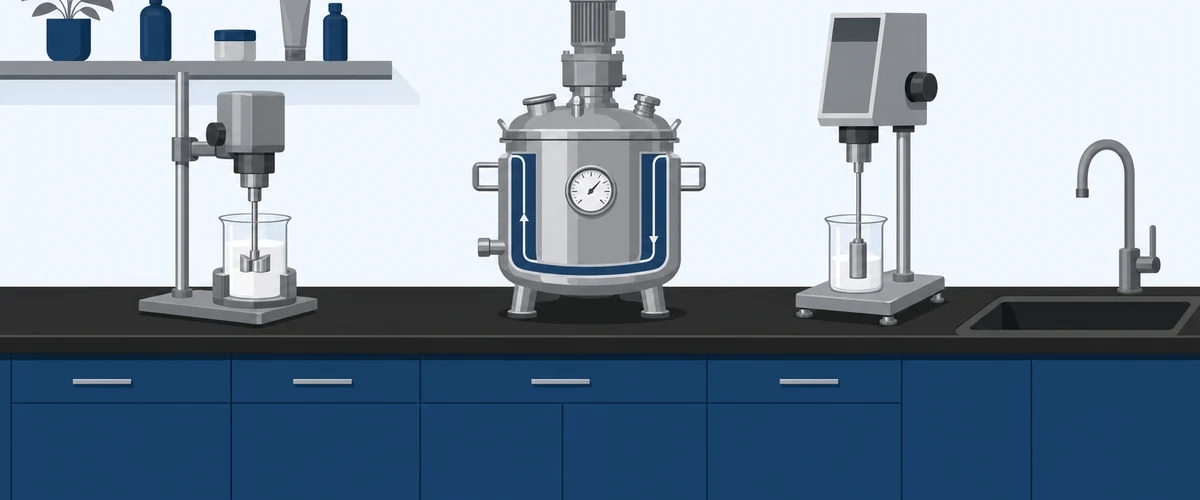
The emulsion prep station is the heart of personal care lab design. Here the formulator builds two phases in parallel. The water phase heats in one jacketed vessel while the oil phase heats in another. A jacketed kettle circulates a heat-transfer fluid through an outer shell, so the contents warm evenly without a scorching hot spot. Even heat matters, because a local hot zone can degrade a thermolabile emollient or active. Both phases typically climb to roughly 70 to 80 degrees Celsius before they combine. A heated addition funnel or a transfer line then moves one phase into the other at a matched temperature, since a cold pour can shock the emulsion and cause it to break on the spot.
Temperature control is the whole game at this station. Each vessel needs a stable, readable set point and a probe the formulator can trust. Furthermore, the bench needs clearance so a hot kettle never sits against a reagent bottle or a glove box. Hot-oil work also generates vapor and the occasional splash. So a vented enclosure or a local exhaust point above the station keeps the breathing zone clear. That intent aligns with ASHRAE Standard 62.1.
Surfaces decide how well this station ages. Epoxy resin is great for areas where heat will come into contact with also needing optimal chemical resistance. Phenolic resin countertops, though they have less heat resistance (up to 350 degrees), are great as a more cost effective counterpart to epoxy but still apples to apples in chemical protection. However, still best not to have phenolic as the work surface under equipment that generates heat as it will eventually ruin the material.
Homogenizer and High-Shear Mixing
Once the phases meet, a high-shear mixer does the real emulsification. A rotor-stator homogenizer spins a rotor inside a fixed, slotted stator at high tip speed. That geometry pulls the mixture through a tiny gap and shears the droplets down to a fine, stable size. Colloid mills work on the same principle for thicker batches. As a result, droplet size drops and the emulsion holds together far longer. Tip speed, gap width, and dwell time all shape the final droplet distribution, so the formulator tunes them for each product.
High shear brings three bench-level problems, though. First, it throws splash. A splash guard or a closed vessel keeps aerosolized product off the formulator and the nearby instruments. Second, it makes noise. A rotor-stator unit at full speed can be loud. Under OSHA 1910.95, an 85 dBA eight-hour average is the action level. That level triggers a hearing conservation program, and 90 dBA is the permissible exposure limit. Therefore, personal care lab design should site loud mixers away from quiet desk work and add acoustic treatment where run times are long.
Third, high shear creates vibration. A mixer bolted to a flimsy bench transmits chatter into every nearby instrument. So the mixer needs a stable, mass-loaded base or a vibration-isolating mount. That isolation matters even more because the same bench often holds a viscometer. SEFA describes casework standards that give “tools for evaluating the safety, durability, and structural integrity of laboratory grade furniture,” per SEFA. A bench built to that bar stays flat and steady under a working mixer.
Viscosity, Rheology, and pH/Conductivity QC
Viscosity tells the formulator whether the emulsion feels right and whether it will stay stable. A rotational viscometer measures that property directly. ASTM D2196 covers “the determination of the apparent viscosity and the shear thinning and thixotropic properties of non-Newtonian materials” with a rotational viscometer. Notably, the method advises that “viscosities at two or more speeds give better characterization of a non-Newtonian material.” A cream is non-Newtonian, so a single number rarely tells the full story.
Sample temperature drives every reading, though. Viscosity changes sharply with heat, so the formulator must measure at a controlled, documented temperature. Therefore, the bench needs a water bath or a jacketed sample cup near the viscometer. It also needs a flat, level, vibration-free surface, because a tilted or shaking stand skews the spindle reading. A dedicated, leveled instrument bench (balance or anti-vibration table, mass spec bench) keeps that measurement honest.
pH and conductivity round out the bench-level checks. A pH meter confirms the batch sits in its target range, since a drifting pH can break an emulsion or knock out a preservative. Meanwhile, a conductivity probe helps identify whether an emulsion is oil-in-water or water-in-oil. Both probes need a clear calibration workflow with fresh buffers and a logged schedule. Consequently, the bench needs buffer storage, a rinse station at the drop-in sink, and space to work without crowding the hot kettle.
Stability Chamber Room
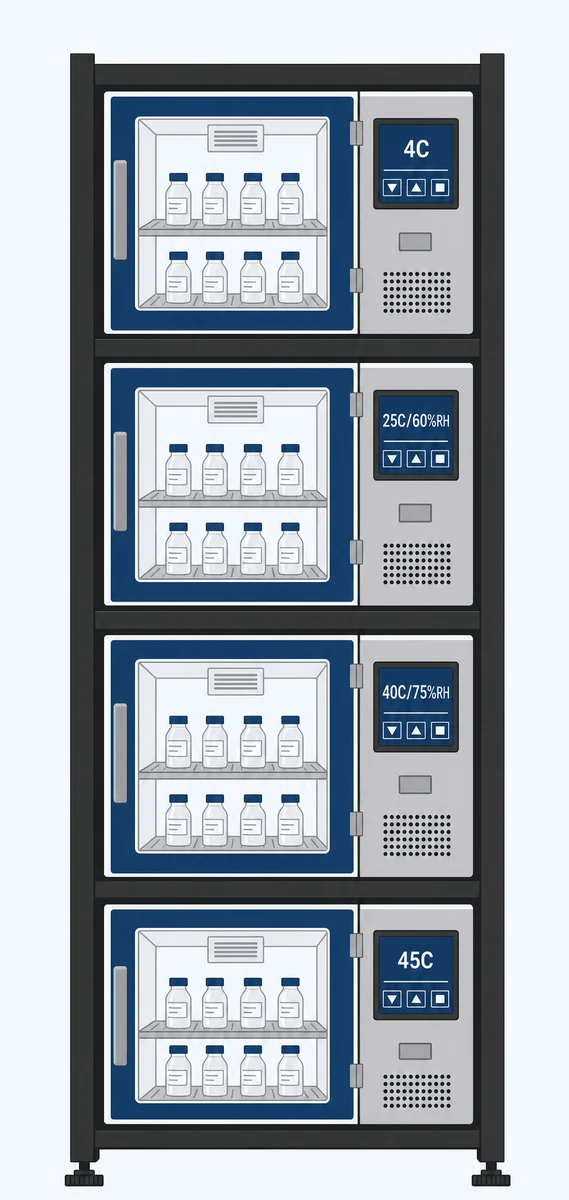
A finished emulsion means little until it survives time and temperature. Stability testing proves it will. The ICH Q1A(R2) stability framework sets the reference conditions that personal care teams adapt. Long-term storage runs at 25 degrees Celsius and 60 percent relative humidity. Accelerated storage runs at 40 degrees Celsius and 75 percent relative humidity. Personal care labs then add a 4 degree refrigerated hold and a thermal-cycling regime to stress the emulsion further. A 45 degree chamber often joins the rack for aggressive heat screening.
Rack layout follows from those conditions. Each condition needs its own chamber, so the room fills quickly. Redundancy matters here, because a single failed chamber can void weeks of a study. Therefore, planners often add a spare chamber or split conditions across two units. Moreover, each chamber needs calibrated data logging with alarms, so a temperature excursion triggers an alert before samples are lost. A logged, alarmed rack is what makes a stability claim defensible later. Furthermore, the data log itself becomes part of the product record, so it should export cleanly for review rather than living only on a chamber’s front panel.
The room itself carries a heavy heat and power load. Several chambers running hot phases dump waste heat into the space, so the room needs its own cooling and enough dedicated circuits. Furthermore, the chambers should sit where a technician can read and service them without moving a rack. Good access keeps a busy stability program on schedule instead of fighting the furniture.
Color-Matching and Sensory Evaluation
Color is a promise to the customer, so a batch must match its standard shade every time. Ambient light fools the eye, though. Therefore, color matching happens inside a controlled viewing booth under a defined illuminant. A D65 daylight source approximates average daylight and gives a repeatable reference. For instrument work, ASTM E308 gives “the values and practical computation procedures needed to obtain CIE tristimulus values” from spectral data. It also supplies standard values for the CIE standard illuminants that the booth mimics.
The booth needs a stable, glare-free place on the bench and consistent power for its lamps. Additionally, it should sit away from windows, since stray daylight corrupts the match. Its footprint stays small, yet the surface under it must stay clean and neutral in tone.
Sensory evaluation needs the opposite of a busy bench: isolation. A sniff panel judges fragrance, so the booth must stay free of competing odors. Consequently, the sensory booth needs dedicated exhaust that clears each scent before the next one arrives. Without that airflow, olfactory carryover from one sample taints the next judgment. That dedicated ventilation aligns with the acceptable indoor air quality intent of ASHRAE 62.1, and it keeps a sniff panel honest.
Regulatory Frame: How the Rules Shape the Bench
Regulation does not sit apart from personal care lab design. Instead, it shapes the bench directly. ISO 22716, the cosmetics GMP guideline, drives three bench-level choices. First, equipment cleaning practices push toward smooth, cleanable surfaces and defined tool zones. Second, personnel flow pushes toward a layout that separates gowning, weighing, and mixing. Third, documentation zones push toward a clean space for records near, but not on, the wet bench. All three trace back to the production, control, and storage guidance in ISO 22716:2007.
MoCRA then adds a facility layer. Under the Modernization of Cosmetics Regulation Act, “manufacturers and processors must register their facilities with FDA and renew their registration every two years.” That registration expects a facility that can support consistent, documented production. So a well-planned bench is not just tidy; it is part of the compliance story. The FDA may even suspend a registration when a product risks “serious adverse health consequences.”
Federal cosmetic rules round out the frame. 21 CFR Part 700 holds the general cosmetics provisions, while 21 CFR Part 720 covers voluntary ingredient-statement filing. None of these rules dictate a countertop material. Yet together they set the expectation that the bench supports clean, controlled, documented work. Personal care lab design simply makes that expectation physical.
The QC Handoff
The formulation bench does not close the loop by itself. Instead, it ships samples to quality control. Once a batch passes bench checks, the formulator pulls representative samples and sends them to the QC lab for release testing. That handoff is a real physical point in the workflow, so the layout should make it easy. A clean pass-through or a defined sample drop keeps formulation and QC from bumping into each other.
QC then runs the release-grade tests that formulation only screens for. Preservative efficacy under USP <51> and microbial limits under USP <61> and <62> live in that space, not on the formulation bench. The USP <51> challenge test, for instance, incubates preserved samples at a controlled temperature and reads them over 28 days. That kind of long, contamination-sensitive work simply cannot share a bench with hot-oil mixing. Those tests need their own controlled, contamination-managed environment. We cover that side in depth in our companion guide on how to design a cosmetic product testing lab. Read that piece for the QC counterpart to this formulation-focused guide, since the two rooms work as one pipeline.
Building a Defensible Personal Care Lab Design
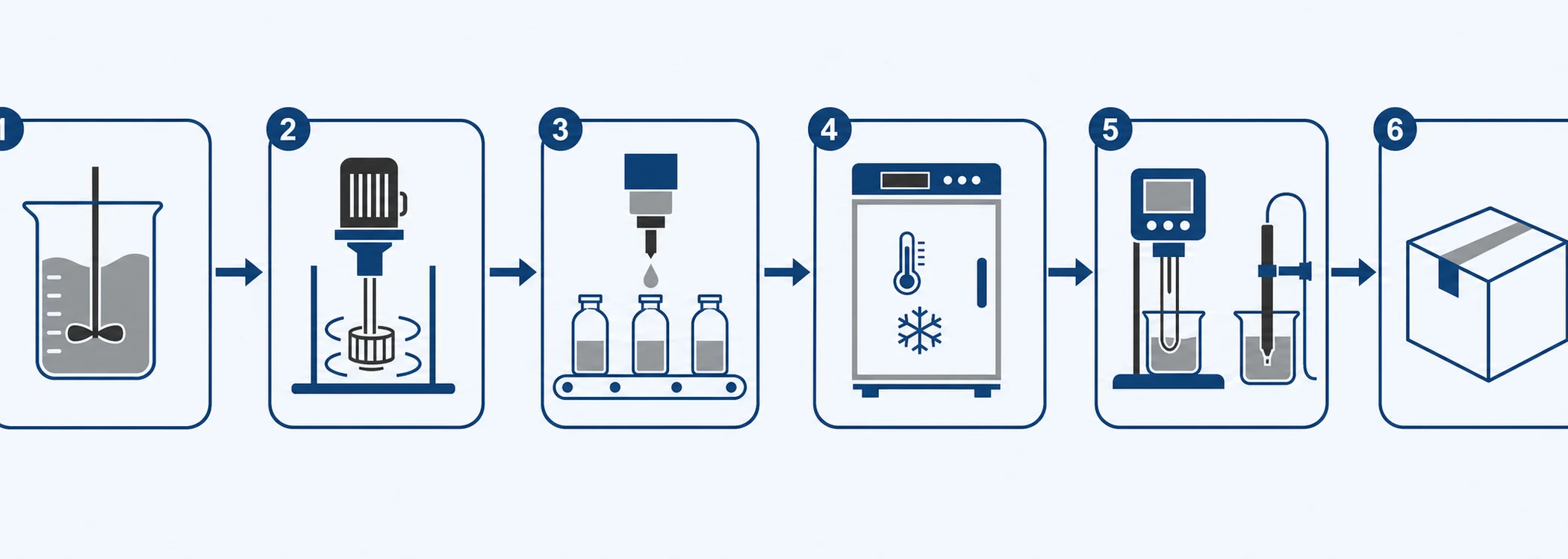
Strong personal care lab design reads as one continuous formulation workflow. Heated phases feed the homogenizer. The homogenizer feeds filling and then stability. Stability, viscosity, and pH feed the release decision. Each handoff carries its own bench requirement, all traceable to a first-party standard. ASTM D2196 sets the viscosity method. ICH Q1A(R2) frames the stability conditions. OSHA 1910.95 sizes the noise controls. ISO 22716 and MoCRA shape the cleaning, flow, and documentation the room has to support.
For related planning, see our lab casework overview for surface and cabinet selection at the formulation bench. Do you need help with your personal care lab design? Then contact our lab design team to start the conversation, from emulsion prep ventilation to stability chamber layout. We can work with selecting the right lab furniture to enhance your workflow.
— OnePointe Solutions Lab Design Team