



Lab managers handle important decisions when planning a lab’s electrical framework. Did you know, according to the ANSI Blog, that electrical issues cause two-thirds of all laboratory fires ? Thus, why having proper power distribution is not only essential for safety and but also operations as well. In this guide, we will touch on three fundamental laboratory electrical solutions based on industry standards and manufacturer specifications.
Laboratory Power Strips: Flexible Power Distribution
Understanding Lab-Grade Requirements
OSHA requires facilities to install listed equipment per manufacturer specifications. Laboratory grade power strips meet significantly higher standards than consumer models, with UL 1363 listing for relocatable power taps being the industry standard.
Florida State University’s safety guidelines specify that power strips in wet chemistry laboratories meet ratings for corrosive and indoor wet locations. Reflecting the demanding environment where chemical exposure and moisture present constant challenges.
Essential Safety Features
- Overcurrent Protection: Power strips need overcurrent protection with circuit breakers, and require direct plugging into permanent wall outlets. Where you may not see power strips directly plugged into wall outlets are on tables or benches if the power supply comes from the ceiling and designed to not solely come from the wall. These are sometimes present on ESD workbenches in electrical testing labs.
-
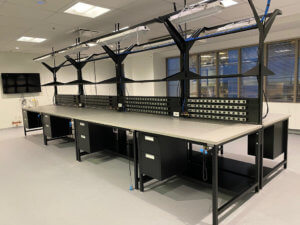
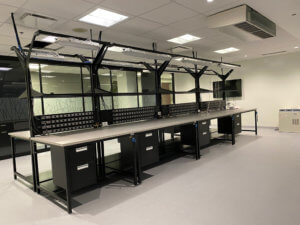
- The University of Kansas guidelines emphasize that not all surge protectors offer overcurrent protection. Those without it are multi-plug extension cords that cannot supply electrical service to other equipment.
- Power Capacity Limitations: Manufacturers design lab grade power strips for high concentrations of low-powered devices, not for high-power appliances like refrigerators, coffee pots, space heaters, or lab equipment used for warming, heating, or cooling. According to safety expert Richard Palluzi, power strips on laboratory benches are clearly subject to spills, overheating from adjacent equipment and similar damage.
- Daisy-Chaining Prohibition: Multiple power strips in series, known as daisy chaining, is not allowed and subject to fines by Fire Marshals. The UL Directory requires that UL-listed relocatable power taps must be directly connected to permanently installed branch circuit receptacles and not be series-connected to other power taps or extension cords.
Where Power Strips Work Best
Power strips excel in temporary applications. Extension cords and power strips should be used for temporary applications lasting less than three months, as situations requiring longer use are considered permanent installations. They provide immediate power expansion without requiring electrician involvement, making them cost-effective for budget-conscious operations.
Recognizing Limitations
The National Electrical Code principle requires no overloading of power strips, and protected from physical damage. NFPA 45 mandates that electrical receptacles, switches, and controls shall be located so as not to be subject to liquid spills, making proper placement challenging in wet laboratory environments.
Electrical Raceways: Organized Permanent Distribution
Professional Raceway Systems
Laboratory raceways provide enclosed channels for electrical distribution while protecting wiring from environmental hazards. PG LifeLink, a major manufacturer, notes that laboratory connection products are made of high quality extruded aluminum, providing modern aesthetic appeal and easy to clean corrosion resistant surfaces.
Configuration Options
- Surface-Mounted Systems: Surface-mounted electrical raceways offer benefits because they are pre-wired and pre-cut in the factory as opposed to in the field by electrical contractors. These systems attach directly to walls or benches for retrofitting existing laboratories.
- Under-Bench Installation: Modular raceways mount directly to bench uprights or horizontals, allowing power and data to be positioned in nearly any location and enabling simple relocation.
- Integrated Systems: UL listed utility raceways with steel dividers mount between uprights for utilities interconnection including data, power, and water from bench to bench. Modern systems can display over six circuits of power and three Cat 5 data cables per bench with no visible trace of wires or cabling.
Advantages of Raceway Systems
Raceways provide superior organization and safety. Raceway systems are CSA C22.2 No. 62-93 certified and feature replacement covers for maximum flexibility when adding or deleting power or data outlets.
Installation Considerations
Professional installation ensures code compliance. Texas Tech University standards specify raceways installation be level and square at proper elevations to maintain headroom and avoid interference with other work. Grounding connections for raceway, boxes, and components must be provided with connectors tightened according to UL Standard 486A specifications if choosing this laboratory electrical solution.
Electrical Pedestals: Permanent Electrical Solutions
Understanding Electrical Pedestals
Electrical pedestals, our next electrical lab solution, also called tombstone fixtures or power monuments, provide freestanding power distribution. Floor Box Outlet explains that nozzles and pedestal boxes are dual sided tombstone enclosures that install on floor or worktop surfaces, affixing to rigid conduit protruding through the surface.
Design Features
- Material Construction: Some designs you’ll come across are pedestal monuments with three finishes including wrinkle black epoxy powder coating and satin brushed aluminum with an attractive chrome-like finish, depending on the manufacturer. Practical Quality Systems manufactures stainless steel surface mounted power and data monuments in several applications including clean environments, laboratories, and medical facilities.
- Modular Configurations: Surface mount outlet boxes provide configurable solutions with internal barriers that isolate compartments, allowing boxes to have twelve modules for power and low voltage jacks including HDMI, USB, and RJ45. Legrand’s Wiremold division produces lab bench pedestal boxes available in two-gang and four-gang configurations.
- UL Listing: Pedestal monuments feature 125 Volt, 15 amp receptacles with on/off switches and UL Listed circuit breakers, ensuring they meet national safety standards for laboratory use.
Benefits of Electrical Pedestals
Tombstone fixtures eliminate trip hazards while providing stable permanent access. Surface mount floor boxes provide ideal solutions when power outlets and data jacks need to be installed in accessible locations, with barriers that separate circuits for safety. Educational spaces like this option due to the compact design of accessible power.
Installation Requirements
Professional installation is essential. Surface mount outlet boxes are made of galvanized steel and powder coated with fine sand texture finish, with snap-in style 15A receptacles that are UL Listed and supplied with screw clamps for neutral, hot and grounding conductors. These permanent installations require floor-routed electrical supply and proper code compliance.
Safety and Compliance Standards
OSHA Requirements
OSHA standard 29 CFR 1910.303(b)(2) requires facilities to install listed equipment per manufacturer specifications. Additionally, OSHA standard 1910.304(b)(2) requires that outlet devices have an ampere rating not less than the load they serve.
NFPA 45 Standards
The National Fire Protection Association established NFPA 45 specifically for laboratories using chemicals. According to the National Institute of Justice, NFPA 45 Standard on Fire Protection for Laboratories Using Chemicals applies to laboratories in which chemicals are handled and stored. The standard addresses electrical safety alongside chemical storage and fire protection requirements.
Ground Fault Protection
Best management practices in laboratory safety call for all outlets within 6 feet of a water source or in wet environments to have GFCI protection. These should be tested at least once per month. Laboratory electrical configurations include GFI (ground fault interruption) outlets specifically for sink and water applications.
Selecting Your Optimal Solution
Laboratory managers must evaluate several factors when choosing electrical solutions. Situations requiring extension cords or power strips exceeding three months are permanent installations. Make sure to address these through upgrades to building wiring systems.
Power requirements significantly influence decisions. High-power devices often have high startup surge loads that can overload circuits. For example, like devices such as refrigerators and lab equipment used for warming, heating, cooling, or other high-power applications.
Conclusion
Laboratory electrical infrastructure requires careful planning based on safety standards and operational needs. As a recap, power strips offer flexibility but must meet UL 1363 listing requirements and include overcurrent protection. Raceways provide organized permanent distribution with pre-wired factory construction and CSA certification. Tombstone fixtures deliver robust freestanding access with UL listed components and multiple finish options.
Compliance with OSHA standards 29 CFR 1910.303 and 1910.304 alongside NFPA 45 requirements ensures safe laboratory operations. Consult qualified electricians and laboratory design professionals to develop comprehensive electrical strategies that support research goals while maintaining safety.
Need Some Laboratory Electrical Solutions?
If you’re planning a lab project and need electrical solutions, as OnePointe Solutions we can help. With over decade of lab experience, we’ve provided electrical solutions for various applications. Give us a call today – 866-612-7312.
Sources
- Florida State University – Electrical Safety in the Laboratory
- University of Kansas EHS – Requirements for Powerstrips and Surge Suppressors
- OSHA – Compliance Requirements for Relocatable Power Taps
- Richard Palluzi, LinkedIn – Power Strips in Laboratories
- SLAC National Laboratory – Flexible Cord and Power Strip Requirements
- University of Kansas Gray-Little Hall – Electrical Extension Cords Requirements
- University of Georgia – Electrical Safety Manual
- University of Pennsylvania EHRS – Electrical Safety in Labs Fact Sheet
- Office of Compliance – Power Strips and Dangerous Daisy Chains
- OSHA Training – Misuse of Power Strips and Surge Protectors
- PG LifeLink – Laboratory Connection Products
- WSI – Modular Flexible Lab Benches
- PG LifeLink – Surface Raceway Materials
- Texas Tech University – Raceways and Boxes Specifications
- Floor Box Outlet – Tombstone and Pedestal Electrical Power Boxes
- Floor Box Store – Surface Mount Floor Outlets
- Legrand Wiremold – Lab Bench Pedestal
- Practical Quality Systems – Stainless Steel Power Monuments
- Floor Box Systems – Surface Mount Floor Box
- ANSI Blog – NFPA 45 Standard Development
- National Institute of Justice – Laboratory Safety Programs NFPA Requirements