


By the OnePointe Solutions Lab Design Team.
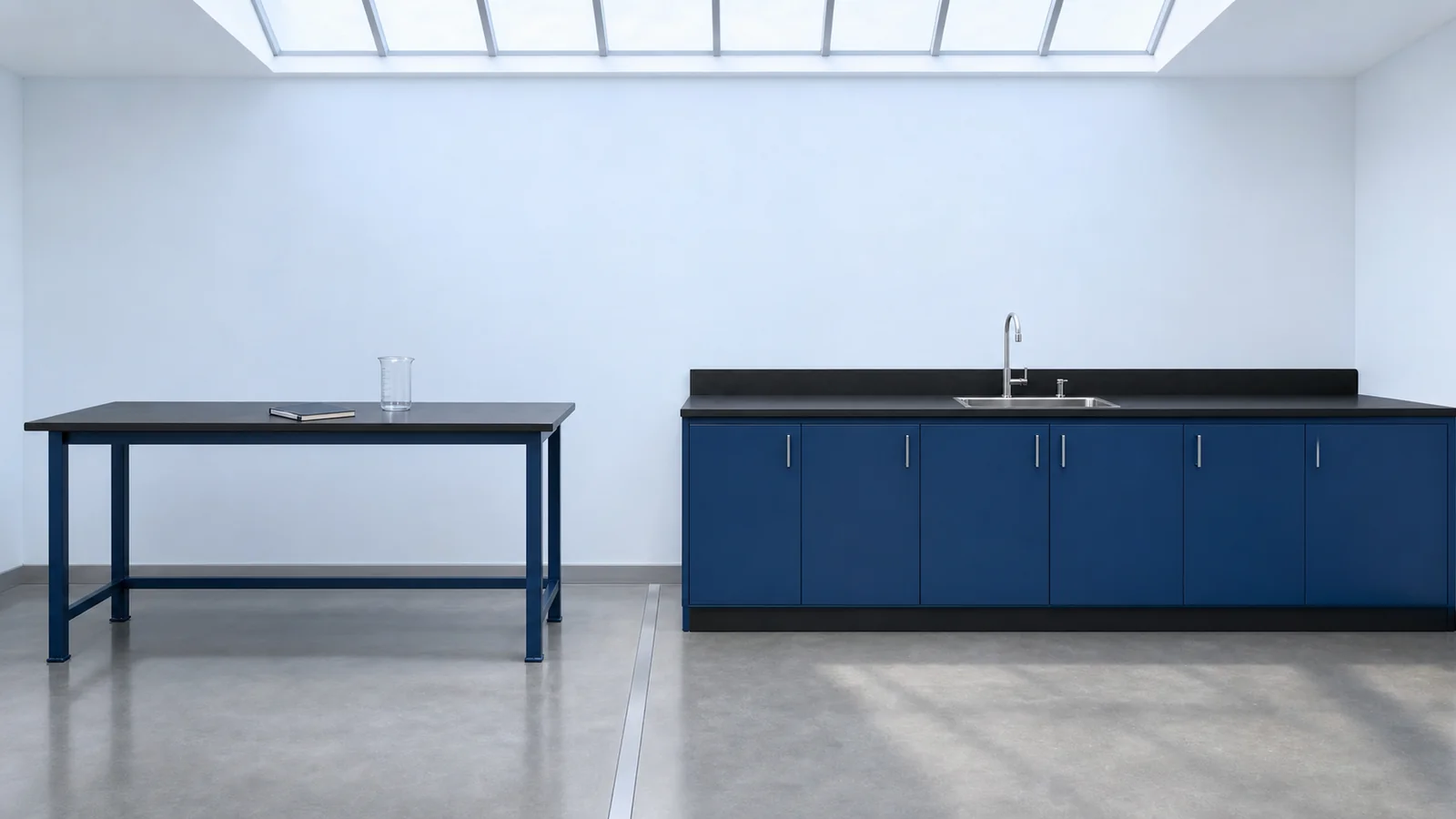
Walk into a lab and ask three people to point at “the bench.” One may point at a stainless-steel table on legs. Another may point at a run of base cabinets with a knee space and a black epoxy top. A third might point at the island in the middle of the room. Only one is correct and it may not be the option you have in mind. Each of those three interpretations sparks a different conversation on the manufacturer side. That is why the lab table vs lab bench question drives so many quote-stage questions. Resolving the lab table vs lab bench distinction up front saves the whole schedule.
When “lab table” and “lab bench” get used interchangeably in RFPs and submittals, projects run into three problems fast. Teams set the wrong expectations. Shop drawings match the wrong scope. The project loses time unwinding the vocabulary before a single unit ships.
This is a terminology guide for end users, specifiers, GCs, procurement teams, and lab managers. It is not a spec comparison. In the lab-furniture industry, a “lab table” and a “lab bench” are typically the same product family. In other words, the lab table vs lab bench confusion is not between two products. Instead, it is between one product (legs + top) and a completely different product (base cabinets with a work surface on top).
Getting the lab table vs lab bench vocabulary right at the RFP stage is the fastest, cheapest lever a project team has. It shortens lead times. It tightens quotes. It eliminates the “wait, that’s not what we ordered” conversation at delivery.
Why the lab table vs lab bench vocabulary matters
Laboratory-furniture manufacturers build to the drawings. That is the practical reality of how a lab-casework quote gets produced. First, the estimator reads the plan set. Then they look at the room layout, the linear footage, the adjacencies, the utility drops, the sink locations, and the fume-hood positions. Finally, they check the elevations. Those elevations show whether a wall is a cabinet run or an open lab-table zone.
The written specification reads alongside the drawings for finishes, materials, hardware grade, and product-family callouts. But the drawings tell the shop what to cut and weld. When the drawings show cabinets and the spec says “bench” while meaning a table (four legs and a top), the shop builds cabinets. The drawing shows cabinets in space, so cabinets win.
Drawings and specs carry equal weight – until the estimator reads them
Manufacturers did not invent this hierarchy. It is how construction documents are structured. Under the AIA A201 General Conditions, drawings and specifications are complementary and carry equal contractual weight. When they disagree, the contractor raises an RFI.
But in the real workflow of estimating and fabricating lab casework, the drawings are the primary source of scope. They are the only document that shows where and how much. A spec that says “lab bench” while the drawings clearly show base cabinets with a continuous top produces a cabinet-run quote every time.
The drawing wins because the drawing shows what can be counted, measured, and built. On federal projects governed by FAR 52.236-21, the order can flip in a formal dispute. The same is true on public projects where supplementary conditions give the specification precedence. However, at the practical level of a first quote, the drawings drive the scope.
Where lab table vs lab bench ambiguity shows up on the invoice
The consequence is straightforward. If the vocabulary in the spec does not match what the drawings show, the drawings win at the estimator’s desk. The mismatch resurfaces later as an RFI, a change order, or a submittal rejection.
And if the drawings themselves are ambiguous — a scribbled “lab bench” on a floor plan with no cabinet elevations — the estimator has three choices. Ask questions and delay the quote. Pick the most likely interpretation and hope. Or price the most expensive interpretation to protect margin. All three cost the project time or money.
Ambiguity does not stop at pricing. It carries through submittals, shop drawings, factory fabrication, freight, and installation if not caught early. Consider a GC who writes “supply and install 42 linear feet of lab bench” on a change order. With no accompanying elevation and no product family named, the GC has told the vendor almost nothing.
Is that 42 feet of table (top on legs, load through legs, storage optional and suspended)? Or 42 feet of base cabinets with a continuous work surface (roughly six or seven 30-inch-wide cabinets, plus tops, plus tail-in fillers, plus toe-kick)? Those two scopes differ significantly. The material costs differ. The shop time differs. So does the full round of connection details the installer needs from plumbing and electrical.
The word “bench” collapses all of that into one syllable. Unless the drawings resolve it visually, that is where projects lose time.
Where the lab table vs lab bench mix-up starts
The vocabulary problem does not begin at submittal review. It begins at the very first email or phone call asking for a price. Laboratory-furniture manufacturers see the same pattern land from two directions.
The first direction is an end user reaching out directly — a lab manager, a facilities coordinator, a PI, or a department head. For example, they write something like, “We need pricing on 30 feet of lab bench for a new wet-chem space.” The second direction is a formal bid or RFP package from a GC or procurement team. Similarly, it reads, “Furnish and install laboratory benches per drawing L-201.” Both start the same way. The word is “bench,” with no differentiating details. So the estimator cannot tell whether the client means cabinets or tables.
End users use “bench” the way researchers use it
End users are not doing anything wrong when they say “bench.” Rather, they use it the way it is used inside their lab. In everyday research language, a researcher’s “bench” is wherever they set down a beaker and a notebook. For instance, it might be a top on legs. Or a full cabinet run against the wall. Or the island in the middle of the room where the balance sits. All three read as “my bench” to the person who works there.
But then that same word travels from the lab. It ends up in an inquiry email or in the program document a GC hands the estimator. At that point, the estimator has to choose which product family to price. The odds of guessing right sit at exactly one in three.
The earliest fix is the most valuable one
The earliest fix is the most valuable one. It does not matter whether the quote conversation starts with an end-user direct inquiry, a designer’s cut sheet, or a formal GC bid. The first sentence of the request should name the product family — lab table, base cabinet run, island, or peninsula — along with dimensions, top material, and accessories. That lets the manufacturer size and price the correct scope on the first pass.
End users can do this by adding one clarifying line to any inquiry: “We need this on legs (a lab table), or as base cabinets with a work surface on top (a cabinet run).” GCs and procurement teams can do it by naming the product family, dimensions, top material, and any accessories (sinks, reagent shelves, service turrets) in the schedule before the RFP goes out.
A CSI MasterFormat section is helpful if your project uses one, but the differentiating details further clarify. Either way, the word “bench” is fine to keep if it helps — as long as the product name follows it. Then the estimator no longer has to guess.
What the standards actually say
The lab-furniture industry has clear, published definitions for each product category on both sides of the lab table vs lab bench line. They live in two places most often. The SEFA 8 series — the Scientific Equipment and Furniture Association’s laboratory-grade casework standards — defines tables as “an article of furniture having a flat, horizontal surface supported by one or more support members (legs), and a frame (apron).” That same document defines casework as “base and wall cabinets, display fixtures, and storage shelves … the generic term for both ‘boxes’ and special desks, reception counters, nurses stations and the like. Generally includes the tops and work surfaces.”
Two definitions, two product families. A table has legs. Casework has boxes. That is the entire lab table vs lab bench distinction in one sentence.
The industry standards also treat these as separate products with separate requirements. SEFA 8 governs casework. SEFA 3 governs work surfaces. SEFA 10 governs adaptable benching systems. For projects that use CSI MasterFormat, laboratory casework lives at 12 35 53 and laboratory countertops at 12 36 61. Not every project references CSI, though, and the estimator does not need a section number to price a quote correctly. The estimator needs the product family, the linear feet, and the differentiating details.
Meanwhile, “bench” is not a product family at all. It is a colloquial descriptor of the workspace itself, measured in equivalent linear feet of usable work surface — the ELF metric used by WBDG and the National Academies “Prudent Practices” reference. When a spec sheet says “provide 20 ELF of benchtop for the organic chemist,” it measures workspace. It does not name a product.
The four products that get called ‘a bench’
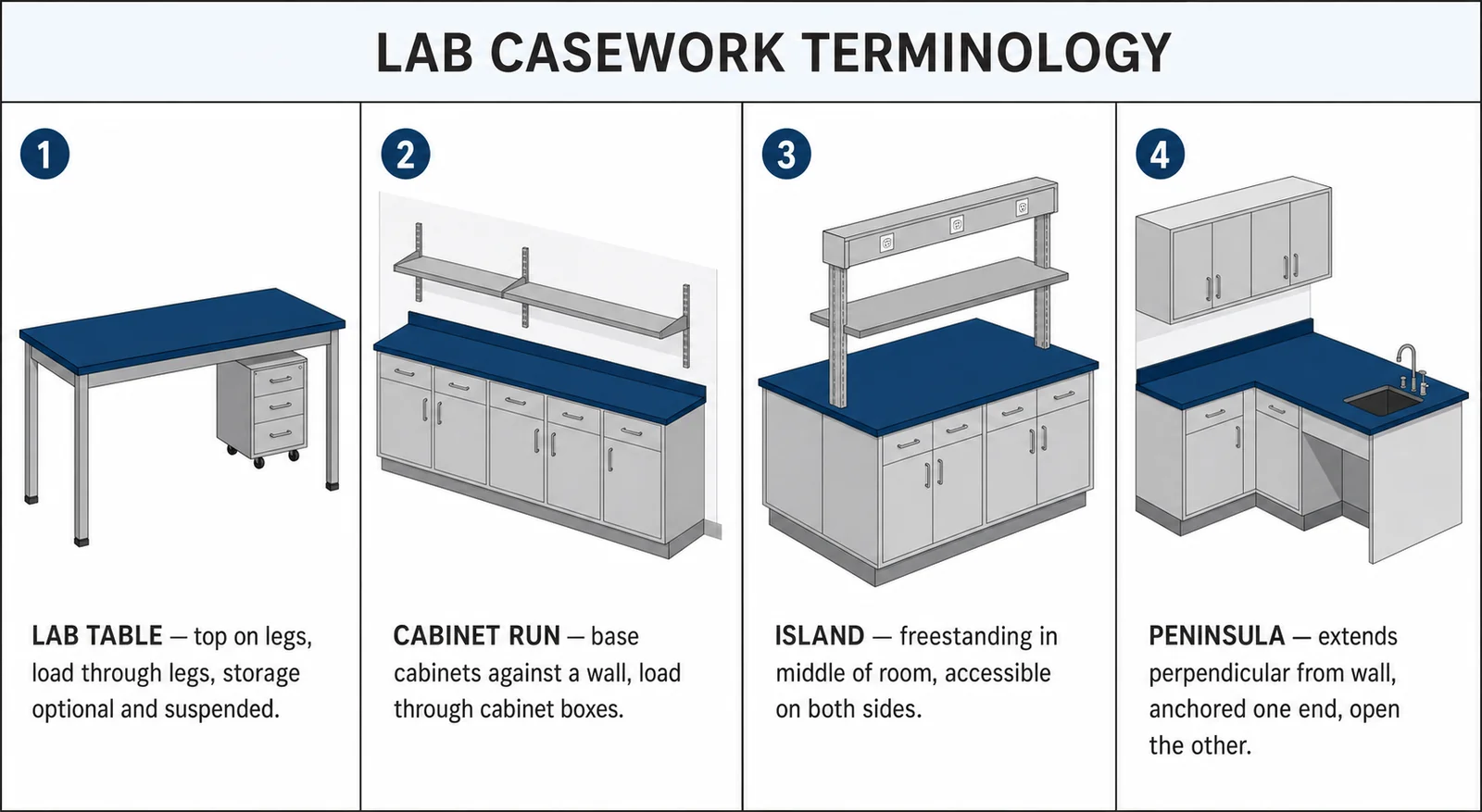
There are really four distinct products underneath the everyday word “bench.” Naming them accurately in RFP and PO language is the single fastest way to compress lead times and eliminate change orders — and it resolves the lab table vs lab bench question at the source.
1. Lab table (or lab bench)
A lab table is a top on legs. The load path runs through the legs, not through a cabinet box. The SEFA 8 definition applies directly — legs, an apron, and a flat work surface. That does not mean a table has no storage; the storage, if any, hangs suspended from the apron or rolls underneath, and it does not carry the load.
A hang-on mobile pedestal that clips to the apron rails, a rolling under-counter cabinet on locking casters, or a suspended drawer bank hung from the apron are all common accessories. SEFA 10 treats them as adaptable-system components rather than as casework.
The table can run fixed-height (typically 30 inches for seated work or 36 inches for standing work, per SEFA 10 and the SEFA 12 seating standard). Or it can run adjustable-height on a manual crank or a powered column. It can use C-frame legs, H-frame legs, or four independent posts. The frame usually accepts SEFA 10 adaptable-system accessories — hang-on mobile base cabinets, reagent shelves, service turrets, or overhead utility carriers.
In everyday shop-floor language, most manufacturers use “lab table” and “lab bench” interchangeably for this product. If someone points at a top-on-legs and calls it a bench, they are correct. This is the “same thing” pairing at the heart of the lab table vs lab bench question.
2. Cabinet run
A cabinet run is a linear sequence of base cabinets set against a wall, with a continuous work surface on top. This is casework, not a table.
SEFA 8 calls it “base cabinets with a work surface.” If your project uses CSI MasterFormat, it lives under 12 35 53.
The individual units typically measure 30 inches wide, 22 inches deep, and 36 inches high. Those dimensions are codified in SEFA 8. Similarly, they are repeated across NIH DRM Section 4.5 and the AWI Architectural Wood Casework standard. As a result, a cabinet run behaves nothing like a table in a quote and settles the lab table vs lab bench question at the linear-foot level.
Every foot of run carries a plumbing chase decision, a toe-kick condition, a filler-panel schedule, a hardware selection (BHMA-rated hinges, drawer slides, pulls), and a countertop seam plan. Calling this “a bench” in an RFP hides all of those decisions from the estimator.
3. Island
An island is a cabinet run that sits in the middle of the lab and does not anchor to a wall on any side. It stands freestanding and accessible from both the front and the back. In the lab table vs lab bench conversation, an island is definitely not a table.
It can run as a single row of base cabinets with a shared work surface. Alternatively, it can run as two rows of base cabinets set back-to-back sharing an overhead service carrier down the centerline. Islands are their own scope line: twice as many finished-exterior panels as a wall run, an overhead reagent shelf or service carrier decision, and utility drops that come down from the ceiling rather than out of the wall.
Submittal reviewers need to know whether an island is one row or two. That single detail changes the linear-foot count, the top square footage, and the utility drop schedule.
4. Peninsula
A peninsula is a cabinet run that extends perpendicular out from a wall cabinet run, anchored to the wall on one end and open to the room on the other. The far end is often finished with a sink, a knee space, or a seated workstation, and stools tuck under the overhang.
Structurally it remains base casework with a continuous work surface. Therefore, the SEFA 8 scope language matches a wall run. But the estimator needs to know it is a peninsula, not part of the wall run. The free end requires a finished-end panel and an end cap on the top. It also often requires an additional utility drop from the ceiling or from a wall-mounted service turret. NIH DRM Section 4.5 treats peninsulas as their own casework detail.
Calling a peninsula an “island” in a PO produces the wrong scope. An island has finished exteriors on all four sides and no wall connection. A peninsula has one anchored end and three exposed sides. Both are casework, so both sit on the same side of the lab table vs lab bench divide.
Where the lab table vs lab bench confusion comes from historically
The linguistic slippage has a legitimate historical root. In older wet chemistry labs and in most academic teaching labs built before SEFA 8 adoption, a “bench” meant a fixed workstation of any kind. It could be a soapstone table on iron legs, or it could be a full-height casework run with a chemical-resistant top. Both fixed to the floor. Both served as the researcher’s primary workspace. Both were the “bench” in the sentence “the sample is on my bench.”
Additionally, the ELF measurement convention reinforces the ambiguity. When a design team writes “each chemist needs 20 ELF of bench,” the metric measures workspace, not products. That ELF could arrive as 20 feet of table, 20 feet of cabinet run, or a mixture of the two.
The word “bench” works correctly in the WBDG and Prudent Practices context as a unit of workspace. But the moment that sentence lands on a procurement team’s desk, “bench” becomes a product to buy, and the language breaks.
Finally, some manufacturers historically marketed catalog products as “chemistry benches” or “lab benches” that were actually cabinet runs with a work surface pre-configured. Catalog marketing language spread into user language. Then users started calling every fixed workstation “a bench,” regardless of whether it had legs or cabinets underneath.

What to write for the RFP
The manufacturer’s estimator needs clear information to price accordingly. Below is the language OnePointe recommends to procurement teams, GCs, and specifiers when they draft the schedule. Every line should also carry the top material and thickness.
Lab table language
If you need a top on legs (load through legs, storage optional and suspended):
Write: “Lab table, [width] × [depth] × [height], [top material], [leg configuration], with [suspended pedestal / mobile roll-under cabinet / no under-counter storage].”
Do not write: “lab bench, 8 ft, black top.”
Cabinet run language
If you need base cabinets in a linear row against a wall:
Write: “Base cabinet run, [total linear feet], [nominal cabinet width] wide × 22 in. deep × 36 in. high, [door/drawer configuration], with [top material] continuous work surface.”
Do not write: “wall bench” or “chemistry bench.”
Island language
If you need cabinets freestanding in the middle of the room (no wall connection):
Write: “Island casework, [total linear feet], [single row / double row back-to-back], [door/drawer configuration], with [reagent shelf / service carrier / no overhead], utilities dropped from ceiling.”
Do not write: “island bench” without specifying one row vs two or more rows.
Peninsula language
If you need cabinets extending out from a wall run (anchored one end, open the other):
Write: “Peninsula casework, [total linear feet] extending perpendicular from [wall grid reference], [door/drawer configuration], with [reagent shelf / service turret / sink at free end], finished-end panel and end-cap top at open end.”
Do not write: “island” if the run is anchored to a wall on one side — that is a peninsula and it prices differently.
Workspace language (ELF, not a product)
If you are talking about workspace, not a product:
Write: “Provide [X] ELF of benchtop per user, per WBDG and Prudent Practices.”
That sentence belongs in a program document, not a PO. The PO should then translate ELF into the mix of tables, cabinet runs, islands, and peninsulas that adds up to the required ELF.
Adjustable-height vs fixed-height (still the same product family)
A common follow-up to the lab table vs lab bench question is whether an adjustable-height workstation counts as a table or a cabinet run. The answer is that it is almost always a table (legs + top). Base cabinets rarely accommodate a full height-adjustment range without exposing the cabinet body or breaking the plumbing connection.
When a lab needs both adjustability and under-counter storage, the correct spec is a SEFA 10 adaptable system — a table frame with hang-on mobile base cabinets that ride under the top and reposition as the table travels up and down. The mobile cabinets ride on casters. Per SEFA 10-2013 adaptable-system guidance, they do not connect structurally to the table.
The accurate PO language for an accessible or ergonomic workstation reads: “Adjustable-height lab table with [manual crank / powered column], [width] × [depth], height range [X] to [Y] inches, with [N] SEFA 10 hang-on mobile base cabinets.” That single sentence tells the estimator four things. First, the scope is a table. Second, how it moves (crank or motor). Third, what the ADA-relevant clearances are. Fourth, how many separate under-counter storage units to price. Notably, the word “bench” appears nowhere in that sentence — and the quote comes back accurate on the first pass. That is the lab table vs lab bench principle in a single PO line.
How this shows up in submittals and shop drawings
Submittal reviewers see the lab table vs lab bench terminology problem earliest and most often. For example, a submittal package that lists “lab benches — see drawing L-201” without further product family definition forces the reviewer to open the drawing. Then the reviewer has to infer whether each unit is a table or casework. Consequently, the submittal review cycle stretches by days as questions go back and forth.
Some GCs try to solve this with a specifier’s addendum. Others try to solve it with a mid-project vocabulary sheet. The most reliable fix is to write the correct product family into the schedule from the beginning.
Furthermore, when the shop drawing arrives at the factory floor, the fabrication team needs to know whether each unit ships as a cabinet (assembled, on a pallet) or as a table (assembled on pallets or broken down, in a legs-and-top crate). Different pack-and-crate procedures apply. Different freight class assignments apply. Different installation-labor durations sit on the GC’s schedule. Language ambiguity that survives to the submittal costs the project real dollars at the loading dock.
The takeaway for procurement and GCs
The industry has clear language. SEFA 8 defines a table. SEFA 10 defines an adaptable benching system. NIH DRM 4.5 governs the mounting, sealing, and finish requirements for casework in federally-funded labs. AWI Architectural Wood Casework and the ANSI/AWI 1235 Specialty Casework standard cover the aesthetic and structural performance duty levels. Projects that use CSI MasterFormat can also reference 12 35 53 for laboratory casework and 12 36 61 for laboratory countertops.
Consequently, the fastest thing a procurement team can do to reduce quote errors, submittal cycles, and change orders is simple. Strip the word “bench” out of purchase orders unless it appears in its correct sense as a unit of workspace, in equivalent linear feet, in a program document. Every actual product being purchased is either a lab table, a base cabinet run, an island, or a peninsula.
Those four words, plus a linear-foot count, plus a top material, plus the accessories that go with it (sinks, reagent shelves, service turrets, finished-end panels), are what the estimator needs to price accurately. A CSI MasterFormat section is helpful if the project uses one. When RFPs arrive at the manufacturer in that language, quotes come back accurate, submittals close on the first review, and factories build the right product the first time. That is the whole point of resolving the lab table vs lab bench question at the RFP stage.
Need lab benches, islands or peninsulas?
If you are a GC, procurement specialist, or end user and you need a laboratory table/bench, cabinet run, island, or peninsula, OnePointe Solutions can manufacture various styles and designs to meet your project requirements. Browse our laboratory bench and casework options to learn more.
Primary sources
SEFA 8-W-2026 Laboratory Grade Wood Casework Standard — table, casework, base cabinet, wall cabinet, tall cabinet, and work-surface definitions.
SEFA 10-2013 Adaptable Laboratory Furniture Systems — benching-system and adaptable-casework category definitions, plus mobile-cabinet guidance.
SEFA 3-2010 Laboratory Work Surfaces — work-surface material categories that get specified separately from the cabinet or table they sit on.
CSI MasterFormat 12 35 00 series — Laboratory Casework (12 35 53) and Laboratory Countertops (12 36 61) section numbers.
NIH Design Requirements Manual, Section 4.5 Casework and Millwork — federally-funded lab casework requirements, including peninsula-casework details.
WBDG Private Sector Laboratory guidance and National Academies Prudent Practices in the Laboratory — ELF (equivalent linear feet) benchmarking convention.
ANSI/AWI 1235-2024 Specialty Casework and AWI Performance Duty Level table — laboratory-grade duty level 4 (135 lb./ft² proof load).