


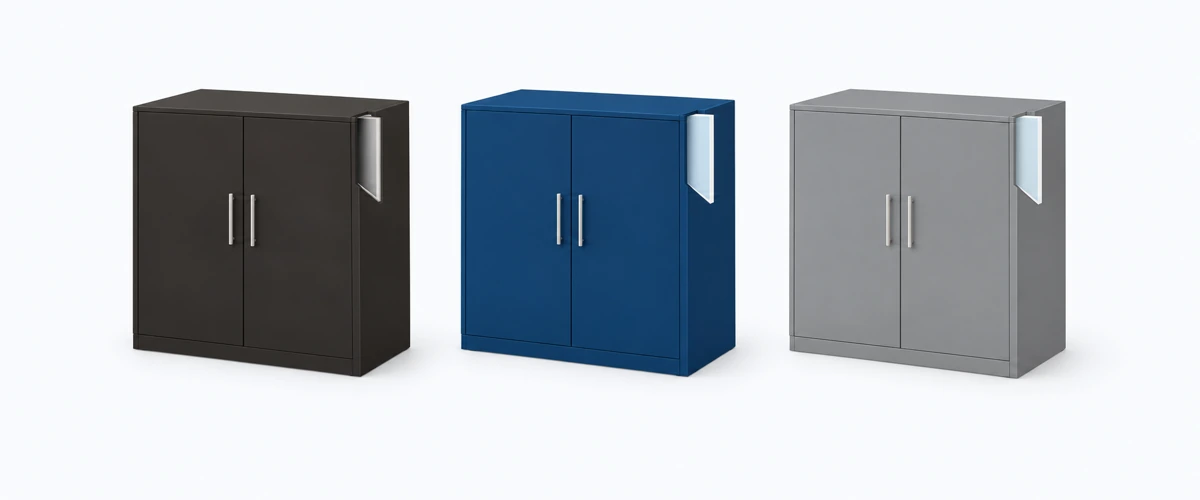
Chemical-storage cabinets are not interchangeable. Flammable-liquid cabinets are designed to protect their contents from an external fire, while acid and corrosive-storage cabinets provide a chemically compatible environment for their contents. Understanding that distinction is essential before cabinet dimensions, materials, finishes, or placement are specified.
The terminology can be confusing. “Acid” and “corrosive” overlap, acids and bases still require separation, and certain chemicals present both corrosion and fire hazards. This guide explains how to evaluate those overlapping hazards and turn the chemical inventory into a more effective cabinet schedule.
The short answer: specify by hazard, not cabinet name
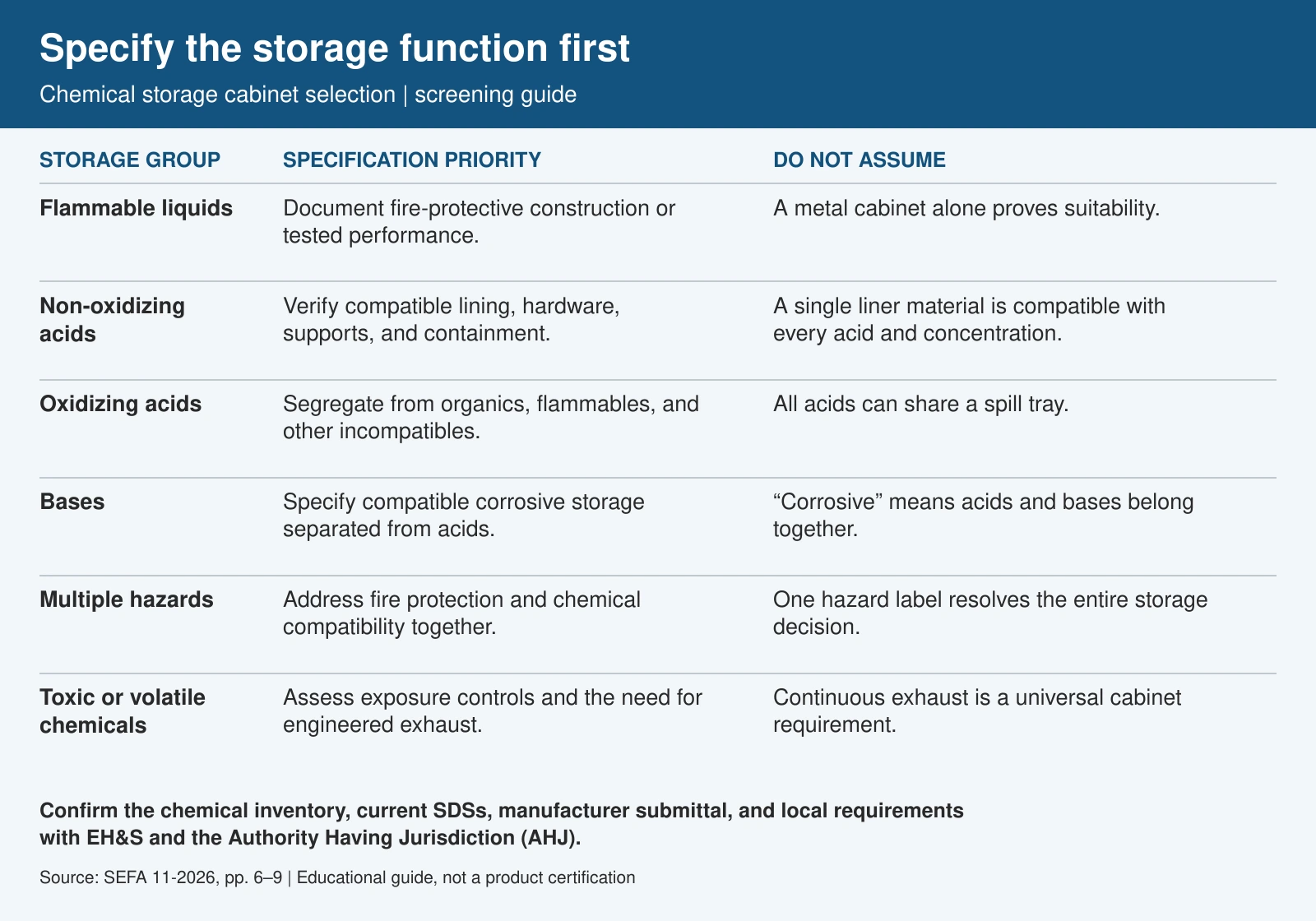
Choose flammable-liquid storage when the inventory and applicable rules call for fire protection (SEFA 11). For acids or bases, specify compatible cabinet interiors and spill containment (SEFA 11). Address multiple hazards together instead of relying on a single label (UW–Madison EH&S).
An acid-resistant liner does not establish flammable-storage performance or make incompatible chemicals safe to store together (SEFA 11, pp. 6–9). Use this matrix to screen chemical storage cabinets. Then confirm the inventory with environmental health and safety (EH&S), the supplier, and the authority having jurisdiction (AHJ).
Chemical storage cabinets: a selection matrix
When to specify a flammable-liquid cabinet
Start with the quantity and classification of liquids, then establish the storage arrangement permitted for the building; the cabinet limit is only one part of that review (OSHA 1910.106(d)). Avoid choosing a cabinet by its advertised gallon capacity before the fire-protection team checks the inventory.
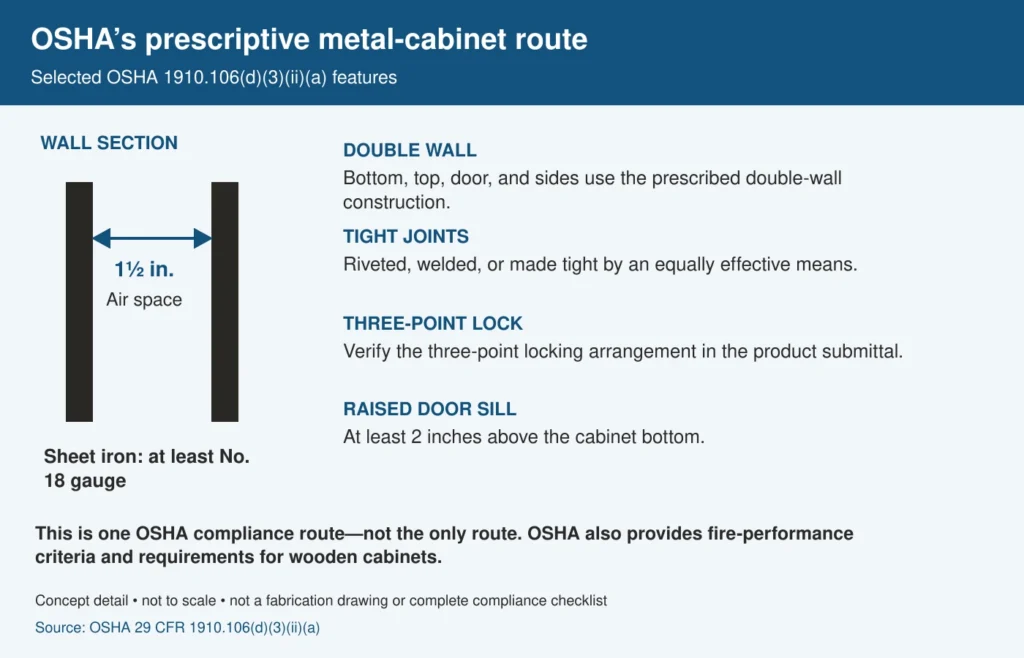
OSHA’s prescriptive metal-cabinet route includes these features (OSHA 1910.106(d)(3)(ii)(a)):
- Walls: At least No. 18-gauge sheet iron, with a 1½-inch air space between double walls.
- Joints: Riveted, welded, or made tight by equally effective means.
- Door: A three-point lock and a sill at least 2 inches above the cabinet bottom.
Use the submittal review to check those construction details. Avoid reducing the comparison to cabinet weight or appearance.
However, OSHA also includes fire-performance criteria and a prescriptive wooden-cabinet route (OSHA 1910.106(d)(3)(ii)). Therefore, describe the required performance and accepted compliance path instead of claiming that steel is universally mandatory.
Self-closing door requirements depend on the applicable code, and third-party cabinet testing is a separate documentation question (SEFA 11, pp. 6–7). Request the exact model’s submittal, installation instructions, and required UL 1275 or FM 6050 documentation where specified; do not substitute a general “compliant” marketing statement.
Acid cabinets and base cabinets need separate decisions
An acid cabinet is a corrosive-storage application, but acids and bases require segregation because contact can produce hazardous reactions (Rice EH&S). Consequently, “corrosive cabinet” should not become permission to place the entire corrosive inventory in one shared spill area.
For these chemical storage cabinets, compatibility is the material-selection question. SEFA 11 addresses compatible interiors, containment troughs, fasteners, and shelf supports, not a universal HDPE requirement (SEFA 11, p. 8). UW–Madison describes both polyethylene cabinets and coated-steel cabinets with protective liners (UW–Madison EH&S).
Ask the supplier to confirm the exact chemical, concentration, temperature, and expected exposure conditions against the proposed interior and containment system. Treat the material name as the beginning of that review, not its conclusion.
Similarly, avoid a shared “weak acids and bases” storage class. Acetic acid and sodium hydroxide are incompatible, and concentrated acetic acid also brings a fire hazard (UW–Madison EH&S). A more useful cabinet schedule separates acids, bases, oxidizing acids, and chemicals with multiple hazards.
Oxidizing acids change the storage plan
Nitric acid illustrates why chemical names matter: oxidizing acids need separation from organic acids, flammables, and combustible materials (SEFA 11, p. 9). A shared “acids” label does not address those incompatibilities.
Secondary containment can support segregation, but its suitability depends on the chemicals and the approved storage arrangement (Rice EH&S). For the specification review, ask a concrete question: if one container leaks, which other containers or materials could that liquid reach?
Then identify the chemical storage cabinets, compartments, or containment arrangements needed for the actual inventory. Have EH&S approve that arrangement before finalizing the cabinet schedule.
Ventilation is a separate specification decision
Flammable-liquid cabinets do not require ventilation for fire protection alone (SEFA 11, p. 7). When ventilation is required, the arrangement must preserve cabinet performance and satisfy the AHJ (SEFA 11, p. 7). For a nonvented cabinet, follow the manufacturer’s instructions for sealing openings with the specified bungs (SEFA 11, p. 7).
Acid storage presents a different question. SEFA 11 recommends venting to remove accumulated noxious fumes (SEFA 11, p. 8). UW–Madison notes potential benefits for volatile corrosives, including hydrochloric acid, without treating ventilation as a universal requirement (UW–Madison EH&S). This distinction matters when writing the mechanical scope.
A connection beneath a fume hood still needs coordinated design; SEFA 11 addresses exhaust connections, spill retention, and professional engineering review rather than an improvised duct connection (SEFA 11, pp. 7–8). Ask the engineer and supplier to document airflow, duct compatibility, discharge, and the effect on cabinet performance.
What the cabinet submittal should prove
SEFA 8-M evaluates metal laboratory furniture, including structural performance and finish resistance, while SEFA 11 specifically addresses liquid chemical storage (SEFA 8-M, SEFA 11). A chemical spot-test result should not stand in for the selected cabinet’s fire-storage documentation.
Before approving chemical storage cabinets, use this review checklist:
- Inventory: Record chemical names, concentrations, container sizes, maximum quantities, and current safety data sheets.
- Hazards: Identify fire, corrosion, oxidizer, toxicity, and special-reactivity concerns, including overlapping hazards.
- Cabinet suitability: Request exact-model construction, chemical compatibility, load limits, door operation, and required test or listing documents.
- Segregation: Mark where acids, bases, oxidizing acids, and incompatible organics will go.
- Containment: Show how the proposed system retains spills without bringing incompatible liquids together.
- Ventilation: State whether exhaust is needed and who designs, installs, and verifies it.
- Approval: Record EH&S and AHJ review before procurement.
For the chemical review, OSHA’s SDS format places safe-storage conditions in Section 7, exposure controls in Section 8, and incompatibilities in Section 10 (OSHA Appendix D). Those sections give the team a better starting point than a cabinet color or a general product category.
Frequently asked questions
Is an acid cabinet different from a corrosive cabinet?
Acid storage is one corrosive-storage application; bases also require compatible storage and separation from acids (SEFA 11, pp. 8–9). Specify the chemical group and compatibility requirements rather than relying on the cabinet name.
Can a flammable cabinet store corrosive chemicals?
Some cabinets address both hazards, but the exact model’s fire-protection performance and chemical compatibility need confirmation (UW–Madison EH&S). Adding a plastic tray to an ordinary cabinet does not establish flammable-storage performance (SEFA 11).
Does a two-inch sill provide chemical separation?
The raised sill is part of OSHA’s metal flammable-cabinet construction route, while incompatible chemical segregation is a separate storage concern (OSHA 1910.106(d)(3), SEFA 11). Review the spill path as well as the sill dimension.
The takeaway: match the protection to the hazard
Flammable-liquid, acid, and corrosive-storage cabinets are designed for different purposes. Fire protection, chemical compatibility, spill containment, and the separation of incompatible substances remain distinct requirements—even when one chemical presents multiple hazards.
Before selecting a cabinet, the project team should determine:
- The chemicals and concentrations that will be stored
- The hazards associated with each chemical
- Which substances require separate storage or containment
- Whether ventilation or other engineered controls are required
- Which construction, testing, listing, and code requirements apply
OnePointe Solutions manufactures acid and flammable-liquid storage cabinets as part of our laboratory casework offering. However, the cabinet name alone does not confirm suitability for every chemical or application. Selection should be based on the current chemical inventory, safety data sheets, product documentation, and applicable project requirements.
Before specifying or purchasing a cabinet, confirm the proposed storage arrangement with the facility’s EH&S team, cabinet manufacturer, design professional, and authority having jurisdiction. The right cabinet begins with understanding what will be stored—and which hazards the complete storage system must address.